Visiting Santo Domingo, Dominican Republic: Top Sights on Foot
Things to Do in Santo Domingo: Historic Landmarks and Museums
Looking for things to do in Santo Domingo? The capital of the Dominican Republic is a city of early colonial landmarks, military fortresses, museums and monuments, with much of its history concentrated in the Colonial City. A free Santo Domingo audio guide from Neywo brings 32 narrated places to life as you explore.
What to See in Santo Domingo’s Colonial City
Puerta del Conde
Puerta del Conde was the historic main gate into Santo Domingo’s colonial heart. It forms part of El Baluarte del Conde, a defensive section of the wall surrounding the Ciudad Colonial. The gate is named after Bernardino de Meneses Bracamonte y Zapata, the first Count of Peñalva, who is credited with saving the city from an English siege in 1655.
Basílica Catedral Metropolitana Santa María de la Encarnación
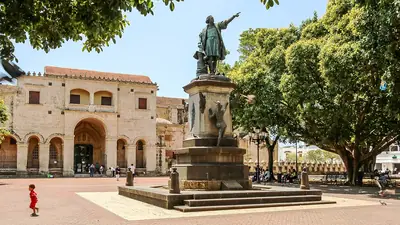
At the centre of the Colonial City stands the Basílica Catedral Metropolitana Santa María de la Encarnación, also known as the Cathedral Primada de América. Construction began in 1504 and was completed in 1550, making it the oldest existing cathedral in the Americas. It was also the first diocese established in the New World.
The cathedral’s façade is made from golden-tinted coral limestone and combines Gothic and Plateresque influences. Inside, its treasury contains ancient woodcarvings, furnishings, funerary monuments, silver and jewellery.
Fortaleza Ozama
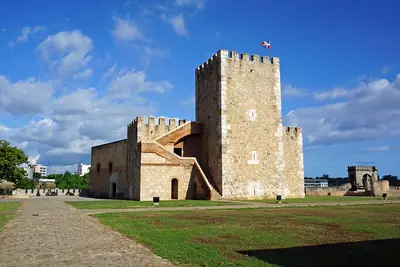
Fortaleza Ozama stands beside the Ozama River at the entrance to the historic Colonial City. Construction began in 1502 under Governor Nicolás Ovando and was completed in 1508. It is considered the oldest European military construction in the Americas.
The stone fortress preserves its original layout, including tunnels and dungeons. Its central tower rises about eighteen metres and was the tallest European-built structure in the Americas during the sixteenth century. Christopher Columbus was among the prisoners held there. Along with the Colonial City of Santo Domingo, the fortress became a UNESCO World Heritage Site in 1990.
Museo de las Casas Reales
On Las Damas Street, overlooking the southern side of Plaza de España, the Museo de las Casas Reales occupies the former Palace of the Real Audiencia. This sixteenth-century building was the first headquarters of Spanish power in the New World and once housed the administrative offices governing Spain’s American colonies.
The building is also known as the Palacio de la Real Audiencia or Palacios Reales. Its history gives the museum a particularly direct connection to the institutions that shaped the early colonial period.
Alcázar de Colón
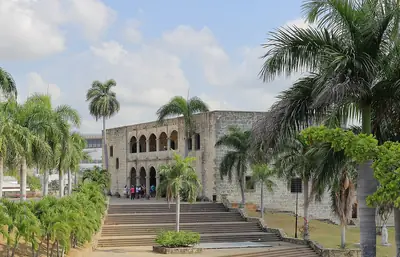
The Alcázar de Colón is the first fortified European palace built in the Americas. Construction took place between 1511 and 1514, but the palace fell into ruin by the middle of the eighteenth century. After restoration in 1957, it opened as a museum.
Its architecture is predominantly Gothic, with Renaissance influences. Among its highlights is a tapestry collection dating from the fifteenth to seventeenth centuries, including works by the Flemish Van Den Hecke family based on designs by Charles Le Brun. The collection is unique in the Caribbean.
Museo Naval de las Atarazanas Reales
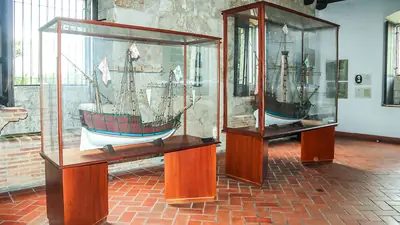
The Museo Naval de las Atarazanas Reales explores the Dominican Republic’s maritime history from a building dating to 1509. The site originally served as shipyards, warehouses, customs offices and tax offices for Santo Domingo’s old port.
The museum displays objects recovered from colonial shipwrecks around Hispaniola. Nearby, the surviving Royal Shipyards—known as the Reales Atarazanas—preserve the walls of one of the oldest surviving shipyard complexes in the Americas.
Monasterio de San Francisco
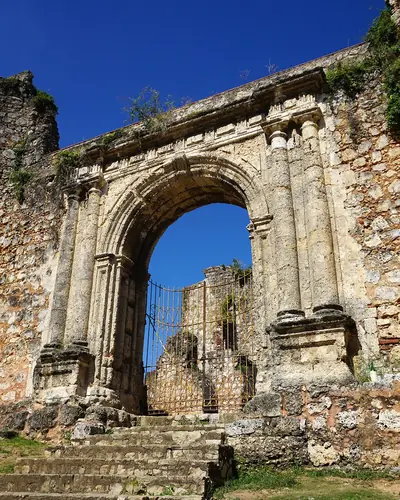
The Monasterio de San Francisco, or Ruinas de San Francisco, preserves fragments of Santo Domingo’s early colonial religious history. Construction began in 1508 after the arrival of the Franciscan fathers, and the monastery was completed around 1560.
Only parts of the original walls and arches remain, but the ruins still suggest the scale of what was once one of the city’s most important religious complexes. It is described as the first and oldest monastery built in the Americas.
Catedral Castrense Santa Bárbara
Dedicated to Saint Barbara of Nicomedia, the Catedral Castrense Santa Bárbara serves as the cathedral of the Military Ordinariate of the Dominican Republic. It stands at the edge of the old colonial wall and is the first parish in the Americas that is suffragan to Santo Domingo’s Primada Cathedral.
Its full name is Santa Iglesia Catedral Castrense Santa Bárbara de los Hombres de la Mar.
Museums and Monuments Beyond the Colonial City
Museum Memorial de la Resistencia Dominicana
The Museum Memorial of the Dominican Resistance is dedicated to the memory of those who opposed the dictatorship of Rafael L. Trujillo. Its exhibitions cover the background of the regime, the resistance of several generations of Dominicans and the dictatorship’s lasting consequences.
Museo del Hombre Dominicano
Located in Plaza de la Cultura, the Museo del Hombre Dominicano presents the heritage of the Taíno people of the Caribbean. It holds the largest collection of Taíno objects and relics in the region, particularly from the island of La Española.
The museum opened on October 12, 1973. Its exhibition rooms bring together artefacts that tell the story of the Taíno legacy and the wider cultural history of the Caribbean.
Museo Nacional de Historia Natural
The Museo Nacional de Historia Natural is the Dominican Republic’s national natural history museum. It is devoted to studying and conserving Caribbean biodiversity and houses the country’s largest scientific fauna collection, with over 130,000 vertebrate and invertebrate specimens.
The building was constructed in 1974 and opened to the public in 1982. It has seven levels: four floors of exhibition halls and three underground levels used as laboratory space. The museum combines public displays with ongoing scientific research and conservation.
Dominican Sports Hall of Fame
The Dominican Sports Hall of Fame is a museum dedicated to athletes and promoters who have shaped the country’s sporting history. Founded in January 1967, it honours people whose achievements brought recognition to the Dominican Republic across different sports.
Since 2012, the Hall of Fame has been housed in its current auditorium in Santo Domingo.
Palacio Nacional
The Palacio Nacional, or National Palace, is the workplace of the President and Vice President of the Dominican Republic. It is also one of the city’s notable civic buildings beyond the historic Colonial City.
Explore Santo Domingo with Neywo
For a Santo Domingo self-guided walking tour, download Neywo and explore at your own pace. The app offers four walking tours, with routes ranging from 1.25 to 2.98 km and lasting from 46 to 71 minutes. Together, they include 22 narrated stops, while the complete city guide covers 32 narrated places.
The walks include:
- Calle El Conde: From the Gate of Independence to the First Cathedral — 1.98 km, 71 minutes and 8 stops.
- Calle Las Damas: Columbus’s Family and the Oldest Fortress — 1.3 km, 63 minutes and 7 stops.
- Colonial Ruins and Firsts of the Americas — 1.25 km, 46 minutes and 5 stops.
- Plaza de la Cultura: Taíno Treasures, Opera and the National Palace — 2.98 km, 68 minutes and 5 stops.
Neywo tells the story of each place as you reach it, at your own pace, with no group and no schedule. Narration is available in 11 languages. Download the free app and discover Santo Domingo one landmark at a time—or continue exploring the Dominican Republic with Neywo.
Places with an audio guide in Santo Domingo
8 places in Santo Domingo with a Neywo audio guide. Each one starts telling its story as you reach it.
Self-guided tours in Santo Domingo
4 tours in Santo Domingo, free in the Neywo app. Each stop tells its story as you reach it.
- Walk
Calle El Conde: From the Gate of Independence to the First Cathedral
Walk the old main street of the Americas' first European city, from the gate where Dominican independence was proclaimed in 1844 to Parque Colón. Pass the mausoleum of the founding fathers, the oldest Catholic building in continuous use in the Americas and the first cathedral of the New World. It also stops at the Museum Memorial of the Dominican Resistance and ends at the Casa del Cordón, one of the first two-story stone houses built by Europeans in the Americas.
Altar of the Homeland · Puerta del Conde · Museum Memorial de la Resistencia Dominicana · Regina Angelorum church · Convento de los Dominicos, Santo Domingo · Parque Colon …
Open this tour: Calle El Conde: From the Gate of Independence to the First Cathedral - Walk
Calle Las Damas: Columbus's Family and the Oldest Fortress
Stroll the colonial city's oldest paved street. It starts at the fortress where Columbus was held prisoner, passes the Pantheon and the first seat of Spanish power in the New World, and ends at the palace where Diego Columbus raised his children, beside the old royal shipyards. The walk starts at the cathedral.
Basílica Catedral Metropolitana Santa María de la Encarnación · Fortaleza Ozama · Panteón Nacional · Museo de las Casas Reales · Alcázar de Colón · Plaza España, Santo Domingo …
Open this tour: Calle Las Damas: Columbus's Family and the Oldest Fortress - Walk
Colonial Ruins and Firsts of the Americas
A short route through the north of the Colonial City. See the first monastery and the oldest hospital in the Americas, both now romantic ruins. Then the carved-rope house, among the first stone houses of the New World, and the military cathedral built at the old city wall. The route also passes the Casa del Cordón, one of the first stone houses of the Americas, and ends at Plaza España.
Hospital San Nicolás de Bari · Monasterio de San Francisco · Catedral Castrense Santa Bárbara · Casa del Cordón · Plaza España, Santo Domingo
Open this tour: Colonial Ruins and Firsts of the Americas - Walk
Plaza de la Cultura: Taíno Treasures, Opera and the National Palace
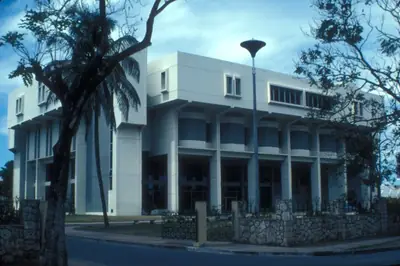
Leave the Colonial City for the modern capital: the National Palace, the Museum of the Dominican Man with the largest Taíno collection in the Caribbean, the natural history museum, the National Theatre named for baritone Eduardo Brito and the white granite Latter-day Saints temple.
Palacio Nacional · Museo del Hombre Dominicano · Museo Nacional de Historia Natural (Dominican Republic) · Teatro Nacional Eduardo Brito · Santo Domingo Dominican Republic Temple
Open this tour: Plaza de la Cultura: Taíno Treasures, Opera and the National Palace
Walk Santo Domingo with Neywo
Neywo turns Santo Domingo into a self-guided audio tour. Stories arrive as you reach the place they belong to, and the route reshapes when you wander off it.

