Exploring a City by Bike: Where It Works and Where It Does Not
A bike is the right tool for a specific problem: the parts of a city that are too spread out to walk and too close together to bother with transport. In the wrong city it is the fastest way to have a bad day.
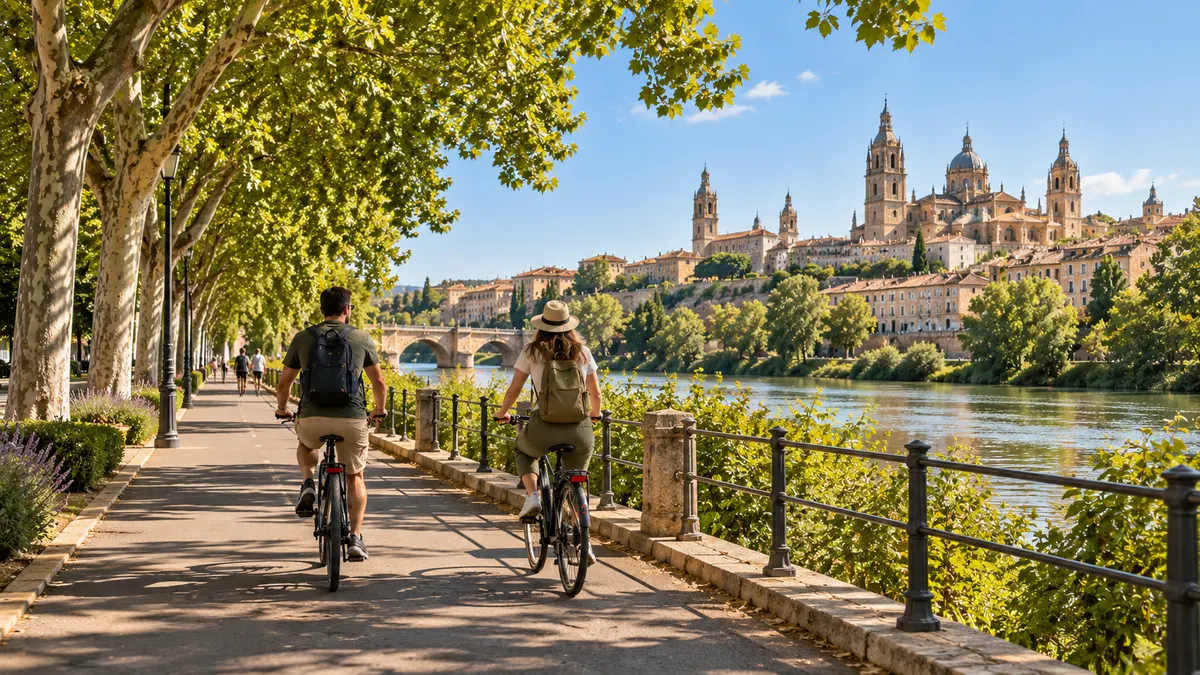
Walking gets you a radius of about 800 m before the return journey starts costing more than the discovery is worth. Public transport is excellent at 5 km and up. Between those two numbers there is a band — the riverside 4 km away, the park at the end of the boulevard, the neighbourhood everyone recommends that is a forty-minute walk each way — that neither one serves well.
That band is what a bike is for. Not a tour, not exercise: a way of making the second ring of a city reachable in an afternoon.
Where cycling actually works
Three conditions, and you want at least two of them.
Flat, or flat where it counts. Copenhagen is the easy case — around 390 km of separated cycle track, roughly half the city’s commutes by bike, and an infrastructure culture where you are expected rather than tolerated. The Cykelslangen, an elevated cycle bridge over the harbour, exists purely to save cyclists a set of stairs, which tells you most of what you need to know.
A continuous corridor. A river, a canal, a park chain, a drained riverbed. These are the best cycling in any city because they have no junctions. Valencia’s Jardín del Turia is nine kilometres of park in the bed of a diverted river and runs most of the way across the city without you meeting a car.
Distance between the good things. Cities that sprawl reward a bike in a way compact ones do not. In a 3 km-wide historic core you will spend more time locking and unlocking than riding.
And where it does not
Cobbles. Not the neat modern kind — the real thing. Lisbon’s calçada portuguesa is polished limestone, slippery in the wet on foot and considerably worse on two wheels. Most historic centres are a surface problem before they are a traffic problem.
Dense medieval lanes. You will push the bike. If the streets are 3 m wide and full of people, the bike is luggage.
Traffic that does not expect you. Central Rome is the standing example. It can be done and locals do it; a visitor on an unfamiliar bike in unfamiliar traffic is not the person to try.
And the counterintuitive one: Amsterdam is the best cycling city in Europe and one of the worst places to learn. The infrastructure is superb and the traffic on it moves fast, close and confidently, with trams and their rails in the mix. A hesitant tourist wobbling in a bike lane at rush hour is a genuine hazard to themselves and everyone behind them. Ride there if you already ride. If your last bike was fifteen years ago, go to Utrecht instead — the same infrastructure, a fraction of the pressure.
Bike-share, without the sting
Almost nobody visiting brings a bike, so the practical question is the share scheme. A few things that cost people money and time every day:
- Register before you land. Most schemes want an app, a card and sometimes a verification step. Doing that on a pavement with 4% battery is a bad start.
- Understand the pricing shape, not the headline price. Very often the first 30 minutes are cheap or included and the rate steps up sharply after that. The move is to dock and immediately re-take at the half hour, which resets the clock. People who do not know this pay four times as much for the same afternoon.
- Expect a deposit hold on the card, sometimes a few hundred euros, released later.
- Docked beats dockless for a visitor. A dockless bike is wherever the last person left it, which is a lottery when you are on a schedule; a dock is on a map and is still there tomorrow.
- E-bikes are worth the surcharge in any city with a hill, and change the calculation about riding up rather than round.
- Helmets. Rules vary by country and share schemes almost never supply one. Decide how you feel about that before you are standing at the dock.
- Locking. In high-theft cities, the frame lock a share bike comes with is for a five-minute stop, not a two-hour museum. Plan the long stops around a dock.
Nine routes that are genuinely worth the day
Neywo has narrated 400+ cycle routes. These are worth singling out, mostly because each one is an example of a different kind of good urban ride:
- Kraków — the Planty. The best of them. When the medieval walls came down in the 1820s the city planted a park ring in the gap, so there is now a roughly 4 km green loop that circles the entire old town. Fifteen narrated stops, the densest of any route in the catalogue, and you never share it with a car.
- Lisbon — the Ciclovia do Tejo. The exception that makes a hill city rideable: a flat, separated path along the Tagus. Ride the water and walk the hills.
- Madrid — El Retiro. A park loop rather than a route across town, which is the right shape for a hot afternoon.
- Barcelona — the Ronda Verda. The green ring, and a good way to get out of the grid.
- Berlin — Industriekultur 1. Industrial heritage instead of monuments; a different city from the one the coaches visit.
- Leipzig — the Karl-Heine canal. A canal corridor through a converted industrial quarter.
- Budapest — Városliget. The city park, which is also where a surprising share of the interesting buildings are.
- Gdańsk — the Wiślana Trasa Rowerowa. The Vistula route; flat, watery, and unlike anywhere on this list.
- Bucharest — Cișmigiu, and Chicago — the Dearborn lane, which is the American version of the whole idea: a protected downtown lane doing the job a park ring does in Kraków.
Listening while you ride
There is a legal problem and a physical one.
Legally: France and Spain both prohibit cycling with headphones, and the rules elsewhere vary enough that you should assume nothing. One ear, at low volume, or bone-conduction headphones that leave both ears open, are the sensible defaults — and in France and Spain, no headphones at all.
Physically: a bike covers ground four times faster than your feet, so anything written for a walking pace arrives too late to be about the thing in front of you. Commentary for a ride has to be short by design — enough to know what you are passing and to decide whether to stop — with the long version waiting for the moment you actually put a foot down. That is how rides are built, and why the same city’s bike guide is not simply its walking guide read faster.
How to actually spend the day
Ride out, walk back. Or more precisely: use the bike to cover the boring middle and your feet for the parts worth slowing down for. The failure mode of a bike day is riding past everything.
A shape that works almost everywhere: take the bike along the continuous corridor — the river, the canal, the park ring — for 4 or 5 km, dock it at the far end, spend two hours on foot in whatever neighbourhood you have arrived in, then take a different bike back along the other bank. You have seen two districts and a waterfront, and you have walked about as much as you would have anyway.
If you would rather leave the bike out of it entirely, the same places work on foot at a different scale — how to plan a route you will actually finish is the walking version of this argument, and every city guide is free to read. You can also just listen to a sample first.
Walk it with the guide in your ear
Neywo has a free walking guide for more than 1,800 cities: what is worth noticing, and the stories behind it, narrated in 11 languages.


More from the blog
- How to Turn a City Walk Into a Scavenger Hunt
- Day Trips by Coach: When the Organised Bus Is Worth It
- Guided Bike Tour or On Your Own? How to Decide
- How to Choose a Walking Tour App: Eight Questions That Matter
- How to Plan a City Walking Route You Will Actually Finish
- The Best Time to Learn a City Is on the Way There
- One Free Hour in a City: How to Spend It Well
- See a City by Public Bus: The Better Hop-On Hop-Off
- What to Do Near Your Hotel: Reading the Streets You Sleep On
- How Location-Aware Audio Guides Work (And Where AI Fits In)
- How to Get More Out of a City Walk: 9 Practical Habits
- The 10 Most Walkable Cities for a Weekend on Foot
- Self-Guided Audio Tour vs Guided Walking Tour: How to Choose