Guided Bike Tour or On Your Own? How to Decide
On foot, a guide sells you knowledge. On a bike, a guide sells you knowledge plus competence in traffic you have never ridden in — which is a different and rather better deal.
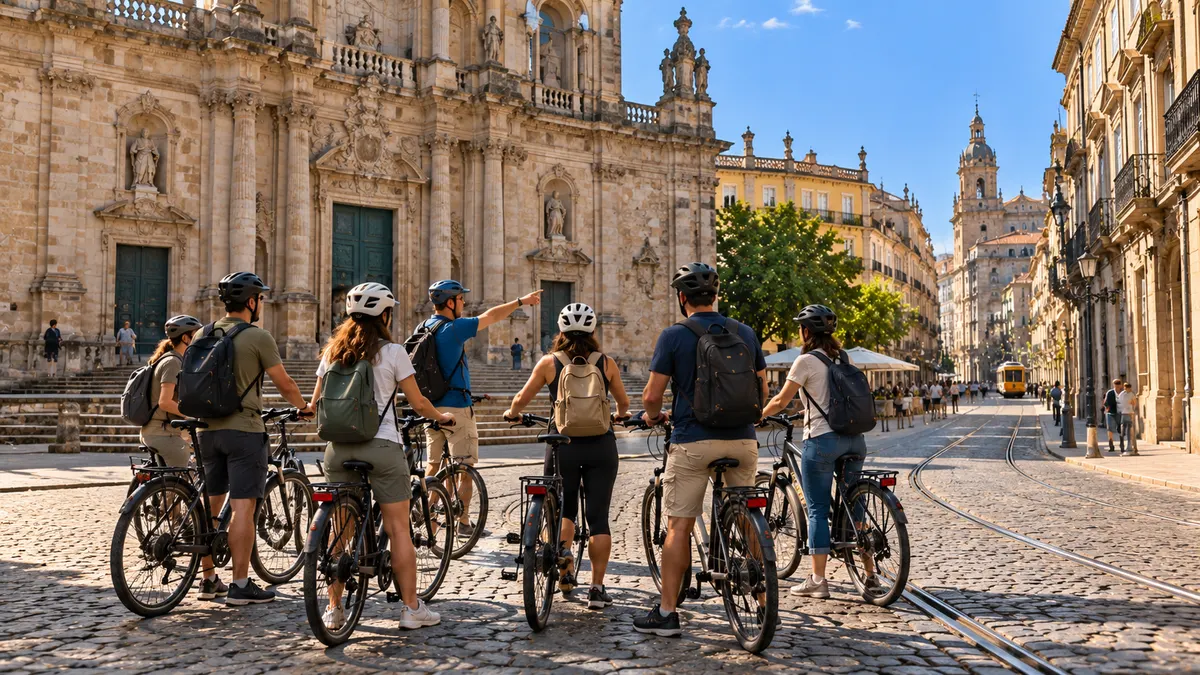
A guided city bike tour is typically three to four hours, 10 to 15 km, and somewhere around €30 to €45 including the bike. Renting a decent hybrid on your own is about €12 to €20 for the day, and a public share scheme is a couple of euros.
So the guide costs you roughly €15 to €30. The question is what that buys, and the answer is different from the walking equivalent — which is why somebody who would never take a guided walking tour might still be right to take a guided ride.
Five things a guide gives you on a bike that they do not on foot
1. Traffic literacy you do not have. Every city has an unwritten cycling grammar: whether you may use the bus lane, which contraflow streets are legal, how the cycle lane behaves at a junction, who yields at a roundabout, whether you are expected to be assertive or deferential. On foot none of this matters. On a bike, getting it wrong is at best embarrassing and at worst dangerous, and there is no way to learn it from a map.
2. A bike that fits you. Saddle height set properly, brakes that work, tyres at pressure, and the right frame size. This sounds minor for three hours and is the difference between a good afternoon and sore knees. A share bike is one size and was last adjusted by a stranger.
3. Mechanical support. A puncture on your own, in a foreign city, with no pump and no idea where a bike shop is, ends the day. On a tour, it is a ten-minute stop while somebody who does this daily deals with it. Share schemes have no roadside assistance of any kind.
4. Getting out of the centre. The genuinely hard navigational problem in urban cycling is not the pretty bit — it is the two kilometres of ring road, junctions and dead ends between the old town and the river path. A guide knows the one street that works.
5. Local hazards, and one in particular. Tram rails. Cross them at a shallow angle and the front wheel drops into the groove and you go down, hard, usually in traffic. Anyone who has cycled in a tram city knows to cross at ninety degrees; nobody who has not has any idea. Add wet cobbles, and door-zone parking, and the fact that in some cities the tourists are the main hazard.
The group-size problem is worse on bikes
This is the thing to actually check before booking, and most people do not.
A group of fourteen cyclists cannot clear a junction in one light phase. On foot, fifteen people cross together. On bikes, the front six get through, the lights change, and the tour becomes a sequence of regroupings at every set of traffic lights — which is where the time and the goodwill go.
Ask the maximum group size. Eight to ten is a different product from twenty, and the price is often the same. If the operator will not tell you, assume the answer is a number you would not like.
The e-bike question
An e-bike is usually a €10 to €15 surcharge and it changes two things.
It makes hill cities possible. Lisbon and Porto on an ordinary bike are a serious workout with a viewpoint at the end of it; on an e-bike they are an afternoon. A 25 km route feels like 12.
Less obviously, it evens out the group. Most of the fragmenting on a mixed-fitness ride comes from the spread between the fastest and slowest rider, and electric assistance compresses that spread dramatically. An e-bike group of twelve holds together better than a pedal group of eight.
The trade is that you are working less, which on a route you chose partly for the exercise is not what you wanted.
When to go on your own
Go alone when at least two of these are true:
- You already ride regularly. Not “I can ride a bike” — you ride in traffic, at home, by choice.
- The city is flat and has separated infrastructure. Copenhagen has around 390 km of separated cycle track and a culture that expects you; Utrecht is the same infrastructure with a fraction of the pressure. Both are easy solo cities.
- There is a continuous corridor — a river path, a canal, a park ring — so you barely meet a junction. That is most of what makes a ride pleasant.
- You have a full day, so a wrong turn is an anecdote rather than a disaster.
And the counterintuitive one: Amsterdam is the best cycling city in Europe and the place where a nervous first-timer benefits most from a guide. The infrastructure is superb and the traffic on it is fast, dense and unforgiving of hesitation, with tram rails throughout. Confident riders should absolutely go alone. Someone whose last bike was fifteen years ago should not learn there at rush hour.
Ride-through or hop-off
Two completely different products sold under one name, and the listing rarely distinguishes them.
A ride-through tour covers 15 km without much dismounting. You see a lot of scenery, a lot of skyline, and almost no buildings up close. It is a good way to understand a city’s shape and a poor way to see anything in it.
A hop-off tour stops eight or ten times, and you get off, stand in front of things, and hear about them. Fewer kilometres, more city.
Neither is wrong. But ask how many stops and how long at each, because a “3-hour, 18 km tour of the highlights” with three stops is a bike ride, not a tour.
What to check before you book
- Maximum group size.
- Bike type — city, hybrid or electric — and whether you can swap.
- Distance and elevation gain. Elevation is the number that gets left out, and it is the one that decides how the day feels.
- Number of stops, and how long at each.
- Helmet supplied, or not, and whether it is legally required.
- Rain policy: does it run, and do you get a refund?
- Language of the commentary.
- Whether the route leaves the centre, and where.
Doing it yourself, with something in your ear
If you decide to ride alone, the gap you are left with is the commentary — and on a bike it is a harder gap to fill than on foot, because you cover ground about four times faster than walking pace. Anything written for a walker arrives after you have gone past the thing it describes.
That is what rides are built for: the same narrated places as a walking guide, but sequenced for a vehicle and deliberately short — enough to know what you are passing and to decide whether to stop, with the full story waiting for the moment you put a foot down. Eleven cycle routes are published so far, including the Planty ring around Kraków’s old town, the Ciclovia do Tejo in Lisbon and El Retiro in Madrid.
The longer version of the case for riding independently — which cities reward it, how to handle share schemes, and the legal problem with headphones in France and Spain — is in exploring a city by bike. And hear a clip first if you want to judge the writing.
The short version
Take the guide if you do not ride regularly, if the city has trams and no separated lanes, if you want the bike sorted for you, or if it is your only day. Go alone if you ride at home, the city is flat and properly built for it, and there is a river or a park chain to follow.
Either way: ask the group size, ask the elevation, and ask how many times you actually get off the bike.
Walk it with the guide in your ear
Neywo has a free walking guide for more than 1,800 cities: what is worth noticing, and the stories behind it, narrated in 11 languages.


More from the blog
- How to Turn a City Walk Into a Scavenger Hunt
- Day Trips by Coach: When the Organised Bus Is Worth It
- Exploring a City by Bike: Where It Works and Where It Does Not
- How to Choose a Walking Tour App: Eight Questions That Matter
- How to Plan a City Walking Route You Will Actually Finish
- The Best Time to Learn a City Is on the Way There
- One Free Hour in a City: How to Spend It Well
- See a City by Public Bus: The Better Hop-On Hop-Off
- What to Do Near Your Hotel: Reading the Streets You Sleep On
- How Location-Aware Audio Guides Work (And Where AI Fits In)
- How to Get More Out of a City Walk: 9 Practical Habits
- The 10 Most Walkable Cities for a Weekend on Foot
- Self-Guided Audio Tour vs Guided Walking Tour: How to Choose