How to Turn a City Walk Into a Scavenger Hunt
A riddle reverses attention. Instead of being told about the facade, you have to search it — and people look harder at a building in ninety seconds of hunting than in five minutes of listening.
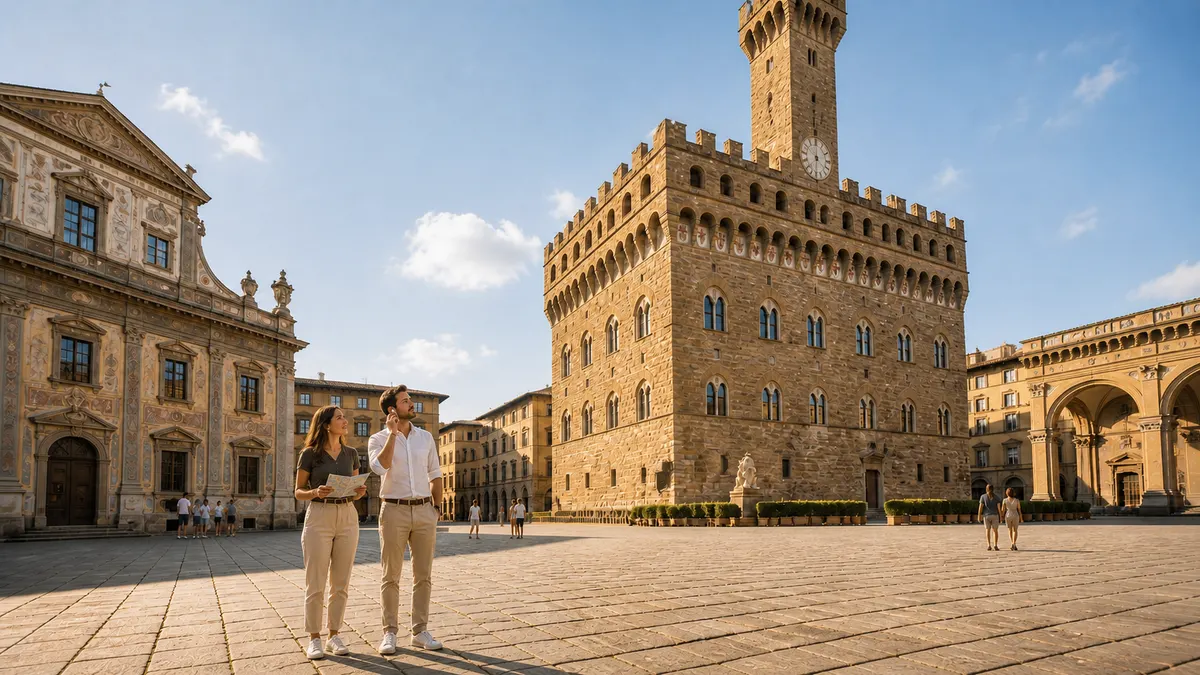
Here is a familiar afternoon. Two adults are interested in the cathedral. A thirteen-year-old is not interested in the cathedral. Everybody walks around the cathedral. Nobody enjoys the cathedral.
The usual fixes do not work. An audio guide fails with a group because everybody ends up on a different sentence and stops talking to each other. A guided tour fails because the pace belongs to the guide. And “just look at how beautiful it is” has never once worked on a teenager.
What does work is turning the looking into a task.
Why a riddle beats an explanation
When you are told about a building, your attention is on the telling. When you are asked a question whose answer is on the building, your attention has to go to the stone.
That is the whole mechanism, and it is unreasonably effective. Ask someone how many columns are across the front of a church and they will look at the front of that church more carefully than any amount of narration would have made them. They will also notice, on the way to counting, the thing you actually wanted them to see.
The other advantage is social. A question is something a group does together, out loud, whereas an audio guide is four people in separate silences.
What makes a good question
This is the craft, and most homemade hunts get it wrong in the same few ways.
The answer must be physically present. On the wall, the plaque, the door, the pavement. If it needs looking up, you have built a quiz, not a hunt, and the phones come out — which is the opposite of the point.
One unambiguous answer, if you are scoring. “How many lions?” is scoreable. “Find something old” is not. Both are useful, but know which you are asking: closed questions are for competition, open ones are for attention.
It must not be faster to google than to look. “What year was this built?” is a search. “Find the year carved above a door on this street” is a hunt.
No ticket required. The moment an answer is inside a paid museum, half the group is outside it.
It has to survive. Scaffolding goes up, signs come down, a café awning covers the exact plaque. Any question resting on one temporary object will fail eventually, and the ones resting on carved stone will not.
Twelve that work almost anywhere
Tested in the sense that any European old town will yield all twelve:
- A date carved in stone, earlier than 1800. Above a door, on a lintel, in a gable.
- A bricked-up window or door. In Britain the classic cause is the window tax; elsewhere it is usually a staircase that moved or a neighbour who built too close.
- A ghost sign — a painted advertisement, faded into the brick, for something nobody sells any more.
- A boot scraper beside a front door, from when the street was mud. Georgian doorways in Edinburgh are full of them.
- A plaque naming somebody none of you has heard of. Then guess what they did before reading it.
- The number of columns across the front of the largest church in sight.
- An animal carved in stone that is not a lion. There are always lions. The hunt is for the eagle, the dog, the dolphin, the thing nobody can identify.
- The highest window in the street, and how many floors are under it.
- A street named after a trade — tanners, dyers, bakers, silversmiths.
- Two buildings that touch and were built centuries apart. Point at the seam. This is the best question on the list because the answer is a skill rather than an object.
- A drain cover with letters on it. In Rome the letters are SPQR, four initials of a phrase about two thousand years older than the drain. Elsewhere it is a foundry and a town, which is its own small history of where things were made.
- A mark showing how high the water came. Flood plaques are on walls in Florence, Prague and Porto, usually well above head height, and they silence a group instantly.
A few that are city-specific and worth knowing if you are going there: in Berlin, a double row of cobblestones set into the road marks where the Wall stood, and following it is a walk in itself. In Prague, houses had carved emblems — the Golden Well, the Two Suns — before they had numbers, so the sign is the address. In Barcelona’s Eixample every corner is cut off at 45 degrees and the pavement tiles have a pattern worth looking down at. And on any British or Irish pillar box, the monarch’s cypher tells you which reign it was installed in, which makes a post box a datable object.
Build one in twenty minutes
You do not need to plan a route. You need about eight questions and a rough direction.
The night before, walk five minutes of the street you are staying on and photograph anything with a date, a carving, a plaque or an oddity on it. That is four or five questions from one block, and it works because the density of this stuff in an old town is far higher than anyone expects.
Then add three or four from the twelve above, which will resolve anywhere. Write them on paper. Do not put them in a phone: the phone is the thing you are trying to get out of everyone’s hands.
What changes with age
- Five to seven. Counting, colours, animals, doors. “Three green doors.” “How many lions in this square?” Keep it to things at eye level, because they are not going to look up.
- Eight to eleven. The sweet spot. Numbers and dates, spot-the-odd-one-out, anything involving being the first to find it. This age will out-perform the adults and should be allowed to.
- Twelve to fifteen. Real puzzles, and — more importantly — autonomy. Hand over the paper, let them go forty metres ahead, and stop narrating. Most of the resistance at this age is to being managed, not to the city.
- Adults who hate museums. Exactly the same thing, and do not under any circumstances announce that it is a game for children.
Running it with a group
One question at a time, out loud. Better than printed sheets and teams, which turn it into a race — and a race stops the looking, which was the entire objective.
Forty-five minutes to an hour. A hunt is a segment of a day, not a day. Past an hour it becomes a chore and you have spent the goodwill you were trying to build.
Do not score across a big age gap. A six-year-old against a fifteen-year-old is not a competition, it is a scheduled disappointment.
The reward is stopping for ice cream, and it should be unconditional. If the prize depends on winning, the losing half of the group has just paid for your afternoon.
Three things not to make a game of
Worth saying plainly, because it is easy to get wrong with momentum behind you.
Memorials. Berlin’s Stolpersteine — the small brass plaques set into pavements outside the last homes of people murdered in the Holocaust — are among the most affecting things in any European city, and they are not scavenger-hunt items. Nor are war graves, nor the sites of atrocities or disasters. Stop, read them, say what they are, and leave the game for the next street.
Places of worship in use. A church with a service on is not a puzzle box. Cemeteries generally deserve the same restraint.
Anywhere with a sign asking you not to. Whatever the reason.
None of this shortens the list of good questions. There is enough carved stone in a European city that you never have to reach for the one thing that deserves quiet.
Where it works, and where it does not
Works: dense old towns with detail at street level and buildings from mixed centuries. Bologna is almost unfair — 38 kilometres of porticoes in the centre alone, which means the questions are covered when it rains. Kraków’s main square, Seville’s Santa Cruz and Edinburgh’s closes are all similarly rich.
Does not work: business districts and modernist quarters, which have almost nothing at street level to interrogate — glass tells you nothing. Also enormous open squares with four buildings on them, museum interiors, and anywhere above about 32°C, where the only correct activity is shade.
The honest limits
A hunt makes people notice detail, which means it can make them miss the whole. Somebody who has counted the columns has not necessarily looked at the building. Alternate: a hunt for an hour, then twenty minutes of just standing and looking at one thing.
And a hunt is not history. It is an attention device, and it only pays off if something arrives after the answer — the reason the date matters, who put the plaque there, what the bricked-up window was avoiding. Without that it is I-spy with better scenery.
That last part is what quest mode in the app is built around: the same stops as a normal walk, but the story is behind a riddle whose answer is on the wall in front of you, and it plays once you have it. It is in the app now; the first quest is being checked on the street before it ships, because every riddle depends on something still being legible in real life and that is not a thing you can verify from a desk. Until then, the paper version above is the one to use.
In the meantime, the two modes that already work well with a group are the researched walk and roam — roam especially, because it has no route to fall behind on and each place speaks once, so nobody is being marched. There are free written guides for every city, samples with transcripts if you want to hear the tone first, and how to plan a route if the hunt is going to need one.
Walk it with the guide in your ear
Neywo has a free walking guide for more than 1,800 cities: what is worth noticing, and the stories behind it, narrated in 11 languages.


More from the blog
- Day Trips by Coach: When the Organised Bus Is Worth It
- Exploring a City by Bike: Where It Works and Where It Does Not
- Guided Bike Tour or On Your Own? How to Decide
- How to Choose a Walking Tour App: Eight Questions That Matter
- How to Plan a City Walking Route You Will Actually Finish
- The Best Time to Learn a City Is on the Way There
- One Free Hour in a City: How to Spend It Well
- See a City by Public Bus: The Better Hop-On Hop-Off
- What to Do Near Your Hotel: Reading the Streets You Sleep On
- How Location-Aware Audio Guides Work (And Where AI Fits In)
- How to Get More Out of a City Walk: 9 Practical Habits
- The 10 Most Walkable Cities for a Weekend on Foot
- Self-Guided Audio Tour vs Guided Walking Tour: How to Choose