The 10 Most Walkable Cities for a Weekend on Foot
Walkable does not mean flat, and it does not mean small. It means the good parts are next to each other, and the streets between them are worth the time.
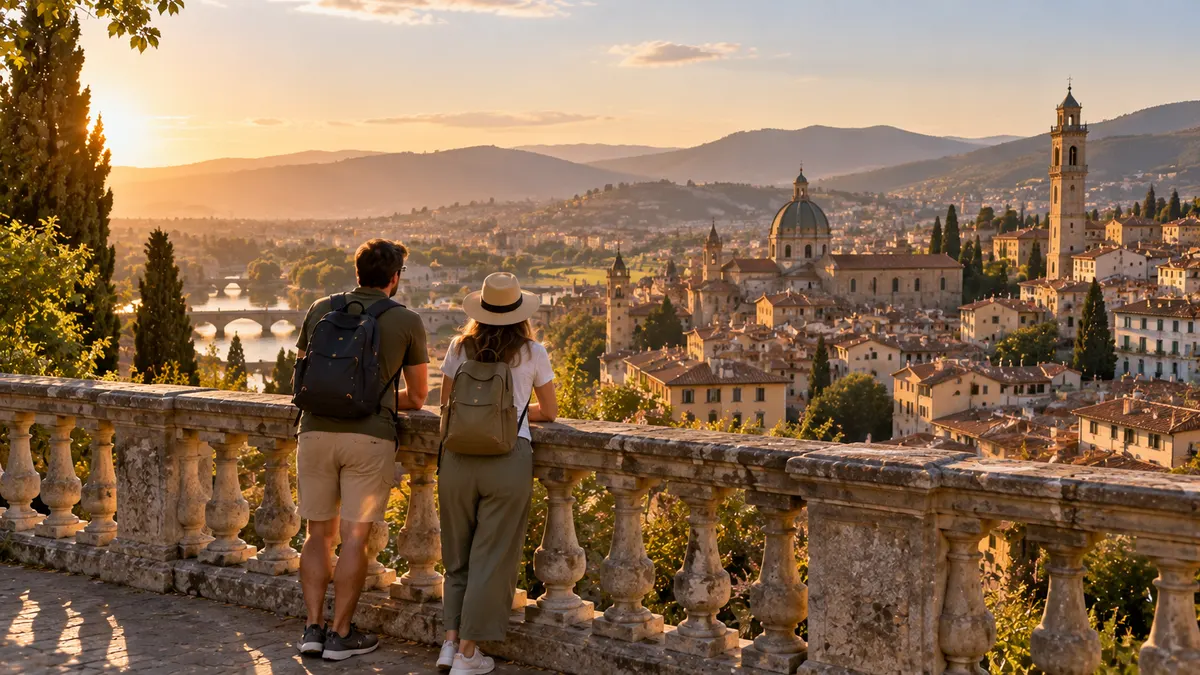
Most “most walkable city” lists are ranking something else — bike lanes, transit scores, air quality. Useful data, wrong question. The question for a weekend is narrower: can I land on Friday evening, walk for two days, and never need to work out a ticket machine?
That takes three things. A centre dense enough that the distances are human. Streets that are interesting in between the landmarks, not just at them. And a shape you can hold in your head after half a day, so you stop navigating and start noticing.
These ten deliver all three. The list leans European, and that is not an accident: cities whose street plans were fixed before the car had to stay walkable to function. Where that is not true, we have said so.
1. Rome, Italy
Why it works: the historic centre is about 3 km across and contains roughly 2,500 years of continuous building, stacked. You can walk from a Republican-era temple to a Baroque fountain to a fascist-era façade in fifteen minutes, and the transitions are the interesting part.
The walking: cobbles, mostly flat in the centre, brutal at midday from June to September. The Aventine and the Gianicolo are the two climbs worth making, both for the view down.
Do this: start at seven, before the coach parties. The Pantheon at opening time with maybe forty people in it is a different building from the Pantheon at noon.
Watch out for: the centre is genuinely crowded, so this is a headphones city rather than a speaker one. → Rome walking guide
2. Lisbon, Portugal
Why it works: vertical. The city is built across seven hills over the Tagus, so the reward structure is unusual — every climb ends at a miradouro with the whole city underneath it, and the descent takes you through a different neighbourhood than the one you came up.
The walking: hard. Steep gradients and calçada portuguesa — polished limestone cobbles that are genuinely slippery when wet. Proper soles, not fashion trainers.
Do this: walk up through Alfama and let the street plan beat you. It is Moorish in origin, it does not follow a grid, and getting lost in it is the point. Tram 28 goes the same way when your legs are done.
Watch out for: the wet-cobble problem is real. On a rainy day, take the flat riverside route instead. → Lisbon walking guide
3. Seville, Spain
Why it works: the old town is one of the largest in Europe and almost entirely closed to through traffic, which makes it the rare city where you can walk for three hours in near silence. Roman foundations, a Moorish palace, a Gothic cathedral and a 1929 exposition ground, all inside a walkable ring.
The walking: flat, shaded, and full of dead ends in Santa Cruz. Distances are short. The orange trees are decorative, and the fruit is inedible.
Do this: go in spring or autumn. July and August routinely pass 40°C and the city sensibly stops moving in the afternoon — walk early, sleep, walk again at eight.
Watch out for: during Semana Santa and the Feria the centre is packed and streets close without notice. Wonderful, but not the weekend for covering ground. → Seville walking guide
4. Edinburgh, United Kingdom
Why it works: two cities side by side and a two-minute walk apart. The medieval Old Town is a spine along a ridge with narrow closes dropping off both sides. The Georgian New Town is a planned grid from the 1700s. The contrast is the attraction, and you can cross between them all day.
The walking: steep, stepped, and often into wind. There is a genuine hill — Arthur’s Seat — inside the city limits, and it is worth an hour.
Do this: take the closes. The Royal Mile is the tourist route. The alleys running down from it are where the city’s shape becomes readable.
Watch out for: in August the Festival triples the population of the Old Town. Come for the Festival or come to walk — not both. → Edinburgh walking guide
5. Granada, Spain
Why it works: the densest concentration of “one more corner” in Spain. The Albaicín is a hillside of whitewashed lanes facing the Alhambra across a ravine, which means the view is of the thing you are about to visit, all day.
The walking: steep, narrow, and frequently cobbled at an angle. The Albaicín rewards walking up and then wandering down.
Do this: book the Alhambra weeks ahead — entry is capped and slots sell out, and turning up on the day usually does not work. Then walk Sacromonte afterwards while it is quiet.
Watch out for: it is cold in winter. The Sierra Nevada is 40 km away and you can see the snow from the city. → Granada walking guide
6. Paris, France
Why it works: the highest density of things-per-street in the list. Paris is bigger than the others, but each arrondissement is walkable on its own, and the river is a spine you can never get badly lost from.
The walking: flat except Montmartre and Belleville, and endless — a Seine walk from the Marais to the Eiffel Tower is a straightforward afternoon.
Do this: pick one arrondissement and walk it properly rather than crossing the city between monuments. The covered passages of the 2nd and the lanes of the Marais both repay two slow hours.
Watch out for: the queues at the headline sights are the worst on this list. Book everything, or plan a walk that goes past them rather than into them. → Paris walking guide
7. Barcelona, Spain
Why it works: two street plans in one city. The Gothic Quarter is a medieval tangle on Roman foundations. The Eixample around it is Cerdà’s 1859 grid with chamfered corners, which means the sightlines are long and you can navigate by them. Gaudí is the headline, but the tiled entrance halls of ordinary Eixample apartment blocks are the better find.
The walking: flat in the Eixample, tight in the Gothic Quarter, uphill in Gràcia and Park Güell. Long distances, so pick two neighbourhoods rather than four.
Do this: get out of the Gothic Quarter for a day. El Born, Gràcia and Sant Antoni are where the city lives.
Watch out for: La Rambla and the Sagrada Família area are among Europe’s most pickpocketed streets. Normal precautions, nothing dramatic. → Barcelona walking guide
8. Berlin, Germany
Why it works: flat, wide and legible, with the twentieth century still visible at street level — a line of cobbles where the Wall stood, bullet damage on façades, whole blocks that are visibly newer than their neighbours because of what happened to the old ones.
The walking: easy underfoot, but the distances are big. Berlin is nine times the area of Paris. Treat it as a set of neighbourhoods, not one centre.
Do this: Mitte and Kreuzberg on separate days. The former is where the history is signposted. The latter is where the city’s present is.
Watch out for: the weather has no manners. Pack for rain in any month. → Berlin walking guide
9. Valencia, Spain
Why it works: the flattest city here, and the only one with a nine-kilometre park where its river used to be — the Turia was diverted after the 1957 flood and the bed became gardens. It runs from the old town to the sea, so the whole city has a walkable spine with no traffic on it.
The walking: flat, easy, shaded in the Turia. The old town is compact. The sea and the Ciutat de les Arts are a longer stretch along the park.
Do this: walk the riverbed from the Serranos towers to the Ciutat de les Arts and let the architecture move a thousand years forward as you go.
Watch out for: the beach and the old town are 4–5 km apart. Fine on foot, but budget the time. → Valencia walking guide
10. London, United Kingdom
Why it works: it should not — it is enormous and its centre is diffuse. It earns the place because the individual districts are so distinct that walking between two of them is a genuine change of country, and because the parks chain together well enough to cross the middle of the city on grass.
The walking: flat, long, and best done in segments. Two or three neighbourhoods a day, transit in between.
Do this: pick a thread and follow it — the river from Tower Bridge west, or the parks from Kensington to Whitehall. London punishes trying to do all of it and rewards doing one line of it well.
Watch out for: distances on a map lie here more than anywhere else on the list. → London walking guide
Outside Europe
The list skews European because dense, pre-car centres do. Three hold up on the same test. Kyoto, where the grid is walkable and the temple districts chain together on foot. Mexico City, whose Centro Histórico and Roma–Condesa are each a full walking day. And Buenos Aires, flat, gridded and built for strolling on purpose.
How to actually walk these
Every city here rewards the same approach: one neighbourhood at a time, early starts, and something in your ear telling you what you are looking at instead of a screen in your hand. The nine habits piece goes into the detail.
Neywo has a free walking guide for each of these ten and for every other city it covers — what is worth noticing, and the stories behind it, in 11 languages. You can hear real samples before you install anything.
Frequently asked questions
What makes a city walkable for a tourist?
Density of interest, not just pedestrian infrastructure. A tourist needs the good parts close together, streets that are worth walking between them, and a layout simple enough to hold in your head — a river, a ridge, a grid. A city can have excellent pavements and still be dull to walk.
Which is the most walkable city in Europe?
For a short trip, Rome and Seville are the strongest — both have large, dense, largely traffic-free historic centres you can cross in under an hour. Lisbon and Edinburgh are more rewarding but much harder underfoot.
How many days do you need to walk a city centre properly?
Two full days covers one dense historic centre well: one to learn the shape, one to go back into the parts that turned out to be interesting. Bigger cities like London, Berlin and Paris need to be treated as several small cities instead of one.
Are hilly cities worth it?
Yes, and they are usually the most memorable — hills give you viewpoints and they break the city into distinct pieces. Just halve your expected distance. Lisbon, Granada and Edinburgh all feel about twice as far as their maps suggest.
Which of these is best for a first city break on foot?
Seville or Valencia. Both are flat, compact, cheap and hard to get lost in, and both have enough in a small area that a beginner does not need to plan.
Walk it with the guide in your ear
Neywo has a free walking guide for more than 1,800 cities: what is worth noticing, and the stories behind it, narrated in 11 languages.


More from the blog
- How to Turn a City Walk Into a Scavenger Hunt
- Day Trips by Coach: When the Organised Bus Is Worth It
- Exploring a City by Bike: Where It Works and Where It Does Not
- Guided Bike Tour or On Your Own? How to Decide
- How to Choose a Walking Tour App: Eight Questions That Matter
- How to Plan a City Walking Route You Will Actually Finish
- The Best Time to Learn a City Is on the Way There
- One Free Hour in a City: How to Spend It Well
- See a City by Public Bus: The Better Hop-On Hop-Off
- What to Do Near Your Hotel: Reading the Streets You Sleep On
- How Location-Aware Audio Guides Work (And Where AI Fits In)
- How to Get More Out of a City Walk: 9 Practical Habits
- Self-Guided Audio Tour vs Guided Walking Tour: How to Choose