What to See in Paris, France: Free Audio Guide
Things to Do in Paris: What to See and Explore
Looking for things to do in Paris? France’s capital combines medieval churches, royal palaces, monumental avenues, world-famous museums, and distinctive neighborhoods. The city is especially rewarding on foot, when its history unfolds from one street, bridge, and square to the next. Neywo offers a free audio guide for Paris with 1,287 narrated places.
Paris is the capital of France and the centre of the Île-de-France region. From the Île de la Cité to the Eiffel Tower, its landmarks reveal more than eight centuries of political, religious, artistic, and architectural history.
What to see in Paris
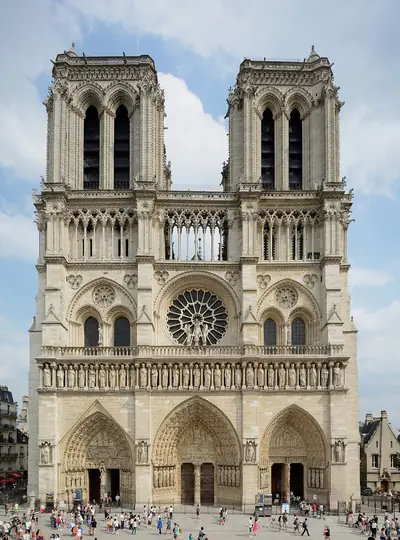
Notre-Dame de Paris
On the Île de la Cité, Cathédrale Notre-Dame de Paris is one of the most recognisable symbols of Paris and France. Dedicated to the Virgin Mary, it serves as the cathedral church of the Roman Catholic Archdiocese of Paris.
Construction began in 1163 under Bishop Maurice de Sully and continued for nearly two centuries, reaching completion around the middle of the fourteenth century. Its architecture brings together different stages of Gothic design, with rib vaults, flying buttresses, richly sculpted façades, and enormous colourful rose windows. The two rose windows at the ends of the transept are among the largest in Europe.
Notre-Dame has been repeatedly altered and restored. After extensive damage during the French Revolution, it underwent a major nineteenth-century restoration led by Eugène Viollet-le-Duc, which introduced new elements including a spire.
Sainte-Chapelle
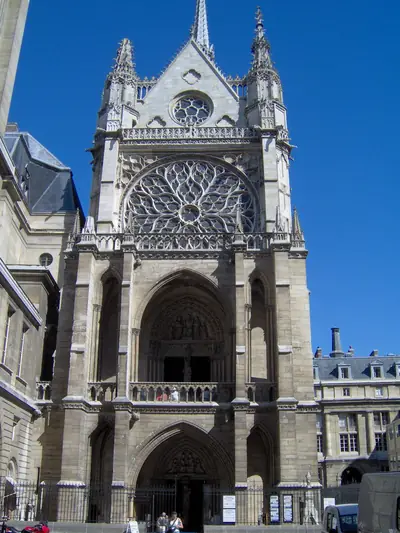
Also on the Île de la Cité, Sainte-Chapelle is a former royal chapel famous for its almost entirely glass-walled upper level. King Louis IX commissioned it to house the Crown of Thorns, a piece of the True Cross, and other Passion relics acquired from 1239 onward.
Consecrated in 1248 after no more than seven years of construction, the chapel combines sculpture, painting, and stained glass. Its immense narrative windows are its greatest treasure, preserving one of the world’s most extensive collections of thirteenth-century stained glass.
Palais du Louvre
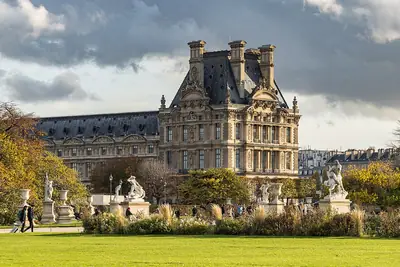
The Palais du Louvre brings more than eight centuries of Parisian history together in one complex. Built around 1190 as a fortress defending the western side of Philip II Augustus’s city wall, it gradually became a royal palace and an important court centre.
From the Renaissance onward, the medieval castle was transformed into a much larger palace. Under Francis I, the Louvre introduced architecture inspired by classical antiquity and the Italian Renaissance into the heart of Paris. The oldest surviving section above ground is the Lescot Wing, begun in the late 1540s.
Today, the palace houses the Louvre Museum, the Museum of Decorative Arts, and the École du Louvre. It is one of the key stops on the Paris self-guided walking tour experience offered by Neywo, particularly the route connecting the Louvre with the Grand Palais.
Arc de Triomphe
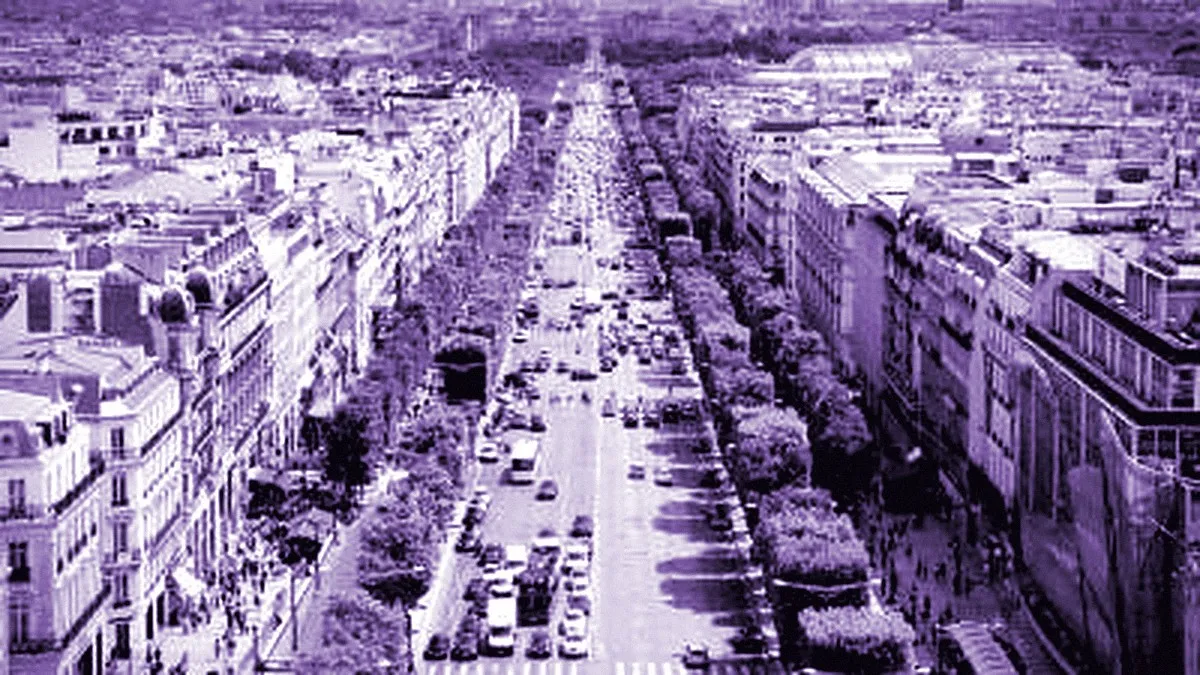
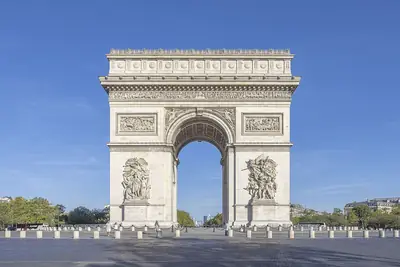
At the western end of the Champs-Élysées, the Arc de Triomphe stands at the centre of Place Charles de Gaulle, where twelve avenues meet in a star-shaped pattern. Commissioned by Napoleon and designed by Jean-François Chalgrin in 1806, it was completed in 1836 during the reign of Louis-Philippe.
The monument honours those who fought and died for France during the French Revolutionary and Napoleonic Wars. Names of French victories and generals cover its inner and outer surfaces. Beneath the arch, the Tomb of the Unknown Soldier adds another layer of national remembrance.
Tour Eiffel
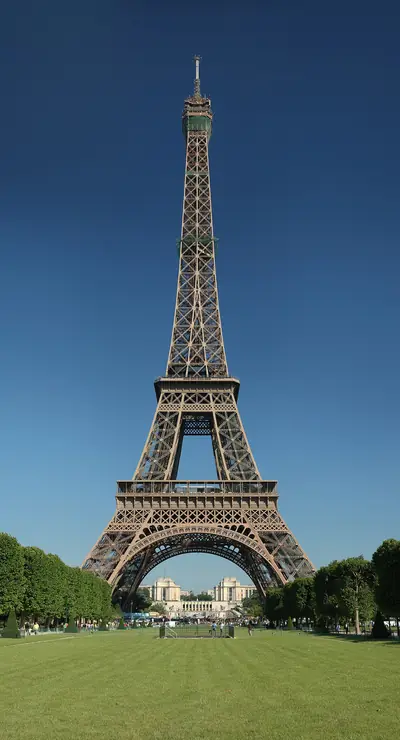
The Eiffel Tower, or Tour Eiffel, rises beside the Seine at the Champ de Mars. This 330-metre iron tower was built between 1887 and 1889 by Gustave Eiffel and his collaborators as the centrepiece of the Paris World’s Fair, held to mark the centenary of the French Revolution.
Its open lattice of wrought iron and broad square base made it an immediate architectural landmark, although some artists and intellectuals initially criticised its design. The tower has three visitor levels, with observation platforms at 57, 115, and 276 metres. The structure became one of the world’s most recognisable symbols of Paris.
Palais de Chaillot
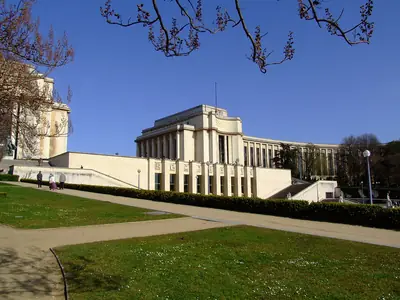
In the Trocadéro area, the Palais de Chaillot occupies Chaillot Hill opposite the Eiffel Tower. Its terrace offers a view of the tower, while the palace brings together museums, a theatre, and other cultural institutions.
The present building was created for the 1937 World’s Fair, replacing the former Palais du Trocadéro. Designed by Léon Azéma, Jacques Carlu, and Louis-Hippolyte Boileau, it is one of three permanent buildings remaining from that exhibition. Palais de Chaillot also has an important place in international history: on 10 December 1948, the United Nations General Assembly adopted the Universal Declaration of Human Rights here.
Petit Palais
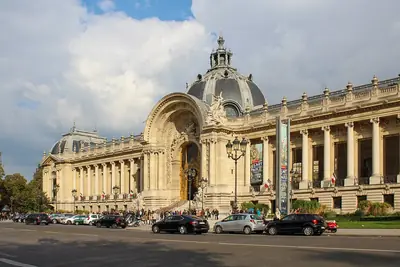
The Musée des beaux-arts de la Ville de Paris is housed in the Petit Palais on Avenue Winston-Churchill, opposite the Grand Palais. Charles Girault designed the building as an exhibition pavilion for the 1900 Exposition Universelle, and it was built between 1897 and 1900.
Today, the Petit Palais is one of fourteen museums of the City of Paris. Since 1 January 2013, these museums have been managed by the public institution Paris Musées.
The Marais and Hôtel de Sens
The Marais is home to historic residences, museums, and distinctive streets. Hôtel de Sens, on Rue du Figuier, is one of its notable landmarks. This fifteenth-century private mansion, also known as the Hôtel des archevêques de Sens, now houses the Forney Library, devoted chiefly to posters and advertising.
When Tristan de Salazar became Archbishop of Sens in 1475, he had the earlier Paris residence rebuilt in the Flamboyant style. The building later served a variety of purposes, including the headquarters of a transport company, a cannery, a jam factory, and a glassworks.
The Marais is also home to Musée Picasso, France’s national museum devoted to Pablo Picasso’s life and work, as well as artists connected with him. Housed in the Hôtel Salé, the museum contains more than five thousand works, including paintings, sculptures, drawings, ceramics, prints, engravings, and notebooks. Its archives preserve tens of thousands of items from Picasso’s personal repository.
Montmartre and La Ville des Arts
Montmartre offers a different perspective on Paris through its artists’ studios and historic buildings. La Ville des Arts is a private road in the 18th arrondissement containing an ensemble of artists’ studios arranged around courtyards and gardens.
Built at the end of the nineteenth century, the complex was listed as a Monument historique in 1994. Its entrance is at 15 Rue Hégésippe-Moreau. The site provides a glimpse of a more intimate artistic setting than the city’s grand museums and monuments.
Catacombs of Paris
The Catacombs of Paris offer an underground encounter with the city’s history. This municipal ossuary holds the remains of around six million people in former underground stone quarries in the 14th arrondissement.
The quarries were transformed into an ossuary at the end of the eighteenth century, and human remains were transferred there from Parisian cemeteries until 1861 in response to concerns about public sanitation. The visitor route extends for about 1.7 kilometres, roughly twenty metres below the surface. Although commonly called catacombs, the site was officially created as an ossuary rather than as a burial place.
Other landmarks worth seeking out
Several further sites show the range of Parisian architecture and history:
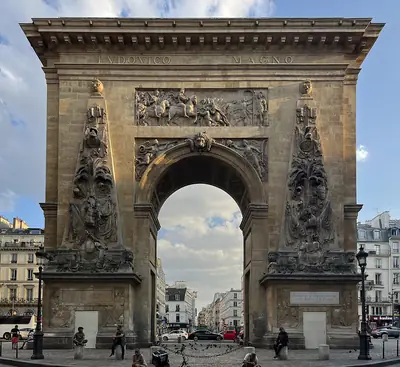
- Porte Saint-Denis occupies the site of a former gate in the Wall of Charles V. Built in the seventeenth century by François Blondel in honour of Louis XIV, the triumphal arch was inspired by the Arch of Titus and declared a historic monument in 1862.
- Montparnasse Tower is the tallest building in Paris proper. Completed and inaugurated in 1973, it rises about 209 metres and has 58 floors, with an observation platform and restaurant on the two highest floors.
- Pont Mirabeau is an arch road bridge spanning the Seine between the 16th and 15th arrondissements. Built in the 1890s, it was officially listed as a historic monument in 1975.
- Église de la Madeleine is a monumental Neoclassical church at Place de la Madeleine. Its design includes an octastyle portico and 52 Corinthian columns. The project began under Louis XV, was interrupted by the French Revolution, and was reshaped by Napoleon I as a Greek-style temple celebrating his Grande Armée before becoming a Catholic parish church in 1845.
Paris self-guided walking tours and audio guide
Neywo’s free audio guide for Paris includes seven walking tours, one bus route, and one bike route. Altogether, these routes range from short city walks to a longer bus journey:
- Seven walking tours, covering between 2.36 and 4.24 km, lasting between 102 and 119 minutes, with between 7 and 11 narrated stops each.
- One bus route, covering 8.8 km in 38 minutes and featuring 12 narrated stops.
- One bike route, covering 2.7 km in 14 minutes and featuring 7 narrated stops.
The walks explore the Île de la Cité and Latin Quarter, the Louvre and Grand Palais, the Marais, Montmartre, the Eiffel Tower and Trocadéro, the Arc de Triomphe and Madeleine, and the Left Bank. The bus route follows a line from La Chapelle to the Catacombs, while the bike route follows the Seine from Quai d’Orsay to Notre-Dame.
Neywo tells the story of each place as you reach it, at your own pace, with no group and no schedule. The narration is available in 11 languages, making it a practical Paris audio guide for exploring the city independently.
Download Neywo and explore Paris at your own pace
Download Neywo to discover Paris with 1,287 narrated places and nine routes: seven walks, one bus route, and one bike route. Choose a route through the Marais, Montmartre, the Louvre, the Left Bank, or along the Seine, or use the bus and bike itineraries to see the city differently.
The app plays each story as you reach the place, at your own pace, with no group and no schedule. It is a free walking tour Paris travellers can follow independently, with the freedom to pause, look around, and continue when ready. Paris is also a starting point for exploring the wider Île-de-France, including nearby Versailles and Auvers-sur-Oise.
Places with an audio guide in Paris
8 places in Paris with a Neywo audio guide. Each one starts telling its story as you reach it.
Self-guided tours in Paris
9 tours in Paris, free in the Neywo app. Each stop tells its story as you reach it.
- Bike ride
Seine Bank Ride: Quai d'Orsay to Notre-Dame
A short, flat ride on the cycle lane along the Left Bank quays. You pass the Quai d'Orsay ministry, the Musée d'Orsay, Henri IV on the Pont Neuf and the Saint-Michel fountain, and finish facing Notre-Dame.
Hôtel du ministre des Affaires étrangères · Fondation Custodia · Musée d'Orsay · Henri IV · Fontaine Saint-Michel · Église Saint-Julien-le-Pauvre …
Open this tour: Seine Bank Ride: Quai d'Orsay to Notre-Dame - Bus ride
Bus 38: La Chapelle to the Catacombs, Straight Down Paris
A regular RATP line that runs south from La Chapelle through the Grands Boulevards, past the Pompidou Centre and the Tour Saint-Jacques to the Conciergerie and the Latin Quarter, then on to the Catacombs at Denfert-Rochereau. One ticket links a dozen sights from the north to the south of the city.
Basilique Sainte-Jeanne-d’Arc · Bouffes du Nord · Église Saint-Laurent · Porte Saint-Martin · Église Saint-Nicolas-des-Champs · Centre Georges Pompidou …
Open this tour: Bus 38: La Chapelle to the Catacombs, Straight Down Paris - Walk
Where Paris Began: Island Palaces and the Latin Quarter
Start at the medieval clock on the Île de la Cité, then pass the Conciergerie where Marie-Antoinette waited, the jewel-box Sainte-Chapelle and Notre-Dame, where Paris measures its distances from a bronze star. Cross to the Left Bank for Roman baths, the Sorbonne, the oldest tree in Paris and the hill where the nation buries its heroes.
Tour de l'Horloge · Conciergerie · Sainte-Chapelle · Point zéro des Routes de France · Cathédrale Notre-Dame de Paris · Église Saint-Julien-le-Pauvre …
Open this tour: Where Paris Began: Island Palaces and the Latin Quarter - Walk
From the Louvre to the Grand Palais: A Royal Promenade
Walk the historic axis of French power: the Palais Royal, the Louvre, Napoleon's little arch and the Tuileries gardens, then on to Monet's water lilies and the 3,000-year-old obelisk of Place de la Concorde. Cross the golden Pont Alexandre III and end under the glass roof of the Grand Palais, built for the 1900 World's Fair.
Palais Royal · Palais du Louvre · Arc de Triomphe du Carrousel · Jardin des Tuileries · Musée de l'Orangerie · Obélisque de Louxor …
Open this tour: From the Louvre to the Grand Palais: A Royal Promenade - Walk
Marais Mansions: Kings, Poets and Picasso
The Marais escaped Haussmann's bulldozers, and its noble mansions still line the streets. Go from the Pompidou Centre past the courtyards of Soubise and Sully, the Picasso and Carnavalet museums, the arcaded Place des Vosges and Victor Hugo's home, and end at the medieval Hôtel de Sens.
Centre Georges Pompidou · Hôtel de Soubise · Musée Picasso · Musée Carnavalet · Square Louis-XIII · Synagogue de la rue des Tournelles …
Open this tour: Marais Mansions: Kings, Poets and Picasso - Walk
Montmartre: Windmills, Cabarets and the White Dome
Climb from the red windmill of the Moulin Rouge through the cabaret streets where Toulouse-Lautrec and Picasso drank. Pass the concrete church of Saint-Jean, the last vineyard of Paris and the Lapin Agile, and end beneath Sacré-Cœur with all of Paris at your feet.
Moulin Rouge · Le Chat Noir · Abbesses · Église Saint-Jean de Montmartre · Moulin de la Galette · Musée de Montmartre …
Open this tour: Montmartre: Windmills, Cabarets and the White Dome - Walk
The Iron Lady and the Trocadéro Heights
Start under the Pont de Bir-Hakeim, where the metro rattles over the Seine, and walk to the Eiffel Tower. Then follow the riverbank to the quai Branly, Palais de Tokyo and the museums of Asian art, fashion and architecture, and finish on Chaillot Hill with the best view of the tower.
Pont de Bir-Hakeim · Tour Eiffel · Musée du quai Branly · Palais de Tokyo · Palais Galliera · Musée Guimet …
Open this tour: The Iron Lady and the Trocadéro Heights - Walk
Belle Époque Paris: From the Arc de Triomphe to the Madeleine
Begin under Napoleon's great arch, then slip into the quiet mansion quarter around Parc Monceau, where bankers built museums of Asian art, French furniture and old masters. Pass the Russian cathedral and the Chapelle expiatoire, and end at the columns of the Madeleine.
Arc de Triomphe · Cathédrale Saint-Alexandre-Nevsky · Musée Cernuschi · Musée Nissim de Camondo · Musée Jacquemart-André · Chapelle expiatoire …
Open this tour: Belle Époque Paris: From the Arc de Triomphe to the Madeleine - Walk
Left Bank Paris: The Luxembourg, Saint-Germain and Orsay
Wander the Luxembourg palace and its Medici fountain, then cut through Saint-Germain past the Odéon theatre, Saint-Sulpice and Delacroix's studio. Pause at Serge Gainsbourg's preserved house and finish on the Seine in the old railway station that is now the Musée d'Orsay.
Jardin du Luxembourg · Palais du Luxembourg · Fontaine Médicis · Odéon–Théâtre de l'Europe · Église Saint-Sulpice · Musée national Eugène Delacroix …
Open this tour: Left Bank Paris: The Luxembourg, Saint-Germain and Orsay
Walk Paris with Neywo
Neywo turns Paris into a self-guided audio tour. Stories arrive as you reach the place they belong to, and the route reshapes when you wander off it.

