Day Trips by Coach: When the Organised Bus Is Worth It
Half the coach day trips sold in European cities go somewhere with a direct train. The other half go somewhere you could not otherwise reach, and those are worth every euro.
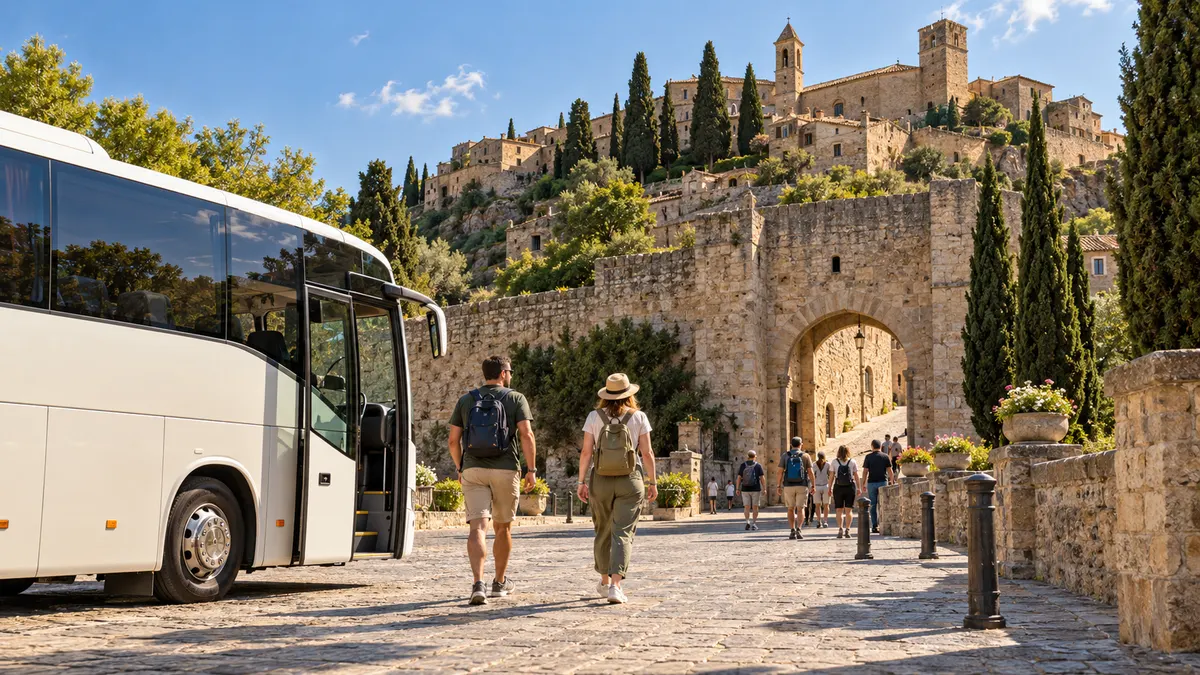
There is a rack of leaflets in every hotel lobby in Europe selling the same day out: an early start, a comfortable coach, a guide with a microphone, four hours of driving and a famous thing at the far end. Prices for a full day usually land between €50 and €100 per person, frequently before entry fees.
Sometimes that is one of the best purchases of a trip. More often it is a way of paying eighty euros for a train ticket that costs twelve. The difference is entirely predictable in advance, and this is how to tell which one you are looking at.
What you are actually buying
Not the commentary. The commentary is a bonus and it is usually thin, for reasons covered below.
What you are buying is the transfer: a seat on a vehicle that goes from where you are to somewhere with no convenient public route, and back, without you driving, parking, or working out a rural timetable. Every judgement about whether a coach trip is worth it follows from asking how hard that transfer would otherwise be.
Which means the first thing to do is not read the itinerary. It is to look up the train.
Do the train test first
Take the destination and search for a direct rail service. A surprising number of the most heavily marketed coach excursions go to places with a fast, frequent train:
- Toledo from Madrid — about 33 minutes on the Avant.
- Segovia from Madrid — under half an hour.
- Girona from Barcelona — around 38 minutes on the high-speed line.
- Sintra from Lisbon — roughly 40 minutes on the suburban line, for the price of a couple of coffees.
All four are sold as coach day trips. In all four the train is faster, several times cheaper, runs all day, and — the part that actually matters — lets you decide when to come home. Independence is not a small extra here: it is the difference between ninety minutes at a cathedral and staying until the light goes.
If there is a direct train under about ninety minutes, take the train and read the free city guide on the way.
The four cases where the coach wins
1. There is no railway. Iceland has no passenger rail network at all, so the classic loop out of Reykjavík is a coach, a rental car or nothing. The Cliffs of Moher from Dublin are about three hours of road each way with no rail alternative. In cases like these the coach is not the lazy option, it is the option.
2. The trip is a loop of several rural stops. This is the strongest case of all. Any itinerary that visits three or four villages with no stations — the Chianti hills and the Val d’Orcia out of Florence, the white villages beyond Ronda — is essentially impossible on public transport in one day. A coach absorbs the connections that would otherwise eat the whole itinerary.
3. The road is the attraction. On the Amalfi coast road out of Sorrento or Naples, the driving is the thing you came for, the parking at the other end is genuinely awful, and somebody else taking the hairpins while you look out of the window is the correct arrangement. Same logic on a lot of Dalmatian coast road out of Split.
4. It is winter. Rural bus timetables in the off season can drop to two services a day, one of which leaves before you arrive. A coach runs regardless, and this is when the leaflet earns its place.
The pickup loop, and other time you do not get back
An “08:00 departure” is rarely eight hours of destination. Build in:
- The pickup loop. A coach collecting from six hotels spends 45 to 60 minutes doing it. Ask where you are in that loop when you book, because the first pickup has the longest day and the last has the shortest.
- A comfort stop, usually at a motorway service area, usually 20 to 30 minutes.
- The lunch that is described as optional and is in practice a fixed hour at a place the operator has an arrangement with.
- The reassembly. Forty-odd people getting back onto a coach takes ten minutes, twice a day, and the one late couple costs everybody twenty more.
None of this makes a coach trip bad. It makes a nine-hour day into about four and a half hours of actually being somewhere, which is a number you should know before you agree to it.
Ninety minutes is the number that matters
The single most useful question on any itinerary is how long you get at each stop. Sixty to ninety minutes is typical.
That is enough for a village, a viewpoint, a small church, or a walk down one street with lunch. It is not enough for a large cathedral plus its treasury, a serious museum, or a hilltop old town that takes twenty minutes to climb into before you have seen anything. If the place you actually care about needs three hours, a coach that gives it ninety minutes will make you resent the whole day — and no amount of comfort on the drive compensates.
Compare the stop times against what each place needs, and if the mismatch is bad, go independently and give it the day.
Ask what language the commentary is in
Frequently underestimated. Many coach excursions run bilingually, with the guide delivering each passage twice, in two languages, alternately. That halves the information density, doubles the dead air, and means half your listening time is spent hearing a language you do not speak.
Others hand out radio receivers with pre-recorded tracks, which is better for coverage and worse for questions. And some run in one language only — check which, because “English available” can mean “the guide speaks English” rather than “the tour is in English”.
Nine questions before you book
- Is there a direct train, and how long does it take?
- What time is the first pickup, and where am I in the loop?
- How long at each stop, stop by stop?
- Are entry fees included, or extra on the day?
- What is the maximum group size?
- Which language is the commentary in, and is it shared with another?
- Is lunch included, optional, or compulsory-in-practice?
- What happens if the weather closes the main sight?
- What time does it actually get back?
Any operator who will answer all nine plainly is probably a good one. Vagueness on question three is the reliable warning sign.
What the coach cannot do for you
Here is the gap nobody mentions in the leaflet. When the coach sets you down for ninety minutes, the guide is usually either back at the vehicle or leading one subgroup of forty people. For the part of the day you actually came for — standing in front of the thing — you are on your own.
That is exactly the slot a self-guided audio guide fills, and it is why the two are complements rather than competitors. The coach solves the transfer; something in your ear solves the ninety minutes. Every city and town this site covers has a free written guide, most of the destinations above included, and the app turns them into audio that plays as you reach each place, in 11 languages — including, usefully, the ones the coach commentary was not in. You can hear a real clip first.
Two related reads if you are weighing the alternatives: how a self-guided audio tour compares with a live guided one, and — for getting around the city you are based in rather than out of it — why the local service bus beats the tourist one.
The short version
Look up the train first. If there is a direct one under ninety minutes, take it and keep your own schedule. If the destination has no railway, or the day is a loop of rural stops, or the road itself is the point, or it is the off season — book the coach and stop feeling bad about it.
Either way, ask how long you get at each stop, and bring your own commentary for the part where you are standing in front of the thing on your own.
Walk it with the guide in your ear
Neywo has a free walking guide for more than 1,800 cities: what is worth noticing, and the stories behind it, narrated in 11 languages.


More from the blog
- How to Turn a City Walk Into a Scavenger Hunt
- Exploring a City by Bike: Where It Works and Where It Does Not
- Guided Bike Tour or On Your Own? How to Decide
- How to Choose a Walking Tour App: Eight Questions That Matter
- How to Plan a City Walking Route You Will Actually Finish
- The Best Time to Learn a City Is on the Way There
- One Free Hour in a City: How to Spend It Well
- See a City by Public Bus: The Better Hop-On Hop-Off
- What to Do Near Your Hotel: Reading the Streets You Sleep On
- How Location-Aware Audio Guides Work (And Where AI Fits In)
- How to Get More Out of a City Walk: 9 Practical Habits
- The 10 Most Walkable Cities for a Weekend on Foot
- Self-Guided Audio Tour vs Guided Walking Tour: How to Choose