What to Do Near Your Hotel: Reading the Streets You Sleep On
You will walk past the same six streets ten times in four days and never once look at them. They are the part of the city you have most access to and the part you will remember least.
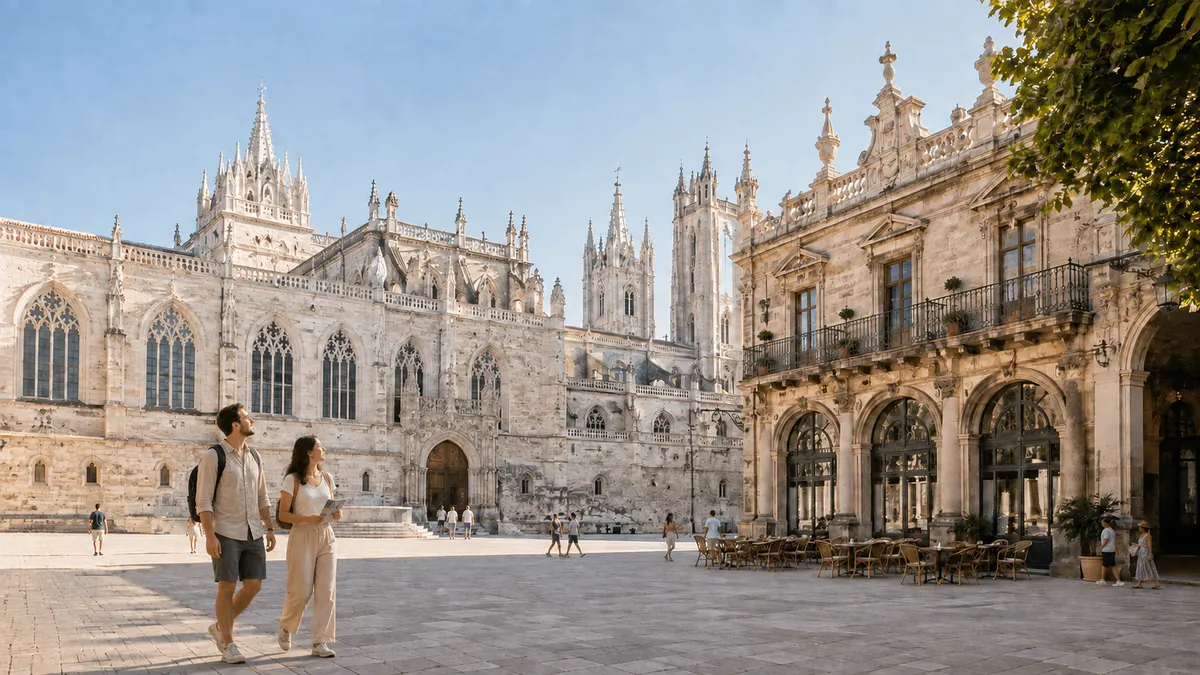
There is a pattern to how people use a hotel. You arrive, you drop the bags, and from then on the building is a place you commute out of in the morning and back to at night. The route between it and the nearest metro station gets walked eight times and looked at zero.
Which is odd, because that 500 metres is the piece of the city you have by far the most access to. You are there early, you are there late, you are there in the twenty minutes before dinner and the ten before checkout — all the times when the actual sights are closed, queued or dark.
The two best hours you have
The first evening. Before dinner on the day you arrive, walk a loop of about fifteen minutes and come back. This is not sightseeing; it is orientation, and it pays for itself immediately. You find where breakfast is, where the late shop is, which direction the noise comes from, and — most usefully — you build the rough mental map that every other day of the trip runs on. It is also the only time the neighbourhood will be completely new to you.
Before breakfast. Seven in the morning is the best hour in almost any city and almost nobody uses it. Deliveries are happening, shutters are going up, the light is low and sideways, the streets are being washed, and the famous thing four blocks away has about forty people in front of it instead of four hundred. If you do one deliberate thing with your hotel neighbourhood, do this.
Nine things to look at
Reading a neighbourhood is a skill and it is mostly a matter of knowing what carries information. None of the following needs a ticket.
1. The street names. The cheapest history in any city. Trade names tell you what was made there — a street of tanners, dyers, bakers, silversmiths — and they survive centuries after the trade has gone. Names commemorating a person or an event date the street’s layout: a road named after something that happened in 1930 was laid out after 1930, which tells you the whole block is younger than it looks.
Edinburgh’s New Town is the extreme case. The 1767 plan named its streets George, Queen, Princes, Hanover, Frederick and Charlotte — a Hanoverian loyalty oath in cobblestones, laid out barely twenty years after the last Jacobite rising. The street plan is an argument.
2. The dates on the buildings. Datestones over doorways, on lintels, in gable ends. Once you start looking you will find them everywhere, and a run of them along one street tells you whether the block went up over eighty years or in one speculative burst of three.
3. Where the height changes. A sudden step in building height or a break in the building line is almost always a boundary: a city wall that came down, a boulevard cut through in the nineteenth century, a bomb site rebuilt in the 1950s. Cities do not lose their old edges, they just build over them.
4. Which way the church faces. Old churches were built facing east. If one sits at an awkward angle to the streets around it, the church is older than the street plan and everything else was fitted around it.
5. The corners. Barcelona’s Eixample is 113-metre blocks with every corner cut off at 45 degrees. Cerdà designed those chamfers in the 1850s so that trams could turn and light could reach street level; the trams are gone and the chamfers are now where the terraces, the trees and most of the neighbourhood’s social life are. A design decision made for traffic became the shape of the city’s evenings.
6. The shop mix. Three phone-repair shops, a money transfer counter and a barber tell you who lives there now. A natural wine bar and a plant shop tell you who arrived in the last five years. A butcher, a haberdasher and an ironmonger tell you the street has held on to something. All three are real information about a neighbourhood, and none of it is in a guidebook.
7. Tracks and joins in the road surface. Tram rails in a street with no tram. A strip of different paving running the length of a road — a filled-in canal, a covered river, a demolished terrace’s footprint. Cities are palimpsests and the ground is the most honest layer.
8. Plaques. Just read them. Every city puts small brass and stone notices on walls and almost every visitor walks past them because they are not on the itinerary.
9. The arcades, if you have them. Bologna has around 38 kilometres of porticoes in its historic centre alone — built because a university town needed to expand its housing outwards over the street, and now the reason you can cross the city in the rain without an umbrella. A practical medieval fix that turned into the thing the city is known for.
When the neighbourhood really is dull
Sometimes it is, and pretending otherwise is not useful. Airport hotels, ring-road business districts, and the blocks immediately around a main railway station are frequently generic — nineteenth-century stations were built on the edge of town, and the surrounding streets were rebuilt for hotels and traffic.
Two responses. Walk ten minutes in one direction — pick the way the map looks oldest, with narrower and less regular streets — because ten minutes is often a different city entirely. Or take one stop of transport, which costs three minutes.
And if your hotel is in the historic centre, the opposite problem applies: the neighbourhood is extraordinary and you will still not look at it, because you will be busy walking through it to somewhere else. Lisbon is a good test. The Baixa is a rigid grid because the 1755 earthquake flattened it and Pombal rebuilt it from nothing on a plan; Alfama, up the hill, is a Moorish tangle because it was on rock and largely survived. Two neighbourhoods next to each other, and the difference between them is a single morning in November 1755. Most people cross both in a day without noticing the seam.
Why an audio guide suits this better than a route
A researched route is the right tool for a city you have never seen — someone has sized it, sequenced it and decided what matters.
But your hotel neighbourhood is the opposite situation. You are not doing it once in order; you are crossing it repeatedly, in fragments, in whatever direction the day happens to take you. A route would be wrong on the second morning and insulting by the fourth.
That is what roam is for, one of the eight ways into a city: no route, no order, no end. You walk wherever you were going anyway and every narrated place you pass tells you its story once as you reach it. Two details make it fit this particular use:
- You can narrow it to the kinds of place you care about — churches, museums, parks, landmarks — and everything else stays quiet, so a neighbourhood does not talk at you continuously.
- Each place speaks once. It does not repeat itself on the way back, which is precisely the thing that would make it unusable on a street you walk twice a day.
There is nothing to finish and nothing to fall behind on, which is the right relationship to have with the streets around where you are sleeping.
The short version
Walk a fifteen-minute loop the evening you arrive. Go out again before breakfast at least once. Read the street names, look for the datestones, notice where the building line breaks, and read the plaques. If the area is genuinely dull, walk ten minutes in the oldest-looking direction.
None of it costs anything, and it is the part of a trip that most reliably turns into the thing you actually remember — not the monument you queued for, but the street you eventually understood.
Every city guide on this site is free to read, samples with transcripts take ninety seconds, and if you have an actual hour rather than an idle twenty minutes, that is a different problem with a different answer.
Walk it with the guide in your ear
Neywo has a free walking guide for more than 1,800 cities: what is worth noticing, and the stories behind it, narrated in 11 languages.


More from the blog
- How to Turn a City Walk Into a Scavenger Hunt
- Day Trips by Coach: When the Organised Bus Is Worth It
- Exploring a City by Bike: Where It Works and Where It Does Not
- Guided Bike Tour or On Your Own? How to Decide
- How to Choose a Walking Tour App: Eight Questions That Matter
- How to Plan a City Walking Route You Will Actually Finish
- The Best Time to Learn a City Is on the Way There
- One Free Hour in a City: How to Spend It Well
- See a City by Public Bus: The Better Hop-On Hop-Off
- How Location-Aware Audio Guides Work (And Where AI Fits In)
- How to Get More Out of a City Walk: 9 Practical Habits
- The 10 Most Walkable Cities for a Weekend on Foot
- Self-Guided Audio Tour vs Guided Walking Tour: How to Choose