What to See in Hebron, Palestine: Free Audio Guide
Things to Do in Hebron: What to See in the Old City
The best things to do in Hebron include visiting the Cave of the Patriarchs, exploring historic mosques and synagogues, and learning about the city’s layered religious and political history. Hebron, also known as Al-Khalil in Arabic, is one of the oldest and most significant cities in the West Bank, with a historic center where sacred sites, markets, traditional architecture, and modern divisions meet. Neywo offers a free audio guide for Hebron with 12 narrated places.
What to See in Hebron
The Cavern of the Patriarchs and Ibrahimi Mosque
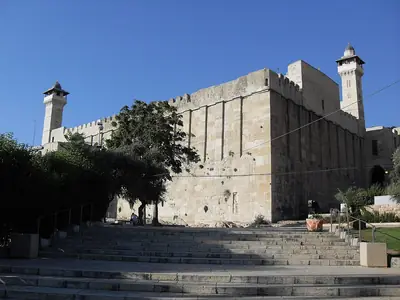
The Cavern of the Patriarchs, known to Jews as the Cave of Machpelah and to Muslims as the Ibrahimi Mosque, is Hebron’s most important landmark. The site is sacred to Judaism, Christianity, and Islam, and tradition identifies it as the burial place of Abraham, Isaac, and Jacob, together with Sarah, Rebecca, and Leah. Some traditions also associate the site with Adam and Eve, while an adjoining structure contains a cenotaph attributed to Joseph.
The massive rectangular enclosure above the caves is surrounded by an enormous wall made from stones, some reaching seven metres in length. The structure dates back to the time of Herod the Great, around the first century BCE. It is considered the second holiest site in Judaism after the Temple Mount and the fourth holiest site in Islam.
The complex also reflects Hebron’s divided religious and political reality. Muslim and Jewish worshippers use two prayer halls positioned side by side, while the doors between them remain locked.
Remembering the 1994 Cave of the Patriarchs massacre
The Ibrahimi Mosque is also a place of profound tragedy. On February 25, 1994, during the Jewish holiday of Purim and the Islamic holy month of Ramadan, Baruch Goldstein entered the mosque in an Israeli army uniform and opened fire on Palestinian worshippers. Twenty-nine people, including children as young as twelve, were killed, and 125 others were wounded. Goldstein was overpowered and beaten to death by survivors inside the mosque.
The event continues to shape life around the complex and remains one of the most sensitive episodes in Hebron’s recent history.
Hebron Observatory
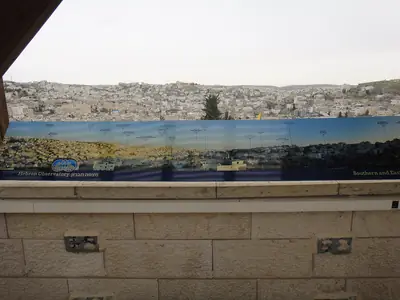
High on the slopes of Tel Rumeida, the Hebron Observatory offers broad views across the city. It stands within Admot Yishai, a Jewish neighborhood named after the nearby Tomb of Jesse, the father of King David, and part of the broader Jewish settlement in Hebron.
The surrounding area includes Beit Menachem, an older building purchased from its previous owners, and a distinctive row of seven caravans arranged over two levels. The road also leads towards Hebron’s Old Jewish Cemetery, located just to the west. The cemetery is described as one of the oldest Jewish cemeteries in the region.
Karantina
Karantina is a historic castle on the hill above Hebron’s Old City. Built during the reign of Sultan Abdulmejid I around 1848, it is considered the first stone health center constructed by the Ottomans in Palestine. It is also believed to have been the second facility of this kind in the Arab world, after one built in Damascus in 1834.
Its position on the hill makes Karantina one of the city’s distinctive historic landmarks.
Palestine Hotel
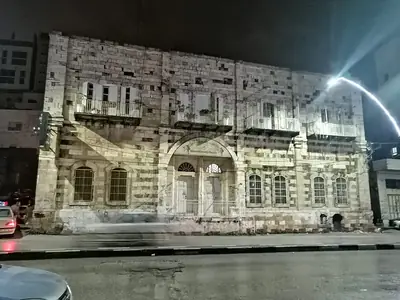
At the entrance to the Old City, the Palestine Hotel stands in the municipality square between the old and new Shalala streets. It was established between 1928 and 1929, although some sources suggest that the building itself is around 150 years old. It is considered the first hotel built in Hebron.
The building operated as a hotel until 1964, when it became a shoe factory. The factory later closed after an Israeli military checkpoint was established nearby during the Second Intifada. Following restoration, the building became a museum dedicated to Hebron’s heritage.
Shajar Al-Durr oil mill
The Shajar Al-Durr olive oil mill, also known as the Abd al-Nabi mill, preserves part of Hebron’s industrial history. Located in the al-Zahid area near the old municipal square, it was one of the city’s largest and most productive olive presses.
The mill was built in the early twentieth century, towards the end of the Ottoman era. A grain mill was added in 1925, and the site continued serving local farmers and families until it closed in 1970.
Ibn Othman Mosque
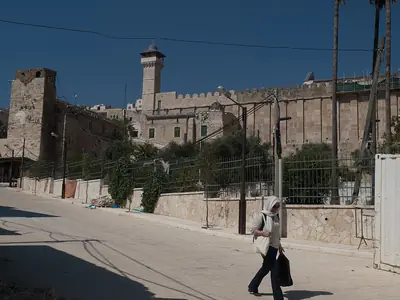
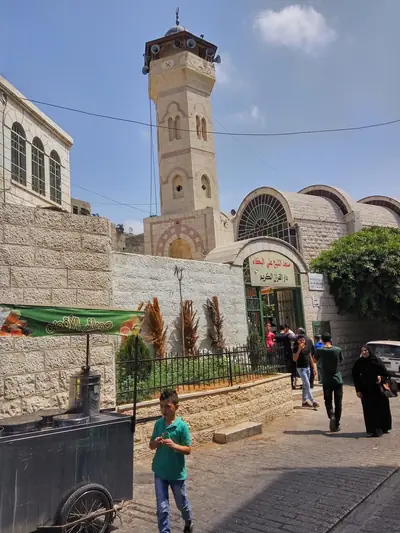
The Ibn Othman Mosque lies in the heart of the Old City, close to the Sakaifiyya market and the Murabba area. It stands at the beginning of Aqaba alley, along the road leading to the Ibrahimi Mosque.
It is regarded as the oldest mosque in Hebron after the Ibrahimi Mosque. A traditional ablution area, known as a midda, is attached to the building.
Abraham Avinu Synagogue
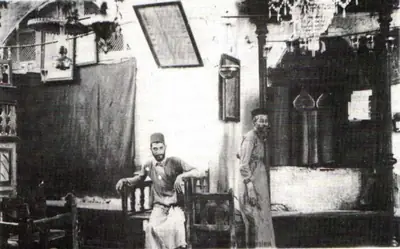
The Abraham Avinu Synagogue was founded in 1540 by Sephardic Jews led by Hakham Malkiel Ashkenazi. Its domed structure became the spiritual center of Hebron’s Jewish Quarter and an important place for the study of Kabbalah.
The synagogue’s name, meaning “Our Father Abraham”, comes from a local legend about a mysterious elderly man who appeared to help the community form a minyan for Yom Kippur. After the service, he disappeared and was later identified in a dream as Abraham the Hebrew. The building was restored in 1738 and enlarged in 1864.
Sheikh Ali al-Bakka Mosque
The Sheikh Ali al-Bakka Mosque dates from the Mamluk period and was built in the year 702 of the Islamic calendar. It is considered the second-oldest mosque in Hebron after the Ibrahimi Mosque.
The mosque is in the northwestern part of the Old City, around a kilometre and a half north of the Ibrahimi Mosque. The surrounding quarter is called Harat ash-Sheikh after the mosque. Its history is recorded in works by several important scholars, including al-Dhahabi and Ibn Kathir.
Hebron University Museum of Antiquities
Founded in 2010 on the campus of Hebron University, the Hebron University Museum of Antiquities focuses on Palestine’s archaeological heritage. Its collection includes materials dating from the Bronze Age.
One of its notable displays is a set of Roman-period pottery coffins from Palestine, offering insight into burial practices and daily life during that era.
The history of Hebron’s Jewish community
Hebron’s history includes a long and often difficult relationship between religious communities. The 1929 massacre marked one of the city’s darkest chapters. On August 24, 1929, 67 Jewish residents were killed, while others were seriously wounded or maimed. Jewish homes were pillaged and synagogues were ransacked.
The violence formed part of the wider 1929 Palestine riots. At the time, Hebron had around 20,000 inhabitants, including approximately 800 Jewish residents. The massacre ended the city’s centuries-old Jewish presence at that time. Some survivors were hidden by local Arab families, although the extent of that protection remains debated. The British authorities evacuated the Jewish population soon afterwards; some returned in 1931, but almost all were evacuated again at the beginning of the 1936–1939 Arab revolt.
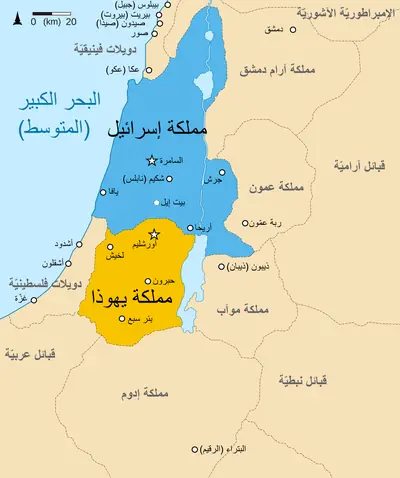
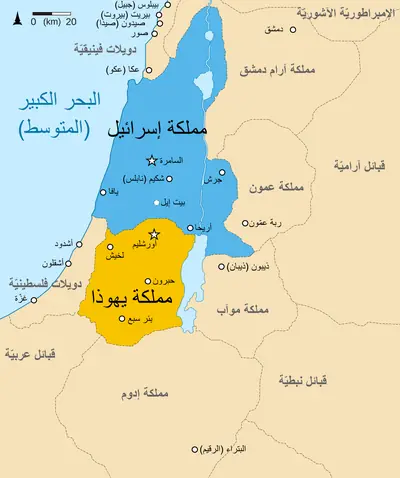
The wider history of the region also includes the Kingdom of Judah, the ancient Israelite kingdom centered in the highlands west of the Dead Sea. According to the Hebrew Bible, Judah emerged after the division of the United Kingdom of Israel and was ruled by the House of David. Archaeological discoveries, including the Tel Dan Stele found in 1993, indicate that the kingdom existed in some form by the middle of the ninth century BCE.
Explore Hebron with a self-guided walking tour
Neywo’s free audio guide lets you explore Hebron independently. Its walking tour, “From Tel Rumeida to the Cave of the Patriarchs,” covers 4.26 km in about 109 minutes and includes 9 narrated stops. The route features the Hebron Observatory, Karantina, the Palestine Hotel, Shajar Al-Durr oil mill, Ibn Othman Mosque, Hebron, Abraham Avinu Synagogue, the Cavern of the Patriarchs, Sheikh Ali al-Bakka Mosque, and the Hebron University Museum.
The app tells the story of each place as you reach it, at your own pace, with no group and no schedule. Narration is available in 11 languages. Download Neywo to explore Hebron through its sacred landmarks, historic buildings, and difficult, layered past.
For more destinations in the region, continue to Palestine, or compare Hebron with Ramallah and Bethlehem.
Places with an audio guide in Hebron
8 places in Hebron with a Neywo audio guide. Each one starts telling its story as you reach it.
Self-guided tours in Hebron
1 tour in Hebron, free in the Neywo app. Each stop tells its story as you reach it.
- Walk
Hebron: From Tel Rumeida to the Cave of the Patriarchs
Start on the Tel Rumeida viewpoint above one of the oldest continuously inhabited cities in the world, then drop into the Old City: the Ottoman quarantine station, the 1920s hotel turned shoe factory, an olive mill, the oldest mosque after the Ibrahimi, the 1540 synagogue and the Cavern of the Patriarchs holy to three faiths. Finish at a Mamluk mosque and the university's museum of antiquities. Parts of the Old City are subject to checkpoints and restrictions, so check access before you go.
Hebron Observatory · Karantina · Palestine Hotel · Shajar Al-Durr oil mill · Ibn Othman Mosque, Hebron · Abraham Avinu Synagogue …
Open this tour: Hebron: From Tel Rumeida to the Cave of the Patriarchs
Walk Hebron with Neywo
Neywo turns Hebron into a self-guided audio tour. Stories arrive as you reach the place they belong to, and the route reshapes when you wander off it.

