Dakar, Senegal: Self-Guided Walking Tour
Things to Do in Dakar: What to See in Senegal’s Capital
Looking for things to do in Dakar? Senegal’s capital sits on the Cap-Vert Peninsula at the westernmost tip of mainland Africa, bringing together major museums, religious landmarks, historic districts, and Atlantic viewpoints. Neywo has a free audio guide for Dakar with 35 narrated places, so you can explore the city and hear its stories as you arrive.
What to See in Dakar
Dakar’s most important sights are concentrated across the Plateau, the peninsula’s coastline, and the nearby island of Gorée. These are the places that best reveal the city’s history, cultural life, and position on the Atlantic.
Our Lady of Victories Cathedral
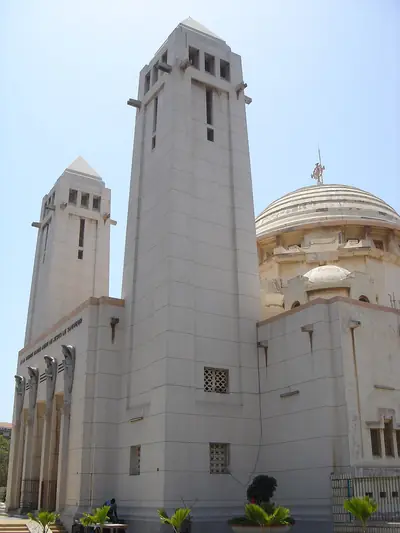
In Dakar’s Plateau district, Our Lady of Victories Cathedral is the city’s largest church and the seat of the Archdiocese of Dakar. It stands on Boulevard de la République, on land that was once an ancient cemetery and was later granted to the church by the government.
Construction began in 1924, and the cathedral was consecrated on 2 February 1936 by Cardinal Jean Verdier, Archbishop of Paris. Its history also connects it to Senegal’s political past: in 2001, it hosted the funeral of Léopold Sédar Senghor, the country’s first president.
IFAN Museum of African Arts
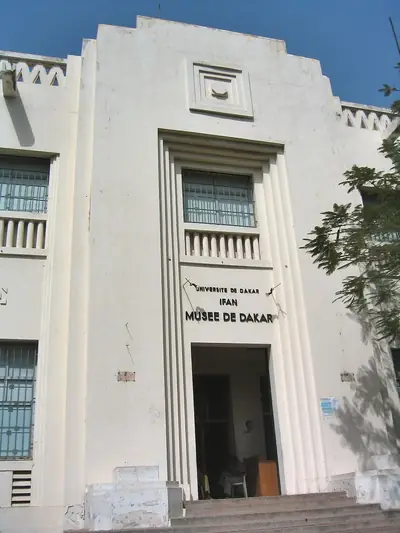
The IFAN Museum of African Arts, at Place Soweto near Senegal’s National Assembly, is one of the oldest art museums in West Africa. It grew out of the IFAN institute, founded in 1936 under France’s Popular Front government.
When the institute moved to Cheikh Anta Diop University in 1960, its former building became a museum. Since receiving the name Théodore Monod African Art Museum in December 2007, it has continued to focus on African culture and regularly hosts the Dakar Biennale, presenting contemporary artists from Africa and the diaspora.
Museum of Black Civilizations
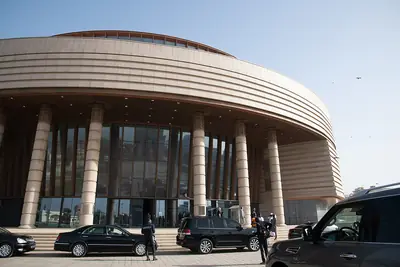
Opened on 6 December 2018, the Museum of Black Civilizations is one of Dakar’s most important modern cultural institutions. Its purpose is to highlight Africa’s contributions to the world’s cultural and scientific heritage.
The building has an ultramodern design, reflecting the innovative spirit of the collections and exhibitions inside. The museum also presents a broad view of African history, including the reminder that ironworking was discovered in Africa more than 2,500 years before Christ.
Galerie Arte
Galerie Arte brings contemporary African art to the centre of Dakar. Founded in 1996 by Joëlle le Bussy, the gallery specialises in original furniture and contemporary African art objects.
Its story extends beyond Dakar: since 2009, Galerie Arte has also operated a branch in Saint-Louis, another historic Senegalese city.
Musée Senghor Fondation
On Dakar’s west corniche, the Musée Senghor Fondation occupies the former residence of Léopold Sédar Senghor. The museum opened on 30 November 2014 in the home of Senegal’s first president.
The setting gives the museum a direct connection to Senghor’s life and to the history of independent Senegal.
African Renaissance Monument
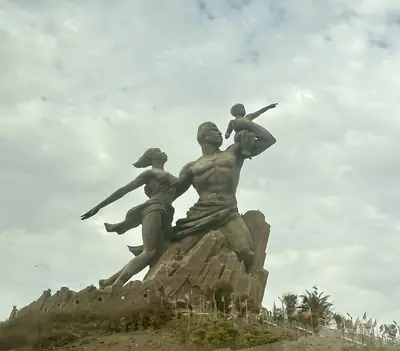
The African Renaissance Monument stands on a hill above Dakar as a towering bronze representation of the continent’s renewal. Site preparation began in 2006, construction started in 2008, and the monument was inaugurated in April 2010 to mark the 50th anniversary of Senegal’s independence from France.
Senegalese architect Pierre Goudiaby Atepa designed the monument from an idea by President Abdoulaye Wade. The North Korean firm Mansudae Overseas Projects built it. The project was controversial: critics questioned its reported cost of around 27 million dollars, some described its style as “Stalinist”, and Muslim leaders objected to its depiction of the human form.
Cap-Vert and Pointe des Almadies
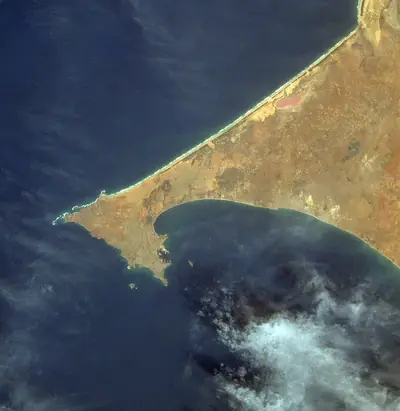
Cap-Vert is the slender peninsula that reaches into the Atlantic and forms the westernmost point of Africa. Its name means “Green Cape” in Portuguese, while its Wolof name is Bopp bu Nëtëx.
The peninsula rises from the volcanic twin cones known as Les Mamelles. A lighthouse there stands about 105 metres high and is considered one of the strongest lights on the African coast. The Portuguese navigator Dinis Dias reached the point in 1445 and named it Cabo Verde. The archipelago now known as Cape Verde later took its name from this cape.
At the north-western end of the peninsula, Pointe des Almadies is a rocky cape where Dakar meets the Atlantic. Its name comes from a local term meaning “bark canoe point”, reflecting the area’s long connection with the sea. The peninsula also acts as a natural breakwater, protecting Dakar’s harbour and Gorée from Atlantic winds and waves.
Dakar Grand Mosque
The Dakar Grand Mosque is one of the city’s most important religious landmarks. It is also included among the narrated stops on Neywo’s Plateau walk, alongside other central sights.
Marché Sandaga
Marché Sandaga is one of Dakar’s best-known markets. The source for the site describes it as a former cinema, adding an unusual detail to the story of this central urban landmark.
Gorée Island
A short boat ride from Dakar’s harbour, Gorée is one of the city’s 19 districts and a UNESCO World Heritage Site. It was among the first twelve places in the world to receive that designation, in 1978.
The island covers 18.2 hectares and is home to around 1,680 people. Its small size contrasts with its historical importance. For centuries, Gorée was connected to the Atlantic slave trade, and the Maison des Esclaves, or Slave House, now serves as a memorial to that history.
Historians debate the exact scale of slave trading on Gorée, but the island remains an internationally recognised place of remembrance. Its quiet streets, colonial buildings, and museums invite visitors to reflect on the layers of history carried by this small island. Fort Estrées, now a museum, also commemorates Gorée’s role in the slave trade.
Dakar’s story
Dakar is the capital and largest city of Senegal, as well as the country’s political and economic centre. The peninsula saw Portuguese presence in the fifteenth century, followed by French control of Gorée from 1677. Dakar replaced Saint-Louis as the capital of French West Africa in 1902, served as the capital of the Mali Federation from 1959 to 1960, and became the capital of independent Senegal in 1960.
The city is also home to institutions including the Institut fondamental d’Afrique noire and the Banque centrale des États de l’Afrique de l’Ouest. Its historic Hôtel de ville stands in the Plateau district.
Explore Dakar with a Self-Guided Audio Tour
A Dakar self-guided walking tour is a practical way to connect the city’s museums, religious buildings, markets, and monuments without joining a group. Neywo’s free audio guide lets you explore at your own pace: each story plays as you reach the place, with no group and no schedule.
The Dakar guide includes two walking tours and one bus route:
- Gorée Island: Memory Across the Water — a 0.73-kilometre walk lasting 30 minutes, with 4 narrated stops.
- Plateau Landmarks: Art, Faith and Memory in Central Dakar — a 4.22-kilometre walk lasting 114 minutes, with 9 narrated stops.
- Line 10: Seafront Landmarks to the Plateau — a 6.4-kilometre bus route lasting 27 minutes, with 4 narrated stops.
The walking tours cover places including Gorée, the Church of Saint Charles Borromee, the Musée de la Mer, the Historical Museum of Senegal, the IFAN Museum of African Arts, Our Lady of Victories Cathedral, Marché Sandaga, the Museum of Black Civilizations, and Dakar Grand Mosque. The bus route links seafront landmarks such as Place du Souvenir africain and the Porte du Troisième millénaire with the Daniel Sorano National Theatre and the Plateau.
Download Neywo and Explore Dakar at Your Own Pace
Download Neywo to explore Dakar with a free audio guide covering 35 narrated places. Choose between two walking tours and one bus route, then let the app tell the story of each place as you reach it. You decide the pace, with no group and no schedule, and narration is available in 11 languages.
Places with an audio guide in Dakar
8 places in Dakar with a Neywo audio guide. Each one starts telling its story as you reach it.
Self-guided tours in Dakar
3 tours in Dakar, free in the Neywo app. Each stop tells its story as you reach it.
- Bus ride
Line 10: Seafront Landmarks to the Plateau
Dakar Dem Dikk line 10 runs between Liberté and the Palais. Ride it past the Place du Souvenir africain and the Porte du Troisième Millénaire on the Atlantic side to the national theatre and the cathedral of Our Lady of Victories in the Plateau. A cheap local ride with a sea view.
Place du Souvenir africain (Dakar) · Porte du Troisième millénaire · Daniel Sorano National Theatre · Our Lady of Victories Cathedral, Dakar
Open this tour: Line 10: Seafront Landmarks to the Plateau - Walk
Gorée Island: Memory Across the Water
A short ferry ride from Dakar lands you on Gorée, a UNESCO World Heritage island that became a symbol of the Atlantic slave trade. Stroll its car-free lanes, past the island church and two museums on the sea and on Senegal's history, in a gentle half-hour loop you can stretch into an afternoon.
Gorée · Church of Saint Charles Borromee (Goree) · Musée de la Mer · Historical Museum of Senegal
Open this tour: Gorée Island: Memory Across the Water - Walk
Plateau Landmarks: Art, Faith and Memory in Central Dakar
Walk through the Plateau and Médina, the old heart of independent Senegal. See one of West Africa's oldest art museums, the great cathedral of Our Lady of Victories, the national theatre and the war memorial of Demba and Dupont, then end at the new Museum of Black Civilizations and the Grand Mosque.
Daniel Sorano National Theatre · IFAN Museum of African Arts · Our Lady of Victories Cathedral, Dakar · Grande Mosquée du Plateau · Marché Sandaga · Place du Tirailleur Sénégalais …
Open this tour: Plateau Landmarks: Art, Faith and Memory in Central Dakar
Walk Dakar with Neywo
Neywo turns Dakar into a self-guided audio tour. Stories arrive as you reach the place they belong to, and the route reshapes when you wander off it.

