Paramaribo, Suriname: Self-Guided Walking Tour
Things to Do in Paramaribo: What to See in Suriname’s Capital
Looking for things to do in Paramaribo? Suriname’s capital brings together Dutch colonial history, religious diversity, contemporary art, museums, and the broad course of the Suriname River. Its historic centre is compact enough to explore on foot, with important sites close together and plenty of stories behind the city’s buildings and public spaces.
Neywo has a free audio guide for Paramaribo with 29 narrated places, available in 11 languages. It is a useful way to understand the city as you walk, rather than simply moving from one landmark to the next.
What to See in Paramaribo
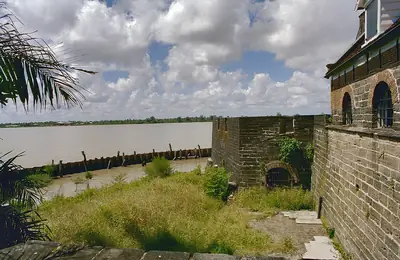
Fort Zeelandia
Fort Zeelandia stands on the left bank of the Suriname River and began as a wooden French fort in 1640. During British rule it was strengthened and called Fort Willoughby; Dutch forces captured it in 1667 and gave it its present name. Today, the site also houses the Surinam Museum.
The fort’s history is not only colonial. During Dési Bouterse’s rule in the 1980s, it was associated with the December Murders of 1982 and used to imprison and torture political prisoners. That difficult past is an essential part of understanding the site.
The Suriname River
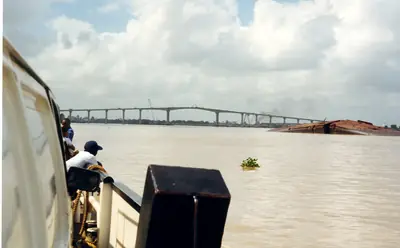
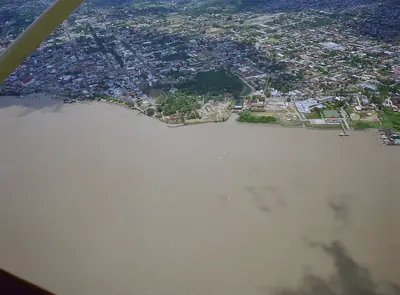
The Suriname River is the waterway that gives the country its name. It stretches for 480 kilometres from the Guiana Highlands towards the Atlantic Ocean, connecting the interior with Paramaribo. Its upper course is known as the Gran Rio, while the Brokopondo Reservoir divides the river into upper and lower sections.
The river also carries traces of modern infrastructure, including the Afobaka Dam and the Jules Wijdenbosch Bridge in Paramaribo. Farther along its course, it meets the Commewijne River near Nieuw-Amsterdam before reaching the Atlantic at Braamspunt.
Paramaribo District
The capital lies within Paramaribo District, the most densely populated part of Suriname. The district’s history reaches back to the seventeenth century, when British colonists established Fort Willoughby. Dutch and British control later alternated until the Treaty of Breda ceded Suriname to the Dutch at the end of the Second Anglo-Dutch War.
Exploring the city therefore means encountering both the capital and the wider administrative area that surrounds it.
Mosque Keizerstraat and Neve Shalom Synagogue
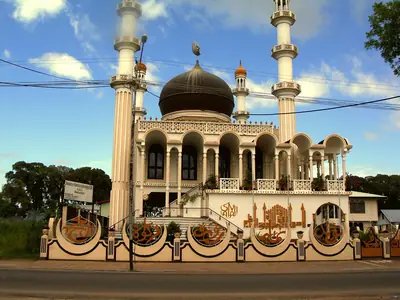
One of Paramaribo’s most distinctive sights is the close presence of Mosque Keizerstraat and Neve Shalom Synagogue. The mosque’s present building was designed by Surinamese architect Nazier Ataoellah and constructed between 1973 and 1984. It replaced an earlier wooden mosque completed in 1932, after Paramaribo’s Muslim community had been established in 1929.
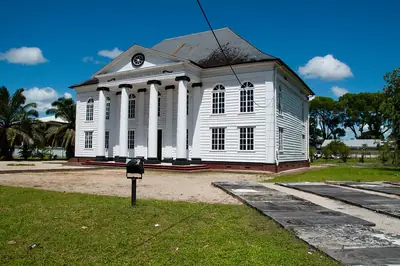
Beside it, Neve Shalom Synagogue contains a small museum dedicated to Jewish life in Suriname. Its sand-covered floor is especially distinctive: it recalls the forty years of wandering in the desert after the Exodus and the sand once used to muffle the sound of secret prayers. The interior includes extensive wooden craftsmanship and Torah scrolls that are hundreds of years old. The site’s history reaches back to the acquisition of the plot by Sephardic Jews in 1716.
Arya Diwaker
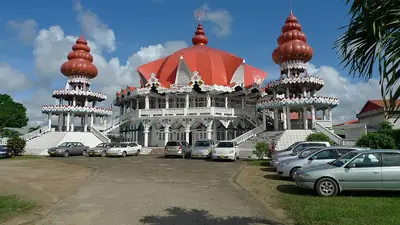
Arya Diwaker, also known as the Arya Dewaker Temple, is Suriname’s largest Hindu temple. The eight-sided, two-storey building was designed by Dutch architect Arthur de Groot. Its tropical features—large eaves, verandas, and divided white windows—combine with Mughal and Al Andalusian influences.
The lower floor contains meeting rooms and a library, while religious ceremonies take place above. Inside, the ritual space is arranged around a central fire, with benches placed around it to express the equality of everyone taking part. Unlike many Hindu temples, Arya Diwaker contains no images of deities because the Arya Samaj movement prohibits the worship of icons.
Reformed Church at Kerkplein
The Centrumkerk, or Reformed Church, is one of the landmarks of Paramaribo’s historic centre. Built in 1810, it has a distinctive octagonal form and no church tower. It belonged to the Dutch Reformed Church of Suriname and served as the state church until independence in 1975.
In that same year, the building was used as the parliament building for the proclamation of independence. The old Oranjetuin cemetery surrounds the church, adding historical depth to Kerkplein, which is both a square and a street.
Grote Stadskerk
The Grote Stadskerk stands on Steenbakkerijstraat and belongs to the Moravian Church. Known in Sranan Tongo as Mamakerki, it is recognized as a monument. Its oldest sections date from 1778, making it one of the historic churches to look out for while walking through central Paramaribo.
Lutheran Church of Paramaribo
At Waterkant, the Maarten Luther Church—also called the Lutheran Church of Paramaribo—is another monument in the historic centre. The present building dates from 1834 and stands on the site of Paramaribo’s first Lutheran church, built in 1747 and destroyed in the great fire of 1832.
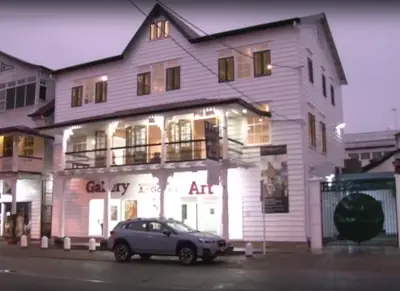
Readytex Art Gallery
Readytex Art Gallery occupies a historic four-storey wooden building on Steenbakkerijstraat. Since 2015, it has presented changing exhibitions of contemporary Surinamese art, from solo displays by local artists to broader survey exhibitions.
Its connected studio produces a wide range of work, including woodcarving, ceramics, paintings, collages, pangi textiles, jewellery, and mixed-media handicrafts. The gallery was founded in 1993 and has since been represented at the National Art Fair and in exhibitions abroad.
Numismatic Museum of the Central Bank of Suriname
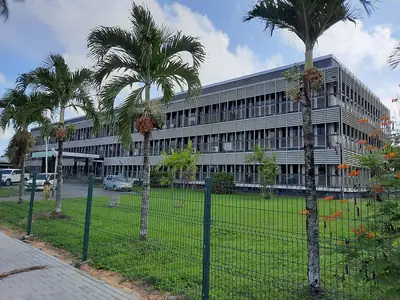
The Numismatic Museum, housed in the Central Bank of Suriname, explores the country’s history through coins, medals, banknotes, and other means of exchange. It opened in 2002, and its collection includes the parrot coin from 1679.
The museum treats money as more than currency, presenting it as a source of cultural, historical, and aesthetic information. Photography is not permitted inside, making it a place to examine the objects directly.
Saamaka Museum Mujee Wosu Dendu
This small museum focuses on Saramaccan heritage. Its name means “traditional home of the Maroon woman” in Saramaccan. Although the museum measures only four by six metres, it presents furniture, household objects, and a reconstructed kitchen with plates, pots, and pans.
Some objects were specially made in the interior following the founder’s instructions, giving the collection a close connection to everyday Saramaccan life.
Anatomical and Embryological Museum
The Anatomical and Embryological Museum is located in the conference room of the Medical Scientific Institute, which also houses the medical faculty of Anton de Kom University of Suriname. Its collection focuses on the human body and its development.
Established in 1976, the museum later closed during Suriname’s economic decline in the 1980s. It reopened on November 18, 2022, with a considerably expanded collection. Its revival helped preserve the preparations held there.
More historic churches
Several other churches add to Paramaribo’s architectural and religious landscape. Bribi Ministries Moedergemeente, opened in May 2010, was the first building owned by Bribi Ministries in the city. Its rectangular façade centres on an entrance marked by a large cross, while the auditorium can accommodate around 1,200 people.
The Sint Alfonsuskerk, also known as the Sint Alfonskerk, is a Roman Catholic church built in 1928 at 65 Verlengde Keizerstraat. Together with the city’s Lutheran, Moravian, Reformed, Hindu, Muslim, and Jewish sites, it reflects Paramaribo’s unusually varied religious heritage.
Explore Paramaribo with a Self-Guided Walking Tour
Neywo’s Paramaribo audio guide includes two self-guided walking tours, with a total of 18 stops across the routes:
- A Fort, a Parrot Coin and Mosque Beside Synagogue: a 2.8-kilometre walk lasting 98 minutes, with 11 narrated stops.
- Wooden Churches, Maroon Heritage and Surinamese Art: a 2.61-kilometre walk lasting 72 minutes, with 7 narrated stops.
The tours include sites such as Fort Zeelandia, the Numismatic Museum, the Reformed Church, Neve Shalom Synagogue, Mosque Keizerstraat, Readytex Art Gallery, Grote Stadskerk, and the Saamaka Museum Mujee Wosu Dendu. The app tells the story of each place as you reach it, at your own pace, with no group and no schedule.
Download Neywo and explore Paramaribo with its free audio guide. After discovering the capital, continue planning your trip with the Suriname destination guide.
Places with an audio guide in Paramaribo
8 places in Paramaribo with a Neywo audio guide. Each one starts telling its story as you reach it.
Self-guided tours in Paramaribo
2 tours in Paramaribo, free in the Neywo app. Each stop tells its story as you reach it.
- Walk
A Fort, a Parrot Coin and Mosque Beside Synagogue
Walk the UNESCO inner city of Paramaribo from the riverside Fort Zeelandia to the Independence Plaza ringed with Caribbean flags. Pass an octagonal Dutch church and two historic synagogues, then end where a mosque and a synagogue share a wall and a sand floor recalls the Exodus.
Fort Zeelandia · Independence Plaza · Numismatisch Museum van de Centrale Bank van Suriname · Helstone Monument · Reformed Church · Tzedek ve-Shalom …
Open this tour: A Fort, a Parrot Coin and Mosque Beside Synagogue - Walk
Wooden Churches, Maroon Heritage and Surinamese Art
A walk through the leafy west of the historic centre, past the Moravian Mamakerki and a four-storey wooden house turned gallery. Visit the tiny Saramaccan museum and squares named for a union leader and for a priest who fought for workers.
Readytex Art Gallery · Grote Stadskerk · De Sivaplein · Sint-Rosakerk · Louis Doedel Square · Saamaka Museum Mujee Wosu Dendu …
Open this tour: Wooden Churches, Maroon Heritage and Surinamese Art
Walk Paramaribo with Neywo
Neywo turns Paramaribo into a self-guided audio tour. Stories arrive as you reach the place they belong to, and the route reshapes when you wander off it.

