Visiting Port of Spain, Trinidad and Tobago: Top Sights on Foot
Things to Do in Port of Spain: Six Places to Discover
Looking for things to do in Port of Spain? Trinidad and Tobago’s capital brings together religious heritage, national history, distinctive architecture, and sporting life. The city is also a useful place to understand the wider character of Trinidad and Tobago, a Caribbean country shaped by Indigenous, Spanish, British, African, Indian, Chinese, and Middle Eastern influences.
Neywo offers a free audio guide for Port of Spain with six narrated places, available in 11 languages. Each story plays as you reach the place, at your own pace.
What to see in Port of Spain
The following landmarks offer a varied introduction to the city, from its national museum to its most distinctive architectural ensemble.
National Museum and Art Gallery
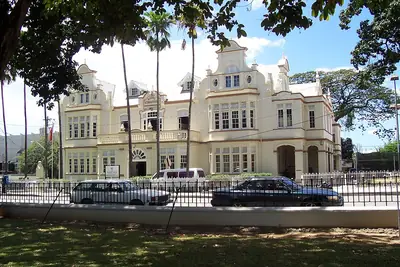
At the top of Frederick Street, opposite Memorial Park and just south of the Queen’s Park Savannah, the National Museum and Art Gallery is one of Trinidad and Tobago’s most important places for exploring the country’s art, history, nature, and geology.
The museum was established in 1892 under the name Royal Victoria Institute, as part of preparations for Queen Victoria’s jubilee. Its permanent collection contains more than ten thousand objects arranged across seven large galleries. The subjects range from art and social history to natural history, economic history, petroleum, and geology.
The building itself is part of the experience. Its Victorian-era colonial architecture reflects the history of the British West Indies and gives the museum a strong sense of place before visitors even enter the galleries.
Cathedral of the Immaculate Conception
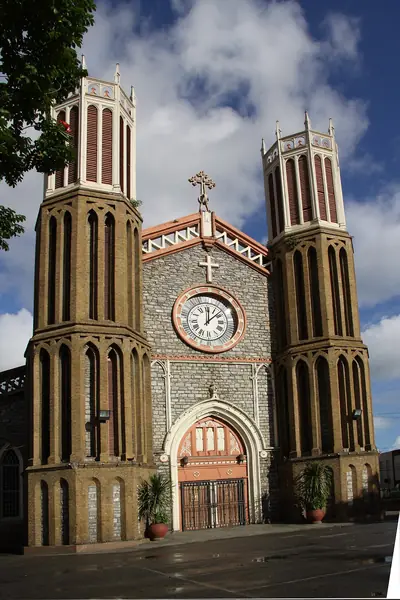
The Cathedral of the Immaculate Conception is a Catholic cathedral and an important religious landmark in Port of Spain. Dedicated to the Immaculate Conception of the Blessed Virgin Mary, it is also the seat of the Archdiocese of Port of Spain.
Construction began in 1816 and was completed in 1851. That same year, the cathedral received the honorary status of a minor basilica, adding to its importance in the religious history of the capital.
The Magnificent Seven Houses
Along Maraval Road, just west of the Queen’s Park Savannah in the St Clair neighborhood, the Magnificent Seven Houses form one of Port of Spain’s most distinctive architectural ensembles. The seven grand buildings were created between 1902 and 1910, and most retain the character of their original designs.
Their styles bring together French Colonial, Scottish baronial, Indian Empire, and Moorish Mediterranean influences, often combined with Caribbean architecture. Individual buildings add their own details: Stollmeyer’s Castle is said to have been modeled on a wing of Balmoral Castle; Hayes Court combines French Colonial design with Scottish cast-iron details and traditional Demerara windows; and White Hall was built from natural white limestone from Barbados.
The group also reflects the changing roles of the buildings. Many began as private residences and remained with the same families for decades, while Archbishop’s House was built as the official residence of the Archbishop of Port of Spain and continues to serve that purpose.
Holy Name Preparatory
Holy Name Preparatory is a primary school with connections to several of Port of Spain’s educational institutions. It was originally associated with Holy Name Convent secondary school and Sacred Heart Boys.
In 1965, Holy Name Preparatory became an independent school. Its history offers a smaller-scale glimpse into the development of education in the city and its relationship with other local institutions.
Hasely Crawford Stadium
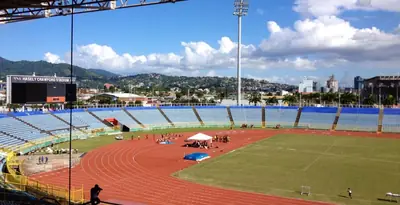
Hasely Crawford Stadium is a major football venue and the largest stadium in Trinidad and Tobago. It is usually home to the national football team as well as several clubs from the capital.
The stadium opened on 12 June 1982, when it was known as the National Stadium. It has space for 27,000 spectators and has hosted major international sporting events, including the final of the 2001 Under-17 World Cup and matches during the 2010 Under-17 World Cup.
Port of Spain in the history of Trinidad and Tobago
Port of Spain is the capital of a country made up of the main islands of Trinidad and Tobago, along with several smaller islets. Trinidad was inhabited by Indigenous peoples for centuries before Spanish colonization began after Christopher Columbus arrived in 1498.
In 1797, the Spanish governor José María Chacón surrendered Trinidad to a British fleet commanded by Sir Ralph Abercromby. Trinidad and Tobago were ceded to Britain in 1802 as separate states, united in 1889, and became independent in 1962. The country became a republic in 1976.
That history is still relevant when exploring the capital. Port of Spain’s cultural identity developed alongside its political changes, while the country’s industrial economy—built around substantial oil and gas reserves—helps distinguish Trinidad and Tobago from Caribbean countries that rely more heavily on tourism.
Explore Port of Spain with Neywo
There are no scheduled tours or group departures: Neywo’s free Port of Spain audio guide includes six narrated places, and the narration is available in 11 languages. The app tells the story of each place as you reach it, at your own pace, with no group and no schedule.
Download Neywo and turn your walk through Port of Spain into a self-guided visit, listening to the history of the landmarks around you when you arrive.
Places with an audio guide in Port of Spain
5 places in Port of Spain with a Neywo audio guide. Each one starts telling its story as you reach it.
Walk Port of Spain with Neywo
Neywo turns Port of Spain into a self-guided audio tour. Stories arrive as you reach the place they belong to, and the route reshapes when you wander off it.

