Bologna, Italy: Self-Guided Walking Tour
Things to Do in Bologna: What to See in Italy’s Historic City
The best things to do in Bologna include exploring Piazza Maggiore, following the city’s famous porticoes, visiting important churches and art museums, and discovering landmarks connected to Bologna’s medieval and university history. Bologna is also known for its distinctive terracotta architecture and lively civic atmosphere. Neywo offers a free Bologna audio guide with 72 narrated places.
What to See in Bologna
Piazza Maggiore and Its Medieval Palaces
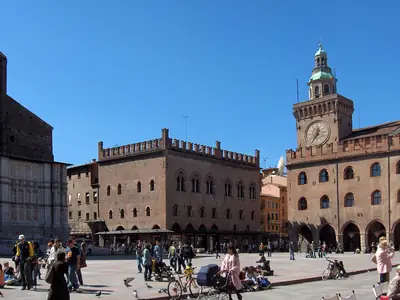
Piazza Maggiore is Bologna’s principal square and the center of its civic, religious, and social life. It measures about 115 meters long and 60 meters wide, and its present form developed from the Middle Ages onward.
The square is surrounded by major historic buildings. The Palazzo del Podestà dates to around 1200 and is topped by the Torre dell’Arengo. Beside it stands Palazzo Re Enzo, built between 1244 and 1246 as an extension of the municipal buildings. The palace takes its name from Enzo of Sardinia, son of Emperor Frederick II, who was captured by Bolognese forces in 1249 and held there until his death in 1272.
On the western side, Palazzo d’Accursio closes the square. The southern side is dominated by the unfinished façade of the Basilica of Saint Petronius.
Palazzo dei Notai
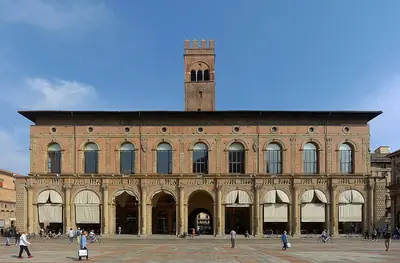
Palazzo dei Notai is another defining building on Piazza Maggiore. The Society of Bolognese Notaries built it in 1381 as its headquarters. The section facing the Basilica of San Petronio belongs to that first phase, while the façade facing Palazzo d’Accursio was redone around 1437 by Bartolomeo Fioravanti.
The rectangular brick palace has a crenellated roofline and awnings at ground level. Inside, 15th-century frescoes preserve part of its history. Its façade also reflects the building’s original purpose, displaying a coat of arms with three inkwells and three quills.
The Basilica of San Domenico
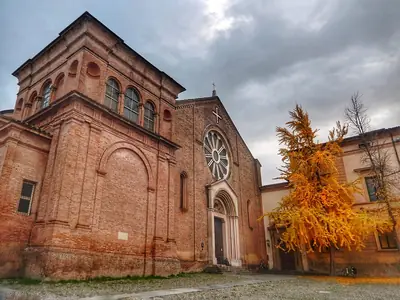
The Basilica of San Domenico preserves the remains of Saint Dominic, founder of the Order of Preachers, who died in 1221 in a cell of the adjoining convent. Its central artistic feature is the Arca di San Domenico, a marble tomb in the chapel on the right, about halfway down the basilica.
Two Bolognese saints, Proculus and Petronius, appear on the Arca holding a model of Bologna. Above it, Guido Reni’s dome painting depicts Saint Dominic in glory with Christ, the Madonna, and saints. The church also contains works by Michelangelo, Pisano, and Filippino Lippi, as well as Giunta Pisano’s 1250 Crucifix in the left transept.
The Porticoes of Bologna
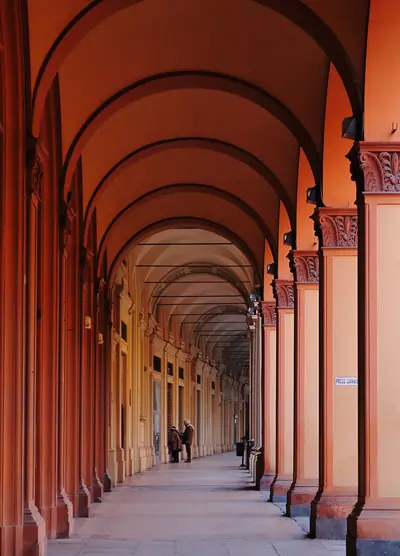
Bologna’s porticoes are among the city’s most characteristic features. These covered galleries shape the ground floors of many central streets and connect churches, squares, palaces, shops, and other parts of the city.
Together, the porticoes extend for nearly 40 kilometers in the historic center and reach about 62 kilometers when those outside the medieval walls are included. In 2021, part of the porticoes was declared a UNESCO World Heritage Site.
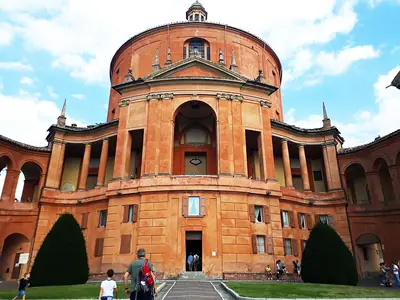
The Portico di San Luca is especially remarkable. It runs for about 3.8 kilometers between the city and the Sanctuary of the Madonna di San Luca, with 666 arches. Built between 1674 and 1793, it includes arches originally sponsored by prominent families, some with icons or small chapels.
Sanctuary of the Madonna di San Luca
The Sanctuary of the Madonna di San Luca stands on the forested hill of Colle della Guardia, southwest of Bologna’s historic center. It is a basilica dedicated to Marian devotion and is closely associated with pilgrimages to venerate the image of the Virgin Mary with the Child, known as “di San Luca.”
The distinctive pink basilica dates from 1732 and took fifty years to construct. Its interior follows the plan of a Greek cross and contains works by Donato Creti, Guido Reni, Vittorio Bigari, Guercino, and Domenico Pestrini. Reaching the sanctuary beneath the long San Luca portico is one of the city’s most memorable walks.
The Two Towers
The Two Towers, known in Italian as the Due torri, are among Bologna’s most recognizable medieval landmarks. Both towers lean: the taller Asinelli Tower and the smaller Garisenda Tower, which leans more noticeably.
The towers are traditionally associated with the Asinelli and Garisenda families and are thought to have been constructed between 1109 and 1119, although the early documentation is limited. Their distinctive forms have inspired writers including Giosuè Carducci, Charles Dickens, and Antal Szerb.
Pinacoteca Nazionale di Bologna
The Pinacoteca Nazionale di Bologna traces the development of painting from the 13th through the 18th century. Its collection offers a broad panorama of Emilian painting while also including important works by artists connected with the city from elsewhere.
Among the highlights are Vitale da Bologna’s Saint George and the Dragon, dated around 1335, and Giotto’s Madonna and Child with Saints. The museum notes that the latter is one of only three panel paintings in the world bearing Giotto’s signature.
Chiesa di San Girolamo alla Certosa
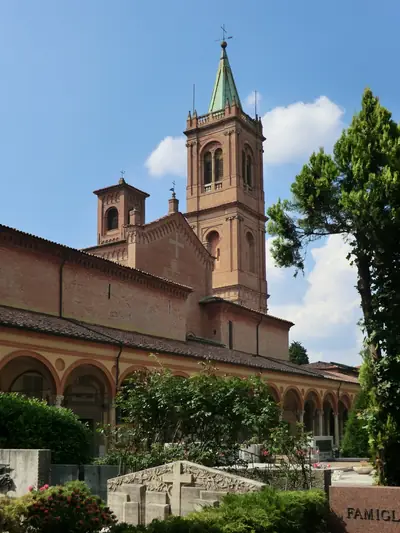
The Chiesa di San Girolamo alla Certosa is connected to the Certosa of San Girolamo di Casara, a Carthusian monastic center founded in Bologna in the 14th century. The complex was adapted as a public cemetery in the early 19th century.
The church retains paintings by Elisabetta Sirani, Canuti, Bibbiena, Bartolomeo Cesi, Antonio and Bartolomeo Vivarini, Ludovico and Agostino Carracci, and Guercino. In 1796, Bonaparte took artworks to Paris; after their return in 1815, they were deposited at the Pinacoteca Nazionale di Bologna.
Other Places to Visit
Bologna’s historic and cultural landscape extends beyond its best-known center. Palazzo Pallavicini is a large 15th-century palace once known as Palazzo Alamandini, extending between Via San Felice, Via del Pratello, and Via de’Coltellini.
Stadio Renato Dall’Ara, inaugurated in 1927, is the home of Bologna FC. Originally called Stadio Littoriale, it was later known as Stadio Comunale before being dedicated to Renato Dall’Ara on June 3, 1984. Its design, particularly the integration of the stands into the architecture, became an influential model for stadiums elsewhere. The stadium hosted matches during the 1934 and 1990 FIFA World Cups.
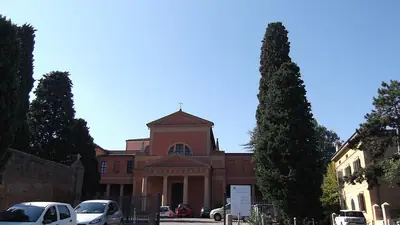
For museum visits, Bologna also offers the Museo Ottocento Bologna, the Museum of Italian Basketball, and the Pinacoteca Nazionale di Bologna. Smaller religious landmarks include Chiesa di San Paolo in Monte, also known as the Chiesa dell’Osservanza, and San Nicolò degli Albari.
Explore Bologna with a Free Audio Guide
Neywo has six walking tours, one bus route, and one bike route in Bologna. Together, they cover routes from 1.14 to 5.76 km and from 20 to 144 minutes, with tours featuring between 3 and 12 narrated stops. The audio guide includes 72 narrated places, and narration is available in 11 languages.
Choose a Bologna self-guided walking tour through Piazza Maggiore and the Pinacoteca, follow the porticoes out to the Certosa, explore Santo Stefano and Strada Maggiore, or discover the university quarter. There is also a bus route across Bologna’s Old Centre and a bike route from the San Luca arch to the Certosa and Porta Galliera.
Download Neywo and explore at your own pace: the app tells the story of each place as you reach it, with no group and no schedule. If you are continuing through the region, you can also discover Emilia-Romagna and nearby cities including Modena, Ferrara, and Ravenna.
Places with an audio guide in Bologna
8 places in Bologna with a Neywo audio guide. Each one starts telling its story as you reach it.
Self-guided tours in Bologna
6 tours in Bologna, free in the Neywo app. Each stop tells its story as you reach it.
- Bike ride
From the San Luca arch to the Certosa and Porta Galliera
Start under the Rococo Arco del Meloncello, where the long portico to San Luca begins, and ride Bologna's cycle lanes past the monumental Certosa cemetery, a UNESCO World Heritage Site just outside the walls, to the Baroque Porta Galliera on the old city's northern edge. Plan a stop for the Certosa's cloisters and their sculpture.
Arco del Meloncello · Portico della Certosa · Porta Galliera
Open this tour: From the San Luca arch to the Certosa and Porta Galliera - Bus ride
Line 19 across Bologna's Old Centre
TPER's regular line 19 runs from Via San Felice through Via Rizzoli and Strada Maggiore. Ride past Palazzo Pallavicini, Palazzo Re Enzo, the Two Towers and the Museo Ottocento like a local, without any hills to climb.
Palazzo Pallavicini · Palazzo Re Enzo · Museo Ottocento Bologna
Open this tour: Line 19 across Bologna's Old Centre - Walk
Santo Stefano and the Strada Maggiore
East of the towers: the seven linked churches of Santo Stefano around their brick courtyard, the sloping medieval square in front, and the music museum and nineteenth-century collection in the palaces along the way.
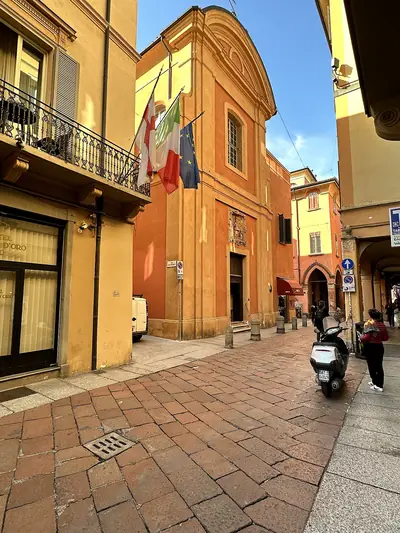
Chiesa di Santa Lucia · Museo di Santo Stefano · Piazza Santo Stefano · Palazzo Bolognini Isolani · Museo Ottocento Bologna · International Museum and Library of Music …
Open this tour: Santo Stefano and the Strada Maggiore - Walk
The university quarter and the Pinacoteca
Europe's oldest university, walked through its collections: zoology, mineralogy, the eighteenth-century observatory, the anatomical wax models, and at the end the national picture gallery with its Carracci and Guido Reni.
Museo di zoologia · Museo della Specola (Bologna) · Museo di Palazzo Poggi · Pinacoteca Nazionale di Bologna · Edificio storico dell'Istituto e Museo di Mineralogia · Porta San Donato …
Open this tour: The university quarter and the Pinacoteca - Walk
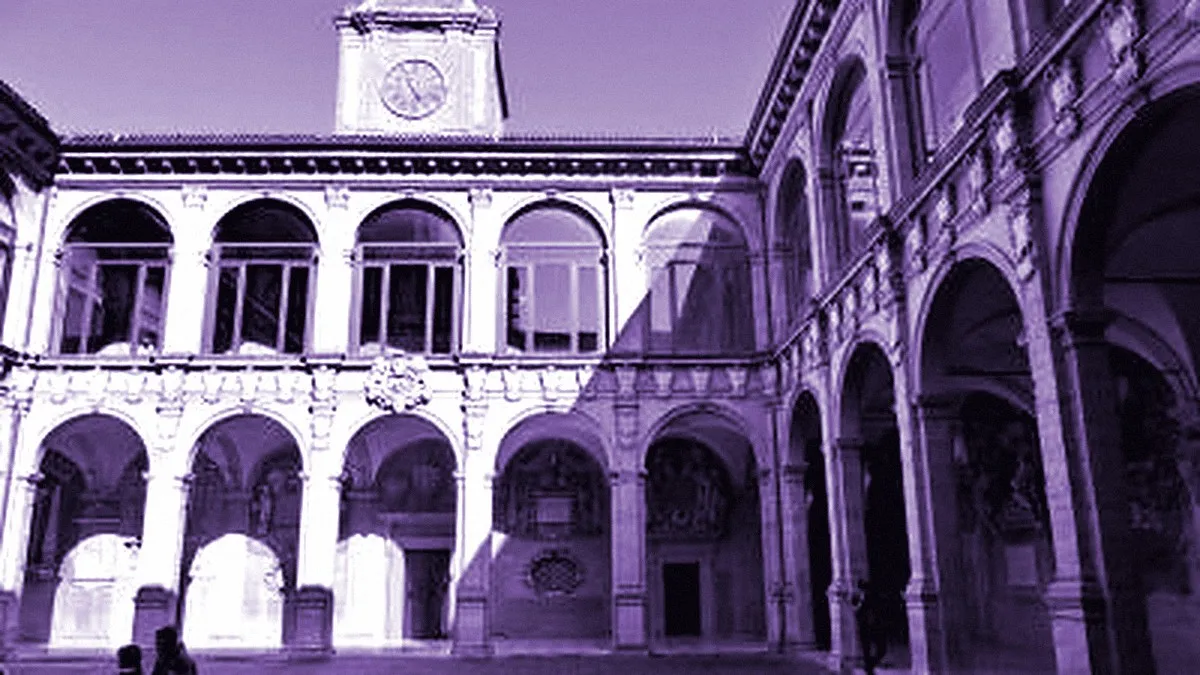
Piazza Maggiore: the Archiginnasio and Neptune
The civic square and the streets behind it — the town hall's art collections, Neptune's fountain, and the Archiginnasio, whose anatomical theatre in carved spruce is the reason to come.
San Paolo Maggiore, Bologna · San Giovanni Battista dei Celestini · Biblioteca comunale dell'Archiginnasio · Archeological Civic Museum of Bologna · Palazzo d'Accursio · Fountain of Neptune, Bologna …
Open this tour: Piazza Maggiore: the Archiginnasio and Neptune - Walk
The Ultimate Bologna: the porticoes, Piazza Maggiore, the Pinacoteca
Four and a half kilometres under the arcades, from the western porticoes through Piazza Maggiore and San Petronio to San Domenico and the national gallery. Rain is not a reason to cancel it here.
Palazzo Pallavicini · Palazzo Re Enzo · Piazza Maggiore · Palazzo dei Notai · San Petronio Basilica · Basilica of San Domenico …
Open this tour: The Ultimate Bologna: the porticoes, Piazza Maggiore, the Pinacoteca
Walk Bologna with Neywo
Neywo turns Bologna into a self-guided audio tour. Stories arrive as you reach the place they belong to, and the route reshapes when you wander off it.

