Things to Do in Melbourne, Australia: Walking Guide
Things to do in Melbourne
Melbourne blends grand Victorian architecture, lively laneways and a multicultural food scene along the Yarra River and Port Phillip Bay. The city’s mix of heritage, creativity and neighbourhood charm makes it a rewarding destination for anyone interested in history, art, sport or simply exploring its streets. Neywo offers a free audio guide for Melbourne with 219 narrated places, letting you hear the story of each site as you walk at your own pace.
Discover Melbourne’s key attractions
National Gallery of Victoria
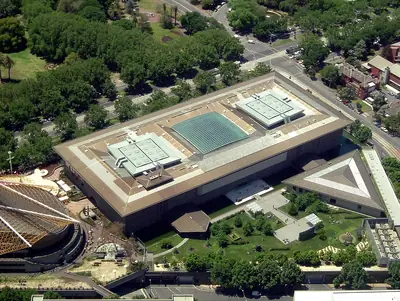
The National Gallery of Victoria (NGV) on St Kilda Road is Australia’s oldest and most visited art museum. Founded in 1861, it now holds more than 76,000 works, the largest collection of any Australian gallery. The building, designed by Sir Roy Grounds and later updated by Mario Bellini, opened in 1968 and reopened after redevelopment in 2003, and is listed on the Victorian Heritage Register.
Labassa
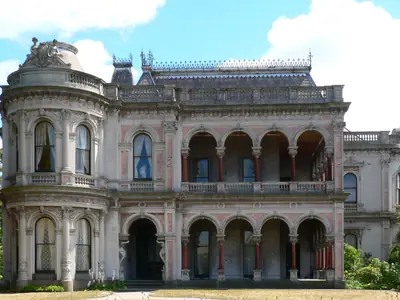
Labassa is a heritage‑listed mansion on Manor Grove that preserves lavish interiors from late‑nineteenth‑century Melbourne. Originally called Ontario, it was expanded in 1890 by architect JAB Koch for businessman Alexander Robertson. Its main rooms retain magnificent decoration despite the building’s later use as flats, and the National Trust of Australia, Victoria acquired it in 1980 to operate as a house museum.
Royal Exhibition Building
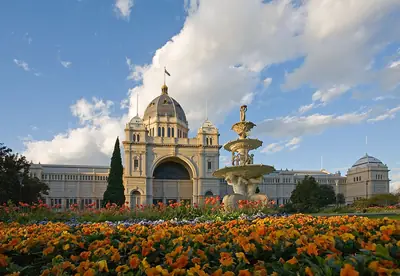
Located in Carlton Gardens, the Royal Exhibition Building is a UNESCO World Heritage‑listed landmark and one of the last major nineteenth‑century exhibition buildings still standing. Constructed between 1879 and 1880 for the Melbourne International Exhibition, it later hosted the Centennial International Exhibition of 1888. The structure stretches 150 metres across a 26‑hectare site, sits at the north‑eastern edge of the CBD beside the Melbourne Museum, and earned Australia’s first UNESCO World Heritage status after restoration in the 1990s.
Immigration Museum
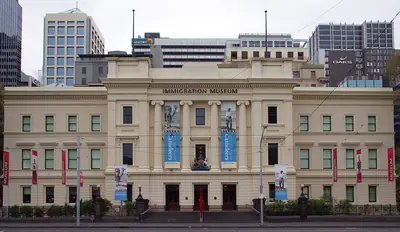
Housed in the restored Customs House on Flinders Street, the Immigration Museum explores how movement has shaped Melbourne and Victoria. Opened in 1998 as part of Museums Victoria, the building itself was added to the Victorian Heritage Register on 8 September 1994 for its historical and architectural importance, linking the museum’s theme with a recognised heritage site.
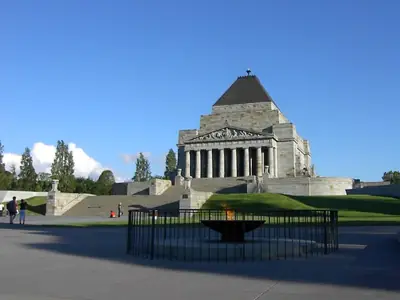
Shrine of Remembrance
The Shrine of Remembrance in Kings Domain on St Kilda Road is one of Australia’s largest war memorials. Conceived after World War I to honour Victorians who served, it now commemorates Australians who have served in any conflict. Designed by veterans Phillip Hudson and James Wardrop, its classical form draws inspiration from the Tomb of Mausolus and the Parthenon, with a ziggurat roof that references the Choragic Monument of Lysicrates. Built from Tynong granite, the sanctuary contains the marble Stone of Remembrance bearing the words “Greater love”.
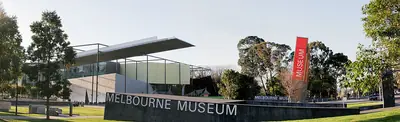
Melbourne Museum
Situated beside the Royal Exhibition Building in Carlton Gardens, Melbourne Museum brings together natural and cultural history. Opened in 2000 under the Government of Victoria and administered by Museums Victoria, the complex includes a café, gift shop and an IMAX theatre whose screen is described as the world’s second largest, showing large‑screen 3‑D films. The museum is part of a broader network that preserves Australasian records over nearly two centuries and was named Best Tourist Attraction at the Australian Tourism Awards in 2011.
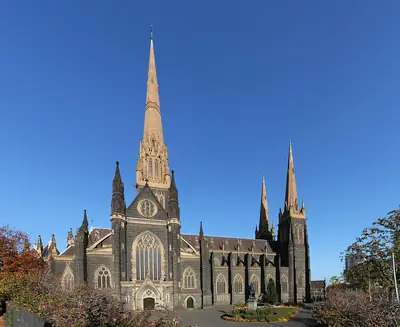
St Patrick’s Cathedral
St Patrick’s Cathedral in East Melbourne is the seat of the Roman Catholic Archdiocese of Melbourne. Designed by William Wardell, its Latin‑cross plan features a central nave, side aisles, transepts, sacristies and a sanctuary with seven chapels. The altar’s eastern placement symbolises belief in the resurrection of Christ. The cathedral was added to the Victorian Heritage Register in 1999, celebrated its centenary in 1997, was made a minor basilica in 1974 and received a visit from Pope John Paul II in 1986.
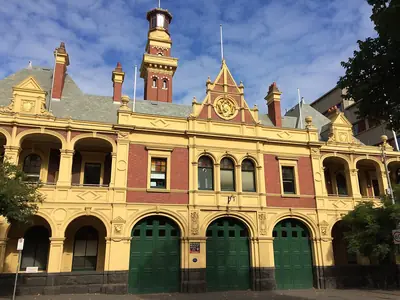
Eastern Hill Fire Station
The former central fire station at the corner of Victoria Parade and Gisborne Street now houses the Fire Services Museum of Victoria. Built in the Australian Queen Anne style, construction began in 1891 and the station opened on 3 November 1893 as headquarters of the Metropolitan Fire Brigade. It originally included living quarters, stables, workshops and a constantly staffed watchtower; firefighters resided there until the 1970s, after which the building was refurbished and reopened alongside a new station in 1979.
Belgrave (Puffing Billy) railway station
Belgrave station is the inner terminal of the Puffing Billy heritage steam railway, marking the start of a journey on one of Victoria’s best‑known historic lines. The present station occupies a site near where the original narrow‑gauge line began, continuing to Selby station. It has a single platform and provides service on the Gembrook railway line, with nearby Selby and Belgrave suburban stations.
Carlton Gardens
Carlton Gardens is a 26‑hectare park on the north‑eastern edge of Melbourne’s CBD. Its sweeping lawns, tree‑lined avenues, ornamental lakes, fountains and award‑winning playground are laid out in a Victorian landscape design that mixes European and Australian plants. A grand allée of plane trees leads toward the fountains and the Royal Exhibition Building, while two smaller lakes provide a quieter southern section. The gardens share UNESCO World Heritage status with the Royal Exhibition Building.
Federation Square
Often called Fed Square, this 3.2‑hectare space at the edge of the CBD brings together arts, culture, public events, cafés and bars in a lively urban setting. Built above busy railway lines directly opposite Flinders Street Station, its broad paved square and glass‑walled atrium make it a natural meeting point between the city’s transport network and its cultural life.
Docklands Stadium
Also known as Marvel Stadium, Docklands Stadium is a major multi‑purpose venue in Melbourne’s Docklands precinct. Best known as the home ground of several Australian Football League teams, its retractable roof and reconfigurable ground‑level seating allow the playing surface to shift from an oval for football and cricket to a rectangle for other sports. At full capacity it holds 56,347 spectators, dropping to 47,000 in cricket or rectangular mode. Opened in 2000 after a A$460 million construction cost, the stadium’s precinct offices serve as the AFL’s headquarters, which has had exclusive ownership since October 2016.
Australian Centre for Contemporary Art
Located in Southbank’s Arts Precinct, the Australian Centre for Contemporary Art (also known as the Ngargee Centre) focuses on contemporary art. Designed by Wood Marsh Architects and completed in 2002, the building stands on Sturt Street and forms part of the Melbourne Arts Precinct.
ANZ Banking Museum
The ANZ Banking Museum offers a concentrated look at the history of banking in Melbourne. Situated in the city, it explores the world of finance through exhibits dedicated to Melbourne’s banking heritage.
Australian National Aviation Museum
At Moorabbin Airport, the Australian National Aviation Museum (also called the Moorabbin Air Museum) preserves a substantial collection of aircraft. Originating in 1962 as the Australian Aircraft Restoration Group with the goal of saving a World War II Bristol Beaufighter, it has grown to include nearly sixty aircraft and twenty‑five engines, telling the story of aircraft restoration in Australia.
Explore Melbourne with Neywo
Neywo’s free audio guide covers 219 narrated places across Melbourne. The guide includes five walking tours and one bike route, each designed to play automatically as you reach a site, so you can explore at your own pace without a group or a fixed schedule. Narration is available in 11 languages.
The walking tours vary in length and focus:
- “Fed Square to Collins Street: Melbourne’s Civic Heart” – 1.19 km, about 80 minutes, 12 stops.
- “Bluestone and Bars: Gaol, Library and Market” – 3.79 km, about 114 minutes, 12 stops.
- “Carlton Gardens and Little Italy” – 3.53 km, about 109 minutes, 10 stops.
- “Arts Precinct and the Shrine” – 3.85 km, about 111 minutes, 10 stops.
- “Parliament Hill: East End Theatres, a Cathedral and Cook’s Cottage” – 2.3 km, about 94 minutes, 11 stops.
The bike route is:
- “Yarra River Trail: Polly Woodside to Olympic Park” – 3.7 km, about 18 minutes, 6 stops.
Each stop features a short audio story that explains the place’s significance, letting you absorb Melbourne’s history, culture and atmosphere while you move freely through the city.
Download Neywo and start your journey
Ready to see Melbourne through the eyes of a local? Download the Neywo app, choose one of the walks or the bike ride, and let the audio guide narrate each landmark as you arrive. With no tickets, no groups and no timetables, you decide where to linger and what to discover next. Experience the city’s galleries, memorials, parks and sporting venues at your own rhythm, all with the support of a free, multilingual audio companion.
Places with an audio guide in Melbourne
8 places in Melbourne with a Neywo audio guide. Each one starts telling its story as you reach it.
Self-guided tours in Melbourne
6 tours in Melbourne, free in the Neywo app. Each stop tells its story as you reach it.
- Bike ride
Yarra River Trail: Polly Woodside to Olympic Park
Follow the Yarra along the city's best cycle path, from the tall ship Polly Woodside past Crown, Queensbridge Square and Federation Square to the Olympic Pylon and the Morell Bridge on the edge of Birrarung Marr.
Polly Woodside · Crown Melbourne · Queensbridge Square · Federation Square · Olympic Pylon · Morell Bridge
Open this tour: Yarra River Trail: Polly Woodside to Olympic Park - Walk
Fed Square to Collins Street: Melbourne's Civic Heart
Start on the glass-and-zinc plaza across from Flinders Street station, take in the screen museum and Indigenous galleries beside it, then follow Swanston and Collins streets past a Gothic Revival cathedral, a plaza reborn by the Metro Tunnel, and the churches and theatres of the city's grandest boulevard, ending under a New York-style skyscraper.
Federation Square · ACMI · Ian Potter Centre · Koorie Heritage Trust · St Paul's Cathedral · City Square …
Open this tour: Fed Square to Collins Street: Melbourne's Civic Heart - Walk
Bluestone and Bars: Gaol, Library and Market
Walk through the north-west of the grid, where the city's oldest buildings survive. Chinatown's dragon museum, the world's first free libraries, Ned Kelly's last prison, a shot tower under a glass cone and Victoria's oldest Catholic church lead to the Southern Hemisphere's biggest open-air market, Melbourne's oldest park and its oldest church.
Museum of Chinese Australian History · Wesley Church, Melbourne · State Library Victoria · Architectural Fragment · Old Melbourne Gaol · Shot Tower Museum …
Open this tour: Bluestone and Bars: Gaol, Library and Market - Walk
Carlton Gardens and Little Italy
A UNESCO World Heritage palace of 1880 sits in Victorian gardens beside Melbourne's modern museum. Walk north into Carlton, where a courthouse, a tiny theatre and polychrome brick churches tell the story of the bohemian, migrant suburb, then on to the University of Melbourne and its art museum.
Royal Exhibition Building and Carlton Gardens · Royal Exhibition Building · Melbourne Museum · Our Lady of the Sacred Heart church · Carlton Court House · La Mama Theatre …
Open this tour: Carlton Gardens and Little Italy - Walk
Arts Precinct and the Shrine
Stroll St Kilda Road from the Shrine of Remembrance to the National Gallery of Victoria, then on through the Arts Centre, its spire-topped theatres, music vault and sculpture to the concert halls and contemporary galleries of Southbank and the Eureka Tower.
Shrine of Remembrance · National Gallery of Victoria · Arts Centre Melbourne · State Theatre · Australian Music Vault · Australian Performing Arts Collection …
Open this tour: Arts Precinct and the Shrine - Walk
Parliament Hill: East End Theatres, a Cathedral and Cook's Cottage
Climb the east end of Collins Street, where Melbourne's oldest theatres still raise their curtains. Pass the sculpture that remembers the women's suffrage petition and Parliament's quiet churches, then St Patrick's Cathedral, and finish in Fitzroy Gardens at a Yorkshire cottage that crossed the world.
Her Majesty's Theatre · Comedy Theatre · Princess Theatre · Great Petition · Federal Oak · East Melbourne Lutheran church …
Open this tour: Parliament Hill: East End Theatres, a Cathedral and Cook's Cottage
Walk Melbourne with Neywo
Neywo turns Melbourne into a self-guided audio tour. Stories arrive as you reach the place they belong to, and the route reshapes when you wander off it.

