Addis Ababa, Ethiopia: Self-Guided Walking Tour
Things to Do in Addis Ababa: A Self-Guided Tour of Ethiopia’s Capital
Looking for things to do in Addis Ababa? Ethiopia’s highland capital brings together imperial history, Orthodox and Catholic religious heritage, memorials, museums, theatres, and lively urban squares. It is also a city where Ethiopia’s modern political and cultural life meets the legacy of its emperors.
Neywo has a free audio guide for Addis Ababa with 12 narrated places. As you explore, the app tells the story of each site when you reach it, at your own pace.
What to See in Addis Ababa
National Museum of Ethiopia
The National Museum of Ethiopia brings the country’s historical, cultural, and archaeological heritage together under one roof. Its most famous exhibits are in the basement, where the archaeology and paleoanthropology collection includes Lucy’s skeleton model and remains of other early human ancestors, including Selam.
The museum extends across four levels. Its collections also cover antiquity and the Middle Ages, imperial insignia and personal objects connected with former rulers such as Emperor Haile Selassie, Ethiopian art, traditional weapons, jewellery, clothing, utensils, and musical instruments. A highlight of the art collection is African Heritage by Afewerk Tekle.
St. George’s Cathedral
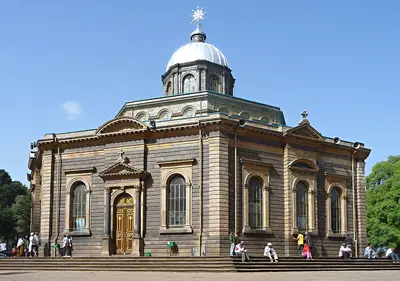
At the northern end of Churchill Road, St. George’s Cathedral is one of Addis Ababa’s most distinctive landmarks. Its octagonal form is traditional for Ethiopian Orthodox churches, while its architectural interpretation is European.
Emperor Menelik II commissioned the cathedral in 1896 to commemorate Ethiopia’s victory over Italian forces at the Battle of Adwa. Italian soldiers captured after the battle built the church, designed by Sebastian Castagna. Dedicated to Saint George, Ethiopia’s patron saint, it later became associated with major moments in the country’s history, including the coronations of Empress Zewditu in 1917 and Emperor Haile Selassie in 1930. Selassie’s coronation also made the cathedral a pilgrimage site for Rastafarians from around the world.
The Nativity of the Blessed Virgin Mary
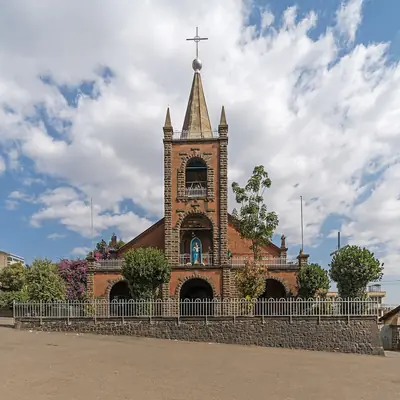
The Cathedral of the Nativity of the Blessed Virgin Mary is the principal Catholic church of the Ethiopian rite in Addis Ababa. Located in the heart of the city, it serves as the seat of the Archeparchy of Addis Ababa and the central place of worship for the Ethiopian Catholic community.
Menelik II Monument
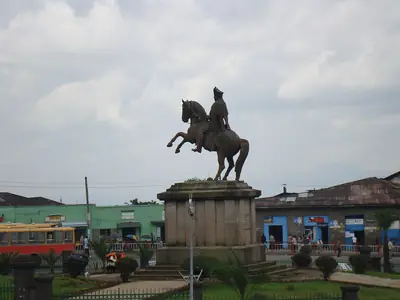
In the centre of Menelik II Square, also known as Adwa Square, a bronze equestrian statue depicts Emperor Menelik II. The monument shows the Neguse Negest, or King of Kings, on horseback and dominates the open space around it.
The square connects the city’s imperial history with the memory of the Battle of Adwa, the victory that St. George’s Cathedral was built to commemorate.
Hager Fikir Theatre
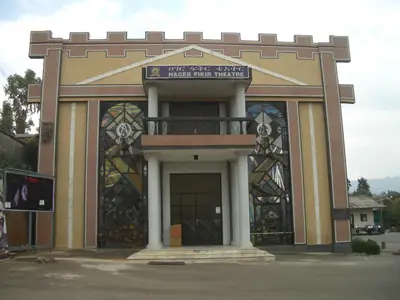
Hager Fikir Theatre is the oldest indigenous theatre in Africa. Founded in 1935, it began as a patriotic association whose name means “Love of Country”. Its earliest performances took place outdoors on Menelik Square rather than in a permanent building.
The theatre survived the Italian occupation, although its productions were restricted during that period. In 1942, it moved into a former Italian nightclub converted into a theatre hall. The complex later gained a larger auditorium and was expanded again in 1955 for Emperor Haile Selassie’s twenty-fifth coronation anniversary. Under Haile Selassie, it became Ethiopia’s national theatre, with radio broadcasts and touring performances reaching audiences beyond Addis Ababa.
St. Gevorg Church
St. Gevorg Church is an Armenian Apostolic church in the historic Piazza district. Consecrated in 1935, it was built for the Armenian community that had settled in Addis Ababa.
Its presence adds another layer to the city’s religious and cultural diversity, alongside Ethiopian Orthodox and Catholic landmarks.
Adwa 00KM Museum
The Adwa 00KM Museum in Piazza commemorates the Battle of Adwa of 1896, when Ethiopian forces defeated the Italian army during the First Italo-Ethiopian War. The victory became a powerful symbol of African resistance to colonial expansion.
The museum’s architecture is part of the experience. An integrated bridge links it with the Mayor’s Office, while four entrance gates feature motifs inspired by war and victory. Inside, artistic designs cover the walls. The complex extends across one and a half hectares, with eleven blocks and five floors.
Yekatit 12 Square
Yekatit 12 Square is a major crossroads marked by a monument to the victims of the Graziani massacre. The memorial recalls the brutal pogrom carried out by Italian occupation forces in February 1937, after an assassination attempt on the Italian viceroy, Rodolfo Graziani.
The square takes its name from the Ethiopian-calendar date on which the violence began. It is also known locally as Siddist Kilo, or Six Kilometers. The roundabout connects Russia Street, Weatheral Street, King George VI Street, and Entoto Avenue, which climbs towards the Entoto Mountains.
Miyazya 27 Square
Miyazya 27 Square, commonly called Arat Kilo, is another historic crossroads where four major avenues meet. Its name refers to the 27th of Miyazya, a date corresponding to May 5. The date marks both the fall of Addis Ababa to Italian forces in 1936 and Emperor Haile Selassie’s return to the liberated city five years later.
The monument at the centre of the roundabout was first erected for the Emperor’s coronation in 1930. After being dismantled during the occupation, it was rebuilt as a symbol of Ethiopia’s victory. The Ministry of Education stands on the eastern side, while Addis Ababa University’s Computer Science department and the Archaeology Museum occupy the western side. Holy Trinity Cathedral and the Imperial Palace are nearby.
Holy Trinity Cathedral
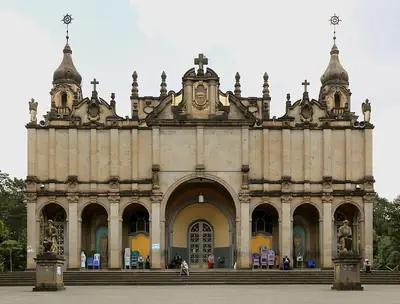
Holy Trinity Cathedral, known locally as Kidist Selassie, is the highest-ranking Ethiopian Orthodox Tewahedo cathedral in Addis Ababa and the country’s second most important place of worship after the Church of Our Lady Mary of Zion in Axum.
Construction began in 1928 under Empress Zauditu, on the site of an older round monastery church founded by Emperor Menelik II. The building was expanded into a cathedral in 1931 under Emperor Haile Selassie, but work was interrupted by the Italian invasion. It was completed in 1942 as a monument to Ethiopia’s victory over the occupation.
The exterior follows a European design, while the interior is richly decorated in traditional Ethiopian style. Murals, carvings, mosaics, and stained-glass windows depict saints and apostles.
Imperial Palace
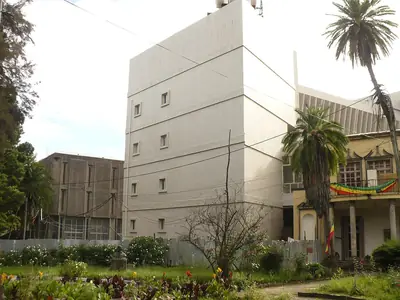
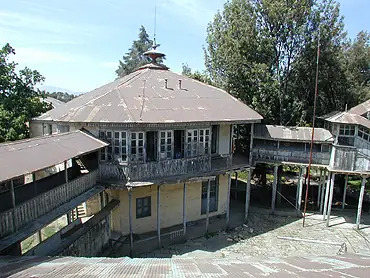
The Imperial Palace has been at the centre of Ethiopian power for more than a century. Known over time as the Gebbi, Menelik Palace, and the Great Ghebbi, it served as the seat of Ethiopia’s emperors from Menelik II until 1974.
The compound is a small city within the city, containing residences, halls, chapels, and administrative buildings, many connected with the Ethiopian Orthodox Church. After the monarchy ended in 1974, the site became the official workplace and residence of Ethiopia’s Prime Minister. The palace grounds are now known as Unity Park.
Addis Ababa itself
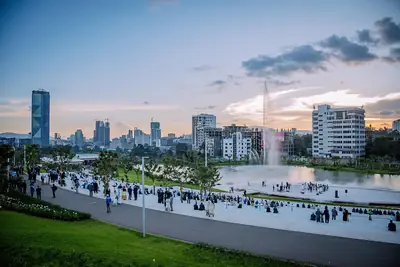
The city’s name is commonly translated as “new flower” in Amharic, while Finfinnee is the Oromo name associated with its hot mineral springs. Addis Ababa became the empire’s capital in 1889, after Menelik II descended from Mount Entoto to the warmer springs below. Nobles and merchants gathered around the settlement, which grew into a permanent city.
Today, Addis Ababa is Ethiopia’s largest city and a major political centre. It has been home to the African Union headquarters since 1963 and to the United Nations Economic Commission for Africa. Its streets and buildings reflect successive periods of imperial rule, Italian occupation, and post-war urban development.
Explore Addis Ababa with Neywo
Neywo’s Addis Ababa audio guide includes 2 walking tours, 1 bus route, and 1 bike route, covering 12 narrated places in total. The walks are:
- Piazza and Menelik’s Capital — 2.16 km, 64 minutes, 6 stops.
- Squares of Memory: Lucy, Lions and the Last Emperor — 3.99 km, 85 minutes, 5 stops.
There is also the Anbessa AB017 bus line from Piazza to Siddist Kilo and up to Entoto, covering 2.9 km in 12 minutes with 5 stops, and the Arat Kilo to Piazza bike route on the cycle lane, covering 1.3 km in 6 minutes with 3 stops.
Download Neywo and explore Addis Ababa with a free audio guide. The app tells the story of each place as you reach it, at your own pace, with no group and no schedule. Narration is available in 11 languages.
Places with an audio guide in Addis Ababa
8 places in Addis Ababa with a Neywo audio guide. Each one starts telling its story as you reach it.
Self-guided tours in Addis Ababa
4 tours in Addis Ababa, free in the Neywo app. Each stop tells its story as you reach it.
- Bike ride
Arat Kilo to Piazza on the cycle lane
A short ride on the city's cycle lane from the Miyazya 27 roundabout at Arat Kilo west to St Gevorg Church and the Hager Fikir Theatre in the heart of the Piazza.
Miyazya 27 adebabay · St. Gevorg church · Hager Fikir Theatre
Open this tour: Arat Kilo to Piazza on the cycle lane - Bus ride
Anbessa AB017: Piazza to Siddist Kilo and up to Entoto
Ride the city's own red-and-yellow Anbessa bus from Raguel Church through the Piazza, past Menelik Square and the Armenian church, then on to the National Museum and Yekatit 12 Square on the way up towards Entoto. A cheap local ride past the capital's main sights.
Addis Ababa · Menelik II monument · St. Gevorg church · National Museum of Ethiopia · Yekatit 12 square
Open this tour: Anbessa AB017: Piazza to Siddist Kilo and up to Entoto - Walk
Piazza and Menelik's Capital
Walk the old heart of Addis Ababa, the Piazza district that grew around Emperor Menelik's new flower. See the octagonal cathedral built by captured Italian soldiers, the bronze king on horseback, Africa's oldest indigenous theatre and the Armenian church of a merchant who paid for it all.
The Nativity of the Blessed Virgin Mary · St. George's Cathedral · Addis Ababa · Menelik II monument · Hager Fikir Theatre · St. Gevorg church
Open this tour: Piazza and Menelik's Capital - Walk
Squares of Memory: Lucy, Lions and the Last Emperor
Follow the capital's political and memorial axis. Meet Lucy at the National Museum, stand at the Yekatit 12 and Miyazya 27 squares that mark the Italian occupation and liberation, visit Haile Selassie's tomb in Holy Trinity Cathedral, and finish at the hill of the Imperial Palace.
National Museum of Ethiopia · Yekatit 12 square · Miyazya 27 adebabay · Holy Trinity Cathedral · Imperial Palace, Addis Ababa
Open this tour: Squares of Memory: Lucy, Lions and the Last Emperor
Walk Addis Ababa with Neywo
Neywo turns Addis Ababa into a self-guided audio tour. Stories arrive as you reach the place they belong to, and the route reshapes when you wander off it.

