Visiting Sandoy, Faroe Islands: Top Sights on Foot
Things to Do in Sandoy: Five Historic Churches to See
Looking for things to do in Sandoy? The island’s villages are home to distinctive Faroese churches, each with its own architecture, craftsmanship and links to local seafaring traditions. From the wooden church in Sandur to the whitewashed stone church in Húsavík, these places offer a close look at Sandoy’s religious and cultural heritage.
Neywo has a free audio guide for Sandoy with five narrated places. Each story is available in 11 languages and plays as you reach the place, at your own pace.
What to See in Sandoy
The churches are spread across Sandoy’s villages, making them a useful way to discover different parts of the island. Their materials and details vary considerably: some are built from timber, others from stone, and several preserve model boats or older objects connected with Faroese life.
Dals kirkja in Dalur
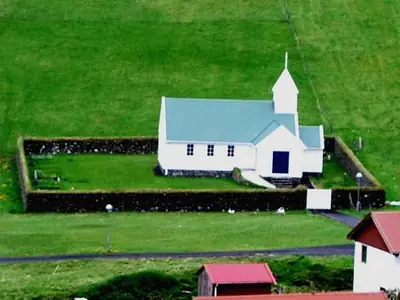
Dals kirkja stands in Dalur, with white-painted wooden walls and a green metal roof. Consecrated on 20 October 1957, it belongs to the Church of the Faroe Islands and was the first church built for the village.
The church was developed through a strong local effort. Residents began planning a churchyard in the early 1950s, and local workers built the foundations and steps before construction of the timber structure began in June 1956. The building is made of wood on a foundation of split stone and has a small roof turret with a pyramid-shaped spire, white roof and cross.
Its bell was cast by De Smithske Støberier in Aalborg. It weighs 170 kilograms and measures 64.5 centimetres across. Dals kirkja was restored in 2007 and made accessible to people with disabilities.
Húsavíkar kirkja in Húsavík
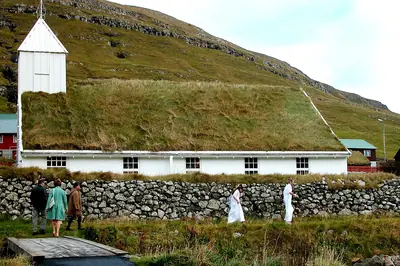
Húsavíkar kirkja is a whitewashed stone church topped with a grass roof. Built in 1863 and consecrated on 13 September of that year, it has a distinctive white wooden roof turret above its western end.
Inside, the white walls rise to an unpainted roof structure, and a half-hipped vault gives the interior its shape. The church has four windows on each side and seating for around 200 people. Its details reflect both religious and maritime traditions: a tin baptismal dish from Copenhagen, dated 1735, stands in a lacquered font, while a Faroese boat hangs from the roof as the church ship.
The church bell was cast in 1954 by De Smithske Støberier in Aalborg. It weighs 85 kilograms and carries the inscription “Soli Deo Gloria”, meaning “Glory to God alone”.
Sands kirkja in Sandur
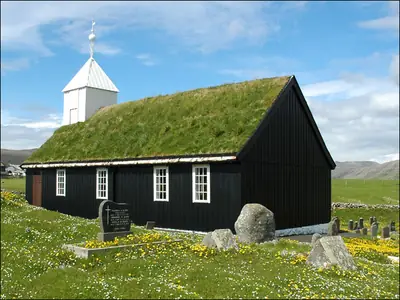
In Sandur, Sands kirkja is a traditional wooden church dating from 1839. Its timber walls are covered with boards and black tar, while the grass roof rests over birch bark. Inside, the wood is unpainted, and the church has a distinctive chancel screen made with turned balusters.
The church’s history reaches much further back than the present building. During restoration in 1969, workers found remains of five earlier churches built one above another. The oldest was a stave church, probably made in Norway and later transported to the Faroe Islands, perhaps between 1000 and 1100.
Sands kirkja was partly destroyed by an intentionally caused fire in 1988. The damaged section was rebuilt, and restoration was completed in time for the church’s 150th anniversary in 1989. Inside, the altarpiece is a painting of the Last Supper after Leonardo da Vinci, and two model ships hang beneath the roof.
Skálavík Church
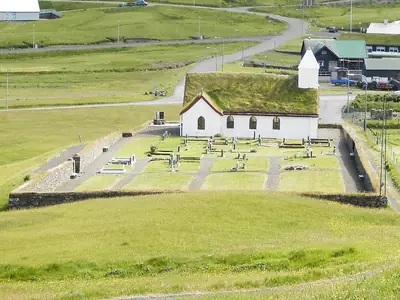
Skálavík Church, or Skálavíkar kirkja, stands on Lógvheyggi in the village of Skálavík. The stone building is plastered on the outside and covered by a grass roof. A small bell turret rises above the western end, topped with a white pyramidal roof.
The church was expanded in 1960 and rededicated the following year, then renovated with a new interior finish in 1979. There are about 200 seats inside. The altar painting of the Last Supper is believed to be the oldest altar painting still in use.
Several smaller details make the church especially interesting. The baptismal font stands on a three-legged column with a brass basin, and the door lock was handmade. A crucifix was later added to the outside of the lock: when the key is not in place, the figure hides the keyhole.
Skopunar kirkja in Skopun
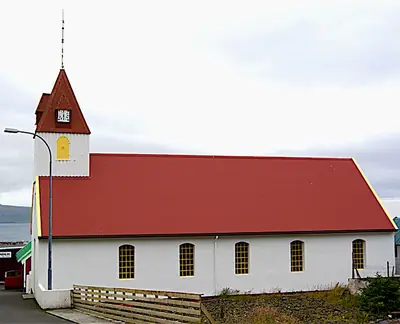
Skopunar kirkja gives Skopun a particularly colourful landmark. Its concrete walls are topped by a bright red corrugated-iron roof, while yellow details appear around the entrance doors, shutters and bargeboards. Small red-framed windows line the building.
The church was inaugurated on 17 October 1897, enlarged in 1960 and rededicated on 25 June 1961. At the western end, a roof tower rises to a pyramid-shaped spire, and clock faces appear on three sides of the roof tower.
The interior has whitewashed walls beneath a blue barrel-vaulted ceiling. The altarpiece is a copy of Carl Bloch’s Jesus with Martha and Mary. Two church ships hang inside: one is a Faroese boat, and the other is a model of the sloop Golden Harp.
Explore Sandoy with Neywo
There are no scheduled group walks or fixed tour times to follow. Instead, Neywo’s free Sandoy audio guide lets you explore independently, with five narrated places across the island.
The app tells the story of each place as you reach it, at your own pace, with no group and no schedule. Download Neywo and discover Sandoy’s village churches while walking through the island. You can also continue exploring the Faroe Islands or visit Tórshavn.
Places with an audio guide in Sandoy
5 places in Sandoy with a Neywo audio guide. Each one starts telling its story as you reach it.
Walk Sandoy with Neywo
Neywo turns Sandoy into a self-guided audio tour. Stories arrive as you reach the place they belong to, and the route reshapes when you wander off it.

