Things to Do in Tórshavn, Faroe Islands: Walking Guide
Things to Do in Tórshavn: What to See in the Faroese Capital
Looking for things to do in Tórshavn? The compact capital of the Faroe Islands brings together Viking-age history, government, art, sport and distinctive Faroese architecture. Its harbour, historic peninsula and cultural landmarks make Tórshavn a rewarding place to explore on foot. Neywo has a free audio guide for Tórshavn with 10 narrated places, available in 11 languages.
What to See in Tórshavn
Skansin
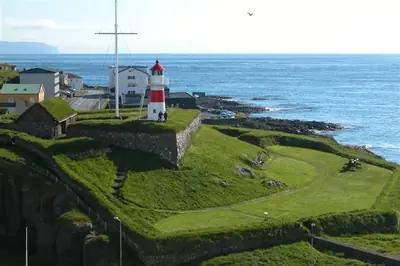
Skansin is a historic fortress on a hill beside Tórshavn’s port. Magnus Heinason built it in 1580 to protect the town from pirate and slave raids. The fort was expanded in 1780 and rebuilt several times afterwards.
Its history also includes the British occupation of the Faroe Islands during the Second World War, when Skansin served as a military base. Two 5.5-inch guns from that period remain alongside four older Danish cannons dating from 1776 to 1813. The Skansin Lighthouse rises above the fort, while the hill provides views across the harbour, the surrounding landscape and the island of Nólsoy.
Tinganes
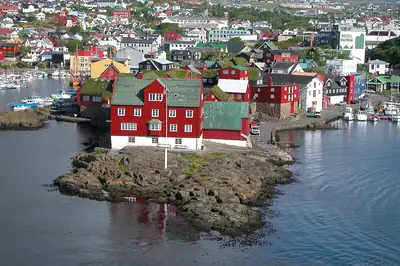
Tinganes is the historic heart of Tórshavn and one of the oldest parliamentary meeting places in the world. Norwegian colonists established their parliament, or Ting, here in 825 during the Viking Age. The peninsula divides the harbour into Eystaravág and Vesteravág.
The Faroese parliament, the Løgting, has since moved to the north of the city, but the home-rule government still sits at Tinganes. Narrow lanes lead between the traditional buildings, many of which date from the 16th and 17th centuries. Gongin, the peninsula’s small main street, is particularly characteristic of the old town.
Tórshavn Cathedral
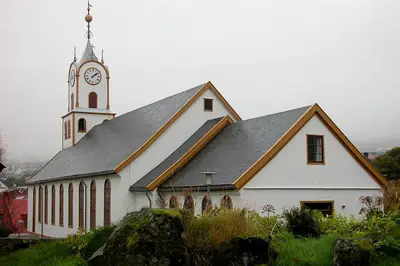
Tórshavn Cathedral, known locally as Havnar Kirkja or Dómkirkjan, stands at the northern end of the Tinganes peninsula. The white church with its slate roof was established in 1788 and is the second-oldest preserved church in the Faroe Islands.
It became a cathedral in 1990, when it was made the seat of the Bishop of the Faroes. Its location places it directly within the historic centre, close to the lanes and buildings of Tinganes.
National Library of the Faroe Islands
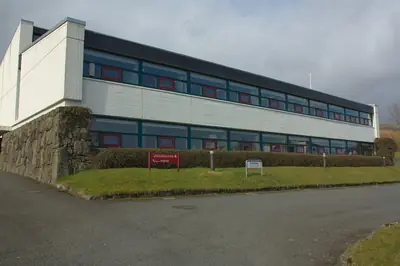
The National Library of the Faroe Islands, or Føroya Landsbókasavn, serves both as a public library and as a research library. It holds the largest collection of works written in Faroese, as well as works by Faroese authors in other languages, translations by Faroese authors and publications about the Faroe Islands.
For visitors interested in the local language and culture, the library offers insight into the written heritage of the archipelago. Faroese is a North Germanic language descended from Old West Norse, with its oldest known text dating from the 14th century.
Vesturkirkjan
Vesturkirkjan, the West Church of Tórshavn, is a modern church belonging to the Faroese Lutheran Church. Consecrated in 1975, it rises just over 40 metres and is the highest building in the Faroe Islands.
The architecture is simple and striking. Its form is said to be inspired by a ship with sails, while the tower resembles a pyramid cut in half vertically. A monument in front of the church, created by sculptor Hans Pauli Olsen, honours Sigmundur Brestisson, who brought Christianity to the Faroe Islands roughly a thousand years ago.
St. Mary’s Church
St. Mary’s Church, or Mariukirkjan, is the only Roman Catholic church in the Faroe Islands. Located on Mariugøta in Tórshavn, it represents the restoration of Catholic life in the islands after centuries of absence following the Danish Reformation.
Two priests, E. G. Boekenoogen and Thomas King, began restoring the Catholic presence in 1931. Franciscan sisters arrived the same year, and the church was consecrated on June 1, 1933.
Listasavn Føroya
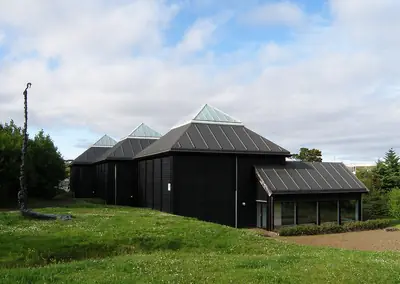
Listasavn Føroya is the National Gallery of the Faroe Islands, located at the northern end of Tórshavn’s city park, near the Nordic House. The museum was established in 1989, bringing together two galleries under one roof. A second gallery for historic arts had been added to the original Listaskáli in 1993.
The museum contains the most important collection of Faroese art, including paintings, prints and sculptures by Faroese artists. It also hosts special exhibitions, international art, concerts and a coffee shop, book store and art store. The building was designed by architect J. P. Gregoriussen.
Tórsvøllur
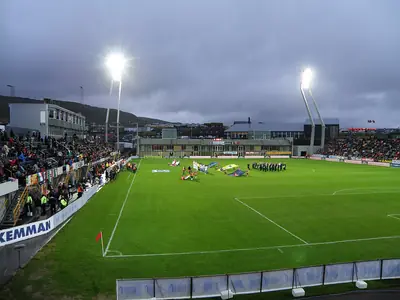
Tórsvøllur is the national stadium of the Faroe Islands and the largest stadium in the country. It forms part of the Gundadalur sports complex and was built in 1999 with an artificial grass surface suitable for international football matches.
The stadium brought the national team’s international matches to Tórshavn instead of the Svangaskarð stadium in Toftir. Its first match was a friendly against Iceland on August 18, 1999. After reconstruction between 2009 and 2021, the stadium had three stands with just over 5,000 seated places.
Nordic House in the Faroe Islands
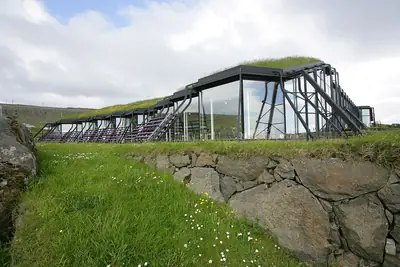
The Nordic House, known locally as Norðurlandahúsið, has been a landmark in Tórshavn since it opened in 1983. It is the most important cultural and congress centre in the Faroe Islands, supporting and promoting Nordic and Faroese culture.
Artists from the Faroe Islands and around the world perform and exhibit here. The building is especially recognisable for its traditional grass roof, which helped inspire a revival of grass roofs in contemporary architecture across the North Atlantic archipelago.
Explore Tórshavn with a Self-Guided Walking Tour
A Tórshavn self-guided walking tour is an easy way to connect the capital’s historic, cultural and architectural highlights. Neywo’s walking route, “Parliament Point to Grass Roofs: Tórshavn on Foot”, covers 4.1 km in 113 minutes and includes 9 narrated stops.
The walk includes Skansin, Tinganes, Tórshavn Cathedral, the National Library of the Faroe Islands, Vesturkirkjan, St. Mary’s Church, Tórshavn, Listasavn Føroya, Tórsvøllur and the Nordic House in the Faroe Islands. Each story plays as you reach the place, at your own pace, with no group and no schedule.
Download Neywo and Explore Tórshavn at Your Own Pace
Download Neywo to explore Tórshavn with its free audio guide and 10 narrated places. The app offers one walking tour in the city: a 4.1 km route lasting 113 minutes with 9 narrated stops.
Neywo tells the story of each place as you reach it, so you can walk independently, stop when you want and discover Tórshavn without a group or a schedule. After exploring the capital, continue discovering the Faroe Islands or see another nearby destination such as Sandoy.
Places with an audio guide in Tórshavn
8 places in Tórshavn with a Neywo audio guide. Each one starts telling its story as you reach it.
Self-guided tours in Tórshavn
1 tour in Tórshavn, free in the Neywo app. Each stop tells its story as you reach it.
- Walk
Parliament Point to Grass Roofs: Tórshavn on Foot
Tórshavn's old town still sits where Vikings held their parliament in 825. Climb to the hilltop fort of Skansin, wander the red-timber lanes of Tinganes and the white cathedral, then walk north past the tall West Church and the national gallery to the grass-roofed Nordic House.
Skansin · Tinganes · Tórshavn Cathedral · National Library of the Faroe Islands · Vesturkirkjan · St. Mary's Church, Tórshavn …
Open this tour: Parliament Point to Grass Roofs: Tórshavn on Foot
Walk Tórshavn with Neywo
Neywo turns Tórshavn into a self-guided audio tour. Stories arrive as you reach the place they belong to, and the route reshapes when you wander off it.

