Things to Do in Vientiane, Laos: Walking Guide
Things to do in Vientiane, Laos
The best things to do in Vientiane include visiting the golden Pha That Luang, exploring historic temples and museums, and discovering the capital’s Buddhist, Christian and Muslim heritage. Vientiane is a city where religious landmarks and modern Lao history stand side by side. Neywo offers a free audio guide for Vientiane with 12 narrated places.
What to see in Vientiane
Pha That Luang
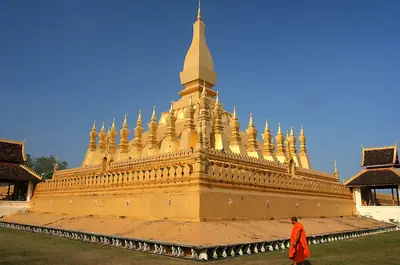
Pha That Luang, or the Great Stupa of Vientiane, is one of the most important landmarks in Laos and the country’s national symbol. Its golden Buddhist stupa represents the spiritual heart of the nation, and its image appears on the coat of arms and Lao banknotes.
The site is traditionally associated with a sacred relic believed to be a bone of the Buddha. The present structure dates largely from the 16th century, when King Setthathirath rebuilt it after moving the capital from Luang Prabang to Vientiane. He expanded the original stupa and surrounded it with thirty smaller stupas, shrines and cloisters.
Patuxai
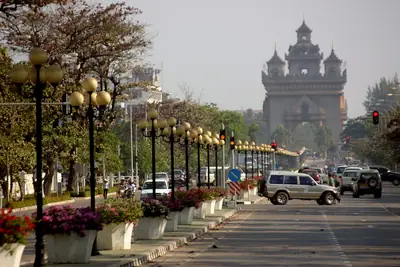
At the end of Lan Xang Avenue, Patuxai rises as Vientiane’s Victory Gate. The monument was built between 1957 and 1968 in memory of those who fought for Laos’s independence from France.
Its shape recalls Paris’s Arc de Triomphe, but its decoration is distinctly Laotian. Mythological figures from Buddhist and Hindu traditions, including kinnari and nagas, cover the structure. Patuxai was originally called the Anousavari Monument and was never fully completed because of the civil war.
Haw Phra Kaew
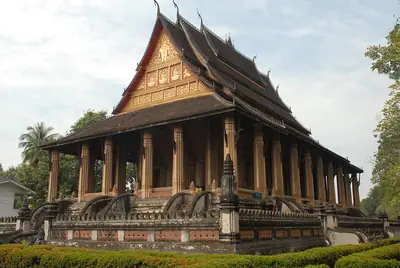
Haw Phra Kaew is a former royal temple on Setthathirath Road, southeast of Wat Si Saket. King Setthathirath built it in 1565 as a place of worship for the royal family and as the home of the Emerald Buddha, a sacred jade statue brought from Chiang Mai.
The statue was taken to Thailand during the attack on Vientiane in 1779 and now stands at Wat Phra Kaew in Bangkok. Haw Phra Kaew itself was destroyed and rebuilt more than once. Today, it is a museum containing Buddhist art and other religious objects.
Wat Si Muang
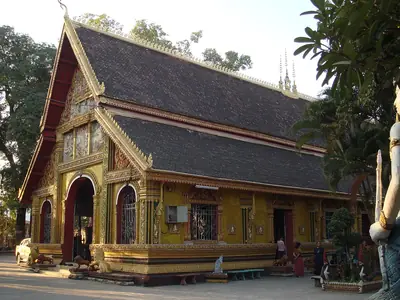
Wat Si Muang is considered the soul of Vientiane. Built in 1566 during the reign of King Setthathirath, the temple stands on the ruins of an older Khmer structure. Remains of the earlier temple can still be seen behind the main hall.
The temple’s central feature is not a Buddha image but the city pillar, a sacred stone post believed to protect Vientiane. A local legend connects the temple’s name with Si, a pregnant woman who sacrificed herself when the city pillar was being installed.
Sacred Heart Cathedral, Vientiane
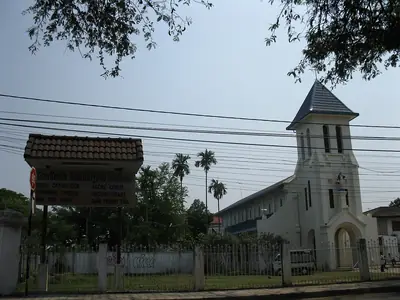
Sacred Heart Cathedral, also known as Vientiane Cathedral, stands on Rue de la Mission near the French Embassy. Built in 1928 during the period of French Indochina, it is the capital’s main Roman Catholic church.
The cathedral follows a neo-Romanesque design, with rounded arches and images of Saint Joan of Arc and Saint Thérèse of Lisieux inside. It serves as the mother church of the Apostolic Vicariate of Vientiane, a status granted in 1952.
Lao National Museum
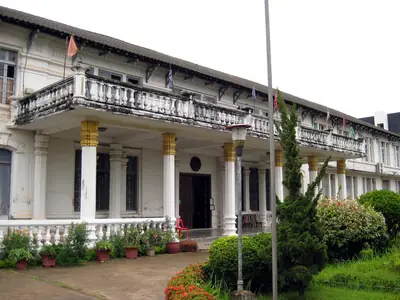
The Lao National Museum occupies a colonial-era building originally constructed in 1925 as the residence of the French governor. Its collections trace the history of Laos from prehistory to the present.
The museum places particular emphasis on the struggle against colonial and imperial forces, as well as the revolutionary events of the 1970s. The building was developed with a United States grant in 2007 and renovated further during the 2010s.
That Dam
That Dam, or the Black Stupa, stands in the middle of a roundabout in central Vientiane. Its dark, weathered appearance gives it its name, while its exact origins remain unknown. The stupa is believed to date from around the 12th century and shows Lanna and Lan Xang architectural influences.
Its eight lotus-shaped tiers support an octagonal upper section. According to a widely held local belief, a seven-headed naga lives inside the stupa and once tried to protect the city from the Siamese army in 1827. Because the structure was left unrepaired and unpainted for more than a century, it retained its distinctive black colour.
Vientiane’s mosques
Vientiane’s religious heritage extends beyond Buddhist temples and Christian churches. The Vientiane Jamia Mosque, near the Nam Phu Fountain, is the oldest mosque in Laos. Built in 1970, it is a Sunni mosque following the Hanafi tradition, with a congregation largely made up of people of South Asian descent, including Pathans and Tamils.
The Azahar Mosque, also known as the Cambodia Mosque or Cham Mosque, serves a Cham Muslim community that fled Cambodia in the late 1970s. The community began building the mosque in 1976, and the complex was completed in 1986. Alongside the prayer hall, it includes a religious school for children.
The Kingdom of Laos
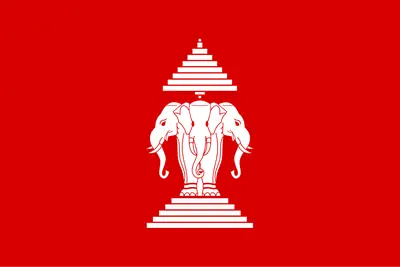
Vientiane’s monuments also reflect the country’s recent political history. The Kingdom of Laos was a constitutional monarchy from 1947 to 1975. Laos gained full independence through the Franco-Lao Treaty of 22 October 1953, but rival political groups continued to compete for power.
The Pathet Lao eventually won the Laotian Civil War. On 2 December 1975, King Sisavang Vatthana surrendered the throne, and the monarchy was abolished in favour of the Lao People’s Democratic Republic.
A Vientiane self-guided walking tour with Neywo
Neywo has two walking tours in Vientiane, both designed for exploring independently:
- From the City Pillar to the Golden Stupa: 5.63 km, 119 minutes and 6 narrated stops.
- Faiths of Vientiane: Mosques, Stupa, Temple and Cathedral: 4.78 km, 101 minutes and 6 narrated stops.
The app tells the story of each place as you reach it, at your own pace, with no group and no schedule. Narration is available in 11 languages, making it a practical way to discover Vientiane without following a fixed guide.
Vientiane is also a useful starting point for discovering more of Laos, including Luang Prabang, Vang Vieng and Huay Xai.
Download Neywo and explore Vientiane at your own pace
Download Neywo to explore Vientiane with two walking tours, 12 narrated places and stories that begin as you arrive at each landmark. Choose a route, walk at your own pace and listen without a group or a schedule.
Places with an audio guide in Vientiane
8 places in Vientiane with a Neywo audio guide. Each one starts telling its story as you reach it.
Self-guided tours in Vientiane
2 tours in Vientiane, free in the Neywo app. Each stop tells its story as you reach it.
- Walk
From the City Pillar to the Golden Stupa
Begin at Wat Si Muang, where a sacred pillar is said to guard the city, and pass a 1920s neo-Romanesque cathedral on the way to Haw Phra Kaew, the former home of the Emerald Buddha. Visit the Black Stupa on its roundabout, walk down Lan Xang Avenue to the Patuxai victory gate and end at Pha That Luang, the gold-covered national symbol of Laos. A full two-hour walk through the capital's best-known landmarks.
Wat Si Muang · Sacred Heart Cathedral, Vientiane · Haw Phra Kaew · That Dam · Patuxai · Pha That Luang
Open this tour: From the City Pillar to the Golden Stupa - Walk
Faiths of Vientiane: Mosques, Stupa, Temple and Cathedral
Vientiane's religious life in one afternoon. Visit the Cham refugees' mosque built after the Khmer Rouge years and the oldest mosque in Laos, then the Black Stupa, the former home of the Emerald Buddha and the French-era Sacred Heart Cathedral. End at Wat Si Muang, the temple of the city's guardian spirit.
Azahar Mosque · Vientiane Jamia Mosque · That Dam · Haw Phra Kaew · Sacred Heart Cathedral, Vientiane · Wat Si Muang
Open this tour: Faiths of Vientiane: Mosques, Stupa, Temple and Cathedral
Walk Vientiane with Neywo
Neywo turns Vientiane into a self-guided audio tour. Stories arrive as you reach the place they belong to, and the route reshapes when you wander off it.

