Pyongyang, North Korea: Self-Guided Walking Tour
Things to Do in Pyongyang: What to See in North Korea’s Capital
The best things to do in Pyongyang include visiting monumental landmarks, historic fortress gates, museums, memorials, and viewpoints along the Taedong River. The city combines ancient Korean heritage with a highly monumental modern landscape, making it a distinctive destination for travellers interested in history, architecture, and political symbolism. Neywo offers a free audio guide for Pyongyang with 81 narrated places.
What to See in Pyongyang
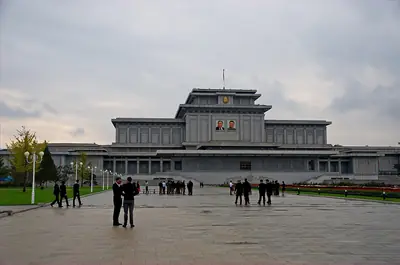
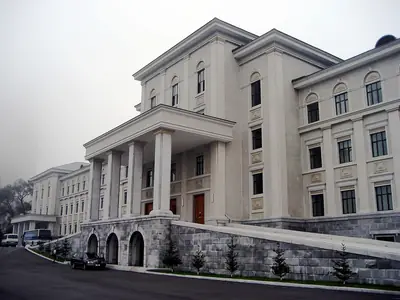
Kumsusan Palace of the Sun
Kumsusan Palace of the Sun is one of Pyongyang’s most important memorial sites. Originally completed in 1976 as Kim Il Sung’s official residence and office, the building was transformed into a mausoleum after his death in 1994. Following Kim Jong Il’s death in 2011, it received its current name.
The memorial contains the preserved bodies of Kim Il Sung and Kim Jong Il, as well as personal belongings and objects associated with Kim Il Sung’s life. Among the exhibits is part of the Kumsusan tram connected with the former residence and office.
The Pyongyang Bell
Known in Korean as Pyongyangjong, the Pyongyang Bell is one of North Korea’s National Treasures. The present bell was cast between June and September 1726 during the Ri dynasty, replacing an earlier bell destroyed by fire in 1714. It offers a direct connection with the city’s long pre-modern history.
Taesongsan Funfair
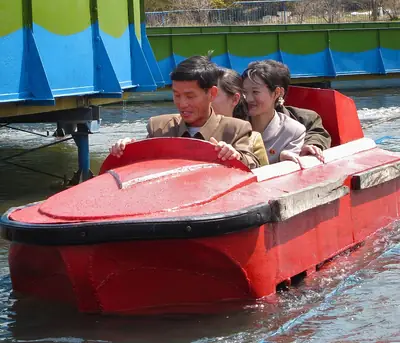
At the foot of Mount Taesong, around twelve kilometres from Pyongyang, Taesongsan Funfair provides a lively contrast to the capital’s solemn monuments. Completed in 1977, the amusement park covers approximately 180,000 square metres and has sixteen rides. Its broad grounds and recreational facilities are set against the mountain landscape.
The Juche Tower
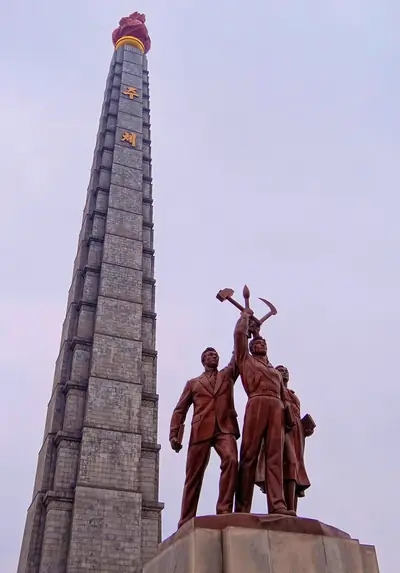
Across the Taedong River from Kim Il Sung Square, the Juche Tower is one of Pyongyang’s most recognisable landmarks. The 170-metre monument represents the ideology of Juche and was completed in 1982 for Kim Il Sung’s seventieth birthday.
Its central granite structure rises 150 metres and is divided into seventy sections. The tower is faced with white stone and contains 25,550 blocks, described as representing each day of the first seventy years of Kim Il Sung’s life. A 20-metre metal torch weighing 45 tons crowns the monument. An elevator reaches the 150-metre level, where visitors can look across Pyongyang.
Kim Il-sung University
Founded on October 1, 1946, Kim Il-sung University was the first university established in post-war North Korea. It occupies around 15 hectares in Taesong District, with academic buildings, libraries, museums, laboratories, dormitories, a hospital, a printing press, and research facilities.
The university began with seven faculties and twenty-four departments. Its later expansion brought programs in areas including law, economics, the humanities, and the natural sciences, alongside graduate studies and more than ten research centres and institutes.
Potongmun
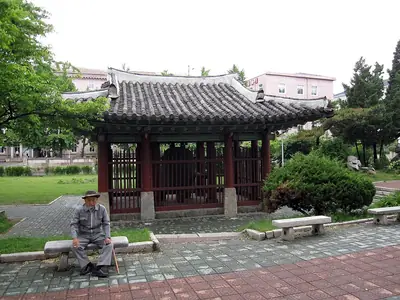
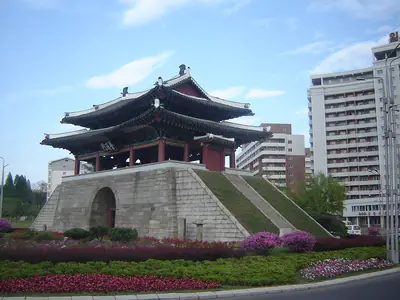
Potongmun, or Potong Gate, is the western gate of Pyongyang’s walled city. Its origins reach back to a Koguryo construction in the sixth century, and it was rebuilt in 1473 as an entrance to Pyongyang Castle.
The compact gatehouse has a granite base supporting a two-storey wooden structure. It was destroyed during American air attacks in the Korean War and reconstructed in 1955, so the present building reflects both its ancient history and its postwar rebuilding.
Hyonmumun
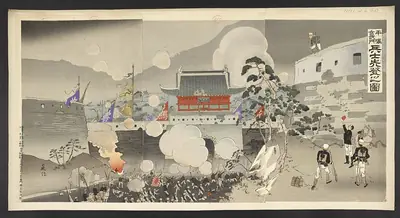
Hyonmumun, also called Hyonmu Gate, stands between Moran Peak and Ulmil Pavilion at the northern approach to Pyongyang Fortress. The gate was first built in the mid-sixth century, when the Koguryo kingdom was developing Pyongyang as its royal capital.
The gatehouse was rebuilt in 1855 and again in 1954 after several repairs and reconstructions. Together with Potongmun, it provides a glimpse of the defensive system that once surrounded the city.
The Liberation Monument
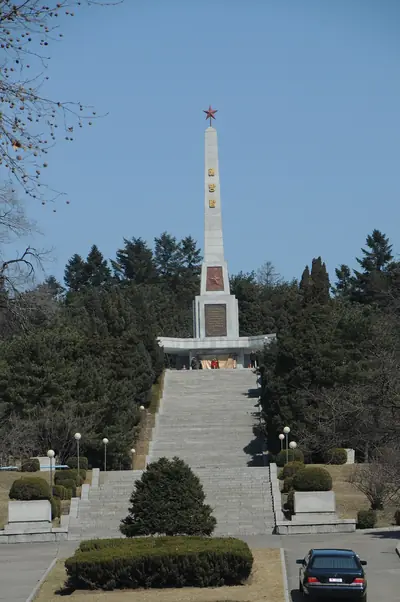
The Liberation Monument commemorates Soviet Red Army soldiers involved in Korea’s liberation from Imperial Japan at the end of the Second World War. It was built in 1947, following the events of August 24, 1945, when Soviet paratroopers took control of Pyongyang.
The 30-metre obelisk-like stele is topped with a five-pointed red star. Its square base carries inscriptions in Russian and Korean, while bronze reliefs on the lower pedestal depict combat and a meeting.
Korean Central History Museum
At the north end of Kim Il Sung Square, the Korean Central History Museum presents Korean history from the Paleolithic period through later eras and the period of Japanese rule. Its collections contain more than 100,000 artefacts, covering a long span of the peninsula’s cultural and political development.
Korean Art Gallery
On the south side of Kim Il Sung Square, the Korean Art Gallery displays painting, printmaking, sculpture, and industrial arts. The four-storey building contains twenty-two display rooms, as well as an exhibition hall, an art-preservation room, and a study room.
Some paintings and paper works are displayed as replicas when the originals require carefully controlled temperature and humidity. These reproductions allow the gallery to present works while preserving the originals in more suitable conditions.
Changchung Cathedral
Changchung Cathedral is one of Pyongyang’s four official Christian places of worship and the city’s only Catholic church among them. Established in March 1988, it operates under the Korean Catholic Association and is regarded as the nominal cathedral of the Catholic Bishop of Pyongyang, although it is not affiliated with the Diocese of Pyongyang.
The cathedral is located in the Changchung neighbourhood of Songyo-guyok. Its building covers about 2,000 square metres and has space for roughly 200 Catholic worshippers.
Ponghwa Station and the Party Foundation Museum
Ponghwa Station is a Pyongyang Metro station where the Chŏllima Line and the Man’gyŏngdae Line meet. Opened on September 6, 1973, it operates as a continuous connection between the two lines. The station is housed in a single-storey building and was retrofitted during the COVID-19 pandemic in the early 2020s.
Near the station, the Party Foundation Museum occupies a building completed in 1923. It first served as the South Pyongan Provincial Products Exhibition Center, later became the Pyongyang branch of the Chojiya Department Store, and was subsequently used as the headquarters of the Central Organising Committee of the Communist Party of North Korea. In October 1970, it became a museum dedicated to the party’s foundation.
The Chollima Statue
On Mansu Hill, the Chollima Statue depicts a legendary winged horse carrying a worker and a farmer into the sky. The worker raises a red letter from the Central Committee of the Workers’ Party of Korea, while the farmer holds a bundle of grain.
The monument is about 14 metres high and 16 metres long, with a pedestal made from 2,500 pieces of granite. Its design emerged from the Chollima Movement, proposed by a work team at the Kangson Steelworks on March 9, 1959. The statue was unveiled on April 15, the birthday of Kim Il Sung.
Korean Revolution Museum
The Korean Revolution Museum stands in the Mansu Hill area beside the Mansudae Assembly Hall. Founded on August 1, 1948, it moved to its present building in April 1972. Its exhibitions present the official account of the Korean revolutionary movement from the nineteenth century to the present day.
Ninety rooms cover subjects including the anti-Japanese resistance, the Korean War, socialist construction, historical battles, and material connected with Kim Il Sung and his associates. The façade carries a mural of Mount Paektu measuring 70 metres long and 12.85 metres high. A new exhibition hall opened in 2022 after extensive renovations.
Chongrungsa
Chongrungsa, or Chongrung Temple, is an important example of Goguryeo Buddhist architecture. The temple stands at the Tomb of King Tongmyong in Ryongsan-ri and dates from the fifth century.
Archaeological excavations in 1974 uncovered vessel fragments bearing the words Goguryeo, Chongrung, and Neungsa, identifying the site’s connection with the tomb. The temple was reconstructed in 1993 in Goguryeo’s architectural style. Both Chongrungsa and its pagoda are listed as National Treasures of North Korea.
Explore Pyongyang with a Free Audio Guide
A Pyongyang self-guided walking tour lets you explore the city at your own pace while Neywo tells the story of each place as you reach it. There is no group and no schedule, and narration is available in 11 languages.
Neywo currently offers five walking tours in Pyongyang:
- Across the Taedong: Kim Il-sung Square and the Juche Tower — 3.13 km, 105 minutes, 8 narrated stops
- Mansu Hill to Moranbong: Monuments, a Soviet Tower and a Giant Arch — 3.8 km, 103 minutes, 8 narrated stops
- Moran Hill’s Eastern Foot: Gates, Stadiums and the University — 4.72 km, 104 minutes, 5 narrated stops
- West Gate to the Pyramid: Pyongyang’s War and Skyline — 4.76 km, 102 minutes, 5 narrated stops
- The East Bank: Bridge, Flowers, Stage and Party Monument — 1.57 km, 45 minutes, 4 narrated stops
Download Neywo and explore Pyongyang with a free audio guide that accompanies you from one landmark to the next, at your own pace.
Places with an audio guide in Pyongyang
8 places in Pyongyang with a Neywo audio guide. Each one starts telling its story as you reach it.
Self-guided tours in Pyongyang
5 tours in Pyongyang, free in the Neywo app. Each stop tells its story as you reach it.
- Walk
Across the Taedong: Kim Il-sung Square and the Juche Tower
Pyongyang's monumental riverfront in one easy loop. Start at the Mansudae Art Theatre, pass a 14th-century hall that survived the war, then take in the great granite square, the national library and two museums before ending at the Pyongyang Bell and the tower that faces the square across the water.
Mansudae Art Theatre · Sungin Hall · Grand People’s Study House · Kim Il-sung Square · Korean Central History Museum · Korean Art Gallery …
Open this tour: Across the Taedong: Kim Il-sung Square and the Juche Tower - Walk
Mansu Hill to Moranbong: Monuments, a Soviet Tower and a Giant Arch
From the bronze giants and the winged horse of Mansu Hill, climb into Moranbong Park, where a Soviet liberation tower and a Koguryo-era fortress gate show how much history Pyongyang has layered on its hills. Then drop down to a triumphal arch taller than Paris's, a funfair and the tower honouring Chinese soldiers of the Korean War.
Chollima Statue · Mansu Hill Grand Monument · Korean Revolution Museum · Liberation Monument · Chilsongmun · Arch of Triumph …
Open this tour: Mansu Hill to Moranbong: Monuments, a Soviet Tower and a Giant Arch - Walk
Moran Hill's Eastern Foot: Gates, Stadiums and the University
A longer, quieter loop east of Moran Hill: the northern gate of the old fortress, the stadium where football and marathons start and end, a cinema and a pleasure ground, then the island stadium built for mass games and the country's first university.
Hyonmumun · Kim Il-sung Stadium · Kaeson Cinema · Rungrado 1st of May Stadium · Kim Il-sung University
Open this tour: Moran Hill's Eastern Foot: Gates, Stadiums and the University - Walk
West Gate to the Pyramid: Pyongyang's War and Skyline
Start at the rebuilt western gate of the old walled city, then see the unfinished 330-metre pyramid that dominates the skyline, a circus hall, and the Korean War monument and museum on the Botong River.
Potongmun · Ryugyong Hotel · People's Army Circus · Monument to the Victorious Fatherland Liberation War · Victorious Fatherland Liberation War Museum
Open this tour: West Gate to the Pyramid: Pyongyang's War and Skyline - Walk
The East Bank: Bridge, Flowers, Stage and Party Monument
Cross the river to the eastern bank: a 1,070-metre bridge over Rungra Island, the flower exhibition hall, the theatre that hosted the New York Philharmonic and the monument of hammer, sickle and brush.
Rungra Bridge · Kimilsungia and Kimjongilia Exhibition Hall · East Pyongyang Grand Theatre · Monument to Party Founding
Open this tour: The East Bank: Bridge, Flowers, Stage and Party Monument
Walk Pyongyang with Neywo
Neywo turns Pyongyang into a self-guided audio tour. Stories arrive as you reach the place they belong to, and the route reshapes when you wander off it.

