What to See in Nizwa, Oman: Free Audio Guide
Things to Do in Nizwa: What to See in Oman’s Historic City
The best things to do in Nizwa include visiting its monumental fort, exploring historic mosques, and discovering the traditional water systems that made life possible in Oman’s dry interior. Beneath the Western Hajar Mountains, Nizwa brings together Islamic heritage, defensive architecture, local crafts, and centuries-old community traditions. Neywo also offers a free audio guide for Nizwa with five narrated places.
What to See in Nizwa
Nizwa Fort
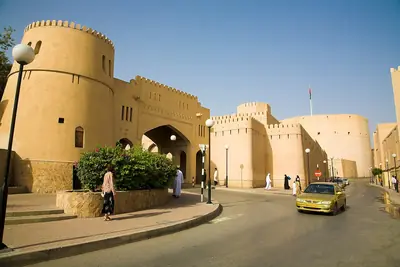
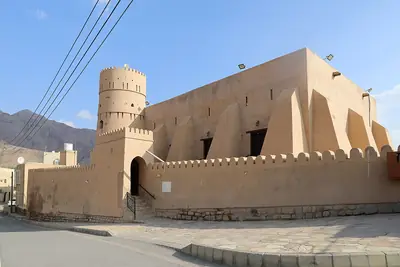
Nizwa Fort is the city’s most distinctive historic landmark. Built around 1650 by Imam Sultan bin Saif bin Malik al Ya’rubi, its construction took twelve years. Sultan bin Saif is remembered in the source tradition as the imam who drove the Portuguese from Oman.
The fort’s enormous circular tower is described as the largest of its kind in the Sultanate. It rises 24 metres high, with an outer diameter of 43 metres and an inner diameter of 39 metres. Much of the structure is filled with earth, which gives the tower its massive, mound-like appearance.
Inside the complex, seven wells, defensive openings, prison areas, and passages reveal how the fort operated. It was not only a military stronghold but also a seat of government, where punishments were carried out for different offences and crimes. A connected fortification adds to the complex, with passages forming a maze around the main structure.
The fort also stands beside Nizwa’s traditional market, where local handicrafts create a broader setting for understanding the relationship between the city’s military power and its commercial life.
Sultan Qaboos Grand Mosque
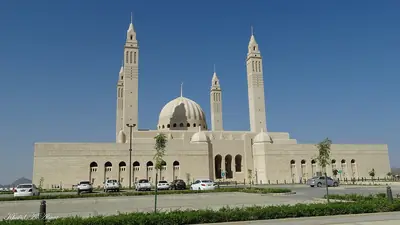
The Sultan Qaboos Grand Mosque is a prominent Islamic landmark in Nizwa. It is also known as the Sultan Qaboos Mosque Nizwa. Its presence offers an introduction to the city’s continuing religious importance and provides a notable stop when arriving in Nizwa.
Al-Shawathna Mosque
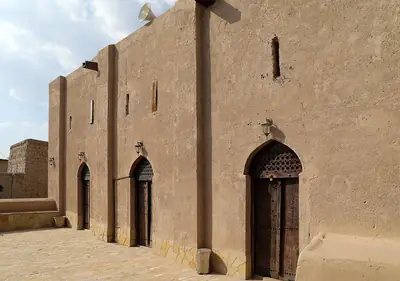
In the historic al-Aqr neighbourhood, Al-Shawathna Mosque is also known as the Mosque of the Two Qiblas. It is regarded as one of Oman’s oldest mosques and remains a place of prayer.
The mosque was built in the seventh year of the Hijri calendar and was rebuilt and restored in 936 Hijri, corresponding to 1529. Its name is associated with the Shathani tribe, which settled in the area.
Its most remarkable feature is the mihrab, whose carved stucco decoration dates from the sixteenth century. The detailed work is considered a masterpiece of Omani stucco art. The name “Mosque of the Two Qiblas” refers to a change in the direction indicated by the mihrab: its earlier form pointed towards Jerusalem, while the rebuilt mosque faces Mecca.
Inside, the prayer hall is on the first floor. A narrow staircase leads to a terraced courtyard, with ablution spaces opening onto it. Three entrances correspond to three long interior sections divided by pillars.
Sa’al Mosque
Sa’al Mosque stands in Nizwa’s Souq district and is connected with the old Saal market. It is regarded as one of the city’s notable archaeological mosques, part of the rich collection of historic and archaeological landmarks found throughout Nizwa’s neighbourhoods and villages.
Its setting in the souq makes it a useful place to notice while exploring the city’s traditional commercial quarter. Together with the many mosques found across Nizwa, it reflects the importance of religious architecture in the city’s historic landscape.
Aflaj Irrigation Systems
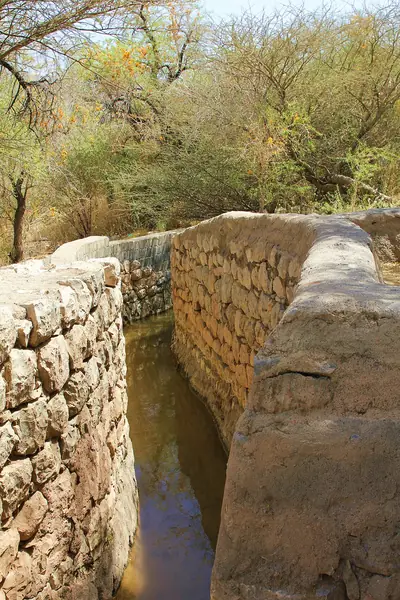
A little beyond Nizwa, the Aflaj Irrigation Systems show how communities cultivated land in a dry environment. These traditional channels carried water from elevated rocky sources to homes and farmland. Some included underground horizontal passages reached through vertical shafts, while others continued as open channels that transported and distributed water across the land.
The wider system could also include watchtowers, mosques, and other buildings. It was a carefully shared network for collecting, carrying, storing, and distributing water among the community—not simply a set of waterways.
The tradition has a history reaching back about five thousand years in the region. In Oman, five aflaj were added to the UNESCO World Heritage list in 2006: Falaj Al Khatmeen, Falaj Al Malki, Falaj Daris, Falaj Al Mayassar, and Falaj Al Jeela. Falaj Daris, the largest of the five, is located about seven kilometres from Nizwa.
Exploring Nizwa and Oman
Nizwa is a rewarding place to discover Oman’s inland heritage, from the imposing structure of Nizwa Fort to the carefully decorated mihrab at Al-Shawathna Mosque. Its historic souq, archaeological mosques, and traditional irrigation systems show how defence, faith, trade, and agriculture shaped life in the city.
If you are also planning time in the capital, see the Muscat destination guide. For a wider itinerary, explore the Oman guide.
Explore Nizwa with Neywo
Neywo’s free audio guide for Nizwa includes five narrated places. The app tells the story of each place as you reach it, at your own pace, with no group and no schedule. Narration is available in 11 languages, so you can explore Nizwa independently while learning more about its forts, mosques, and heritage.
Places with an audio guide in Nizwa
5 places in Nizwa with a Neywo audio guide. Each one starts telling its story as you reach it.
Walk Nizwa with Neywo
Neywo turns Nizwa into a self-guided audio tour. Stories arrive as you reach the place they belong to, and the route reshapes when you wander off it.

