Visiting Ponce, Puerto Rico: Top Sights on Foot
Things to do in Ponce, Puerto Rico
Looking for things to do in Ponce? The city’s historic centre brings together grand civic buildings, museums, churches and colourful architecture around Plaza Las Delicias, while viewpoints and archaeological sites reveal more of Puerto Rico’s history beyond the centre. Neywo offers a free audio guide for Ponce with 26 narrated places, available in 11 languages.
What to see in Ponce
Plaza Las Delicias and Parque de Bombas
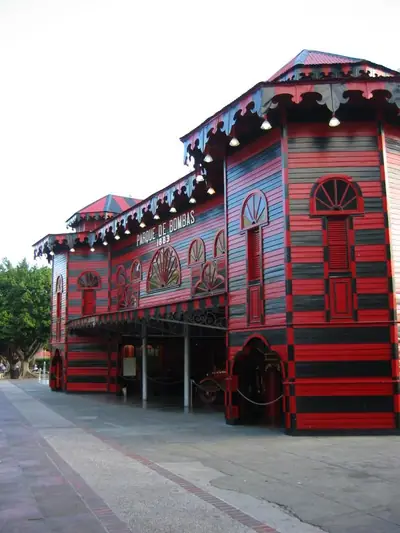
Plaza Las Delicias is the natural starting point for exploring Ponce. The main square is made up of Plaza Muñoz Rivera and Plaza Federico Degetau, with the distinctive Parque de Bombas standing just behind the cathedral.
Built in 1882, Parque de Bombas first served as a pavilion for an exhibition before becoming Puerto Rico’s first fire station. It operated for more than a century and was converted into a museum in 1990. Its colourful architecture and long connection with the city’s firefighters make it one of Ponce’s most recognisable landmarks.
Nuestra Señora de Guadalupe Cathedral
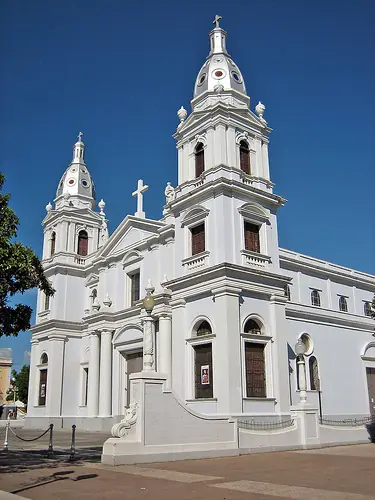
The Cathedral of Our Lady of Guadalupe stands in the centre of Plaza Las Delicias and serves as the seat of the Roman Catholic Diocese of Ponce. Its history reaches back to 1670, when the site was a hermitage and rustic chapel. The church became a parish when Ponce was founded in 1692 and was raised to cathedral status in 1924.
The building has been affected by fires and earthquakes. Its present façade dates from the major remodelling carried out between 1918 and 1934. The cathedral’s neoclassical design includes a cruciform plan and a large dome over the crossing.
Plaza Muñoz Rivera and Plaza Federico Degetau
The two sections of Plaza Las Delicias each offer a different view of Ponce’s central square. Plaza Muñoz Rivera has benches, trees and paths beneath the shade, as well as a bronze statue of Luis Muñoz Rivera, the Puerto Rican poet, journalist and politician. The statue stands on a marble Beaux-Arts pedestal.
Plaza Federico Degetau is centred on the Fuente de los Leones. The ornate fountain features stone lions and a basin, making it an important detail to look for while walking through the square.
Casa de la Masacre de Ponce
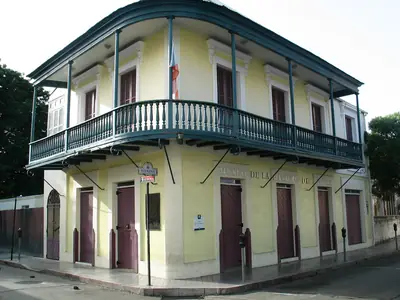
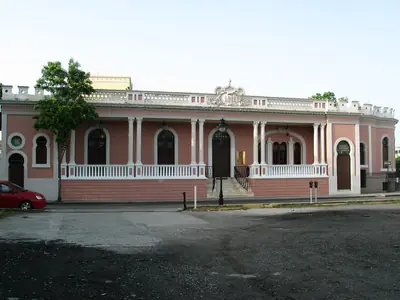
The Museo de la Masacre de Ponce occupies the building where the tragic events of Palm Sunday in 1937 took place. This human-rights museum explains the history surrounding the Ponce Massacre and documents the blacklisting of Puerto Rican Nationalists by the United States.
Photographs from the Nationalist era help place the events in their historical context. The building is listed on the U.S. National Register of Historic Places under the name Casa de la Masacre.
Armstrong-Poventud Residence
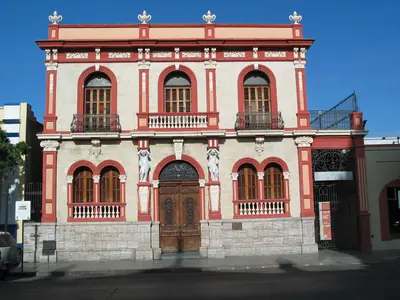
Across from the cathedral, in the heart of the Ponce Historic Zone, the Armstrong-Poventud Residence is one of the city’s most elegant historic homes. It is also known as Casa de las Cariatides, or the House of the Caryatids, after the figures incorporated into its façade.
The residence is an example of Ponce Creole architecture, a style associated with the city’s refined homes around the turn of the twentieth century. The Instituto de Cultura Puertorriqueña converted it into a museum in 1991.
Museum of Ponce History
The Museum of Ponce History occupies Casa Salazar-Candal, around two blocks from Plaza Las Delicias. It was the first museum in Puerto Rico devoted entirely to the history of a single city.
Its exhibits cover Ponce from the Taíno people to the present day, including the city’s ecology, economy, architecture, government and everyday traditions. The museum was inaugurated on December 12, 1992, during the city’s tricentennial celebrations, and later expanded into the neighbouring Casa Rosita Serrallés.
Tricoche Hospital
On Calle Tricoche, the former Tricoche Hospital is an imposing example of nineteenth-century civil architecture. Also known as the Albergue Caritativo Tricoche, it opened in 1878 after being designed by the Spanish Royal Corps of Engineers in the Classical Revival style.
When it opened, it was considered the largest and most beautiful public building in Puerto Rico. An annex called the Hospital Civil de Ponce was added in 1885 as the institution expanded.
Castillo Serrallés
Above downtown Ponce, Castillo Serrallés is a mansion built in the 1930s for Juan Eugenio Serrallés, whose family founded Destilería Serrallés. Designed by Pedro Adolfo de Castro in the Spanish Colonial Revival style, the four-storey building occupies a landscaped property.
Today, the mansion houses the Museo Castillo Serrallés, also known as the Sugar Cane and Rum Museum. Its exhibitions explore sugar cane, the rum industry and their influence on Puerto Rico’s economy. The refurbished residence is furnished to evoke its appearance in the 1930s, and the property also includes a temporary exhibition area for local artists.
Museo de Arte de Ponce
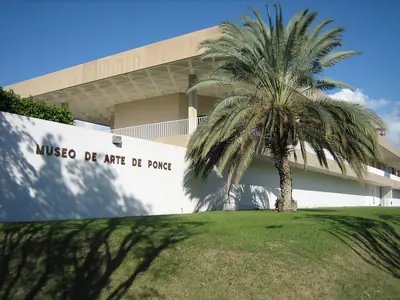
The Museo de Arte de Ponce is one of the city’s major cultural attractions. Founded in 1959 by industrialist and philanthropist Luis A. Ferré, it moved to its current location on Avenida Las Américas in 1965. An expansion in 2010 added considerably to the museum.
Its collection contains around 4,500 works displayed across fourteen galleries, including European art and works by Puerto Rican artists. The Spanish, French and English painting collections are particularly strong, while the Pre-Raphaelite collection is considered one of the most important in the Western Hemisphere.
Tibes Indigenous Ceremonial Center
The Tibes Indigenous Ceremonial Center lies in Barrio Tibes, just outside Ponce. It is one of the most significant archaeological discoveries in the Antilles and the oldest Indigenous ceremonial and sports complex yet uncovered in Puerto Rico.
The site offers insight into the lives of the Igneri and Taíno peoples. Archaeological evidence indicates that the Igneri occupied the area as early as 25 AD and abandoned it around 600 AD; the Taínos later repopulated and continued using the ceremonial space. The site also contained the largest Indigenous cemetery discovered in the region, with more than 186 human remains.
Cruceta del Vigía
The 100-foot Cruceta del Vigía rises above Ponce on Cerro del Vigía. A tourist centre stands at its base, while a vertical tower and horizontal skybridge provide panoramic views over the city and the Caribbean Sea. Visitors can reach the skybridge by glass elevator or staircase.
The cross was inaugurated in 1984 and has reinforced-concrete arms spanning 70 feet. The hill also has a much older role: Spanish settlers used it to watch ships approaching the port, and in 1801 townspeople built a smaller wooden cross for the lookout.
Letras de Ponce
In Barrio Sabanetas, at the intersection of PR-52 and PR-10, the giant Letras de Ponce spell out the city’s name. Each of the five red-and-black letters is 20 feet high, 18 feet wide and 12 feet deep, creating a striking landmark associated with Ponce throughout Puerto Rico.
United States Customs House
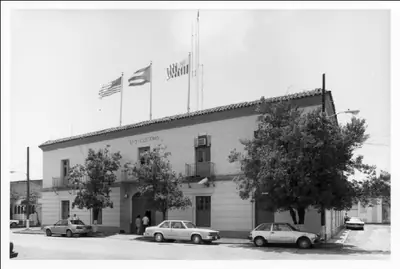
In the La Playa neighbourhood, at the corner of Bonaire and Aduana streets, the United States Customs House is known locally as the Aduana de Ponce. It is the oldest customs house in Puerto Rico and the only one of its kind still standing under the U.S. flag.
The building was listed on the U.S. National Register of Historic Places in 1988 and on the Puerto Rico Register of Historic Sites and Zones in 2001. It was formerly owned by the U.S. Customs Service in Washington, D.C., and played an active role in the island’s customs operations.
A Ponce self-guided walking tour
Ponce’s central sights are well suited to a self-guided walking tour, beginning at Plaza Las Delicias and continuing through the cathedral, Parque de Bombas, the historic residences and the museums around the square. For a wider route, the hills above the city add Castillo Serrallés, the Museo de Arte de Ponce, the old aqueduct and Cruceta del Vigía.
You can also explore more of Puerto Rico with the Puerto Rico guide or visit the island’s capital with San Juan.
Explore Ponce with Neywo
Download Neywo’s free Ponce audio guide and choose between two walking tours. The route around Plaza Las Delicias covers 2.25 km in about 95 minutes and includes 12 narrated stops. The hills-above-Ponce route covers 4.23 km in about 95 minutes and includes 7 stops.
The app tells the story of each place as you reach it, at your own pace, with no group and no schedule.
Places with an audio guide in Ponce
8 places in Ponce with a Neywo audio guide. Each one starts telling its story as you reach it.
Self-guided tours in Ponce
2 tours in Ponce, free in the Neywo app. Each stop tells its story as you reach it.
- Walk
Plaza Las Delicias: Heart of the Pearl of the South
Ponce's historic zone packs a cathedral, the red-and-black fire station, a bronze poet and the birthplace of a world-famous tenor into a few blocks. Walk past Creole mansions with caryatids, a theatre called The Pearl and a museum on the site of a 1937 massacre to see why Ponce is Puerto Rico's second city.
Iglesia de la Santísima Trinidad · Monumento a la Mujer · Museo de la Masacre de Ponce · Casa Paoli · Church of Our Lady of Mercy · Teatro La Perla …
Open this tour: Plaza Las Delicias: Heart of the Pearl of the South - Walk
Hills Above Ponce: Rum Castle, Cross and Aqueduct
Start with Puerto Rico's finest art museum and its Pre-Raphaelite collection, then climb to the national pantheon and the Tricoche hospital. Trace the gravity-fed aqueduct, tour the rum baron's castle and finish under the 100-foot Cruceta del Vigia with views to the Caribbean.
Santa María Reina Church · Museo de Arte de Ponce · Román Baldorioty de Castro National Pantheon · Tricoche Hospital · Acueducto de Ponce · Castillo Serrallés …
Open this tour: Hills Above Ponce: Rum Castle, Cross and Aqueduct
Walk Ponce with Neywo
Neywo turns Ponce into a self-guided audio tour. Stories arrive as you reach the place they belong to, and the route reshapes when you wander off it.

