Things to Do in St Petersburg, Russia: Walking Guide
Things to do in St Petersburg: historic squares, palaces and waterways
St Petersburg is a Russian city of grand Neoclassical architecture, imperial history, cultural institutions and dramatic political memories. Founded on the Neva River, it rewards exploration on foot, from Palace Square and Nevsky Prospekt to the bridges, museums and historic buildings of Vasilievsky Island. Neywo’s free audio guide for St Petersburg includes 580 narrated places, so you can discover the city while you walk.
What to see in St Petersburg
Tauride Palace and Garden
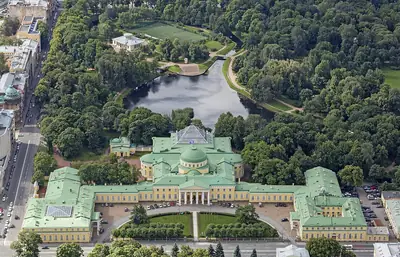
Tauride Palace is one of St Petersburg’s oldest and most historically significant palaces. Built between 1783 and 1789 to a design by Ivan Starov, it is a major example of Russian Neoclassical architecture. Its composition brings together three connected buildings beneath a central dome, a design that influenced buildings elsewhere in the country.
The palace later became an important political setting. Its interiors were adapted for the State Duma between 1906 and 1910, and during the February Revolution of 1917 it accommodated the Provisional Committee of the Duma, the Provisional Government and the Petrograd Soviet. The All-Russian Constituent Assembly met here in January 1918. The expansive Tauride Garden lies directly behind the palace.
Prachechny Bridge
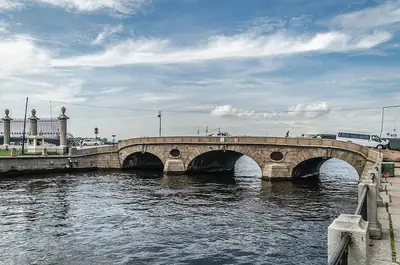
Prachechny Bridge, also known as Laundry Bridge, crosses the Fontanka River beside the Summer Garden, connecting the Kutuzov and Palace embankments. It is one of the earliest stone bridges in St Petersburg and the city’s first three-span stone bridge.
Its name refers to the royal palace laundries that once stood nearby. Today, the bridge is protected as a cultural heritage site of federal significance and offers a useful connection between the riverfront and the garden.
Palace Square and the Winter Palace
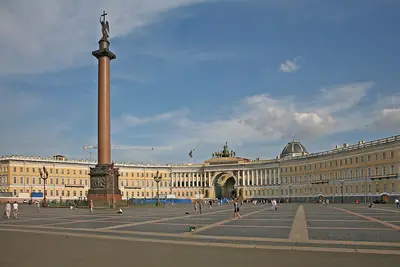
Palace Square is the monumental heart of St Petersburg’s former imperial center. The approximately five-hectare pedestrian square links Nevsky Prospekt with Palace Bridge and the route to Vasilievsky Island.
Its architectural ensemble is dominated by the white-and-turquoise Winter Palace, rebuilt between 1754 and 1762 as a residence for the Russian tsars. The palace now houses part of the State Hermitage Museum, with galleries extending through its former royal interiors.
Across the square, the bow-shaped General Staff Building was designed by Carlo Rossi between 1819 and 1829. Its central double triumphal arch, topped by a bronze Roman quadriga, commemorates Russia’s victory over Napoleonic France. At the center stands the Alexander Column, erected between 1830 and 1834 to honor Alexander I and the same victory.
The Spit of Vasilievsky Island
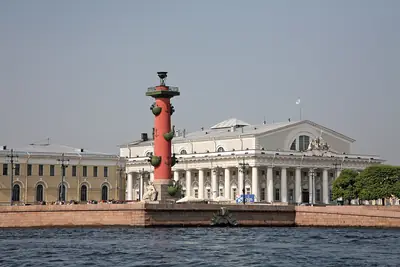
At the eastern tip of Vasilievsky Island, the Spit forms one of St Petersburg’s most recognizable waterfront ensembles, where the Bolshaya Neva and Malaya Neva divide. The area is part of the city’s UNESCO World Heritage waterfront and brings together the Old Stock Exchange, the Rostral Columns, the Kunstkamera, the Zoological Museum, the Academy of Sciences and the Twelve Collegia.
The Spit served as St Petersburg’s sea port until 1885. Its broad riverfront setting makes it one of the city’s most rewarding places for taking in the relationship between the Neva, the skyline and the city’s imperial architecture.
The Zoological Museum
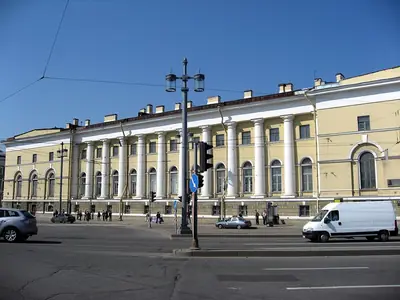
The Zoological Museum of the Russian Academy of Sciences occupies a former southern warehouse of the St Petersburg Bourse, built between 1826 and 1832. It is Russia’s oldest zoological museum and one of the largest natural history museums in the world, with more than thirty thousand specimens displayed across six thousand square meters.
The museum began with Peter the Great’s zoological collection in the Kunstkamera, founded in 1714. It became a separate institution in 1832 and moved to its current building in 1896. The entrance hall contains a monument to Karl Ernst von Baer, while large cetacean skeletons—including a twenty-seven-meter blue whale skeleton—make an immediate impression.
Imperial Academy of Arts
The Imperial Academy of Arts stands along the riverfront on Vasilievsky Island. Founded in 1757 under Empress Elizabeth Petrovna, it shaped generations of Russian painters, sculptors and architects.
Its Neoclassical headquarters was designed by Jean-Baptiste Vallin de la Mothe and constructed by Alexander Kokorinov between 1764 and 1789. The academy’s history also includes the “Revolt of the Fourteen” in 1863, when protesting graduates challenged its official academic restrictions and helped lay the foundations for the Peredvizhniki realist movement.
Senate Square
Senate Square lies on the left bank of the Bolshaya Neva, in front of St. Isaac’s Cathedral and beside the western edge of the Alexander Garden. The Admiralty rises to the east, while the Senate and Synod buildings occupy the western side.
The square is closely associated with the Decembrist Revolt of December 1825. It was renamed Decembrists’ Square in 1925 and officially returned to the name Senate Square in July 2008.
St Petersburg Mosque
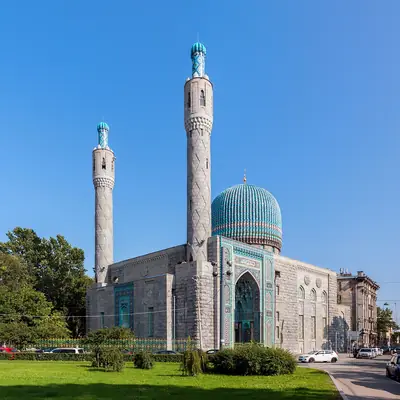
St Petersburg Mosque combines Northern Art Nouveau with Central Asian Islamic traditions. Designed by Nikolai Vasilyev, it was modeled on the Gur-e-Amir mausoleum in Samarkand. Its central dome rises thirty-nine meters, while its two minarets reach forty-nine meters.
When it opened in 1913, it was the principal mosque of the Russian Empire and the largest mosque in Europe outside Turkey. The foundation stone had been laid in 1910 to commemorate the twenty-fifth anniversary of the reign of Abdul Ahat Khan in Bukhara. Construction was completed in 1921.
Steregushchy Monument
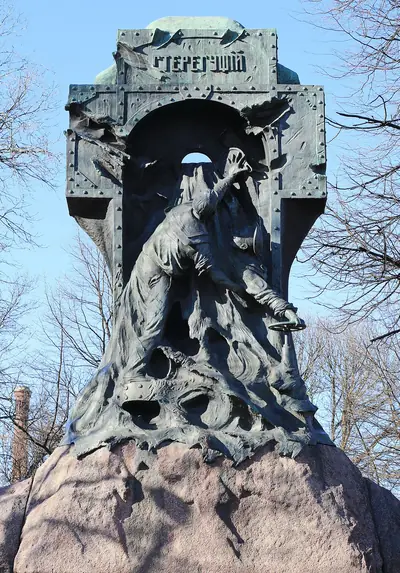
The Steregushchy Monument commemorates the torpedo boat Steregushchy, lost during the Russo-Japanese War in 1904. Unveiled in May 1911, it is notable as St Petersburg’s only monument in the Art Nouveau style and as the last monument erected in the city before the Russian Revolution.
Nevsky Prospekt
Nevsky Prospekt is St Petersburg’s main thoroughfare, lined with historic architecture and cultural landmarks. At its intersection with the Griboyedov Canal Embankment stands Engelhardt’s House, a former center of concerts, masquerades and literary gatherings.
The building became associated with figures including Alexander Pushkin, Vasily Zhukovsky, Ivan Krylov, Anton Delvig, Pyotr Vyazemsky and Kondraty Ryleyev. In the 1820s, Ivan Slyonin’s bookstore occupied the ground floor, adding to the avenue’s role in the city’s literary life.
The Garden of Friendship
The Garden of Friendship is a small Chinese garden on Liteyny Prospekt, opened in May 2003 as a gift from St Petersburg’s sister city, Shanghai, for the city’s three-hundredth anniversary. It recreates, on a smaller scale, Shanghai’s Yu Yuan, or Garden of Joy.
Its features include the Pagoda of Friendship, a Nine Dragon Wall, a stone bridge, a pond and a fountain. Carefully arranged rocks evoke miniature mountain ranges, while pines, willows, apple trees and a Japanese sakura tree complete the landscape.
St. Ann’s Church
St. Ann’s Church, or Annenkirche, was built between 1775 and 1779 for St Petersburg’s German Lutheran community. Designed by Georg Friedrich Veldten, the Neoclassical church is marked by elegant Ionic columns.
After its closure by the Soviet regime in 1935, the building was converted into a cinema called Spartak. It later operated as a nightclub before being severely damaged by a fire in 2002.
Saint Andrew’s Cathedral
Saint Andrew’s Cathedral on Vasilievsky Island is distinguished by its pastel pink exterior and five domes. It is the last Baroque cathedral built in St Petersburg.
The original project was conceived under Peter the Great as the chapter church of the Order of Saint Andrew. After a timber church on the site burned down following a lightning strike in 1761, architect Alexander Whist designed a stone replacement. Construction suffered another setback when the main cupola collapsed in 1766, and the completed cathedral was finally consecrated in 1780.
The Siege of Leningrad memorial
The Siege of Leningrad memorial recalls the city’s 872-day encirclement during the Second World War. The blockade began on September 8, 1941, when German and Finnish forces cut the last overland routes between Leningrad and the rest of the Soviet Union.
Bombing, starvation and the bitter winter of 1941–1942 caused hundreds of thousands of civilian deaths. Lake Ladoga became the city’s remaining lifeline: supplies arrived by boat in warmer months, by air and across the ice in winter along the route known as the Road of Life.
Explore St Petersburg with a free audio guide
Neywo offers 7 walking tours and 1 bus route in St Petersburg, with narration available in 11 languages. The walks range from 2.66 to 3.99 km and from 89 to 116 minutes, while the bus route covers 5.5 km in 24 minutes. Together, the tours include between 6 and 12 narrated stops each.
Choose a route through the imperial center, follow Nevsky Prospekt to the Church of the Savior on Blood, discover where the city was born at Peter and Paul Fortress, or explore Vasilievsky Island and the historic Spit. The app tells the story of each place as you reach it, at your own pace, with no group and no schedule.
Download Neywo and explore St Petersburg independently, from its palaces and squares to its bridges, museums and riverfront landmarks. For more of the country, continue with the Russia guide, or compare St Petersburg with Moscow, Yekaterinburg, Vladivostok, Sochi or Kaliningrad.
Places with an audio guide in St Petersburg
8 places in St Petersburg with a Neywo audio guide. Each one starts telling its story as you reach it.
Self-guided tours in St Petersburg
8 tours in St Petersburg, free in the Neywo app. Each stop tells its story as you reach it.
- Bus ride
Bus 7: Nevsky Prospect to Vasilyevsky Island
Ride bus 7 from Vosstaniya Square down Nevsky Prospect, past Gostiny Dvor, over the Anichkov and Green bridges and across the Neva by the Palace Bridge to Vasilyevsky Island. It passes the Kunstkamera, Menshikov's palace and the Rumyantsev Obelisk and ends near St Andrew's Cathedral. It is a cheap cross-section of the old capital.
Vosstaniya Square · Great Gostiny Dvor · Nevsky Prospekt · Green Bridge · Palace Bridge · Kunstkamera …
Open this tour: Bus 7: Nevsky Prospect to Vasilyevsky Island - Walk
Imperial Petersburg: Tsars, Horsemen and Golden Spires
Walk through the stage of imperial Russia. Pass under the General Staff arch into Palace Square, face the Winter Palace, then stroll Alexander Garden to the golden-spired Admiralty. Meet the Bronze Horseman on Senate Square, climb the steps of Saint Isaac's Cathedral and end at the statue of Nicholas I and the Mariinsky Palace.
General Staff Building, Saint Petersburg · Palace Square · Winter Palace · Alexander Garden · Admiralty building in Saint Petersburg · Bronze Horseman …
Open this tour: Imperial Petersburg: Tsars, Horsemen and Golden Spires - Walk
Nevsky Prospect to the Church of the Spilled Blood
Follow the grand avenue from the baroque Stroganov Palace to the colonnaded Kazan Cathedral, then turn to the onion domes of the Church of the Savior on Blood. Continue through Arts Square and the Russian Museum, the Mikhailovsky Garden and the moated Saint Michael's Castle, then cross the Field of Mars to the pink Marble Palace.
Stroganov Palace · Kazan Cathedral · Church of the Savior on Blood · Arts Square · Russian Museum · Mikhaylovsky Garden, Saint Petersburg …
Open this tour: Nevsky Prospect to the Church of the Spilled Blood - Walk
Peter and Paul Fortress: Where the City Was Born
Start where the city began in 1703. Walk the bastions and the mint of the Peter and Paul Fortress, see the spire of its cathedral where the tsars are buried, then cross to the Petrograd Side for the blue-domed mosque, the ballerina's art nouveau mansion and the log cabin Peter the Great lived in while his city was built.
Saint Petersburg Mint · Monument to Peter I by Mihail Chemiakin · Peter and Paul Cathedral · Commandant's House of Peter and Paul Fortress · Military Historical Museum of Artillery, Engineers and Signal Corps · Stereguschemu Monument …
Open this tour: Peter and Paul Fortress: Where the City Was Born - Walk
Vasilyevsky Island: Scholars, Spit and Stock Exchange
Walk the length of Vasilyevsky Island along the Neva. Start at the Academy of Arts with its sphinxes, pass Menshikov's palace, the Twelve Collegia and Mendeleev's flat, and finish on the Spit with the Old Stock Exchange and Peter the Great's Kunstkamera.
Imperial Academy of Arts · Rumyantsevsky Obelisk · Menshikov Palace (Saint Petersburg) · Saint Petersburg State University · Dmitry Mendeleev's Memorial Museum Apartment · Twelve Collegia …
Open this tour: Vasilyevsky Island: Scholars, Spit and Stock Exchange - Walk
Mariinsky Petersburg: Opera, Ballet and the Naval Cathedral
A walk around the cultural heart of the city. Start at Yusupov Palace, where Rasputin was killed, then visit the blue-and-white Naval Cathedral, Theatre Square and the oldest conservatory in Russia. Pass the Mariinsky Second Stage, the Grand Choral Synagogue and a Catholic church before ending at the apartment museum of the poet Alexander Blok.
Yusupov Palace on Moika · St. Nicholas Naval Cathedral, St. Petersburg · Theatre Square (Saint Petersburg) · Saint Petersburg Conservatory · Mariinsky Theatre Second Stage · Grand Choral Synagogue …
Open this tour: Mariinsky Petersburg: Opera, Ballet and the Naval Cathedral - Walk
Fontanka Petersburg: Anichkov Bridge to Dostoevsky's Street
Leave the main avenue for the Fontanka river. Start at the Alexandrinsky Theatre and the puppet theatre on Nevsky, cross the Anichkov Bridge with its horse tamers, see the Fabergé Museum and Fountain House, then wander to Vladimir Cathedral, the Kuznechny Market and the flat where Dostoevsky wrote his last novel.
Alexandrinsky Theatre · Marionette Theatre Evgeny Demmeni · Fabergé museum in Saint Petersburg · Sheremetiev Palace · Cathedral of the Vladimir Icon of the Mother of God · Kuznechny Market …
Open this tour: Fontanka Petersburg: Anichkov Bridge to Dostoevsky's Street - Walk
Tauride and Smolny: Palaces of Power
Visit the quieter east of the centre: the cathedral of the Preobrazhensky guards, the Joy of All Who Sorrow church and the grand Tauride Palace and its garden, where the first Russian parliament met. End at the baroque Smolny Convent by Rastrelli.
Transfiguration Cathedral · Our Lady of the Joy of All Who Sorrow church (Saint Petersburg) · Tauride Garden · Tauride Palace · Kikin Hall · Smolny Convent
Open this tour: Tauride and Smolny: Palaces of Power
Walk St Petersburg with Neywo
Neywo turns St Petersburg into a self-guided audio tour. Stories arrive as you reach the place they belong to, and the route reshapes when you wander off it.

