Things to Do in Banská Bystrica, Slovakia: Walking Guide
Things to do in Banská Bystrica: what to see in the historic centre
Banská Bystrica is a historic city in central Slovakia, set in a broad valley surrounded by the Low Tatras, Veľká Fatra and Kremnica Mountains. Its medieval prosperity came from copper mining, while its modern identity is closely connected with the Slovak National Uprising. Neywo’s free audio guide for Banská Bystrica narrates 15 places as you explore.
What to see in Banská Bystrica
The best way to discover the city is to begin in the historic centre, then continue through its museums, churches, theatres and modern squares.
Banská Bystrica Castle
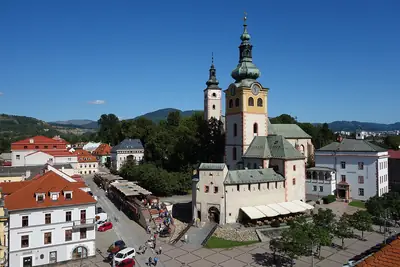
Banská Bystrica Castle is not a single fortress but a complex of buildings developed over several centuries. The ensemble includes the Church of the Assumption, Matthew’s House, the Church of the Holy Cross, the old town hall, the rectory, fortifications, bastions, an entrance gate and a barbican.
The Church of the Assumption is the centrepiece. Also known as the German Church, it was built in the mid-thirteenth century for the city’s wealthy German burghers and mine owners. Parts of its chancel and tower are among the oldest surviving masonry in Banská Bystrica.
Nearby, the Church of the Holy Cross is known as the Slovak Church. It stands on the site of an earlier chapel and was connected to the town’s defensive walls and Matthew’s House. Its name reflects the historic division between Slovak and German communities in the city.
Slovak National Uprising Square
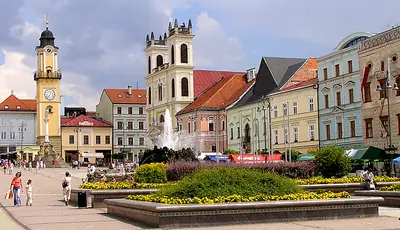
Slovak National Uprising Square, or Námestie SNP, is the central public space of Banská Bystrica. Its elongated shape and surrounding historic buildings reflect the wealth generated by the medieval copper trade. The square brings together several important sights, including the castle area, the Museum of Central Slovakia and St. Francis Xavier Cathedral.
The city received free royal privileges in 1255, after which German settlers arrived to develop the mines. Their influence, together with the wealth of the copper trade, shaped the churches, mansions and fortifications that still define the centre.
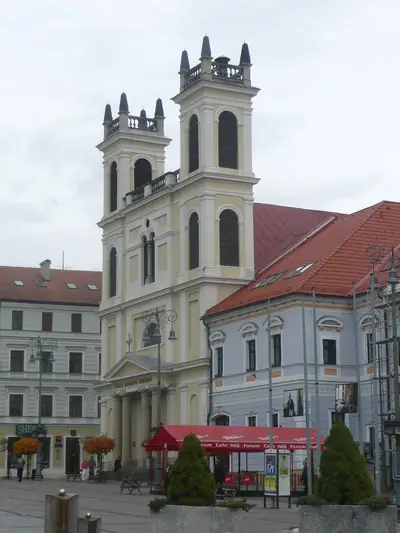
St. Francis Xavier Cathedral
At the corner of Slovak National Uprising Square and Kapitula Street, St. Francis Xavier Cathedral is the seat of the Roman Catholic Diocese of Banská Bystrica. It began as a Jesuit church in 1695, inspired by the Jesuit church of Il Gesù in Rome.
Construction was interrupted between 1701 and 1709 during Francis Rákóczi’s uprising. The church was eventually consecrated in 1715 and became a cathedral in 1776, when the Diocese of Banská Bystrica was established.
Museum of Central Slovakia
The Museum of Central Slovakia is the oldest cultural institution in Banská Bystrica. It was approved by the city council in 1889, and its first exhibition opened in 1909 at Matejov dom.
Today, the museum operates from three buildings. Its historical exhibition is housed in Thurzov dom on SNP Square, a Renaissance palace once associated with the Thurzo family, one of Central Europe’s influential mining dynasties. The natural history exhibition is located in Tihányiovský kaštieľ in the Kráľová district and focuses on the flora, fauna and geology of central Slovakia.
Church of St. Elizabeth
The Church of St. Elizabeth, known locally as Alžbetka, stands on Dolná ulica and is one of Banská Bystrica’s oldest surviving buildings. It dates back to 1303, when it stood beside the former city hospital.
A fire in 1605 destroyed most of the church. It was rebuilt several times, and the present building largely reflects the neo-Gothic reconstruction of 1877. Today it is a national cultural monument and a quiet reminder of more than seven centuries of the city’s history.
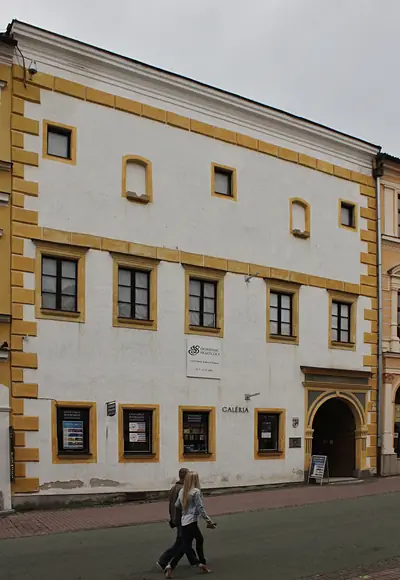
Central Slovakian Gallery
The Central Slovakian Gallery has been the region’s main art museum since 1956. Its collection and exhibitions focus on modern and contemporary art.
One of its highlights is the permanent exhibition dedicated to Dominik Skutecký, one of Slovakia’s important painters. The exhibition follows the development of his style and his place in Slovak art history.
Museum of the Slovak National Uprising
Banská Bystrica was the centre of the Slovak National Uprising, which began on August 29, 1944. The coordinated resistance was led mainly by members of the Democratic Party, Social Democrats and Communists within the Allied-recognised 1st Czechoslovak Army in Slovakia.
The uprising was largely defeated by German forces, although guerrilla operations continued until the territory was liberated in 1945. The Museum of the Slovak National Uprising documents this history, including the Slovak State from 1939 to 1945 and its collaboration with Nazi Germany.
SNP Monument and Museum
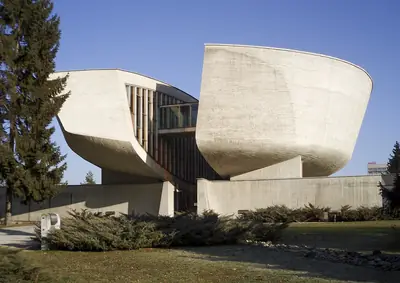
The SNP Monument and Museum is a major memorial to the 1944 uprising. Its brutalist building was completed in 1969 and designed by architect Dušan Kuzma. The structure is regarded as one of Slovakia’s notable examples of modern architecture.
Together, the monument and museum give the uprising a powerful physical presence in the city. They are among the most important places to visit for anyone interested in Slovakia’s twentieth-century history.
Námestie slobody
Námestie slobody, or Freedom Square, is the city’s second-largest square. It was laid out during the communist era as a new urban centre, with monumental buildings surrounding a broad public space.
The Hotel Lux was built in 1969, followed by the House of Culture in 1979 and the building now occupied by the VÚB bank in 1980. The square once contained a statue of Vladimir Lenin, which was removed on May 17, 1990, after a symbolic episode during the Velvet Revolution.
Bábkové divadlo na rázcestí
Bábkové divadlo na rázcestí, the Puppet Theatre at the Crossroads, has been part of Banská Bystrica’s cultural life since 1960. Its first production was Šuki a Muki, staged on December 10 of that year.
The theatre developed a distinctive role beyond children’s entertainment. Its work used puppetry to reflect social realities, including the restrictions of the communist period. Since 1991, it has used its present name.
Divadlo z Pasáže
Divadlo z Pasáže, or the Theatre from the Passage, is a professional community theatre built around actors with mental disabilities. Founded in 1995, it combines artistic work with social services.
The company’s activities are connected with a Day Centre and Protected Housing facility. Its work has included original productions, a feature film, television documentaries and an international biennial festival of community art.
Štátna opera Banská Bystrica
Štátna opera Banská Bystrica stages opera, operetta, musicals, ballet and concerts. Its history began in 1959, when a music drama ensemble was established in Banská Bystrica as part of the Central Slovak Theatre in Zvolen.
The company later became the State Opera, a name it has used since 1999. Its performances bring both Slovak and international works to audiences in Slovakia and abroad.
Štefan Moyses Square
Štefan Moyses Square lies in the historic heart of Banská Bystrica. In 1937, it was known as Horné Square, or Upper Square. It forms part of the central area explored by the city’s historic walking route.
A Banská Bystrica self-guided walking tour with Neywo
Neywo offers a free Banská Bystrica audio guide with 15 narrated places. Its city tours include one walking tour and one bus route, with narration available in 11 languages.
The walking tour, Copper Kings and the Uprising: Banská Bystrica’s Old Centre, covers 2.13 km in about 88 minutes and includes 11 narrated stops. It leads through the city’s historic centre, connecting places such as the Church of St. Elizabeth, the Central Slovakian Gallery, the Museum of Central Slovakia, St. Francis Xavier Cathedral, Banská Bystrica Castle, the Museum of the Slovak National Uprising and Námestie slobody.
The bus route, Bus 22 across Banská Bystrica: from the uprising memorial to the castle, covers 8.6 km in about 37 minutes and includes six stops. It connects the SNP Monument and Museum, Bábkové divadlo na rázcestí, the Church of St. Elizabeth, the Central Slovakian Gallery, Banská Bystrica and Banská Bystrica Castle.
Download Neywo and explore at your own pace: the app tells the story of each place as you reach it, with no group and no schedule. Banská Bystrica is a good starting point for discovering Slovakia, and you can continue your trip to Banská Štiavnica, Bratislava or Nitra.
Places with an audio guide in Banská Bystrica
8 places in Banská Bystrica with a Neywo audio guide. Each one starts telling its story as you reach it.

Self-guided tours in Banská Bystrica
2 tours in Banská Bystrica, free in the Neywo app. Each stop tells its story as you reach it.
- Bus ride
Bus 22 across Banská Bystrica: from the uprising memorial to the castle
Public city bus 22 runs through the heart of Banská Bystrica between the Rudlová hillside and the Hron embankment. Ride it from the brutalist SNP memorial and the Puppet Theatre at the Crossroads past St. Elizabeth's church and the Central Slovakian Gallery to the old castle complex above the main square.
SNP Monument and Museum in Banská Bystrica · Bábkové divadlo na rázcestí · Church of St. Elizabeth · Central Slovakian Gallery · Banská Bystrica · Banská Bystrica Castle
Open this tour: Bus 22 across Banská Bystrica: from the uprising memorial to the castle - Walk
Copper Kings and the Uprising: Banská Bystrica's Old Centre
Banská Bystrica grew rich on copper, and its old centre still shows it: Gothic and Baroque churches, the Thurzo family palace and a fortified castle complex with onion-domed towers. Follow the story from the oldest church on Dolná ulica to the great square, then east to the concrete memorial to the 1944 Slovak National Uprising and the socialist plaza that replaced a Lenin statue.
Church of St. Elizabeth · Central Slovakian Gallery · Banská Bystrica · Museum of Central Slovakia · St. Francis Xavier Cathedral · Banská Bystrica Castle …
Open this tour: Copper Kings and the Uprising: Banská Bystrica's Old Centre
Walk Banská Bystrica with Neywo
Neywo turns Banská Bystrica into a self-guided audio tour. Stories arrive as you reach the place they belong to, and the route reshapes when you wander off it.

