What to See in Johannesburg, South Africa: Free Audio Guide
Things to Do in Johannesburg: What to See in the City
Johannesburg is a South African city shaped by gold mining, political struggle, culture, sport, and contemporary art. The best things to do in Johannesburg include visiting museums, exploring historic neighbourhoods, and seeing landmarks connected to the country’s twentieth-century history. Neywo offers a free audio guide for Johannesburg with 64 narrated places, available in 11 languages.
What to See in Johannesburg
MuseuMAfricA and Newtown
MuseuMAfricA is a history museum housed in Johannesburg’s former fruit and vegetable market. Also known as the Africana Museum, it stands opposite Mary Fitzgerald Square and shares a block with the Market Theatre. Its location makes it a useful starting point for understanding Newtown’s historic surroundings.
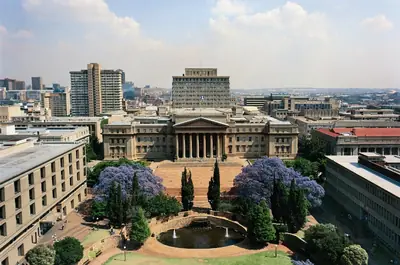
The University of the Witwatersrand
The University of the Witwatersrand, commonly called Wits, is a public research university in the northern part of Johannesburg’s central business district. Its origins lie in the South African School of Mines, founded in Kimberley in 1896 after the discovery of diamonds and gold. The institution moved to Johannesburg in 1903 and became a university in 1922.
Its first faculties included arts, science, medicine and dentistry, commerce, engineering, and law. Wits also has a connection with football through Wits University FC, which plays in the Premier Soccer League.
Johannesburg Planetarium and Origins Centre
The Johannesburg Planetarium stands on Wits University’s East Campus in Braamfontein. It was the first full-sized planetarium in Africa and the second in the southern hemisphere, making it an important landmark in the history of astronomy and science on the continent.
Nearby, the Origins Centre explores the history of early humans in Africa. Its exhibitions include ancient rock art, offering a glimpse into some of the earliest human stories and forms of expression on the continent.
Johannesburg Art Gallery
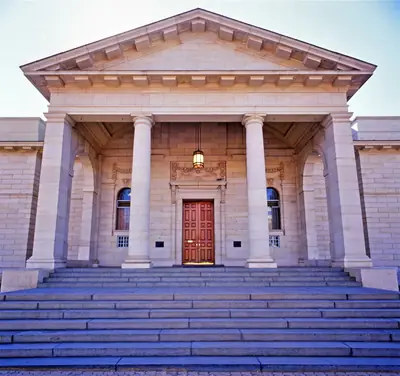
Johannesburg Art Gallery, usually called JAG, is set in Joubert Park in the city centre. The gallery brings together art, architecture, and Johannesburg’s mining history. Its collection contains more than 9,000 artworks, although only about a tenth can be shown at once across its 15 exhibition halls and sculpture gardens.
The building was completed in 1915 and designed by Sir Edwin Lutyens, with Robert Howden as supervising architect. Inside, the collection ranges from 17th-century Dutch paintings to British and European art from the 18th and 19th centuries, South African works, contemporary local and international art, and prints dating from the 15th century to the present.
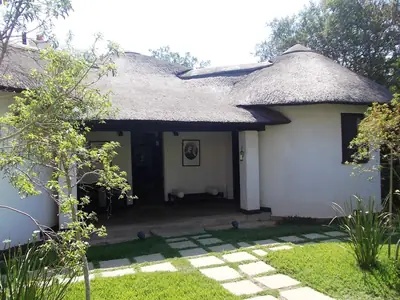
Satyagraha House
Satyagraha House, also known as Gandhi House, is a museum and guest house connected with Mahatma Gandhi. Gandhi lived and worked there from 1908 to 1909. The house was designed by Hermann Kallenbach for Gandhi and himself and is now recognized as part of Johannesburg’s historical heritage.
Goodman Gallery
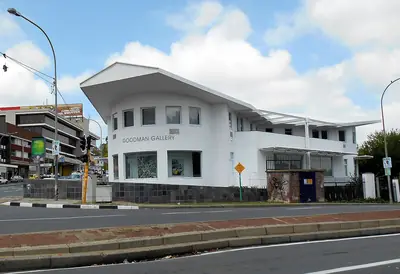
Goodman Gallery is an important Johannesburg institution in the history of contemporary art in Southern Africa. Linda Givon, previously known as Goodman, founded the gallery in 1966. Since then, it has remained connected with artists shaping the region’s art landscape.
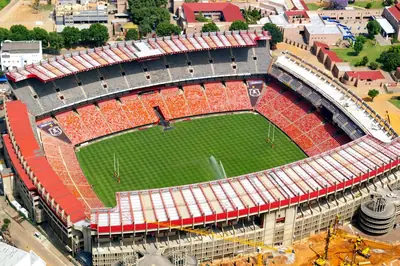
Ellis Park Stadium
Ellis Park Stadium is one of Johannesburg’s best-known sporting venues. It hosts rugby union, association football, and major live events, including concerts. The stadium is particularly associated with the 1995 Rugby World Cup final, when South Africa’s national team, the Springboks, defeated its opponent.
The stadium was upgraded in 1982 and was then South Africa’s most modern stadium, with capacity for almost 60,000 spectators. It takes its name from J.D. Ellis, who made the land available for its construction. Cricket was once also part of its history: six Test matches were played there between 1948 and 1954, before first-class cricket moved on after New Wanderers Stadium opened in 1956.
James Hall Transport Museum
The James Hall Transport Museum is beside Wemmer Pan in La Rochelle. It is the largest transport museum on the African continent, with collections focused on the history of transport in South Africa and across Africa.
Jimmie Hall founded the museum with the City of Johannesburg in 1964. Its collections at Pioneers’ Park show how vehicles and other forms of transport contributed to the movement of people and goods across the continent.
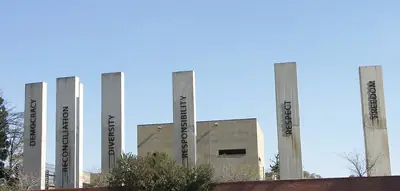
Apartheid Museum
The Apartheid Museum, part of the Gold Reef City complex, explores apartheid and South Africa’s twentieth-century history. It opened in November 2001 and operates as a non-profit organisation with an independent board of trustees.
The museum is also a place of public remembrance. Events are held there at least five times a year to mark the end of apartheid and the beginning of multiracial democracy in South Africa.
FNB Stadium and the 2010 FIFA World Cup final
FNB Stadium, also known as Soccer City or the Calabash, is a football and rugby union stadium in Nasrec, bordering Soweto. Its shape resembles an African pot or gourd, which explains its nickname. With a capacity of 94,736, it is Africa’s largest stadium.
The venue has an important place in Johannesburg’s political history. Nelson Mandela delivered his first speech in the city after his release from prison there in 1990. The stadium also hosted the funerals of Chris Hani and Oliver Tambo, as well as Mandela’s international memorial service in 2013.
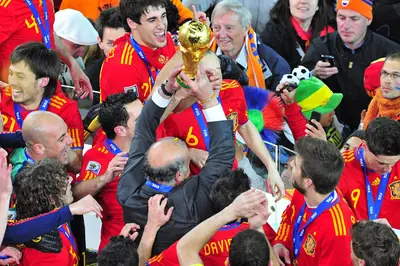
On 11 July 2010, FNB Stadium hosted the FIFA World Cup final between the Netherlands and Spain. It was the first and only World Cup final held outside Europe to feature two European finalists.
Mandela House
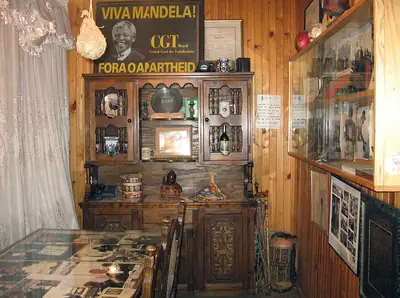
Mandela House, formally the Nelson Mandela National Museum, is the Soweto house where Nelson Mandela lived from 1946 to 1962. Mandela donated the house to the Soweto Heritage Trust on 1 September 1997 so that it could be run as a museum. It was declared a National Heritage Site in 1999.
Hector Pieterson Museum
The Hector Pieterson Museum in Orlando West, Soweto, focuses on the Soweto Uprising and the life and death of student protester Hector Pieterson. The museum stands two blocks from the place where Pieterson was shot and killed on 16 June 1976.
Films, newspapers, personal accounts, and photographs tell the story of that day and the wider anti-apartheid struggle. One of the best-known images on display is Sam Nzima’s photograph of Pieterson. The museum opened on 16 June 2002 and was one of the first museums in Soweto.
Military history and Holy Trinity Catholic Church
The South African National Museum of Military History preserves the history of South Africa’s involvement in conflict. Prime Minister Jan Smuts officially opened it on 29 August 1947 to preserve the country’s Second World War history. Its role later expanded to include all conflicts involving South Africa.
In Braamfontein, the site associated with Wits Art Museum is also connected with Holy Trinity Catholic Church, a Catholic parish church in north-central Johannesburg.
Explore Johannesburg with a self-guided walking tour
A Johannesburg self-guided walking tour is a practical way to connect the city’s museums, architecture, public spaces, and historical landmarks. Neywo has three walking tours in Johannesburg:
- Newtown to the Carlton Centre: Johannesburg’s Gold Rush City covers 3.23 km in 86 minutes, with eight narrated stops including MuseuMAfricA, the Market Theatre, the Statue of Mahatma Gandhi, and the Carlton Centre.
- Braamfontein and Constitution Hill: Students, Stage and Justice covers 4.56 km in 105 minutes, with eight stops including the University of the Witwatersrand, Johannesburg Planetarium, Origins Centre, Constitution Hill, and the Flame of Democracy.
- Cathedral, Ponte City and Ellis Park: East of the Centre covers 4.27 km in 99 minutes, with seven stops including Johannesburg Art Gallery, the Cathedral of Christ The King, Ponte City Apartments, and Ellis Park Stadium.
Download Neywo for Johannesburg
Download Neywo to explore Johannesburg with its free audio guide and 64 narrated places. The app tells the story of each place as you reach it, at your own pace, with no group and no schedule. Choose one of the three walking tours or follow the city’s stories independently, listening as Johannesburg’s history, art, sport, and political heritage unfold around you. You can also continue discovering South Africa, from Johannesburg to Cape Town, Langebaan, or Simon’s Town.
Places with an audio guide in Johannesburg
8 places in Johannesburg with a Neywo audio guide. Each one starts telling its story as you reach it.
Self-guided tours in Johannesburg
3 tours in Johannesburg, free in the Neywo app. Each stop tells its story as you reach it.
- Walk
Newtown to the Carlton Centre: Johannesburg's Gold Rush City
Walk from the creative heart of Newtown into the old gold-rush centre. You pass the theatre that defied apartheid, a ten-metre steel woman carrying fire, a church that shelters refugees, the squares named for Beyers Naude and Gandhi, and the tower that was Africa's tallest building for 46 years.
MuseuMAfricA · Market Theatre · Fire Walker · St Aidan's Anglican Church, Johannesburg · Central Methodist Church, Johannesburg · Beyers Naudé Square …
Open this tour: Newtown to the Carlton Centre: Johannesburg's Gold Rush City - Walk
Braamfontein and Constitution Hill: Students, Stage and Justice
From the Fietas Museum, which recalls a neighbourhood torn apart by forced removals, to the university where many of South Africa's leaders studied, through the museum of early humanity and the city's theatre complex, to Constitution Hill, where a former prison now holds the Constitutional Court.
Fietas Museum · University of the Witwatersrand · Johannesburg Planetarium · Origins Centre · Alexander Theatre · Joburg Theatre …
Open this tour: Braamfontein and Constitution Hill: Students, Stage and Justice - Walk
Cathedral, Ponte City and Ellis Park: East of the Centre
East of the centre: the Johannesburg Art Gallery and the Church of Peace, a modern Catholic cathedral, the cylindrical Ponte City tower that dominates the skyline, the Lions Synagogue, the rugby and football stadium where South Africa lifted the 1995 Rugby World Cup, and the Baptist church of Troyeville.
Johannesburg Art Gallery · Friedenskirche · Cathedral of Christ The King, Johannesburg · Ponte City Apartments · Doornfontein Synagogue · Ellis Park Stadium …
Open this tour: Cathedral, Ponte City and Ellis Park: East of the Centre
Walk Johannesburg with Neywo
Neywo turns Johannesburg into a self-guided audio tour. Stories arrive as you reach the place they belong to, and the route reshapes when you wander off it.

