Things to Do in Dubai, United Arab Emirates: Walking Guide
Things to Do in Dubai: A Guide to What to See
The best things to do in Dubai range from futuristic museums and record-breaking skyscrapers to historic neighbourhoods, traditional houses, religious landmarks and lively souks. The city is especially rewarding when you explore the contrast between its modern skyline and the creekside districts that preserve its earlier history. Neywo has a free audio guide for Dubai with 45 narrated places.
What to See in Dubai
Museum of the Future
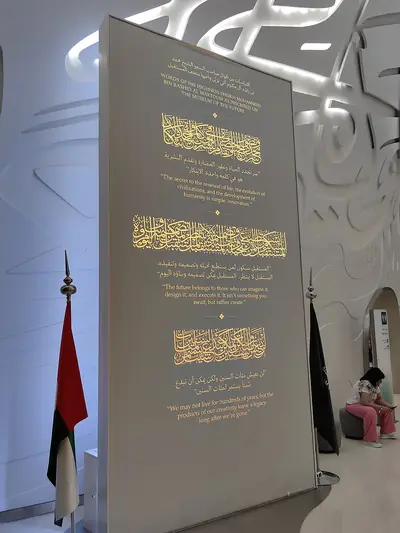
The Museum of the Future is an exhibition space dedicated to science, technology and innovation. Its torus-shaped building is one of Dubai’s most distinctive landmarks, with Arabic poetry about the future integrated into its windows. Emirati artist Mattar bin Lahej crafted the calligraphy in the glass.
Opened on 22 February 2022 by the Dubai Future Foundation and the Government of the United Arab Emirates, the museum describes itself as a “living museum”. Its experience combines traditional exhibitions with immersive theatre and themed attractions. National Geographic has recognized the building as one of the world’s 14 most beautiful museums.
Burj Khalifa
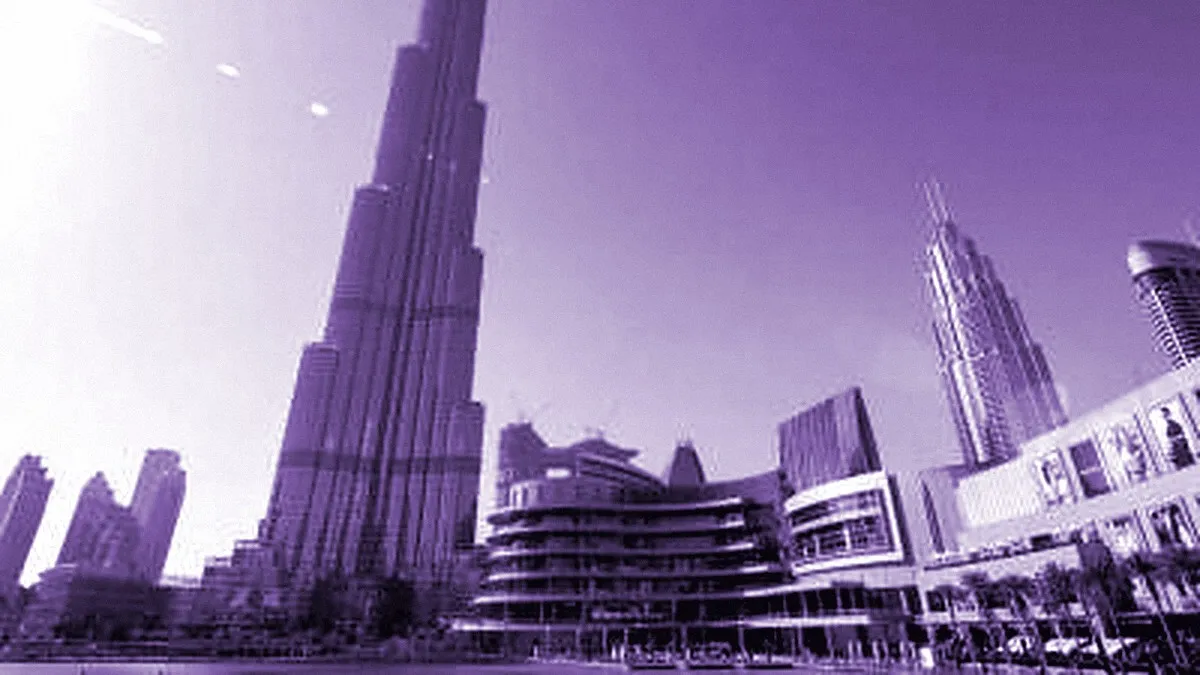
Burj Khalifa dominates Dubai’s skyline and is described as the world’s tallest structure. It reaches 829.8 metres in total, including a 242.6-metre spire, and has held the title since it topped out in 2009.
Construction began in 2004, and the building opened in 2010 as part of Downtown Dubai. Its Y-shaped floor plan was designed to optimize residential and hotel space, while its architecture draws on Islamic influences, including the Great Mosque of Samarra. The exterior cladding was also designed to withstand Dubai’s hot summer temperatures.
Dubai Mall
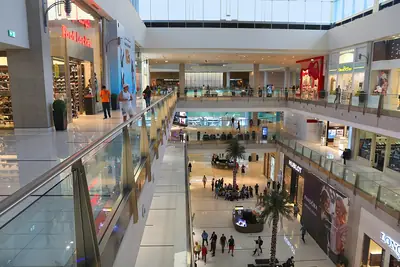
Dubai Mall is one of the city’s largest shopping and entertainment destinations. It forms part of the wider Downtown Dubai complex and officially opened on 4 November 2008. Its attractions include the Dubai Aquarium & Underwater Zoo, as well as a wide range of retail and entertainment experiences.
The mall attracted more than 37 million visitors in 2009 and 47 million in 2010. By 2012, it was described as the world’s most visited shopping mall and entertainment destination, with more than 65 million visitors.
The Dubai Fountain
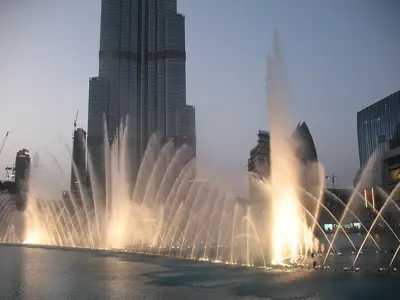
On the artificial lake in Downtown Dubai, The Dubai Fountain combines water, light and music in a choreographed performance. As of 2025, it is described as the world’s largest choreographed fountain.
Its system stretches 275 metres, with water reaching up to 152.4 metres into the air. The show uses 6,600 lights, 25 coloured projectors, five circles of different sizes and two arcs. Its musical programme ranges from classical compositions to contemporary Arabic and world music.
Al Bastakiya and the Al Fahidi Historical Neighbourhood
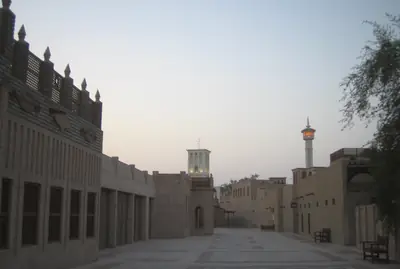
Al Bastakiya, also known as the Al Fahidi Historical Neighbourhood, offers a glimpse of Dubai before the modern skyline transformed the city. Developed in the 1890s as a residential district, it is characterized by narrow lanes, traditional one- and two-storey buildings and wind towers.
The neighbourhood once housed wealthy merchants, and the number of wind towers was reportedly used as a sign of a resident’s wealth. After oil was discovered, many merchants moved away and expatriate workers took over the houses. In the 1970s, half of the buildings were demolished for an office complex, while the remainder fell into disrepair, apart from the Majlis Arts Centre.
Dubai Coins Museum
The Dubai Coins Museum in Bur Dubai is dedicated to coins used in Dubai and the wider region. Its collection reflects connections between the monetary systems of the British Empire, India and other parts of the region before independence and the formation of a union.
The museum also helps explain the history of Dubai Creek. In the early twentieth century, the creek served as a small port for dhows from India and East Africa. It was Dubai’s sole port or harbour and supported important commercial activities, including the pearl industry.
Sheikh Obaid bin Thani House
In Al Shindagha, Sheikh Obaid bin Thani House is one of the area’s oldest surviving homes. Built in 1916 from sea stone, gypsum and mud, the two-storey house contains 18 rooms arranged across two phases of construction.
The second floor hosts “Arabic Calligraphy Through Time”. One section follows the development of Arabic calligraphy, while another displays original examples by notable calligraphers from the region. The house was restored between 1956 and 1961 and carefully restored again in 1998.
Al Shindagha Museum
The Al Shindagha Watchtower dates from 1939, when it formed part of a group of three defensive towers guarding Dubai Creek. Built from stone matching the traditional style of the district, it blends naturally into its surroundings.
The tower was restored in 1994. Today, it provides a compact reminder of the creek’s importance to the city and a distinctive setting for photographs.
Saeed Al Maktoum House
Saeed Al Maktoum House was established around 1896 as the seat of the Al Maktoum family. It remained the residence of Sheikh Saeed Al Maktoum until his death in 1958 and is now a museum presenting the history of old Dubai through rooms, displays and artefacts.
The traditional house uses coral covered with lime and sand, with high ceilings, arched entrances and carved windows. Its ground-floor rooms are arranged around a central courtyard, while the upper floor has balconies and views over the creek.
Majlis Ghorfat Umm Al Sheif
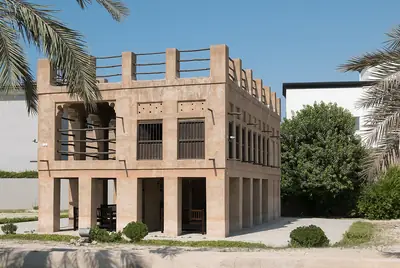
Majlis Ghorfat Umm Al Sheif is a summerhouse built in 1955 for Sheikh Rashid bin Saeed Al Maktoum, the former Ruler of Dubai. It was named after a pearl fishery and originally stood in a date-palm plantation near a fishing village, away from the town of Dubai.
The building combines adobe, gypsum, coral and timber. Its roof terrace was used to dry dates and as an open-air sleeping platform. The majlis was fully restored in 1994, with a garden containing date palms and a traditional aflaj irrigation system.
Jumeirah Mosque
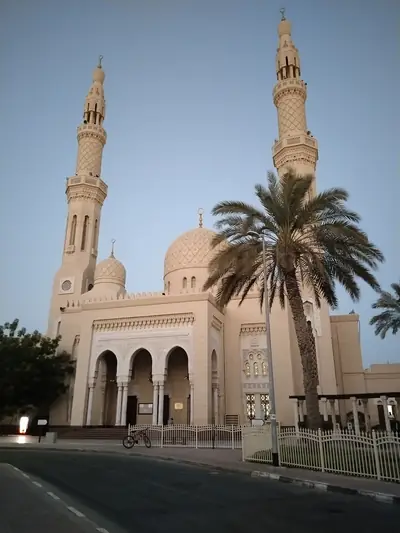
Jumeirah Mosque is one of Dubai’s most photographed mosques. Construction began in 1975, and it officially opened in 1979. Its design combines historical Islamic influences, including Fatimid and Mamluk styles.
The exterior uses multicoloured marble and Quranic verses, while the dome features Arabic inscriptions. Two minarets and an ablution fountain create a balanced composition, and the interior includes a prayer hall and Qibla wall.
Dubai Frame
Located in Zabeel Park, Dubai Frame is an observatory, museum and monument designed to connect Dubai’s past and present. It measures 150.24 metres high and 95.53 metres wide, making it the largest frame in the world.
Its position provides views towards the older parts of Dubai to the north and newer areas to the south. The structure is covered with gold leaf, and its proportions were inspired by the golden ratio, 1.618. The project opened in January 2018.
Hindu Temple, Dubai
The Hindu Temple in Dubai is an active place of worship serving the UAE’s Hindu community. The complex was initially established in 1958 in Bur Dubai and included the Shiva Mandir, Krishna Mandir and Gurudwara.
In October 2022, the Shiva Mandir and Gurudwara moved to a new Hindu Temple in Jebel Ali. The Krishna Mandir remains at the Bur Dubai location. The Jebel Ali temple combines Indian and Emirati architectural influences and has a capacity of about 1,000 people.
Ski Dubai
Inside the Mall of the Emirates, Ski Dubai offers an indoor winter environment in the middle of the city. Opened in November 2005, the resort covers 22,500 square metres and maintains temperatures between minus one and two degrees Celsius.
Its artificial mountain rises 85 metres and is served by chairlifts and tow lifts. Five slopes offer different levels of difficulty, including a 400-metre run and the world’s first indoor black diamond run. The 3,000-square-metre Snow Park includes sledding and toboggan runs, a body slide, climbing towers, giant snowballs and an ice cave. Ski Dubai also has penguins, with encounters available to book.
Almas Tower
Almas Tower, or “Diamond Tower”, is a 360-metre, 68-storey skyscraper in Jumeirah Lakes Towers. Construction began in early 2005 and was completed in 2008. When it topped out, it became Dubai’s tallest building, before Burj Khalifa surpassed it in 2009.
The Dubai Multi Commodities Centre and Dubai Diamond Exchange were among the first occupants. The tower is known for its office facilities and its emphasis on security and confidentiality.
Explore Dubai with a Self-Guided Walking Tour
A Dubai self-guided walking tour is a practical way to focus on the city’s historic districts without joining a group. Neywo currently offers two walking tours in Dubai:
- Bur Dubai: the souks, the fort and the Hindu temple — 0.98 km, 45 minutes and 6 narrated stops.
- The Ultimate Dubai: gold souk to the Heritage Village — 4.74 km, 144 minutes and 15 narrated stops.
The routes include places such as Dubai Textile Souk, the Grand Mosque, Hindu Temple, Al Fahidi Fort, Dubai Coins Museum, Baniyas Square, Naif Market, Dubai Gold Souk, Spice Souk and Al Shindagha Museum.
Download Neywo and Explore Dubai at Your Own Pace
Download Neywo to explore Dubai with stories that play as you reach each place. The app includes 45 narrated places, two walking tours and narration in 11 languages. Each story starts at the relevant location, so you can walk at your own pace, without a group and without a schedule.
Dubai is also a good starting point for discovering the wider United Arab Emirates, including nearby Sharjah, Abu Dhabi and Al Ain.
Places with an audio guide in Dubai
8 places in Dubai with a Neywo audio guide. Each one starts telling its story as you reach it.
Self-guided tours in Dubai
2 tours in Dubai, free in the Neywo app. Each stop tells its story as you reach it.
- Walk
Bur Dubai: the souks, the fort and the Hindu temple
A kilometre in the oldest part of the city, on the creek's south bank: the textile souk, the 1787 coral-block fort that is now the Dubai Museum, the Grand Mosque and the Hindu temple behind it.
Ali bin Abi Talib Mosque · Dubai Textile Souk · Grand Mosque · Hindu Temple, Dubai · Al Fahidi Fort · Dubai Coins Museum
Open this tour: Bur Dubai: the souks, the fort and the Hindu temple - Walk
The Ultimate Dubai: gold souk to the Heritage Village
Across the creek and back — the gold and spice souks in Deira, then the abra over to Al Bastakiya's wind-tower houses, the fort, the ruler's family house and the heritage village. This is the Dubai that existed before the towers.
Baniyas Square · Naif Market · Dubai Gold Souk · Spice Souk · Dubai Coins Museum · Al Bastakiya …
Open this tour: The Ultimate Dubai: gold souk to the Heritage Village
Walk Dubai with Neywo
Neywo turns Dubai into a self-guided audio tour. Stories arrive as you reach the place they belong to, and the route reshapes when you wander off it.

