Visiting Abu Dhabi, United Arab Emirates: Top Sights on Foot
Things to Do in Abu Dhabi: What to See in the UAE Capital
The best things to do in Abu Dhabi include visiting one of the world’s largest mosques, exploring museums and historic buildings, walking along the Corniche, and discovering the city’s modern architectural landmarks. The capital of the United Arab Emirates combines Islamic heritage, international culture, waterfront parks, and striking contemporary design. Neywo has a free audio guide for Abu Dhabi with 26 narrated places.
What to See in Abu Dhabi
Sheikh Zayed Grand Mosque
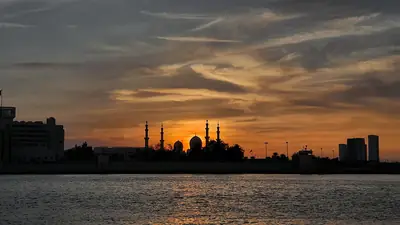
Sheikh Zayed Grand Mosque is Abu Dhabi’s key place of worship and the largest mosque in the United Arab Emirates. Its scale is extraordinary: the complex measures approximately 290 by 420 metres and covers more than 12 hectares, excluding exterior landscaping and parking.
Construction lasted from 1994 to 2007, and the mosque was inaugurated in December 2007. Four minarets stand at the corners of the outer courtyard, each rising to 107 metres, while the main dome over the prayer hall is described as 75 metres. The building’s main axis is rotated about 12 degrees south of true west, aligning it towards the Kaaba in Mecca. Sheikh Zayed, who died in 2004, is buried in the mosque’s courtyard.
Louvre Abu Dhabi
Louvre Abu Dhabi is an international museum created through a long-term agreement between the UAE and France. Covering about 24,000 square metres, including around 8,000 square metres of galleries, it is the largest art museum in the Arabian Peninsula.
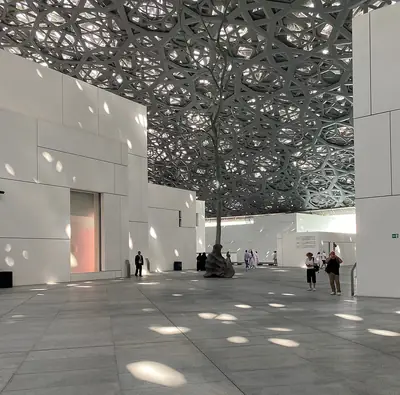
The architecture is central to the visit. Designed by Jean Nouvel, the museum is covered by an iconic dome with an intricate geometric pattern. Sunlight filters through the structure to create the effect known as a “rain of light” inside the galleries. The collection presents artworks from around the world with the aim of connecting Eastern and Western artistic traditions. Louvre Abu Dhabi opened to visitors in November 2017.
Heritage Village
On the Corniche Breakwater, Heritage Village offers a glimpse of traditional Arabian life. The site includes an old-style market, an ancient mosque, and a Bedouin tent.
Craft demonstrations are an important part of the experience. Visitors can see traditional weaving, pottery, glassblowing, and metalwork, and are encouraged to try some of the crafts themselves. The spice shop sells dried herbs, handmade soaps, and souvenirs.
Qasr Al Hosn
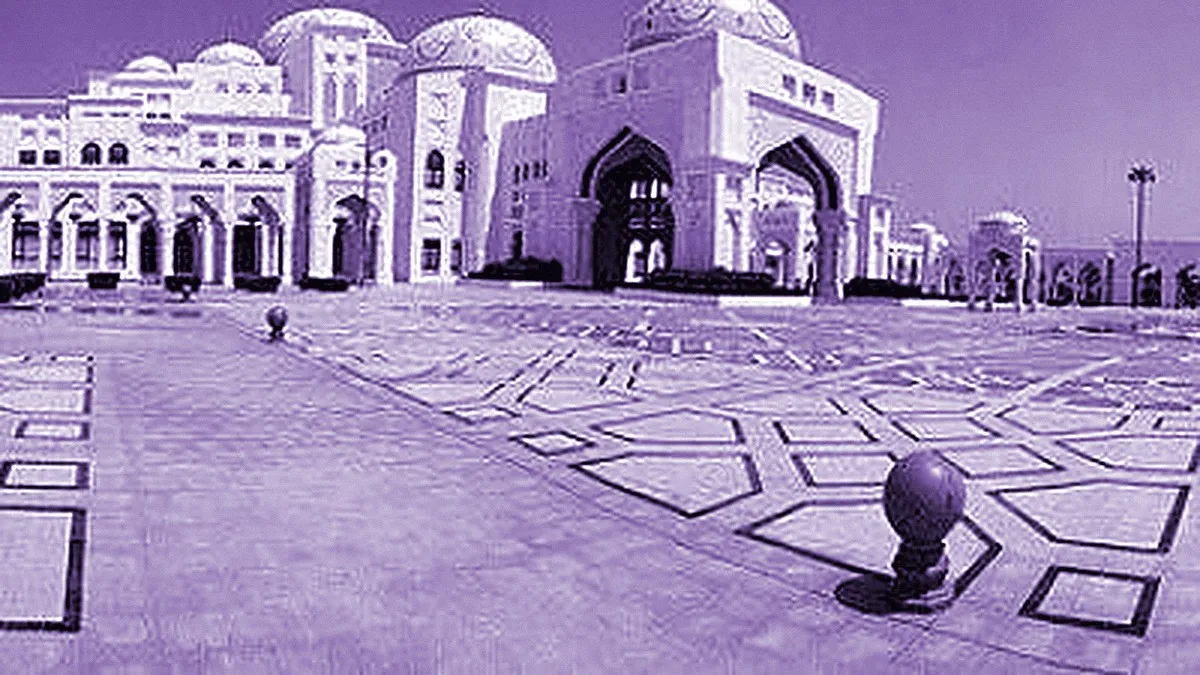
Qasr Al Hosn, also known as قصر الحصن, is Abu Dhabi’s oldest stone palace of its kind and one of the city’s most important historic landmarks. Its story began in the 18th century with a round watchtower built around 1761 to guard a freshwater well on Abu Dhabi island.
The structure developed into a small fort around 1793 and later became the permanent residence of the ruling sheikh. In the late 1930s, revenues from Abu Dhabi’s first oil licence funded a major expansion, establishing the building as a royal palace. Qasr Al Hosn served as the seat of government until 1966. Later renovations added the bright white concrete render that gave it the name “White Palace.”
Abu Dhabi Cultural Foundation
Close to Qasr Al Hosn, the Abu Dhabi Cultural Foundation was founded in 1981 as a centre for art and learning. Its programme has included exhibitions, lectures, concerts, films, and arts workshops.
The building combines contemporary architecture with elements of Islamic design, including carved doorways and arched columns. Gardens and courtyards surround the foundation, while exhibitions can explore old Abu Dhabi through city models, historical photographs, ancient Islamic art, and traditional musical instruments.
Central Market Souk
The Central Market Souk has been a centre of shopping and trade since the 1970s. After the original souk was ravaged by fire in 2003, a major project rebuilt the market while preserving the atmosphere of a traditional souk.
Geometric star and rectangle patterns, wooden latticework, and the scent of incense shape the interior. The rooftop garden provides a quieter setting, with trees, sculptures, and cafés overlooking Culture Square. A traditional tent in the garden also offers a place to enjoy shisha.
St. Joseph’s Cathedral
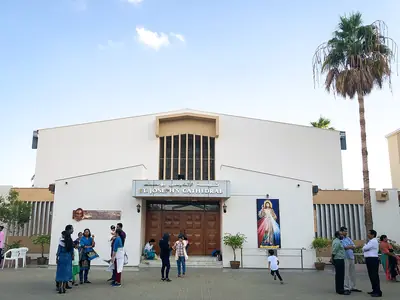
St. Joseph’s Cathedral is the only Catholic church in the Emirate of Abu Dhabi. The first church was built in 1962 on the present Corniche, on land donated by Sheikh Shakhbut, then ruler of Abu Dhabi.
In 1974, the Apostolic Vicariate that had been based in Aden moved to Abu Dhabi, and the local church became the cathedral of the local bishop. The original church was later moved to its current location in 1981. The compound includes a school and the Bishop’s House.
The Corniche
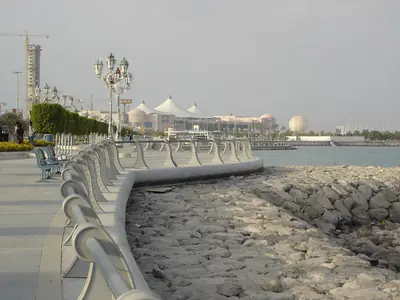
The Corniche, or Corniche Road, runs for about eight kilometres along the western side of Abu Dhabi’s main island. It combines cycle paths, separate pedestrian routes, fountains, parks, children’s play areas, restaurants, cafés, and Corniche Beach.
The waterfront changed significantly between 2002 and 2004, when land was reclaimed from the sea and the Corniche was extended. Before the 1970s, this area was a beach where dhows and ships anchored to transfer cargo and passengers. The present Corniche offers a broad public space for walking, cycling, and enjoying views across the Gulf.
Capital Park
Capital Park is a green oasis in central Abu Dhabi, with shaded areas, play spaces, and places for picnics and barbecues. A pool with waterfalls sits in the middle of the park, creating a calm focal point.
The park opened in 1969 on Khalifa Street near the Corniche. Its attractions include climbing structures, swings, slides, fun rides, and horse rides, making it suitable for different kinds of outings.
Etihad Towers
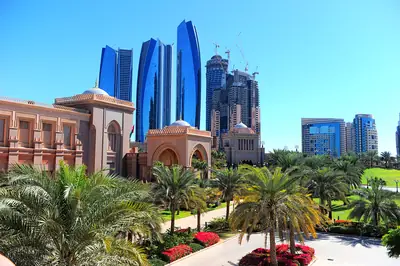
Etihad Towers is a complex of five towers and one of Abu Dhabi’s most recognisable modern landmarks. Construction was completed in November 2010. Tower 2 is the tallest tower on Abu Dhabi Island and includes an observation platform on the 75th floor.
The Observation Deck at 300 occupies the 74th floor of Tower 2 and offers views over the city. The towers also became a film location in 2015, appearing in Furious 7.
The Founder’s Memorial
The Founder’s Memorial commemorates Sheikh Zayed bin Sultan Al Nahyan, the first President of the United Arab Emirates, who is remembered as the Father of the Nation. He served as President from 2 December 1971 until his death in 2004.
The memorial presents key moments in the country’s formation, including the meeting on 18 February 1968 when Sheikh Zayed and Sheikh Rashid bin Saeed Al Maktoum agreed on the principle of founding a federation. The UAE was established on 2 December 1971.
The National Aquarium Abu Dhabi
The National Aquarium Abu Dhabi brings together more than 300 species and around 46,000 individual marine creatures across 10 zones. Its environments range from tropical Pacific waters and the Amazon to Arctic ice covers and Mediterranean caverns.
The aquarium’s collection includes more than 200 sharks and rays representing over 25 species, making them one of its most notable highlights.
Other modern Abu Dhabi landmarks
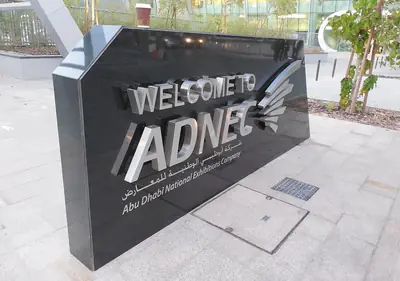
Several other places show the scale and variety of the capital. The Abu Dhabi National Exhibition Centre contains 13 interconnected exhibition halls, an atrium and concourse, a 6,000-capacity International Convention Centre, two conference halls, and 21 meeting rooms.
The Abu Dhabi Investment Authority Tower, completed in 2006, rises 185 metres across 40 floors. Its two wings enclose a central atrium, while Islamic-inspired frets and moving “sails” form part of its design. Marina Mall combines shopping and entertainment with gardens, the Shade House, the Animal Barn, an amphitheatre, and several themed outdoor areas.
Explore Abu Dhabi with a self-guided audio tour
Neywo’s Abu Dhabi audio guide includes one walking tour: Downtown Abu Dhabi: Qasr Al Hosn and the Corniche parks. The route covers 4.96 kilometres, takes approximately 109 minutes, and includes nine narrated stops: Capital Park, Formal Park, Lake Park, Central Market Project, Al Ittihad Square, Abu Dhabi Cultural Foundation, Qasr Al Hosn, Abu Dhabi Investment Authority Tower, and Family Park A.
Download Neywo and explore Abu Dhabi at your own pace. The app tells the story of each place as you reach it, with no group and no schedule. Narration is available in 11 languages. You can also continue exploring nearby destinations such as Dubai, Sharjah, and Al Ain.
Places with an audio guide in Abu Dhabi
8 places in Abu Dhabi with a Neywo audio guide. Each one starts telling its story as you reach it.
Self-guided tours in Abu Dhabi
1 tour in Abu Dhabi, free in the Neywo app. Each stop tells its story as you reach it.
- Walk
Downtown Abu Dhabi: Qasr Al Hosn and the Corniche parks
Abu Dhabi is not a walking city and this is the one stretch that works: the old coral-and-sand fort the city grew out of, the cultural foundation beside it, the market quarter and the string of parks down to the water. The Sheikh Zayed Mosque and the Louvre are both unmissable and both need a taxi.
Capital Park · Formal Park · Lake Park · Central Market Project · Al Ittihad Square · Abu Dhabi Cultural Foundation …
Open this tour: Downtown Abu Dhabi: Qasr Al Hosn and the Corniche parks
Walk Abu Dhabi with Neywo
Neywo turns Abu Dhabi into a self-guided audio tour. Stories arrive as you reach the place they belong to, and the route reshapes when you wander off it.

