Things to Do in Kraków, Poland: Walking Guide
Things to do in Kraków: what to see in the historic city
The best things to do in Kraków include exploring the medieval Main Market Square, visiting Wawel Castle and Wawel Cathedral, and discovering the historic districts of Kazimierz and Podgórze. Kraków combines royal history, Gothic churches, defensive architecture and distinctive museums in a city centre that is rewarding to explore on foot. Neywo offers a free audio guide for Kraków with 149 narrated places.
What to see in Kraków’s historic centre
Rynek Główny and Sukiennice
Kraków’s Main Market Square, Rynek Główny, was laid out in 1257 as part of a new urban plan focused on trade, civic life and order. Its roughly square layout, with sides of about 200 metres, is surrounded by historic townhouses and churches.
At the centre stands Sukiennice, the Cloth Hall. A long market hall for textile merchants existed here from the 13th century; after a fire in 1555, the building was reconstructed in Renaissance style. Its upper section is topped by a Polish parapet decorated with carved masks, making it one of the square’s most recognisable landmarks. The Sukiennice Museum is located inside the building.
St. Mary’s Basilica
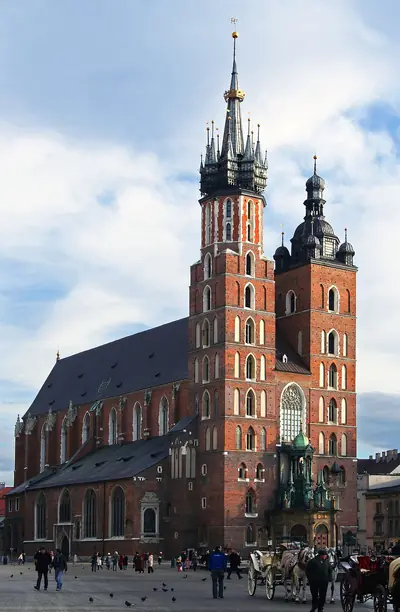
St. Mary’s Basilica dominates the Main Market Square with its two uneven towers. The brick Gothic church began as a foundation in the early 13th century and was rebuilt in Gothic style after the Mongol invasion of 1241.
Inside, the deep-blue, star-covered vault creates a striking celestial effect. The basilica’s most celebrated treasure is the monumental wooden altarpiece carved by Veit Stoss in the late 15th century. Its detailed scenes from the life of the Virgin Mary make it one of the outstanding works of Gothic sculpture in Europe.
St. Adalbert’s Church
At the southern edge of the Main Market Square, St. Adalbert’s Church—also called the Church of St. Wojciech—is one of Kraków’s oldest and smallest churches. Its origins reach back to the early Middle Ages, and the present Romanesque form dates to the end of the 11th century.
The church was later expanded with a Baroque addition in 1618. It is named after St. Wojciech, a missionary bishop from Bohemia who, according to tradition, preached at this location on his way to Prussia.
St. Florian’s Gate and the Barbican
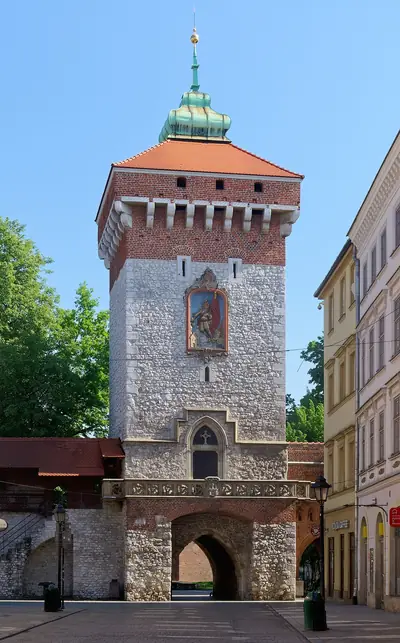
St. Florian’s Gate, or Brama Floriańska, is a Gothic tower that once formed part of Kraków’s city fortifications. Built in the early 14th century, it protected the northern entrance to the Old Town. A bas-relief of Saint Florian appears on its southern face, while a stone eagle carved in 1882 can be seen on the northern side. The gate leads directly to Floriańska Street.
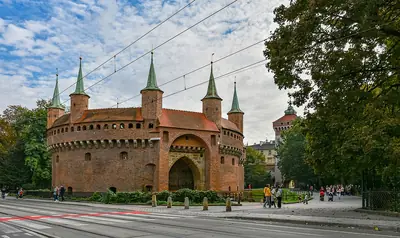
Nearby, the Kraków Barbican protected the northern approach along the route towards Wawel Castle. Construction began in 1498 under Johann I Albrecht. Built from brick, the circular fortress has seven semicircular towers, cannon openings and a moat that was once crossed by a drawbridge. Its design combines Gothic and Renaissance elements and reflects the changing demands of warfare after the rise of artillery and gunpowder.
Planty Park and the Royal Route
Planty Park follows the line of the former city walls, creating a green belt around Kraków’s historic centre. From this area, the Royal Route leads south towards Wawel Hill, passing churches, palaces and other historic buildings.
The city’s university quarter forms another worthwhile part of this central walk. Collegium Maius, the Church of St. Anne, the Palace of Art and Bunkier Sztuki are among the places included in Neywo’s self-guided routes through the area.
Wawel Castle and Cathedral
Wawel Castle
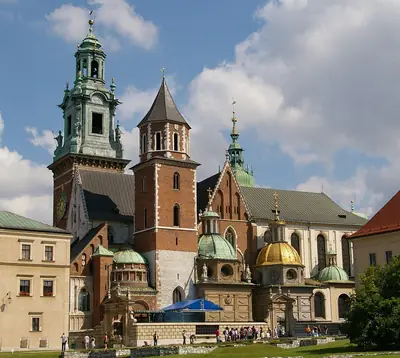
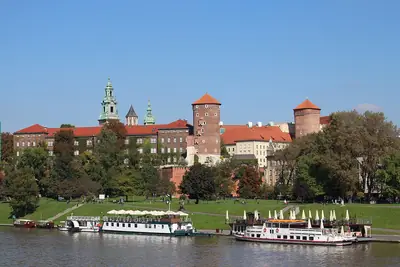
Wawel Castle stands on Wawelski Hill, a site inhabited since ancient times and one of Poland’s most important centres of royal and national history. The first stone buildings appeared around the 11th and 12th centuries.
Under Casimir III the Great in the 14th century, the castle was fortified and rebuilt in Gothic style. In the 16th century, Sigismund I the Old commissioned Italian architects to transform it into a Renaissance palace. Later Baroque additions created the blend of Romanesque, Gothic, Renaissance and Baroque elements visible today. The arcade courtyard conveys the scale of the Renaissance residence, while the rooms and exhibitions reveal further layers of the complex’s history.
Wawel Cathedral
Wawel Cathedral, formally the Royal Archcathedral Basilica of Saints Stanislaus and Wenceslaus, is part of the Wawel Castle Complex. The site has been sacred since around the year 1000, when the local bishopric was established. A Romanesque basilica consecrated in 1142 was destroyed by fire in 1305, and construction of the present Gothic cathedral began in the 14th century. It was consecrated in 1364.
The cathedral served as the coronation site of Polish monarchs. Successive rulers and church dignitaries added chapels, tombs and decoration, producing a mixture of Romanesque, Gothic, Renaissance, Baroque, Neoclassical and Neogothic features. Sigismund’s Chapel is one of its most memorable elements.
For a wider introduction to the area, Neywo’s Lesser Poland guide places Kraków within the region that also includes destinations such as Oświęcim, Tarnów and Zakopane.
Kazimierz and Podgórze
Corpus Christi Basilica and Kazimierz
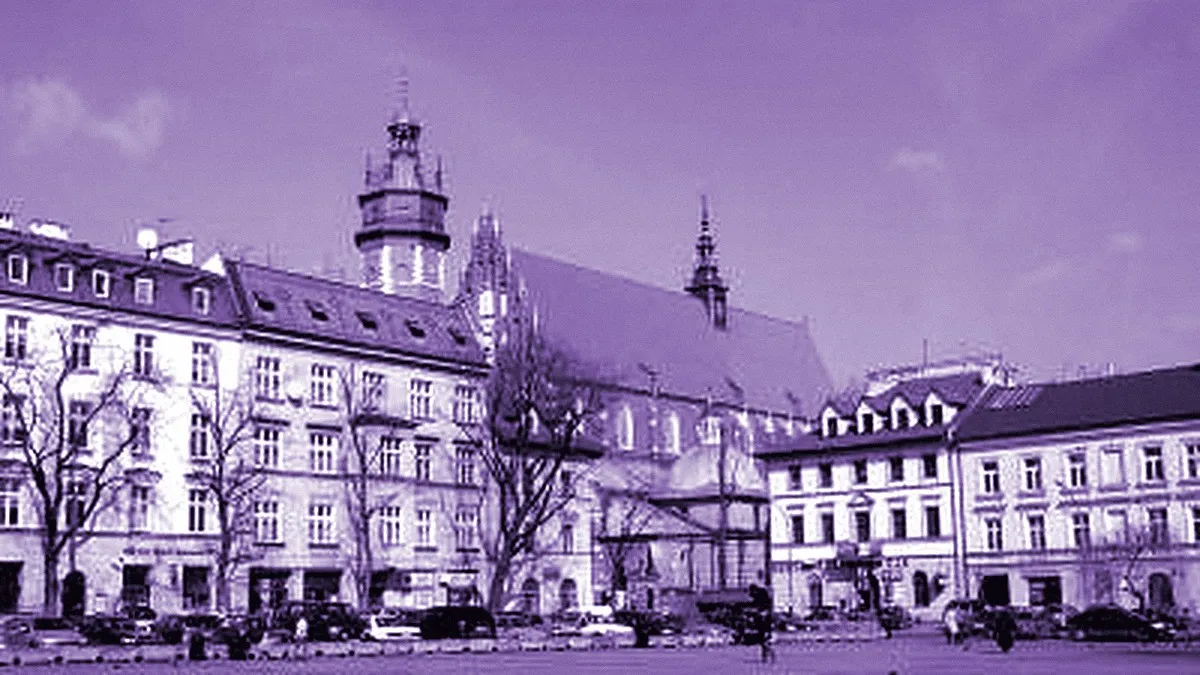
Corpus Christi Basilica is a historic Gothic church in Kazimierz, the former Jewish district. It is the parish and conventual church of the Canons Regular of the Lateran and is described as a triple sanctuary dedicated to the Blessed Virgin Mary, Saint Stanisław Kazimierczyk and the Eucharist. The building is protected as a cultural monument of the Lesser Poland Voivodeship.
Neywo’s Kazimierz walk continues through the Galicia Jewish Museum, the Old Synagogue, Szeroka Street, Izaak Synagogue and Tempel Synagogue before reaching Corpus Christi Basilica, Saint Catherine’s Church and Skałka.
Krakus Mound
In Podgórze, Krakus Mound—also known as Kopiec Krakusa or Kopiec Kraka—is a historic tumulus associated with the legend of Kraków’s mythical founder, King Krakus. It stands on Lasota Hill, on a limestone ridge, and rises 16 metres from its base. The base has a diameter of 57 metres, with a flat top about 8 metres across.
An excavation in the 1930s found no human remains but did uncover artefacts dated to the 8th to 10th century. It also revealed a solid wooden core covered with soil and turf. The mound is one of Kraków’s two prehistoric mounds and is linked to celebrations connected with Rękawka.
Fort 31 Benedykt
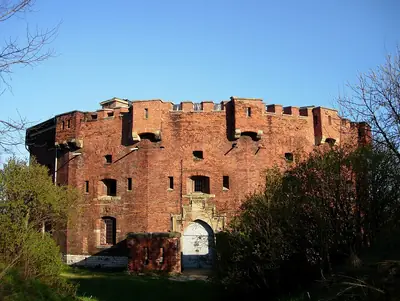
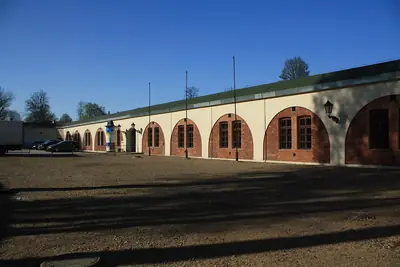
Fort 31 Benedykt, also known as “Św. Benedykt”, is a tower fort on Wzgórze Lasoty and part of Fortress Kraków. It was built between 1853 and 1856, adding a military layer to the historic landscape around Podgórze.
Further from the centre, Kraków’s fortress system includes Fort 49 Krzesławice, a single-storey artillery fort in the north-eastern section of the third ring of Austrian fortifications, and Fort Barycz. Fort Barycz was built between 1897 and 1899 by Emil Gołogórski and formed part of the seventh fortified area. In December 1914, it helped hold back the Russian offensive towards Kraków together with Fort 50 “Prokocim” and Fort 51 “Rajsko”. It is now part of the Kraków Fortress Museum and is periodically available to visitors.
Fort 51½ Swoszowice is an ammunition bunker constructed in 1913–1914. Its stone-and-brick structure has a steel-and-concrete ceiling, an earth-covered exterior, armoured doors and protected windows. Inside, a partition divides the storage space from an antechamber.
Explore Kraków with Neywo
Neywo’s free Kraków audio guide includes 149 narrated places and lets you explore without joining a group or following a schedule. The app tells the story of each place as you reach it, at your own pace.
There are eight walking tours:
- Wawel: the castle, the cathedral and the Romanesque churches — 1.64 km, 145 minutes, 12 stops
- The Main Square: St Mary’s and the Cloth Hall — 1.15 km, 124 minutes, 12 stops
- Floriańska Street, the Barbican and the Czartoryski — 1.15 km, 113 minutes, 12 stops
- The university quarter and the Planty — 1.68 km, 118 minutes, 12 stops
- Podgórze: Schindler’s factory and the Krakus Mound — 2.91 km, 98 minutes, 6 stops
- Kazimierz: the synagogues and Skałka — 2.44 km, 111 minutes, 11 stops
- Kleparz: the old station and St Florian’s — 1.15 km, 56 minutes, 5 stops
- The Ultimate Kraków: St Mary’s down the Royal Route to Wawel — 2.03 km, 201 minutes, 15 stops
The guide also includes one bus route, Bus 124: Barbican, the National Museum and Manggha, covering 4.9 km in 21 minutes with 6 stops, and one bike route, From the National Museum to Wawel and Kazimierz by Vistula cycle path, covering 7.4 km in 37 minutes with 7 stops. Narration is available in 11 languages. Download Neywo and explore Kraków’s churches, museums, fortifications and historic districts with the story starting when you arrive.
Places with an audio guide in Kraków
8 places in Kraków with a Neywo audio guide. Each one starts telling its story as you reach it.
Self-guided tours in Kraków
12 tours in Kraków, free in the Neywo app. Each stop tells its story as you reach it.
- Bike ride
From the National Museum to Wawel and Kazimierz by Vistula cycle path
A ride on Kraków's cycle paths from the National Museum to the Vistula bank at the Manggha Japanese art centre, then past the Dragon's Den and Wawel Hill to Kazimierz. Stop at Wawel Cathedral, the Bernardine church, St Agnes and Skałka.
National Museum in Kraków · Manggha · Smok Wawelski · Wawel Cathedral · Church of St. Bernard of Siena in Kraków · Church of Agnes of Rome in Kraków …
Open this tour: From the National Museum to Wawel and Kazimierz by Vistula cycle path - Bike ride
The Planty · the ring around the Old Town by bike
15 narrated places along the way: Czarkowski Palace in Kraków, Greek Catholic Church of the Exaltation of the Holy Cross in Kraków, 4 Piłsudskiego street in Kraków, Church of St. Francis of Assisi, Basilica of the Holy Trinity, Kraków, Saints Peter and Paul Church, St. Andrew's Church, Aquarium and Natural History Museum in Kraków, 18 Mikołajska street in Kraków, Church of St. Mary of the Snow in Kraków, Church of the Holy Cross, Krakow, Kraków Barbican, Stolarzy Tower, 4 Lubicz Street in Kraków, Haberdasher Tower in Kraków.
Czarkowski Palace in Kraków · Greek Catholic Church of the Exaltation of the Holy Cross in Kraków · 4 Piłsudskiego street in Kraków · Church of St. Francis of Assisi · Basilica of the Holy Trinity, Kraków · Saints Peter and Paul Church …
Open this tour: The Planty · the ring around the Old Town by bike - Bus ride
Bus 124: Barbican, the National Museum and Manggha
A city bus that skirts the north and west edge of the Old Town: it passes the Celestat and the Barbican, then runs along Aleje Trzech Wieszczów past the National Museum to the Manggha Japanese art centre on the Vistula, facing Wawel. A cheap way to link the medieval gate with the riverside museums.
Celestat · 4 Lubicz Street in Kraków · Kraków Barbican · Church of the Visitation of the Blessed Virgin Mary · National Museum in Kraków · Manggha
Open this tour: Bus 124: Barbican, the National Museum and Manggha - Bus ride
Bus 124 · Kleparz to the Barbican and the National Museum
Board at Stary Kleparz 05, alight at Rondo Grunwaldzkie 03. 6 narrated places along the way: Celestat, 4 Lubicz Street in Kraków, Kraków Barbican, Church of St. Francis de Sales in Kraków, National Museum in Kraków, Manggha.
Celestat · 4 Lubicz Street in Kraków · Kraków Barbican · Church of St. Francis de Sales in Kraków · National Museum in Kraków · Manggha
Open this tour: Bus 124 · Kleparz to the Barbican and the National Museum - Walk
Wawel: the castle, the cathedral and the Romanesque churches
Poland's coronation hill — the cathedral with its royal tombs and Sigismund bell, the castle's Flemish tapestries — approached past St Andrew's, which held out through the Mongol siege of 1241.
Artemis · Archaeological Museum of Kraków · Bishop Ciolek Palace · St. Andrew's Church · Saints Peter and Paul Church · Church of St. Martin in Kraków …
Open this tour: Wawel: the castle, the cathedral and the Romanesque churches - Walk
The Main Square: St Mary's and the Cloth Hall
Europe's largest medieval square. Veit Stoss's altarpiece in St Mary's, the trumpeter who breaks off mid-phrase on the hour, the Cloth Hall, and the Romanesque St Adalbert's marooned in the middle of it.
Gallery of International Culture Center · Town Hall Tower · Sukiennice · Adam Mickiewicz Monument, Kraków · St. Adalbert's church · Planty Park …
Open this tour: The Main Square: St Mary's and the Cloth Hall - Walk
Floriańska Street, the Barbican and the Czartoryski
The other end of the Royal Route — the brick barbican and St Florian's Gate, Matejko's house, and the Czartoryski Museum, which owns Leonardo's Lady with an Ermine.
Galeria Zderzak · Desa · Church of SS. John the Baptist and John the Evangelist in Krakow · Floriańska Street · Jan Matejko House · Haberdasher Tower in Kraków …
Open this tour: Floriańska Street, the Barbican and the Czartoryski - Walk
The university quarter and the Planty
West of the square: Collegium Maius, where Copernicus studied and the medieval lecture rooms survive, St Anne's baroque collegiate church, the Palace of Art, and the Szymanowski philharmonic.
Palace of Art · Bunkier Sztuki · Church of St. Anne · Collegium Maius · 4 Piłsudskiego street in Kraków · The Emeryk Hutten-Czapski Museum …
Open this tour: The university quarter and the Planty - Walk
Podgórze: Schindler's factory and the Krakus Mound
Across the river into the wartime ghetto district — the enamel factory, now a museum, the Płaszów memorial, the contemporary art museum in the factory's old halls, and the prehistoric mound above it all.
MOCAK, Museum of Contemporary Art in Kraków · Oskar Schindler's Enamel Factory · Church of St. Benedict in Kraków · Fort 31 Benedykt · Krakus Mound · Płaszów Monument in Kraków
Open this tour: Podgórze: Schindler's factory and the Krakus Mound - Walk
Kazimierz: the synagogues and Skałka
The Jewish quarter, with four surviving synagogues in half a kilometre, the Galicia museum, and at the far end Skałka, where Poland's kings are not buried but its writers and composers are.
Galicia Jewish Museum · Old Synagogue in Kraków · Szeroka Street · Izaak Synagogue · Tempel Synagogue · Corpus Christi Basilica …
Open this tour: Kazimierz: the synagogues and Skałka - Walk
Kleparz: the old station and St Florian's
A short walk north of the walls — the 1847 station building, the church where Poland's kings lay in state before their funeral procession, and the Kleparz market, which has traded since the fourteenth century.
Church of the Holy Cross, Krakow · 4 Lubicz Street in Kraków · Zabytkowy Dworzec Główny · St. Florian's Church · Market Square in Kleparz, Kraków
Open this tour: Kleparz: the old station and St Florian's - Walk
The Ultimate Kraków: St Mary's down the Royal Route to Wawel
Two kilometres of the coronation road — the Main Square, the Cloth Hall, the Franciscan and Dominican churches, the archaeology museum, St Andrew's and up to Wawel Castle and Cathedral.
St. Mary's Basilica in Kraków · Sukiennice · Town Hall Tower · St. Adalbert's church · Planty Park · Józef Dietl Monument in Kraków …
Open this tour: The Ultimate Kraków: St Mary's down the Royal Route to Wawel
Walk Kraków with Neywo
Neywo turns Kraków into a self-guided audio tour. Stories arrive as you reach the place they belong to, and the route reshapes when you wander off it.

