Things to Do in Salzburg, Austria: Walking Guide
Things to do in Salzburg
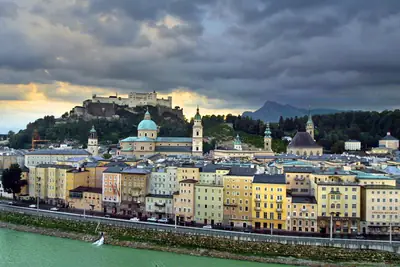
Salzburg is a historic city on the Salzach River where Baroque architecture, musical heritage and Alpine scenery combine to create a compact yet culturally rich destination. Its well‑preserved old town, dominated by the massive Hohensalzburg Fortress, offers visitors a vivid journey through centuries of ecclesiastical power, artistic innovation and popular culture. Neywo provides a free audio guide for Salzburg with 156 narrated places, letting you explore the city at your own pace.
Explore Salzburg’s highlights
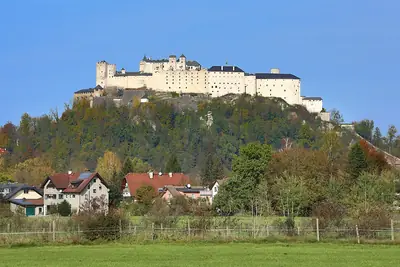
Hohensalzburg Fortress
Perched on the Festungsberg, Hohensalzburg Fortress covers more than seven thousand square metres of built‑up area (over fourteen thousand including its bastions) and stretches 250 m long by 150 m wide, standing 506 m above sea level. Construction began in 1077 under the city’s prince‑archbishops and continued over the centuries. A cargo cable car installed in 1515 may be the world’s oldest funicular. The fortress was besieged only once, in 1525, reinforced during the Thirty Years’ War, and surrendered without a fight in the Napoleonic Wars. In the early twentieth century it served as a prison, holding Italian POWs during World War I and later Nazi detainees before Austria’s annexation in 1930s.
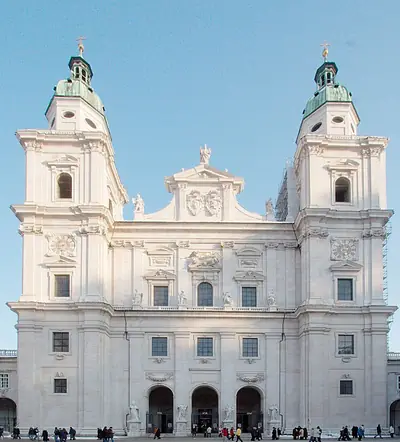
Salzburg Cathedral
At the heart of the old town, Salzburg Cathedral is the seat of the Roman Catholic Archdiocese of Salzburg, dedicated to Saints Rupert and Virgil. The first church on the site dates to 774, founded by St. Vergilius on remnants of a Roman settlement. After a fire in 1181 the building was rebuilt, but a Romanesque structure suffered severe damage in 1598 and was demolished. The present Baroque cathedral began with the laying of its foundation stone in 1614 and was completed in 1628. Inside, the baptismal font where Wolfgang Amadeus Mozart was baptized is still preserved. The cathedral suffered damage during World War II, with restoration work finished in 1959.
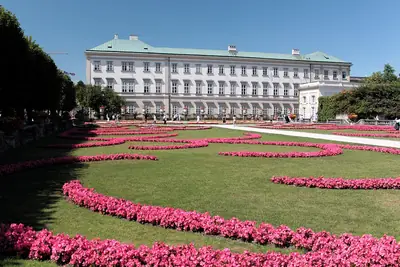
Mirabell Palace
Located on the right‑bank of the old town, Mirabell Palace was erected in Baroque style in 1606 by Prince‑Archbishop Wolf Dietrich. It is celebrated for its historic interior, its formal garden and the renowned Baroque staircase by Georg Raphael Donner. The garden’s geometric layout features four groups of mythological sculptures—depicting Aeneas, Hercules, Paris and Pluto—crafted by Ottavio Mosto. Several iconic scenes from The Sound of Music were filmed here.
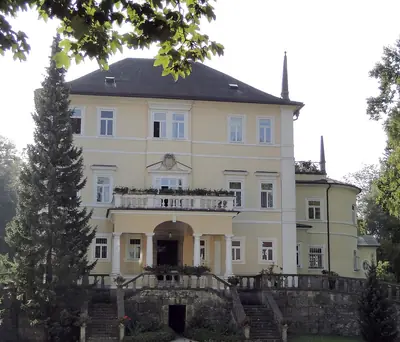
Schloss Emsburg
Situated on Hellbrunner Allee, Schloss Emsburg has been known over time as the Kreuzhof, Ritterhof or Lambergschloss. No further architectural details are provided in the source material.
Sebastianskirche
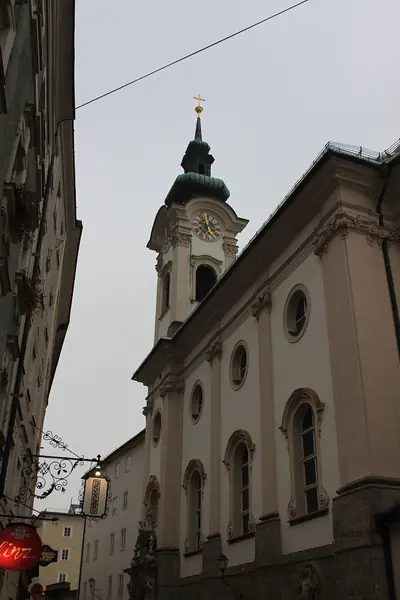
Found on Linzer Gasse in the Neustadt district, Sebastianskirche is a Baroque church dedicated to the martyr St. Sebastian, whose feast day is observed on 20 January.
Wetterhäuschen
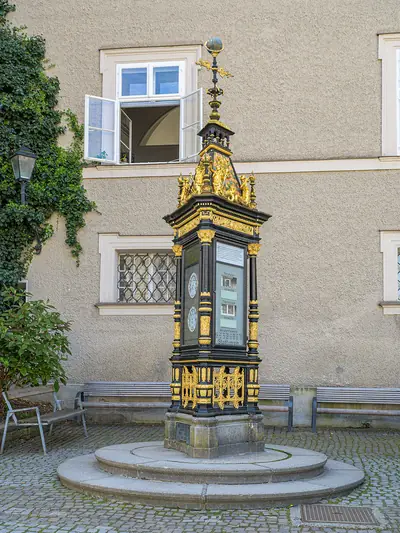
In the centre of Alter Markt stands the Wetterhäuschen, a historic weather column erected in 1888 by the Salzburg City Association for public weather observation. It has been protected as a historic monument since 2007.
Hellbrunn Palace
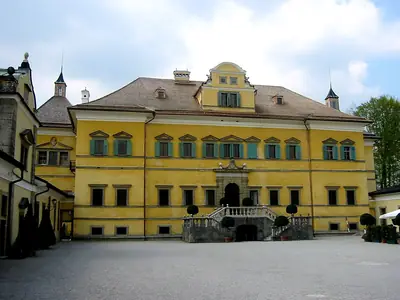
South of the city, Hellbrunn Palace is a Mannerist pleasure palace built between 1613 and 1619 by Prince‑Archbishop Markus Sittikus von Hohenems. Its name derives from the “clear spring” that fed its famous water features. Designed solely as a summer day residence—since the archbishop returned to the city each evening—the palace notably lacks any bedrooms.
Historic Centre of the City of Salzburg
The Altstadt, or historic centre, is a UNESCO World Heritage Site recognised in 1996. The listing highlights an unusually rich urban fabric developed from the Middle Ages through the 19th century, when Salzburg was a city‑state ruled by prince‑archbishops. Flamboyant Gothic architecture attracted craftsmen and artists, while later Italian architects Vincenzo Scamozzi and Santini Solari contributed the Baroque character still visible today. The blend of northern and southern European influences is noted as a possible factor in shaping the genius of Wolfgang Amadeus Mozart.
Synagogue in Salzburg
On Lasserstraße, the Synagogue in Salzburg has served as a Jewish house of prayer since 1901. After World War II it was temporarily repaired by returning Salzburg Jews and displaced‑persons camp residents, then fully restored with community funds in 1967‑1968. The restoration added a women’s entrance on the west side and a ritual bath (mikveh) on the east—the only such bath in Austria outside Vienna.
Salzburg Museum
Housed today in the Neue Residenz (since 2005), the Salzburg Museum presents the art and cultural history of the city and region. It originated as the Provincialmuseum and was later known as the Museum Carolino‑Augusteum.
Haus der Natur Salzburg
Located on the left bank of the old town, Haus der Natur is a museum of natural history and technology.
Dancing Master’s House
At Makartplatz 8, the Tanzmeisterhaus (Dancing Master’s House) was the Salzburg home of Leopold Mozart and his family beginning in 1773.
Hagenauerplatz
Situated at Getreidegasse 9 in the old town’s left bank, the Hagenauerhaus—world‑renowned as Mozart’s Birthplace—faces Hagenauerplatz, the square just outside.
Gurken
In the Wilhelm‑Furtwängler‑Garten stands “Gurken” (Cucumbers), a set of five sculptures created in 2011 by Austrian artist Erwin Wurm as part of the Salzburg Art Project. Nearby is the Schillerdenkmal monument.
Bayrisches Platzl
Despite its name, Bayrisches Platzl is not a true square but a spot in the Elisabeth‑Vorstadt district at the corner of Plainstraße and Bayrisch‑Platzl‑Straße, surviving only as an old field name. Between the 16th and 19th centuries it allegedly held some legal significance for representatives of the Bavarian dukes, although Bavaria never pressed the claim.
Experience Salzburg with Neywo
Neywo’s free audio guide turns a simple walk into a self‑guided discovery of Salzburg. The app offers:
- 7 walking tours ranging from 0.61 km to 3.2 km in length, lasting between 34 and 102 minutes and featuring 5 to 11 narrated stops each.
- 1 bus route (Bus 25: From Mirabell to the Hellbrunn Trick Fountains) covering 6.5 km in about 28 minutes with 5 stops.
- 1 bike route (Along the Salzach: A Short Ride Past Mozart’s Salzburg) spanning 2.4 km in roughly 12 minutes and including 5 stops.
Every tour provides a narrated story that plays automatically as you arrive at each point of interest, allowing you to move at your own pace without a group or a fixed schedule. Narration is available in 11 languages, making the experience accessible to visitors from around the world.
To start exploring, download the Neywo app, select Salzburg, and choose the walk, bus or bike route that matches your interests. Let the city’s stories unfold step by step, from the towering fortifications of Hohensalzburg to the intimate courtyards of Mozart’s birthplace, and discover why Salzburg remains a timeless blend of music, history and mountain scenery.
For further travel ideas in Austria, you might also consider visiting nearby destinations such as Vienna, Hallstatt or Innsbruck, all easily reachable from Salzburg.
Austria remains the gateway to the country’s rich cultural landscape, and Salzburg offers a perfect introduction to its alpine charm and artistic legacy.
Places with an audio guide in Salzburg
8 places in Salzburg with a Neywo audio guide. Each one starts telling its story as you reach it.
Self-guided tours in Salzburg
9 tours in Salzburg, free in the Neywo app. Each stop tells its story as you reach it.
- Bike ride
Along the Salzach: A Short Ride Past Mozart's Salzburg
A flat riverside ride on the Salzach cycle path, with quick detours into the old town: the university, the Mozart monument, Mozart's birthplace, the natural history museum in a former convent and the old leper-house church in Mülln.
University of Salzburg · Mozart monument, Salzburg · Mozart's birthplace · Haus der Natur Salzburg · Leprosenkirche
Open this tour: Along the Salzach: A Short Ride Past Mozart's Salzburg - Bus ride
Bus 25: From Mirabell to the Hellbrunn Trick Fountains
A regular city bus that crosses the old town and runs south to Hellbrunn. Hop off at Mirabellplatz and Makartplatz for Mozart's family home, then ride on along the Hellbrunner Allee to the Baroque pleasure palace with its water games.
Mirabellplatz · Dancing Master's House · Kranzlmarkt and Rathausplatz · Maria-Theresien-Schlössl, Salzburg · Wasserspiele Hellbrunn
Open this tour: Bus 25: From Mirabell to the Hellbrunn Trick Fountains - Walk
Mozart's Salzburg: From Mirabell to Mozartplatz
Follow the young Wolfgang Amadeus across the Salzach: the Baroque gardens of Mirabell, the family's apartment on Makartplatz, the yellow house on Getreidegasse where he was born, and the bronze Mozart on his own square. Expect fountains, marionettes and Sound of Music scenery on the way.
Mirabell Palace · Mirabellgarten · Mozarteum University Salzburg · Makartplatz · Dancing Master's House · Spirit of Mozart …
Open this tour: Mozart's Salzburg: From Mirabell to Mozartplatz - Walk
The Prince-Archbishops' Rome of the North
Salzburg's rulers wanted a Rome in the Alps, and this walk shows what they built: the Residenz and its museum, the great cathedral where Mozart was baptized, Europe's oldest monastery, and a fortress that was never taken. It ends at the top, above the whole old town.
Salzburg Museum · Michaelskirche · Residenzplatz · DomQuartier Salzburg · Domplatz · Salzburg Cathedral …
Open this tour: The Prince-Archbishops' Rome of the North - Walk
Festival City: Stages Carved into the Mönchsberg
Salzburg turns into one big theatre every summer. Walk past the church where university and festival meet, the festival halls cut into the rock, the horse trough where archbishop's stallions bathed, and finish with a view over the rooftops from the old bastion.
Franciscan Church, Salzburg · Kollegienkirche, Salzburg · Haus für Mozart · Felsenreitschule · Großes Festspielhaus · Pferdeschwemme …
Open this tour: Festival City: Stages Carved into the Mönchsberg - Walk
Across the River: Churches and Graves of the Neustadt
Leave the postcard old town behind: the Orthodox synagogue on Lasserstrasse, Fischer von Erlach's Holy Trinity, a convent church from Italy, a camposanto cemetery with Mozart's father and wife, and a Capuchin monastery above the roofs.
Synagogue in Salzburg · Andräkirche · Church of the Holy Trinity, Salzburg · Loretokirche (Salzburg) · Sebastianskirche · St. Sebastian's Cemetery …
Open this tour: Across the River: Churches and Graves of the Neustadt - Walk
Mülln and the Mönchsberg: Beer, Bastions and a Leper Church
Salzburg's old suburb under the cliff: the hospital church, Austria's largest beer hall in a former monastery, the Gothic church on its rise and the leper-house chapel by the river. Then up to the natural history museum, the modern art museum and the highest point of the Mönchsberg.
Johannsspitalkirche · Augustiner Brewery Mülln · Pfarrkirche Mülln · Leprosenkirche · Haus der Natur Salzburg · Museum der Moderne Salzburg …
Open this tour: Mülln and the Mönchsberg: Beer, Bastions and a Leper Church - Walk
Hellbrunn: Trick Fountains and Summer Palaces
South of the old town the prince-archbishops built their summer retreats along the Hellbrunner Allee. See the Kayserburg and the Emsburg, then Hellbrunn Palace with its trick fountains and the hunting lodge on the hill above.
Kayserburg · Schloss Emsburg · Maria-Theresien-Schlössl, Salzburg · Hellbrunn Palace · Wasserspiele Hellbrunn · Monatsschlössl
Open this tour: Hellbrunn: Trick Fountains and Summer Palaces - Walk
Nonntal and Nonnberg: The Quiet South
Walk the old town's calm southern edge: the University founded by a prince-archbishop in 1622, the Baroque Erhardkirche, the abbey church of Nonnberg that looks down on the whole city, and the Theatine church on Kajetanerplatz.
University of Salzburg · Erhardkirche · Stiftskirche Nonnberg · Kajetanerkirche, Salzburg · Kajetanerplatz
Open this tour: Nonntal and Nonnberg: The Quiet South
Walk Salzburg with Neywo
Neywo turns Salzburg into a self-guided audio tour. Stories arrive as you reach the place they belong to, and the route reshapes when you wander off it.

