Sarajevo, Bosnia and Herzegovina: Self-Guided Walking Tour
Things to do in Sarajevo
Sarajevo, Bosnia and Herzegovina’s largest city, lies in a narrow valley along the Miljacka River and is framed by the Dinaric Alps. Its streets reveal layers of Ottoman, Austro‑Hungarian and Yugoslav history, making it a compelling destination for anyone interested in cultural diversity and resilience. Neywo offers a free audio guide for Sarajevo with 150 narrated places to help you explore at your own pace.
Explore Sarajevo’s highlights
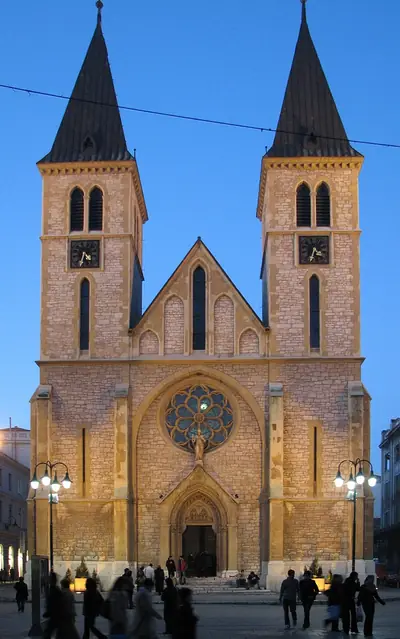
Cathedral of Jesus’ Heart
This Catholic cathedral is the largest in Bosnia and Herzegovina and the seat of the Archbishop of Vrhbosna. Designed by Josip Vancaš, it blends Romanesque and Gothic styles and was completed in 1889 on the site of a former Janissary camp that the Austro‑Hungarians had once earmarked for a city market.
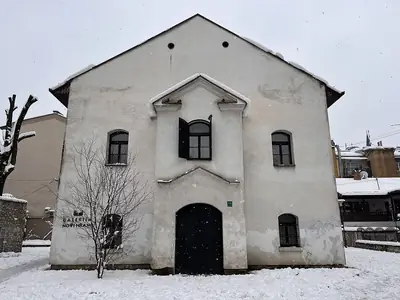
New Temple Gallery (Novi Hram)
Located at Mula Mustafe Bašeskije 38, this space occupies a former Sephardic synagogue built around 1870. After ceasing worship in 1930, it became an art gallery run by La Benevolencija since 1984. Right beside it stands the Old Synagogue, now the Jewish Museum of Bosnia and Herzegovina, the country’s oldest synagogue.
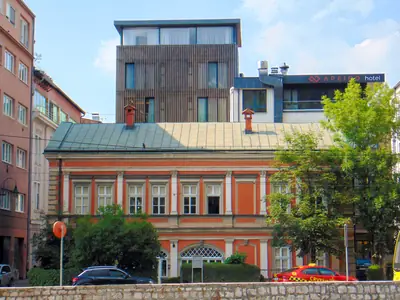
Despić House
Situated at the corner of Obala Kulina bana and Despić Street within Baščaršija, this historic home belonged to the wealthy Serbian Orthodox Despić family. It now forms part of the Museum of Sarajevo and was declared a national monument in 2005, preserving the character of an old merchant house once located in the Dubrovnik‑linked Latinluk district.
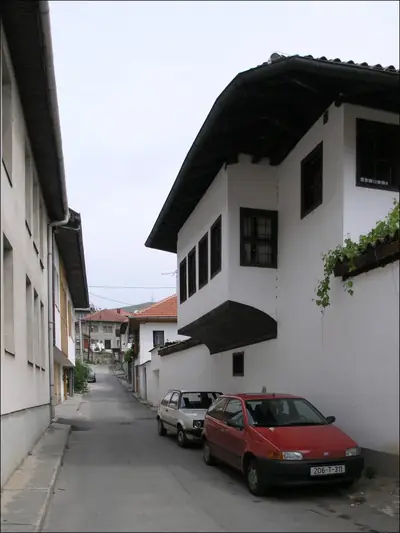
Svrzo’s House
A well‑preserved Ottoman‑era residence, Svrzo’s House showcases traditional Bosnian domestic life. Its fence marks the transition from public street to a stone‑paved courtyard with a washing fountain, flanked by flower and vegetable gardens. Built of sun‑dried adobe brick (ćerpič) and wood, it was reconstructed after the siege and reopened in 1997, with a further overhaul in 2005.
Brusa Bezistan
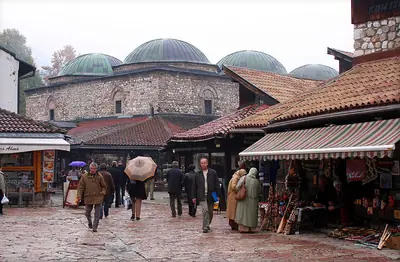
This six‑domed market hall, commissioned in 1551 by Grand Vizier Rustem‑pasha Opuković, takes its name from Bursa, the source of the silk once traded here. Its rectangular layout features entrances on all four sides, linking the surrounding craft streets of Kundurdžiluk, Veliki Čurčiluk, Mali Čurčiluk and Abadžiluk with Baščaršija.
Šeher‑Ćehaja Bridge
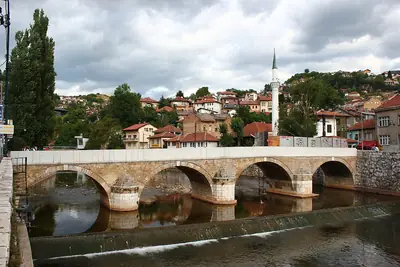
Spanning the Miljacka near Vijećnica, this Ottoman stone‑arch bridge is a national monument. A chronogram points to its construction in 1585‑86 (Islamic year 994), though some sources cite 1620. The bridge survived floods in 1619 and 1629, suffered pillar damage in 1843 and 1880, and is linked to a local tale about Hadži Husein Hodžić building it after his son left for Constantinople.
War Childhood Museum
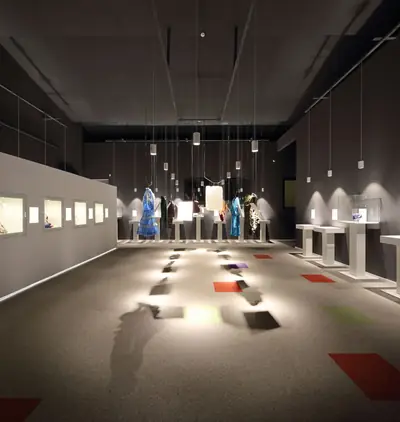
Opened in January 2017, this museum presents the experiences of children who lived through the 1992‑1995 war. Its collection includes toys, diaries, photographs, clothing, letters and drawings, each accompanied by the donor’s recollection, alongside audio and video testimonies gathered since 2010 for Jasminko Halilovic’s book Childhood in War.
Gazi Husrev‑beg Mosque
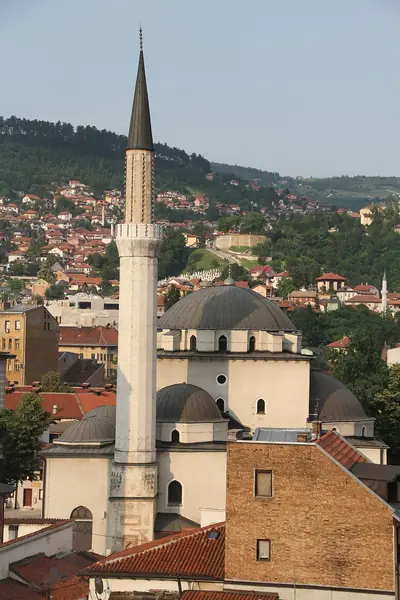
Built in 1531 as an endowment of the Bosnian Sanjak ruler Gazi Husrev‑beg, this mosque is a cornerstone of Islamic architecture in the Balkans. Its main dome measures 13 m in diameter and 26 m high, complemented by a southern half‑dome and smaller side domes. The present dome dates from 1893, while two türbes in the linden‑tree shade house the tombs of Gazi Husrev‑beg and Murad‑beg Tardić.
National Museum of Bosnia and Herzegovina
Founded in 1888, this is the country’s oldest museum institution. Its Neo‑Renaissance building by Karlo Paržik comprises four pavilions linked by terraces around a central atrium with a botanical garden. Collections span archaeology, ethnology and natural history, and include the Sarajevo Haggadah, a Sephardic Jewish manuscript brought to the city after the Spanish expulsion.
Sarajevo Synagogue (Ashkenazi Synagogue)
The only functioning synagogue in Sarajevo today stands on the south bank of the Miljacka, near the Latin Bridge. Erected in 1902 and described as the third largest in Europe, it features pseudo‑Moorish façades with corner domes on tall drums. It was renovated in 1927, expanded in 1933, and divided vertically in 1964‑65 to separate religious and community spaces.
Abdesthana Mosque
Located in Kovači within the Stari Grad municipality, this mosque forms part of a protected historic site that also includes a cemetery and a fountain. In March 2011 the Bosnian Commission to Preserve National Monuments declared the mosque, cemetery and fountain a national monument.
Serbian Orthodox Cathedral
Beside the Economic Faculty and the Miljacka River, this cathedral is one of the largest Orthodox churches in the Balkans. Before the war it served as the seat of the Dabrobosnian Metropolitanate, and in 2006 it was designated a national monument of Bosnia and Herzegovina.
Goat’s Bridge (Kozija ćuprija)
A few kilometres east of the old centre, this stone bridge spans the Miljacka canyon. It has a single arch framed by two circular openings, measures 42 m long and 4.75 m wide, with an arch span of 17.5 m. Its limestone‑tufa masonry once carried traffic on the Constantinople Road, linking Sarajevo with the empire’s eastern reaches and onward to Constantinople.
Bijela Tabija (White Fortress)
Perched at 667 m above sea level, this stone fort overlooks Sarajevo’s eastern approach. It occupies the site of a medieval stronghold erected around 1550 and later reinforced against Prince Eugene of Savoy in the 17th century and the Austro‑Hungarian advance of 1878. Its thick walls contain cannon openings, and the upper section built from large stone blocks dates from the Austro‑Hungarian period.
Žuta Tabija (Yellow Fortress)
Situated at the entrance to the old Walled City of Vratnik, this cannon fortress was erected between 1727 and 1739 near the Jajce Barracks and the old Jekovac water reservoir. It played a key defensive role in 1878 against Austro‑Hungarian troops, suffered repeated damage and rebuilding, and was most recently restored in 1998. From its heights you obtain one of the finest panoramic views over Sarajevo’s rooftops and minarets.
Discover Sarajevo with Neywo
Neywo provides 4 walking tours, 1 bus route and 1 bike route in Sarajevo. The walks are:
- Baščaršija: Silk Domes, a Lunar Clock and the Old Bazaar – 1.41 km, about 70 minutes, 7 stops
- Empire, Assassins and the Miljacka: Sarajevo 1914 – 1.36 km, about 70 minutes, 7 stops
- Jerusalem of Europe: Synagogue, Mosque and Two Cathedrals – 0.88 km, about 60 minutes, 6 stops
- Above the City: Yellow Fortress, White Fortress and the Walled Vratnik – 1.44 km, about 52 minutes, 5 stops
The bus line is Bus 31E: From Vijećnica Along Titova Street – 3.8 km, roughly 16 minutes, 8 stops.
The bike route is From the First Victims’ Bridge to Grbavica: Sarajevo’s West‑Side Cycle Lane – 2.2 km, about 11 minutes, 4 stops.
As you walk, cycle or ride, the app plays the story of each place exactly when you reach it, letting you explore at your own pace with no group and no schedule. Narration is available in 11 languages.
Ready to explore?
Download Neywo for free and let the city’s stories guide you through its streets, bridges, forts and museums. Whether you follow the historic Baščaršija walk, trace the events of 1914, or enjoy the views from the Yellow and White Fortresses, the audio guide turns every step into a deeper understanding of Sarajevo’s past and present.
Federation of Bosnia and Herzegovina
Bosnia and Herzegovina
Mostar
Jajce
Trebinje
Places with an audio guide in Sarajevo
8 places in Sarajevo with a Neywo audio guide. Each one starts telling its story as you reach it.
Self-guided tours in Sarajevo
6 tours in Sarajevo, free in the Neywo app. Each stop tells its story as you reach it.
- Bike ride
From the First Victims' Bridge to Grbavica: Sarajevo's West-Side Cycle Lane
A short, flat ride on the city's cycle lane west of the centre. Begin at the Suada and Olga Bridge, where the siege began, pass the Neo-Renaissance National Museum with its botanical atrium, and continue to Novo Sarajevo's Holy Transfiguration church and the home ground of FK Zeljeznicar.
Suada and Olga bridge · National Museum of Bosnia and Herzegovina · Church of the Holy Transfiguration · Stadion Grbavica
Open this tour: From the First Victims' Bridge to Grbavica: Sarajevo's West-Side Cycle Lane - Bus ride
Bus 31E: From Vijećnica Along Titova Street
GRAS bus 31E starts at the Vijećnica and runs west along the main street of central Sarajevo, past the Old Orthodox Church, the oldest synagogue in Bosnia, the Catholic cathedral, the Eternal Flame and Ali Pasha's Mosque. Ride it for a cross-section of the city's faiths and eras, then continue to Novo Sarajevo's modernist church.
Sarajevo City Hall · Muzej Stare srpske pravoslavne crkve Sarajevo · Old Synagogue in Sarajevo · Cathedral of Jesus' Heart · Eternal Flame Memorial · Saint Vincent de Paul church in Sarajevo …
Open this tour: Bus 31E: From Vijećnica Along Titova Street - Walk
Baščaršija: Silk Domes, a Lunar Clock and the Old Bazaar
Sarajevo's Ottoman heart is a lattice of lanes where the same craft streets still run. Meet the Beg Mosque and its tower that tells time by the sunset, an Ottoman house with separate men's and women's quarters, a silk market hall with six domes and the city's first mosque.
Gazi Husrev-beg Mosque · Clock Tower of Sarajevo · Svrzo's House · Muzej Stare srpske pravoslavne crkve Sarajevo · Brusa bezistan · Baščaršija Mosque …
Open this tour: Baščaršija: Silk Domes, a Lunar Clock and the Old Bazaar - Walk
Empire, Assassins and the Miljacka: Sarajevo 1914
Walk the Miljacka from the Moorish Revival City Hall to the corner where the shot of 28 June 1914 was fired. On the way: an Ottoman bridge with a love story, a merchant's house, the Ashkenazi synagogue, a department store turned national gallery and the officers' club where Lehar's father once conducted.
Šeher-Ćehaja Bridge · Sarajevo City Hall · Assassination of Archduke Franz Ferdinand · Despić House · Sarajevo Synagogue · National Gallery of Bosnia and Herzegovina …
Open this tour: Empire, Assassins and the Miljacka: Sarajevo 1914 - Walk
Jerusalem of Europe: Synagogue, Mosque and Two Cathedrals
Few cities place a synagogue, a mosque, a Catholic cathedral and an Orthodox cathedral within a few minutes of one another. Walk the old city's faith trail from the oldest synagogue in Bosnia to the Eternal Flame, with a stop at the museum that remembers the 1990s war.
Old Synagogue in Sarajevo · Ferhadija Mosque · Museum of crimes against humanity and genocide 1992-1995 · Cathedral of Jesus' Heart · Serbian Orthodox Cathedral in Sarajevo · Eternal Flame Memorial
Open this tour: Jerusalem of Europe: Synagogue, Mosque and Two Cathedrals - Walk
Above the City: Yellow Fortress, White Fortress and the Walled Vratnik
Climb into old Vratnik, the walled quarter that defended Sarajevo for centuries. Visit the gate tower museum, the cannon fortress with the best sunset view of the city, a looming Austro-Hungarian barracks, the White Fortress and the Višegrad gate. The streets are steep; take your time.
Museum "Alija Izetbegović" · Žuta Tabija · Jajce Barracks · Bijela Tabija · Višegradska kapija
Open this tour: Above the City: Yellow Fortress, White Fortress and the Walled Vratnik
Walk Sarajevo with Neywo
Neywo turns Sarajevo into a self-guided audio tour. Stories arrive as you reach the place they belong to, and the route reshapes when you wander off it.