Amman, Jordan: Self-Guided Walking Tour
Things to Do in Amman: Ancient Ruins, Museums and Lively Streets
The best things to do in Amman combine Roman monuments, archaeological museums, historic mosques and the everyday energy of Jordan’s capital. Built across hills and shaped by successive civilizations, Amman is especially rewarding when explored on foot, from the Citadel down to the Roman Theatre and the busy streets of downtown. Neywo has a free audio guide for Amman with 16 narrated places, available in 11 languages.
Amman is also a good starting point for discovering more of Jordan, including historic Jerash, seaside Aqaba and Petra.
What to See in Amman
Amman Citadel
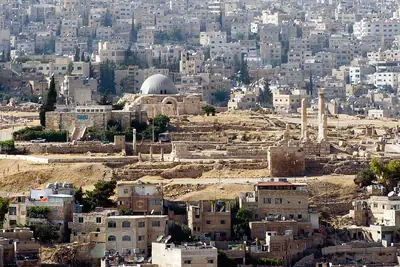
The Amman Citadel, known locally as Jabal Al-Qal’a, or “the Fortress,” occupies the hill above downtown. Evidence of settlement here goes back to the Neolithic period, while the hill was fortified during the Bronze Age around 1800 BCE. It later became the capital of the Kingdom of Ammon and came under Assyrian, Babylonian, Ptolemaic, Seleucid, Roman, Byzantine and Umayyad influence.
Most of the remains visible today date from the Roman, Byzantine and Umayyad periods. The fortification walls enclose the central part of the site, where visitors can see the Temple of Hercules, a Byzantine church, the Umayyad Palace and the Jordan Archaeological Museum.
Temple of Hercules
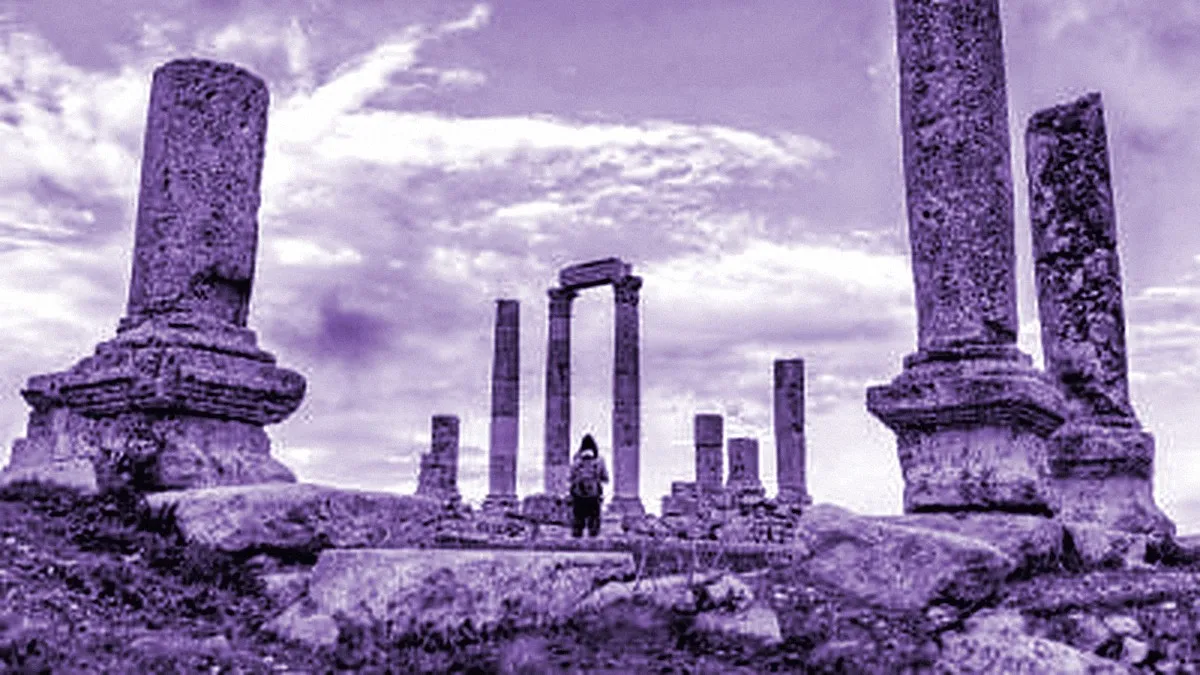
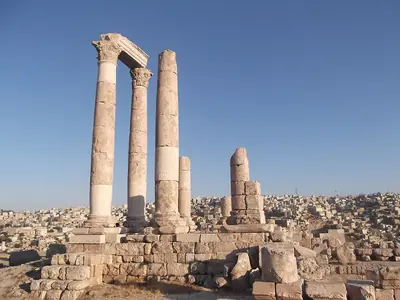
The Temple of Hercules is one of the most important Roman buildings still standing in Amman. Located within the Citadel, it dates to the second century AD and was built during the time of Geminius Marcianus, governor of the province of Arabia, according to inscriptions.
The surviving remains are particularly striking for their scale. Nearby, the Byzantine Church adds another layer to the hill’s history. Built in the sixth century AD, it followed a basilica plan with a central nave, two side aisles and a semicircular apse.
Umayyad Palace
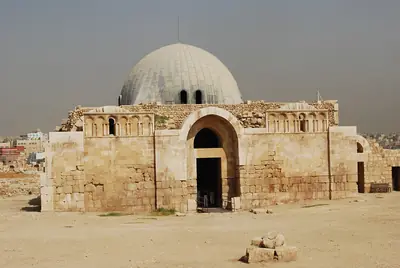
The Umayyad Palace was built during the transition between the seventh and eighth centuries. Although much of the wider complex is now in ruins, its domed audience hall remains one of the Citadel’s most memorable structures.
The palace also includes a courtyard with remnants of residential buildings and a cistern that helped manage water within the complex. Its remains show how the Citadel continued to serve as an important center after the Roman and Byzantine periods.
Jordan Archaeological Museum
Built in 1951 on Citadel Hill, the Jordan Archaeological Museum brings together discoveries from excavations across Jordan. Its collections are arranged chronologically, from the Paleolithic period through the Islamic eras.
The museum displays pottery, glass, metal objects, plaster and stone statues, inscriptions, seals, gold jewelry and coins. Among its most notable pieces are the plaster statues of ʿAin Ghazal, dating to around 6000 BCE, as well as plastered human skulls from Jericho.
The Jordan Museum
The Jordan Museum presents the country’s heritage in a larger modern setting. Its two main permanent exhibitions focus on the Dead Sea Scrolls, including the Copper Scroll, and the ʿAin Ghazal statues, which are 9,000 years old and among the earliest known human statues ever created.
The collections include artifacts from prehistoric and ancient archaeological sites across Jordan, arranged in chronological order. The museum also has lecture halls, outdoor exhibitions, a library and a conservation centre.
Roman Theatre
At the base of Jabal Al-Joufah, opposite the Citadel, the Roman Theatre is one of Amman’s defining landmarks. Dating from the second century, it was built when the city was known as Philadelphia. A Greek inscription on one of its pillars states that it was erected in honor of Emperor Antoninus Pius, who ruled from 138 to 161 CE.
The theatre’s steep seating could accommodate around 6,000 spectators. It is divided into three horizontal sections, or diazomata, and faces north to help protect the audience from the sun. The lower level includes side entrances known as paradoi, leading toward the orchestra and stage areas.
Odeon
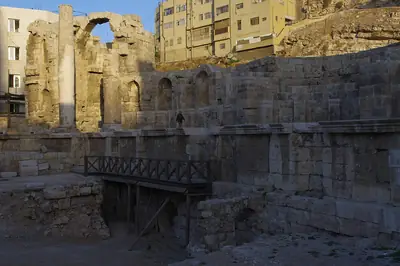
The smaller Odeon stands in the Roman Forum area near the Roman Theatre. Also dating from the second century AD, it was designed for more intimate cultural and intellectual gatherings and could hold about 500 people across nine tiers of semicircular seating.
The building may originally have had an ornate wooden roof. Its stage building was decorated with friezes and niches, while a vaulted interior passage connects the stage area through three doorways. The Odeon remains part of Amman’s cultural life, hosting music, poetry readings, debates and lectures.
Nymphaeum
The Nymphaeum is a partially preserved Roman public fountain in downtown Amman. Built during the Roman period and associated with the second century CE, it once stood near the center of ancient Philadelphia.
The fountain is believed to have contained a pool measuring about 600 square meters and around three meters deep. It was continuously refilled with fresh water, creating an oasis in the ancient city. The monument stands near the Roman Forum area, the Roman Theatre and the Odeon.
Hashemite Plaza
Hashemite Plaza is a 20,000-square-meter public space along Al-Hashemi Street. Fountains, gardens and seating areas make it a place to pause between visits to downtown’s historic monuments.
The eastern end offers scenic views of the surrounding landscape. The plaza also hosts cultural events and festivities, including the Amman Book Festival.
Al Husseini Mosque
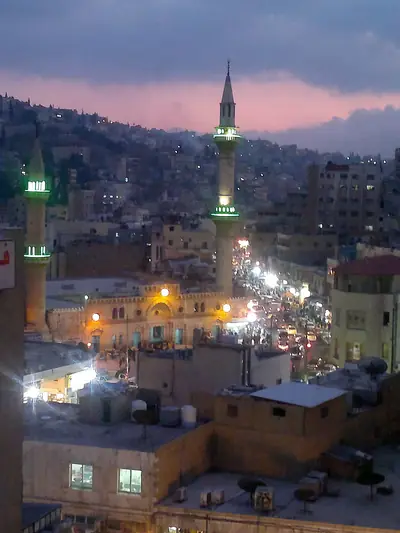
The Al Husseini Mosque, also called the Grand Husseini Mosque, is one of Amman’s oldest mosques and a central landmark in the downtown area. It was established in 1923 by Prince Abdullah I bin Al-Hussein and named in honor of Sharif Hussein bin Ali.
The mosque’s foundations are said to date to the reign of Caliph Omar Ben Al Khattab, from 634 to 644 AD, with later renovations during the Umayyad era. The present structure includes front and side arcades, a central open courtyard and two minarets.
The Duke’s Diwan
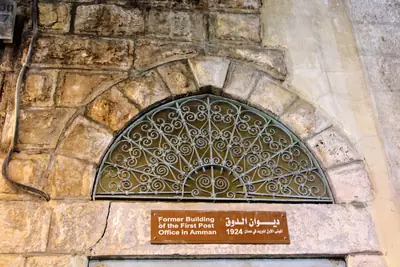
The Duke’s Diwan occupies one of downtown Amman’s oldest significant buildings. Constructed in 1924 as the city’s first post office, it later became the Finance Ministry and then operated as the Haifa Hotel from 1948 to 1998.
The building was later transformed into a gathering place for artists, thinkers and poets. Its rooms contain antiquities, photographs and old furniture, including chairs from the 1920s, a freestanding stove and a vintage radio. Drawings of Amman’s Ottoman and Roman ruins decorate the walls alongside historical images of the city.
King Abdullah I Mosque
The King Abdullah I Mosque is recognized by its blue mosaic dome and contemporary Islamic architecture. Beneath the dome, the octagonal prayer hall can hold 3,000 worshippers and features Quranic inscriptions.
The complex also includes a museum with King Abdullah I’s personal items, ancient pottery and coins. The mosque was built by King Hussein bin Talal and named in honor of his grandfather, the first King of Jordan.
Rainbow Street
Rainbow Street is a nearly flat, pedestrian-friendly stretch in the heart of Amman. Its cafés, shops, restaurants and rooftop bars offer a more contemporary view of the capital and make it a useful contrast to the ancient monuments downtown.
On Thursday nights, the street becomes especially lively, with cars cruising by and pedestrians taking leisurely promenades.
Royal Tank Museum
The Royal Tank Museum in Al Muqabalain presents military vehicles from Jordan, Arab nations and countries including the United States, Britain, the Soviet Union and Germany. Inaugurated on January 29, 2018, it covers about 20,000 square meters and houses around 110 tanks and armored vehicles arranged chronologically.
The collection includes original and restored vehicles showing the development of military technology from 1915 onward. There is also a hall dedicated to local military industries and an outdoor arena for demonstrations of tanks and armored vehicles.
Abdali Mall
Abdali Mall, opened in May 2016 as part of the Abdali Project, offers a modern shopping and entertainment setting. It includes more than 160 retail outlets, a supermarket, restaurants and cafés, an entertainment center and nine cinema screens.
Its design includes open-air areas intended to bring in natural ventilation and sunlight, adding a contemporary architectural dimension to Amman’s urban landscape.
Explore Amman with Neywo
Download Neywo and explore Amman with two walking tours. The route from the Citadel down to the Roman Theatre is available as a 1.78-kilometre walk lasting 74 minutes, with nine narrated stops, or as a 3.1-kilometre walk lasting 101 minutes, with 10 stops.
The tours include places such as the Amman Citadel, Umayyad Palace, Temple of Hercules, Jordan Archaeological Museum, The Jordan Museum, The Duke’s Diwan, Al Husseini Mosque, Nymphaeum, Roman Theatre and Odeon. The app tells the story of each place as you reach it, at your own pace, with no group and no schedule.
Places with an audio guide in Amman
8 places in Amman with a Neywo audio guide. Each one starts telling its story as you reach it.
Self-guided tours in Amman
1 tour in Amman, free in the Neywo app. Each stop tells its story as you reach it.
- Walk
The Citadel down to the Roman Theatre
Amman's two ancient layers in one walk. The hilltop citadel holds a Roman temple of Hercules and an Umayyad palace; below it, downtown keeps the theatre, the odeon and the nymphaeum of Roman Philadelphia, plus the city's main mosque.
The Jordan Museum · Al Husseini Mosque · Nymphaeum · The Duke's Diwan · Jordan Archaeological Museum · Amman Citadel …
Open this tour: The Citadel down to the Roman Theatre
Walk Amman with Neywo
Neywo turns Amman into a self-guided audio tour. Stories arrive as you reach the place they belong to, and the route reshapes when you wander off it.

