Things to Do in Petra, Jordan: Walking Guide
Things to Do in Petra, Jordan: What to See in the Rose City
Petra is an ancient Nabataean city carved into the rose-coloured sandstone of southern Jordan. The archaeological site is worth visiting for its monumental façades, rock-cut tombs, temples, churches and ingenious water system, all set among dramatic mountain landscapes. Neywo offers a free audio guide for Petra with 19 narrated places.
What to See in Petra
The Siq and Al Khazneh, the Treasury
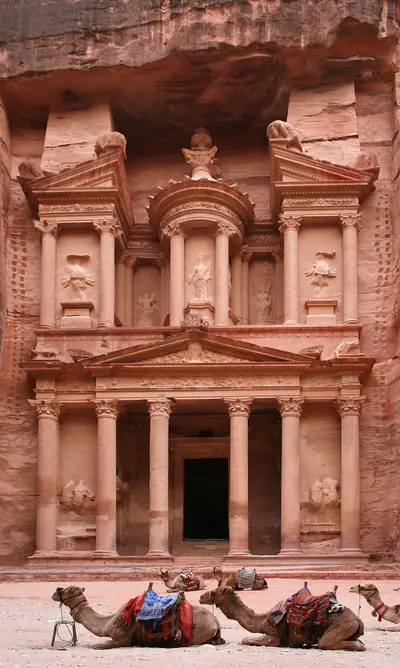
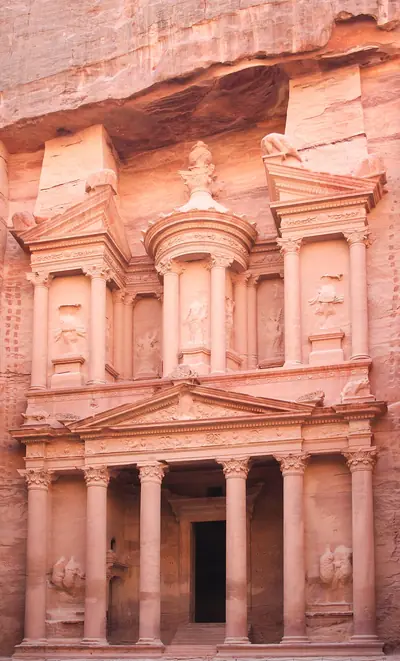
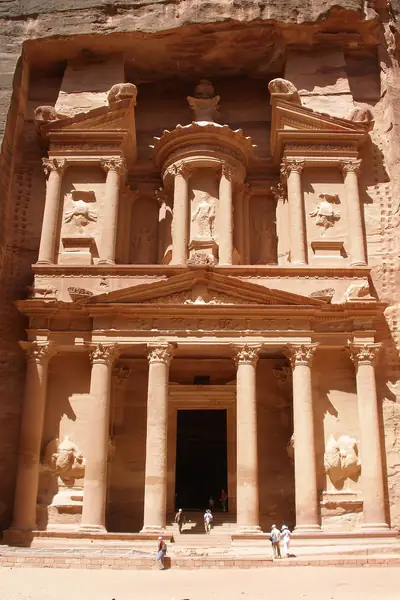
The winding Siq provides Petra’s dramatic approach, leading into the ancient city through a narrow natural gorge. At its end stands Al Khazneh, known locally as the Treasury: one of Petra’s most elaborate rock-cut tombs.
Carved directly into the sandstone cliff, the façade is topped by a large urn. Al Khazneh is thought to have been built as a mausoleum and crypt at the beginning of the first century AD, during the reign of King Aretas IV Philopatris. Its name comes from a local Bedouin belief that the urn concealed a pharaoh’s treasure, although it actually marks a royal burial chamber.
Petra Theatre
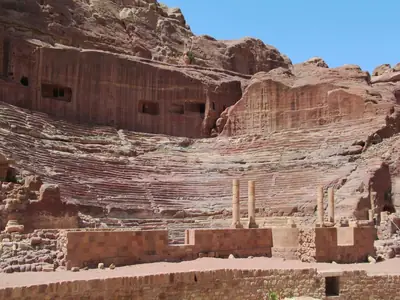
Around six hundred metres from the heart of the city, Petra Theatre is a large Nabataean theatre carved into the rock. It dates from the first century AD, while the Romans added another section after taking control of Petra in 106 AD.
The auditorium has three horizontal tiers of seats, walkways and seven stairways. Although much of the theatre was hewn from the rock, the stage area and outer walls were built from masonry. Its Roman-influenced design also gives it excellent acoustics, and the theatre could hold roughly 8,500 spectators.
The Royal Tombs
The cliffs around Petra contain numerous monumental tombs, including the Urn Tomb, Silk Tomb, Palace Tomb and Corinthian Tomb. Their façades show how extensively the Nabataeans integrated architecture with the surrounding sandstone.
The Corinthian Tomb is also known locally as Tumba Corintia. Mughar an-Nasara is another site described as a grave. Together, these places form part of the wider funerary landscape that makes Petra much more than a city centred on the Treasury.
The Colonnaded Street and Qasr al-Bint
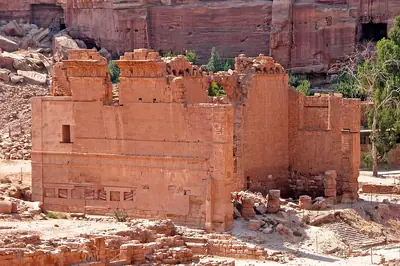
Petra’s Colonnaded Street leads towards Qasr al-Bint, one of the city’s few freestanding temples. Unlike most of Petra’s monuments, which were carved directly into the cliffs, this Nabataean religious temple was constructed from carefully placed stone blocks.
Dating from the first century AD, Qasr al-Bint is one of the best-preserved ancient structures in Petra. Its prominent position made it an important focal point for religious worship and public gatherings.
Temple of the Winged Lions
At the end of Petra’s main Colonnaded Street, opposite Qasr al-Bint, stands the ruined Temple of the Winged Lions. The temple complex lies in Petra’s Sacred Quarter and dates from the reign of King Aretas IV, around 9 BCE to 40 CE.
The building was destroyed by the earthquake of 363 CE. Some researchers have suggested that it may have been dedicated to Dedoun, a Nubian god of luck symbolised by lions.
Petra’s Byzantine Churches and the Blue Chapel
The Byzantine Church of Petra occupies elevated ground north of the Colonnaded Street. It is one of three Byzantine churches on the hillside, alongside the Ridge Church and the Blue Chapel.
The main church is known for its well-preserved floor mosaics. Excavations in the 1990s also uncovered more than a hundred papyri, now known as the Petra papyri, offering evidence about daily life in Byzantine Petra and the surrounding countryside. The Blue Chapel takes its name from the blue Egyptian granite used in its construction.
The Ridge Church is thought to be Petra’s oldest church building, dating from the third or fourth century. It was built over two family tomb chambers and later underwent changes following the earthquake of 363 CE. The Blue Chapel stands opposite it across the central piazza.
Ad Deir, the Monastery
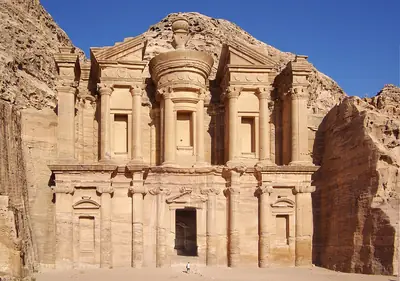
Ad Deir, or the Monastery, is one of Petra’s largest rock-cut buildings. Set high above the ancient city centre, its façade is about fifty metres wide and roughly forty-five metres high.
The monument was probably carved in the mid-first century AD by the Nabataeans in honour of their king Obodas I after his death. Its design recalls Al Khazneh but uses less ornamentation. During the Byzantine period, the interior may have been reused as a church.
The High Place of Sacrifice
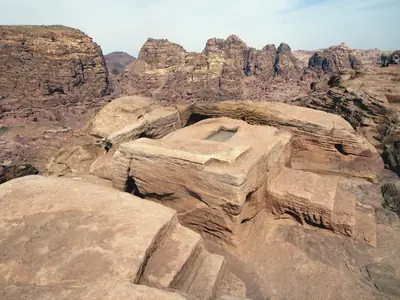
The High Place of Sacrifice, also known as Al-Madbah, is a temple site within Petra. It forms part of the city’s religious landscape alongside Qasr al-Bint and the Temple of the Winged Lions.
Little Petra
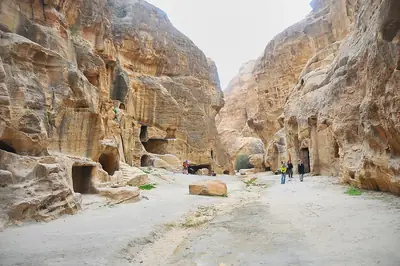
North of Petra lies Little Petra, also known as Siq al-Barid, or the cold canyon. This archaeological site formed part of the Petra Archaeological Park and is a UNESCO World Heritage Site.
Little Petra was built during the height of Nabataean influence in the first century CE and may have served as a suburb of Petra, housing visiting traders on the Silk Road. Its three open areas are connected by a 450-metre canyon, with rooms and façades carved into the sandstone walls.
One cave contains a biclinium, or dining room, whose ceiling preserves a 2,000-year-old Hellenistic-style fresco of grapes, vines and putti. It is a rare example of interior Nabataean figurative painting.
The Old Petra Museum
The Old Petra Museum occupies a natural Nabataean cave. Its cultural exhibits are displayed within the original stone setting, offering another way to explore Petra’s history beyond its monumental façades.
Petra’s Nabataean and Roman History
Settlements in the area date back thousands of years, but the Nabataeans made Petra their capital and developed it into a thriving centre on the incense trade routes. Their channels, cisterns, dams and other water systems allowed the city to collect rainwater and support a large population in an arid environment.
Petra later came under Roman rule in 106 AD and was renamed Arabia Petraea. The city gradually declined as sea routes became more important, while earthquakes damaged its structures. After centuries of obscurity, the Swiss explorer Johann Ludwig Burckhardt rediscovered Petra for the Western world in 1812.
Petra also reflects the history of the wider region. The kingdom of Edom flourished in southern Jordan between the 13th and 8th centuries BC before falling to the Babylonians in the 6th century BC. The Nabataean Kingdom later rose from this landscape, remaining independent for centuries before becoming a Roman client state and eventually being annexed in 106 AD.
For more context on the country around the ancient city, see the guide to Jordan. Petra also fits naturally into a wider journey including Aqaba, Amman or Jerash.
Explore Petra with Neywo
Neywo has two walking tours in Petra, covering the city’s main monuments and the route up to the Monastery:
- The Rose City: Treasury, Royal Tombs and Colonnaded Street — 3.32 km, 98 minutes and 9 narrated stops, including Al Khazneh, Petra Theatre, the Royal Tombs, the Temple of the Winged Lions, Qasr al-Bint, the Byzantine Church and the Blue Chapel.
- Up to the Monastery — 2.56 km, 57 minutes and 4 narrated stops, including Qasr al-Bint, the Byzantine Church, the Blue Chapel and Ad Deir.
With a Petra self-guided walking tour, the app tells the story of each place as you reach it. Explore at your own pace, with no group and no schedule. Neywo’s narration is available in 11 languages, so download the app and discover Petra while walking through its ancient streets and sandstone canyons.
Places with an audio guide in Petra
8 places in Petra with a Neywo audio guide. Each one starts telling its story as you reach it.
Self-guided tours in Petra
2 tours in Petra, free in the Neywo app. Each stop tells its story as you reach it.
- Walk
The Rose City: Treasury, Royal Tombs and Colonnaded Street
Walk out of the Siq into the open valley of Petra and meet the Treasury, then follow the Nabataeans' main road past the great theatre and the royal tombs on the eastern cliffs. You will end where the city's religious life centred, among the temples at the far end of the Colonnaded Street, and climb to the Byzantine churches on the hill with their mosaic floors.
Al Khazneh · Petra Theatre · Urn Tomb (Petra) · Silk Tomb · Palace Tomb (Petra) · Temple of the Winged Lions …
Open this tour: The Rose City: Treasury, Royal Tombs and Colonnaded Street - Walk
Up to the Monastery
A longer climb for those with energy to spare. Start at the freestanding Nabataean temple Qasr al-Bint, then ascend the rock-cut stairway to Ad Deir, the Monastery, a façade nearly as grand as the Treasury and far quieter. The view over the mountains from the top is the reward.
Qasr al-Bint · Church of Petra · Blue Chapel · Ad Deir
Open this tour: Up to the Monastery
Walk Petra with Neywo
Neywo turns Petra into a self-guided audio tour. Stories arrive as you reach the place they belong to, and the route reshapes when you wander off it.

