Things to Do in Mdina, Malta: Walking Guide
Things to do in Mdina, Malta: what to see in the Silent City
Mdina is a fortified historic city in the centre of Malta, known for its narrow streets, limestone buildings and peaceful atmosphere. Once Malta’s capital, it is worth visiting for its medieval character, Baroque churches, noble palaces and views across the island. Neywo has a free audio guide for Mdina with 23 narrated places, available in 11 languages.
What to see in Mdina
The best way to explore Mdina is on foot. Its main sights are close together, while the surrounding area adds Roman and early Christian history to the experience.
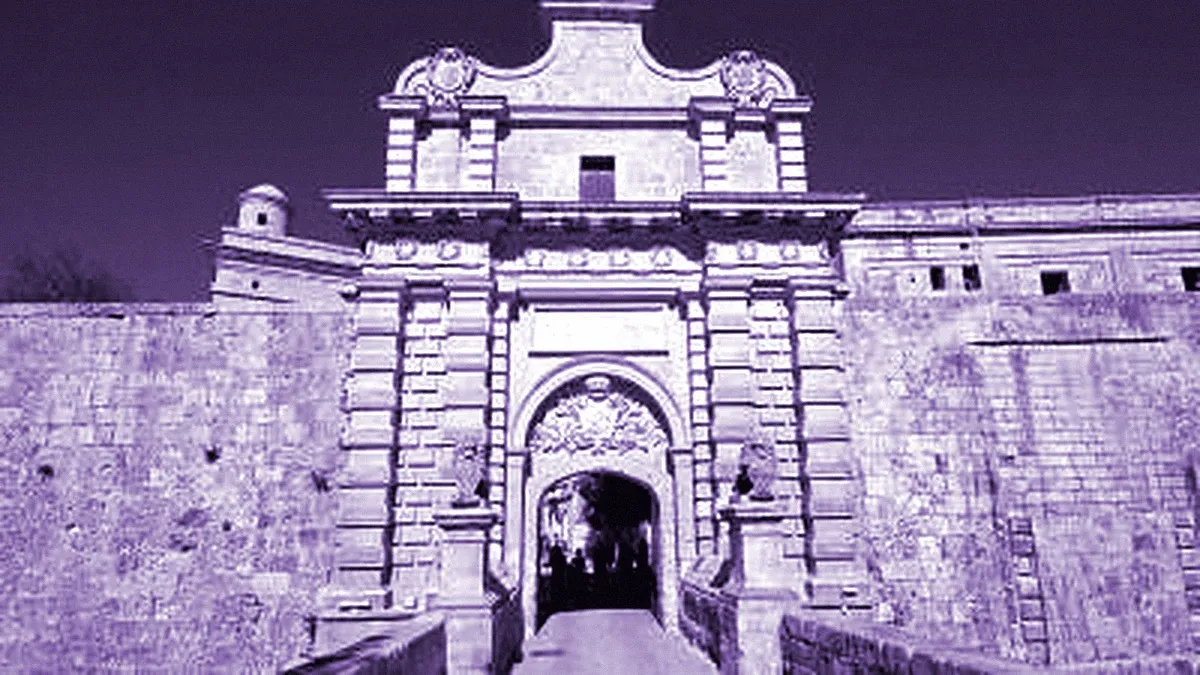
Mdina Gate
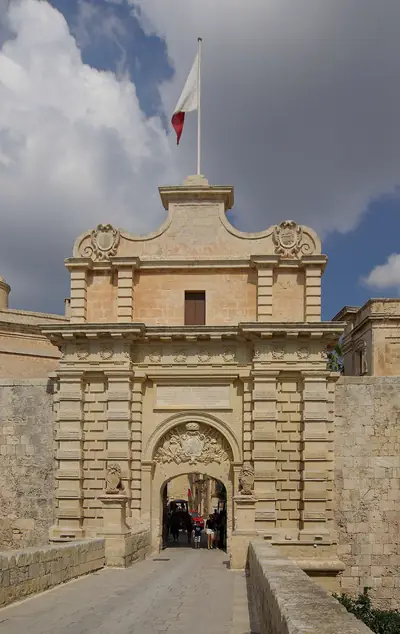
Mdina Gate is the grand Baroque entrance to the fortified city and connects Mdina with the neighbouring suburb of Rabat. Also known as the Main Gate or Vilhena Gate, it was built in 1724 to designs by Charles François de Mondion, during the magistracy of Grand Master António Manoel de Vilhena.
The entrance is decorated with coats of arms and lions, symbols of strength and nobility. The present gate stands a few metres to the left of the original entrance, traces of which remain in the surrounding walls. On the inner side, statues of Saint Publius, Saint Paul and another religious figure welcome visitors into the city.
Palazzo Vilhena and the National Museum of Natural History
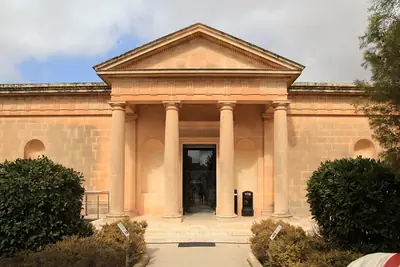
Palazzo Vilhena is a French Baroque palace commissioned by Grand Master António Manoel de Vilhena and built between 1726 and 1728. It is also known as the Magisterial Palace or Palazzo Pretorio.
The palace now houses Malta’s National Museum of Natural History, which opened to the public in 1973. Its collections include nearly one million specimens covering minerals, fossils, insects, reptiles, birds, mammals, fish, geology and palaeontology. Displays also explore Malta’s biodiversity, including endemic plants and birds such as the Maltese Centaury and the Blue Rock Thrush.
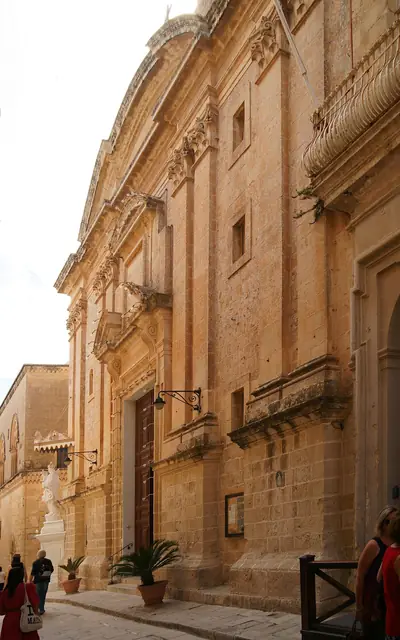
St Peter’s Church and Monastery
St Peter’s Church and Monastery is dedicated to Saint Peter and Saint Benedict. The complex was associated with cloistered Benedictine nuns, with the arrival of the first nuns in Malta traditionally placed around 1418.
The present church was renovated in 1625. Its most notable works include an 1682 altarpiece by Mattia Preti showing the Madonna and Child with Saint Peter, Saint Benedict and Saint Scholastica, as well as paintings by Francesco Zahra.
St Roque’s Church and Palazzo Santa Sofia
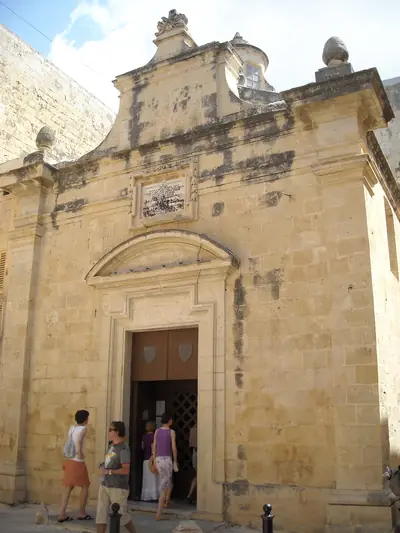
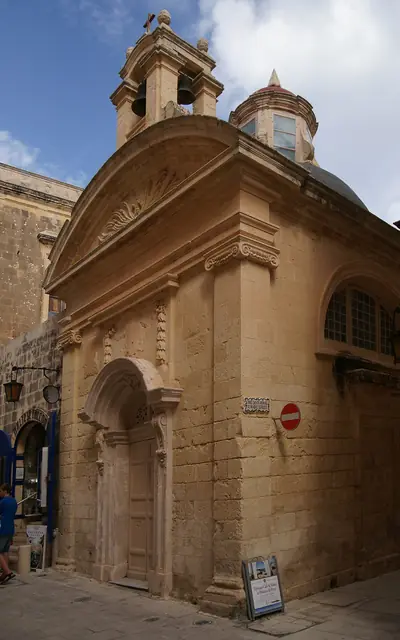
St Roque’s Church, also called the Chapel of Our Lady of Light, stands across the square from Palazzo Santa Sofia. The palace is one of Mdina’s important surviving historic buildings: its lower level dates from 1233, a date still inscribed on one of the window mouldings.
Palazzo Santa Sofia began as a single-storey building arranged around a courtyard. Its upper floor, with four ornate mullioned windows, was added during the twentieth century after 1938. The façade combines coats of arms, decorative cornices and architectural details from different periods.
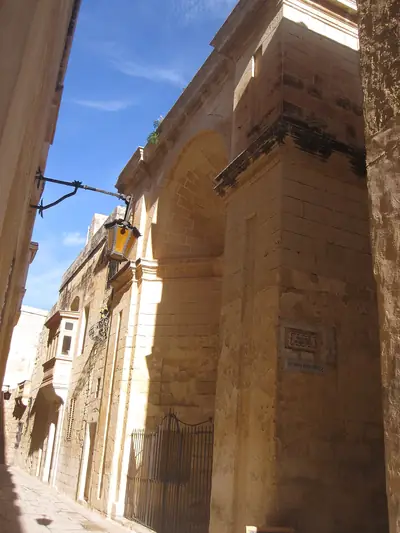
Palazzo Costanzo
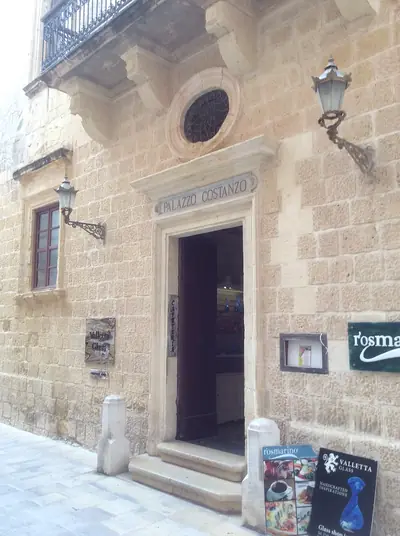
On Villegaignon Street, Palazzo Costanzo reflects Mdina’s noble past. Built in 1666 by Tomaso Costanzo for a noble Sicilian family, the palace has two floors and underground cellars.
Its façade is arranged around a central doorway with a small oval window and an open balcony, framed by two further windows. The building is now a restaurant and a setting for the Medieval Times Show, which presents aspects of local life during the fourteenth and fifteenth centuries.
Palazzo Falson
Palazzo Falson is one of Mdina’s remarkable medieval townhouses. Believed to date from around 1495, it may incorporate parts of a thirteenth-century structure and is considered the second oldest building in Mdina after the ground floor of Palazzo Santa Sofia.
The former residence of Maltese nobility is now a house museum with seventeen rooms. Its collections of domestic belongings and antiques offer a personal glimpse into life inside an old Maltese home. The building has also been known as Palazzo Cumbo-Navarra, Casa dei Castelletti and the Norman House.
Annunciation Church
The Annunciation Church, also known as the Carmelite Church, was built between 1660 and 1675. It was the first church constructed in Malta with an elliptical plan, an important feature of Maltese Baroque architecture.
Inside, the main altar is dominated by Stefano Erardi’s 1677 painting of the Annunciation. Works by Giuseppe Cali add to the decoration. The church forms part of the Priory of Our Lady of Mount Carmel, whose rooms, museum and refectory preserve objects connected with the spiritual life of the Carmelite friars.
Mdina Cathedral Museum
The Mdina Cathedral Museum occupies a Baroque building that was originally built as a Jesuit seminary. Its collections include religious and secular works, archaeological remains and important paintings by Mattia Preti.
The museum is close to St Paul’s Cathedral and adds context to the city’s ecclesiastical heritage. The Cathedral Museum is also connected with the cathedral’s wider collection, which includes works dating from the fourteenth century to the early twentieth century.
St Paul’s Cathedral
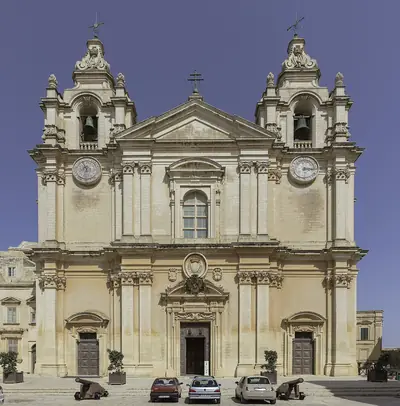
St Paul’s Cathedral, also known as Mdina Cathedral, is dedicated to Saint Paul the Apostle. Tradition places it where the Roman governor Publius is said to have met Paul after his shipwreck on Malta.
The cathedral was founded in the twelfth century, but its first building was severely damaged by the 1693 Sicily earthquake. Lorenzo Gafà designed the Baroque rebuilding, carried out between 1696 and 1705. The result is regarded as the architect’s masterpiece.
The Cathedral Museum holds medieval panels once displayed in the cathedral, religious vestments, historic furniture, ancient coins and a permanent exhibition of 76 original woodcuts by Albrecht Dürer.
Archbishop’s Palace
Close to St Paul’s Cathedral and the Cathedral Museum, the Archbishop’s Palace is the residence of the Archbishop of Malta. Built in the early eighteenth century, it was known as the Bishop’s Palace until 1944.
Its changing name reflects the building’s ecclesiastical role and its close connection with Mdina’s cathedral quarter.
Outside Mdina’s walls
Mdina’s history continues into neighbouring Rabat and the area beyond the walls. The Domvs Romana preserves the remains of an aristocratic Roman town house built in the first century BC, inside the Roman city of Melite.
The site was discovered in 1881, and its most striking features are the well-preserved Roman mosaics. A museum now protects the remains and presents objects connected with the house and the later cemetery established above it.
Other smaller religious landmarks include St Agatha’s Chapel and the Church of St Nicholas. St Agatha’s Chapel was first erected in 1417 and rebuilt after the 1693 earthquake to designs by Lorenzo Gafà. The Church of St Peter in Chains, also known as San Pietru fil-Ktajjen, is a protected Grade One listed building.
Mdina also makes a useful historical stop alongside Malta’s other cities. Continue to Valletta, explore the harbour area around Birgu, or compare Mdina’s character with Victoria on Gozo.
Explore Mdina with Neywo
Looking for an Mdina self-guided walking tour or a free walking tour in Mdina? Neywo offers two walking routes covering 1.86 km in total, with 138 minutes of narration and 17 stops between them:
- Mdina, the Silent City: Gate to Cathedral — 1.05 km, 90 minutes and 12 narrated stops.
- Outside the Walls: Roman Melite and the Bastions — 0.81 km, 48 minutes and 5 narrated stops.
Neywo’s Mdina audio guide tells the story of each place as you reach it, at your own pace, with no group and no schedule. Download the free app and explore Mdina’s gates, palaces, churches, cathedral and Roman remains while the city unfolds around you. When you continue travelling through Malta, Neywo also offers audio guides for Sliema.
Places with an audio guide in Mdina
8 places in Mdina with a Neywo audio guide. Each one starts telling its story as you reach it.
Self-guided tours in Mdina
2 tours in Mdina, free in the Neywo app. Each stop tells its story as you reach it.
- Walk
Mdina, the Silent City: Gate to Cathedral
Enter by the Baroque Mdina Gate and follow narrow streets of noble palaces, a Jesuit-built museum and small Baroque churches. The walk ends at St Paul's Cathedral, rebuilt after the 1693 earthquake, after a pause at the bastion square with its view across Malta.
Mdina Gate · Palazzo Vilhena · St Peter's Church and Monastery, Mdina · St Roque's Church, Mdina · Palazzo Costanzo · Palazzo Falson …
Open this tour: Mdina, the Silent City: Gate to Cathedral - Walk
Outside the Walls: Roman Melite and the Bastions
Start at the Roman house with its mosaics, circle the green bastions through Howard Gardens, and slip back in beside the best-preserved defensive walls in Malta to find two small chapels with centuries of history.
Domvs Romana · Howard Gardens · Fortifications of Mdina · St Agatha's chapel, Mdina · Church of St Nicholas
Open this tour: Outside the Walls: Roman Melite and the Bastions
Walk Mdina with Neywo
Neywo turns Mdina into a self-guided audio tour. Stories arrive as you reach the place they belong to, and the route reshapes when you wander off it.

