Visiting Mandalay, Myanmar: Top Sights on Foot
Things to Do in Mandalay: Royal Heritage and Buddhist Culture
The best things to do in Mandalay combine royal history, Buddhist devotion, and the everyday life of Myanmar’s cultural capital. The city was the country’s final royal capital, and its landmarks reveal a layered past shaped by monarchy, religion, colonial rule, war, and reconstruction.
Mandalay is also a useful starting point for exploring Myanmar, with a character distinct from nearby Yangon and the ancient monuments of Bagan. Neywo offers a free audio guide for Mandalay with 34 narrated places, so you can understand the stories behind the city as you explore.
What to See in Mandalay
Mandalay Palace
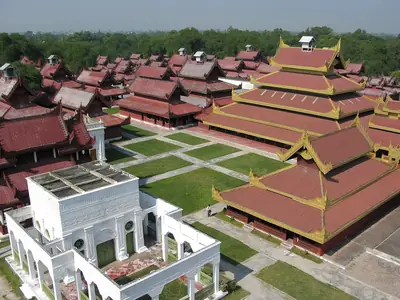
Mandalay Palace was the last royal palace of the Burmese monarchy and remains one of the city’s defining landmarks. King Mindon founded Mandalay as a new royal capital, and the palace was built between 1857 and 1859 as the residence of King Mindon and King Thibaw, the country’s last two kings.
The palace stands at the centre of a walled citadel surrounded by a moat. Its traditional Burmese design includes single-storey buildings, while the number of spires above each building indicated the importance of the space below. The palace faced east and ceased to be a royal residence on 28 November 1885, when troops entered during the Third Anglo-Burmese War and captured the royal family.
The British later converted the compound into Fort Dufferin. Much of the palace was destroyed by Allied bombing during the Second World War, although the royal mint and watchtower survived. A replica palace was rebuilt in the 1990s.
Mahamuni Buddha Temple
Mahamuni Buddha Temple is one of Myanmar’s major pilgrimage sites. Its centrepiece is the Mahamuni Image, a deeply venerated representation of the Buddha.
An ancient tradition says that only five likenesses of the Buddha were made during his lifetime. According to the legend, the Buddha visited Dhanyawadi in Arakan in 554 BC, where King Sanda Thuriya asked for an image to be cast in his likeness. After it was completed, the Buddha breathed upon it, and the image was believed to have taken on his exact appearance.
Mandalay’s religious and cultural landscape
Mandalay’s identity is closely connected with Buddhist practice. Monasteries, pagodas, and sacred sites are woven into the city’s neighbourhoods, while tea shops, markets, and residential lanes offer a view of everyday urban life.
The city also has Burmese, Chinese, and Indian influences, visible in its distinct communities and lively street culture. Traditional craftsmanship adds another dimension: marble carving workshops and gold-leaf work provide insight into artistic practices that remain part of Mandalay’s cultural character.
Mandalay Self-Guided Walking Tour
A self-guided walk makes it possible to connect Mandalay’s royal, religious, and civic landmarks without joining a group. Neywo’s audio guide narrates each place as you reach it, allowing you to explore at your own pace.
Teak, Tiers and the Last Royal Capital
This 5.32-kilometre walk takes 104 minutes and includes five narrated stops:
- Atumashi Monastery
- Shwenandaw Monastery
- Mandalay Palace
- Mandalay Culture Museum
- Sacred Heart Cathedral, Mandalay
The route brings together teak architecture, monastic heritage, the former royal centre, cultural collections, and a cathedral, reflecting the different layers of Mandalay’s history.
Old Mandalay: Teak, Faith and a Pilgrim’s Buddha
This 6.46-kilometre walk takes 112 minutes and includes four narrated stops:
- Mandalay Culture Museum
- Sacred Heart Cathedral, Mandalay
- Shweinbin Monastery
- Mahamuni Buddha Temple
It combines civic and religious landmarks before reaching the city’s major pilgrimage site, making it a way to explore both Mandalay’s built heritage and its continuing spiritual life.
Explore Mandalay with Neywo
Download Neywo and explore Mandalay with two walking tours, covering 5.32 km in 104 minutes and 6.46 km in 112 minutes. Together, the walks include 9 narrated stops, while the city guide contains 34 narrated places. Narration is available in 11 languages.
The app tells the story of each place as you reach it, at your own pace, with no group and no schedule. It is a simple way to discover Mandalay’s royal landmarks, monasteries, museums, cathedral, and pilgrimage sites while walking through the city.
Places with an audio guide in Mandalay
8 places in Mandalay with a Neywo audio guide. Each one starts telling its story as you reach it.
Walk Mandalay with Neywo
Neywo turns Mandalay into a self-guided audio tour. Stories arrive as you reach the place they belong to, and the route reshapes when you wander off it.

