Bagan, Myanmar: Self-Guided Walking Tour
Things to Do in Bagan: Temples, History and the Ancient Pagan Kingdom
Bagan is an archaeological landscape in Myanmar, where thousands of Buddhist temples, pagodas and monasteries spread across a semi-arid plain beside the Irrawaddy River. Once the capital of the Pagan Kingdom, it is worth visiting for its extraordinary concentration of historic monuments, distinctive brick architecture and stories connected to kings, pilgrims and captive rulers. Neywo has a free audio guide for Bagan with 22 narrated places, available in 11 languages.
What to See in Bagan
The best way to understand Bagan is to explore its monuments in sequence. Each one reveals something different about the former kingdom: its religious traditions, architectural development, royal ambitions and connections with neighboring regions.
Bagan Archaeological Site
From the 9th to the 13th centuries, Bagan was the capital of the Pagan Kingdom, the first realm to unify the lands that would become Myanmar. At its height, more than 10,000 Buddhist temples, pagodas and monasteries stood across the plain; more than 2,200 survive today.
The archaeological zone covers 36 square kilometers and is framed by the Irrawaddy River. In July 2019, the ancient city was inscribed as a UNESCO World Heritage Site. Its most celebrated monuments include Ananda Temple, Thatbyinnyu Temple, Dhammayangyi Temple and Sulamani Temple.
Lawkananda Pagoda
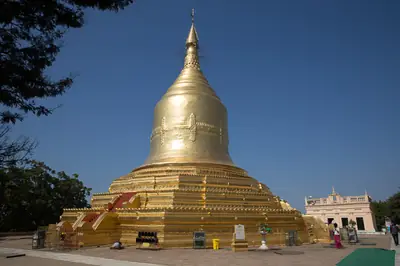
Lawkananda Pagoda stands on the bank of the Irrawaddy and has been a revered riverside shrine for nearly a thousand years. King Anawrahta built it in 1059, and tradition says that a replica of the Buddha’s tooth relic was brought from Sri Lanka by ship.
The pagoda’s bell-shaped dome rises from an octagonal base with three receding terraces. Stairways climb all four sides, while the clean, tapering spire reflects an early Burmese style influenced by Pyu traditions.
Tharabha Gate
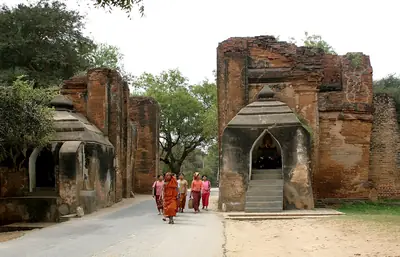
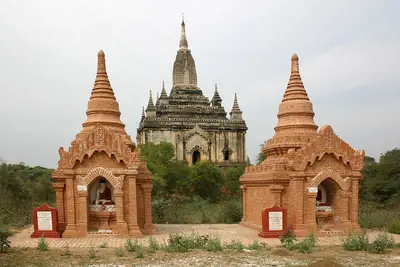
Tharabha Gate is the only surviving entrance of the twelve gates that once pierced Bagan’s city walls. The chronicles attribute the fortifications to King Pyinbya in 849 CE, although carbon dating places the main walls visible today closer to the early 11th century.
Two opposing brick shrines stand at the entrance, each associated with a guardian nat spirit. The wooden doors that once connected the shrines have disappeared, leaving the gate as the last visible doorway of ancient Bagan.
Shwegugyi Temple
King Sithu I commissioned Shwegugyi Temple in 1131, modelling it on the Gandhakuti, the Buddha’s dwelling at Jetavana monastery. The temple stands on a brick platform three metres high, giving it a commanding position.
Its arched windows, finely worked stucco and carefully carved wooden doors are among its most notable details. Stone inscriptions record that construction took exactly seven months, from mid-May to mid-December.
Thatbyinnyu Temple
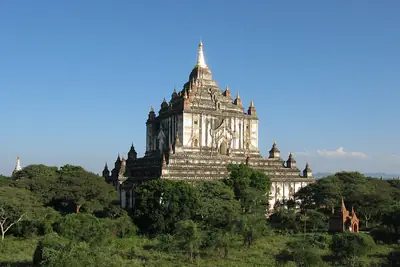
At 66 metres, Thatbyinnyu Temple is the tallest temple in Bagan and one of the plain’s defining landmarks. King Sithu I commissioned it in the mid-12th century, and it was completed around 1150.
Its two-storey design was the first of its kind in Bagan. Two massive square blocks support receding terraces decorated with miniature stupas, while a slender shikhara rises above them. The temple’s name comes from the Pali word Sabbaññū, meaning “the Omniscient”, one of the Buddha’s epithets.
Gawdawpalin Temple
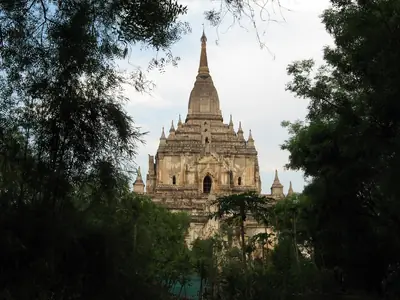
Gawdawpalin Temple rises 55 metres and is the second tallest temple in Bagan. Construction began in 1203 under King Sithu the Second and was completed on 26 March 1227 during the reign of King Htilominlo.
The temple follows the hollow gu-style design, creating interior spaces for meditation, worship and Buddhist rituals. Its two storeys, pointed arches and vaulted chambers represent the ambitious development of Bagan architecture. The building suffered heavy damage in the 1975 earthquake and was later reconstructed.
Bagan Archaeological Museum
Near Ananda Temple, the Bagan Archaeological Museum provides context for the monuments across the plain. It was first established in 1904 and rebuilt in 1938 as the three-storey building that stands today.
Its collection includes the original Myazedi inscription, often called the Rosetta Stone of Burma. The quadrilingual stone, written in Pali, Pyu, Mon and Old Burmese, helped unlock the previously unreadable Pyu language.
Ananda Temple
Ananda Temple is one of Bagan’s most important monuments and a celebrated example of Buddhist art. King Kyansittha built it between around 1090 and 1105, during the height of the Pagan Dynasty.
The temple has a square plan with four projecting porches facing the cardinal directions. Inside are four standing Buddhas, each more than nine metres tall, facing north, east, south and west. The north and south figures are originals from the 11th century, while the east and west images are later replacements.
Sulamani Temple
Sulamani Temple stands in Minnanthu and was commissioned by King Narapatisithu in 1183. Its two-storey form marks a transition between the earlier Mon-influenced style and the more developed Burmese temple design.
A massive lower cube supports an upper cruciform shrine crowned by a soaring sikhara. Its design echoes Thatbyinnyu Temple and Dhammayangyi Temple, and later influenced Htilominlo Temple.
Shwesandaw Pagoda
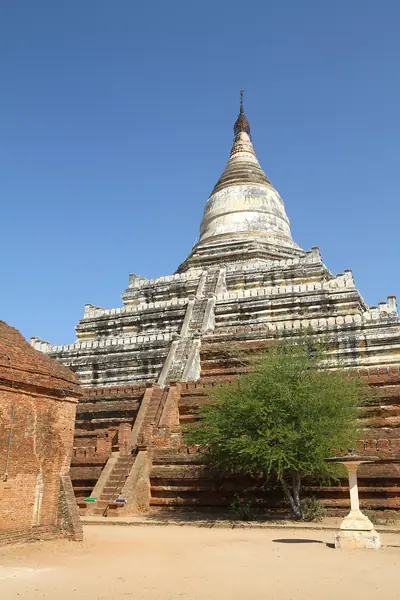
King Anawrahta built Shwesandaw Pagoda in 1057 after conquering the Mon kingdom of Thaton. Sacred relics, described as hairs of the Buddha, were enshrined here.
The pagoda rises through five square terraces topped by a bell-shaped stupa and jeweled umbrella, or hti. The terraces were once covered with glazed terracotta tiles illustrating scenes from the Jataka tales, although most of these tiles have weathered away.
Dhammayangyi Temple
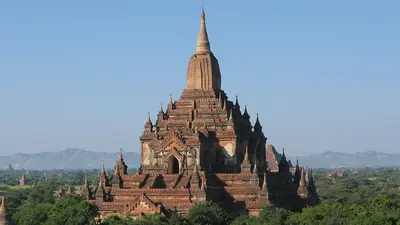
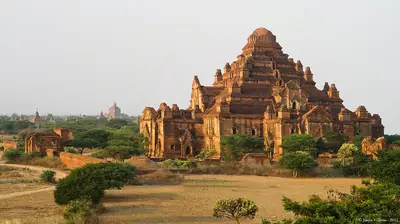
Dhammayangyi is the largest and most imposing temple in Bagan. King Narathu began building it in 1167, shortly after coming to the throne, apparently as an act of atonement after the murders of his father and elder brother.
Its Greek-cross plan resembles Ananda Temple but on a grander scale. Steep terraces give the building a pyramidal silhouette, while the exceptionally precise brickwork is central to its reputation. Construction stopped before the temple was completed after Narathu was assassinated.
Myazedi Pagoda
The most important feature of Myazedi Pagoda is the inscription housed there rather than the pagoda itself. Carved in 1113, the Myazedi Inscription presents the same text in Pali, Pyu, Mon and Old Burmese.
The inscription records the reconciliation of King Kyansittha and his son Prince Yazakumar. In 1911, Charles Otto Blagden used the text to decipher the Pyu language. One of the two inscription pillars stands at the pagoda in Myinkaba village, south of Old Bagan.
Manuha Temple
King Manuha built this temple in 1067 after being brought to Bagan as a captive ruler from the Thaton Kingdom. Its most striking feature is the cramped arrangement of the Buddha images inside.
Three enormous seated Buddhas fill the front chambers, while a reclining Buddha occupies the rear chamber. Their shoulders and body press against the surrounding walls, a design traditionally interpreted as an expression of Manuha’s captivity.
Nanpaya Temple
Nanpaya Temple stands in Myinkaba village beside Manuha Temple. King Manuha built it during his captivity as his residence. Unlike most Bagan temples, its core is made from sandstone blocks rather than brick.
Four large stone pillars support the central roof, each carved with the face of Brahma, the Hindu creator god. Perforated stone windows filter light into the sanctuary, highlighting the fine workmanship of this unusual monument.
Explore Bagan with a Free Audio Guide
Neywo offers two walking tours and one bike route in Bagan. The stories play automatically as you reach each place, at your own pace, with no group and no schedule.
- Old Bagan: the walled city of the Pagan kings — a 4.24 km walk lasting 116 minutes, with 8 narrated stops.
- Temples of conquerors and captive kings — a 4.59 km walk lasting 107 minutes, with 7 narrated stops.
- Cycling the temple plain of Bagan — an 8.4 km bike route lasting 42 minutes, with 10 narrated stops.
Together with the rest of the city guide, Neywo covers 22 narrated places in Bagan. Download the app and explore the temples, gates, museum and ancient stories as you move through the archaeological plain.
Places with an audio guide in Bagan
8 places in Bagan with a Neywo audio guide. Each one starts telling its story as you reach it.
Self-guided tours in Bagan
3 tours in Bagan, free in the Neywo app. Each stop tells its story as you reach it.
- Bike ride
Cycling the temple plain of Bagan
Bagan's archaeological zone is made for bikes and e-bikes: sandy lanes link the great temples across the plain. This loop rides from Ananda out to the red-brick Htilominlo, Sulamani and the mighty Dhammayangyi, back past Shwesandaw and Thatbyinnyu and south to the Myinkaba temples.
Htilominlo Temple · Sulamani Temple · Dhammayangyi Temple · Shwesandaw Pagoda · Thatbyinnyu Temple · Gawdawpalin Temple …
Open this tour: Cycling the temple plain of Bagan - Walk
Old Bagan: the walled city of the Pagan kings
Begin at Htilominlo, the temple raised on the spot where a royal umbrella chose a king, then enter the walled city of the Pagan kings through its last standing gate. Pass the Ananda Temple with its four golden Buddhas, the soaring Thatbyinnyu and the only Hindu temple left in the zone, finish at the museum that explains it all.
Htilominlo Temple · Tharabha Gate · Shwegugyi Temple · Thatbyinnyu Temple · Nathlaung Kyaung Temple · Gawdawpalin Temple …
Open this tour: Old Bagan: the walled city of the Pagan kings - Walk
Temples of conquerors and captive kings
From Sulamani, the model for Bagan's later great temples, to Dhammayangyi, the temple born of a king's guilty conscience, and Shwesandaw, built with relics from a conquered kingdom, then on to Myinkaba, where Thaton's captive king Manuha built his own temples. See the Myazedi inscription, the Rosetta Stone of Myanmar, on the way.
Sulamani Temple · Dhammayangyi Temple · Shwesandaw Pagoda · မြဇေတီ Myazedi Pagoda · Manuha Temple · Nanpaya Temple …
Open this tour: Temples of conquerors and captive kings
Walk Bagan with Neywo
Neywo turns Bagan into a self-guided audio tour. Stories arrive as you reach the place they belong to, and the route reshapes when you wander off it.

