Visiting Granada, Nicaragua: Top Sights on Foot
Things to Do in Granada, Nicaragua
Granada is a historic colonial city on the shores of Lake Nicaragua, known for its colorful churches, plazas, and Spanish-era architecture. Founded in 1524 by Francisco Hernández de Córdoba, it offers an easy-to-explore mix of heritage, local life, and nearby volcanic landscapes. Neywo has a free audio guide for Granada with 9 narrated places, available in 11 languages.
What to See in Granada
Catedral de Nuestra Señora de la Asunción
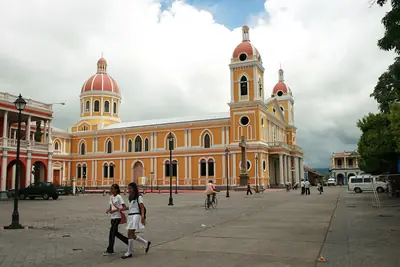
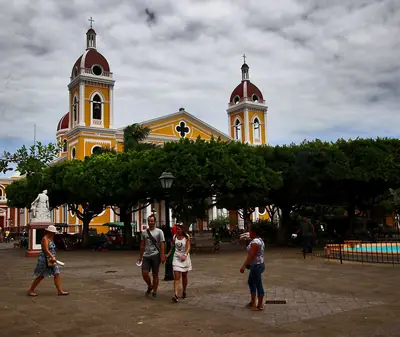
The Catedral de Nuestra Señora de la Asunción is Granada’s main cathedral and one of the city’s most recognizable landmarks. The neoclassical building stands at the heart of the historic city and has served as the spiritual center of Granada for centuries.
Its story began around 1525, when the first temple was built with stone, brick, lime, and a straw roof. That early structure was burned twice by 1578. A second temple, completed around 1751, forms the basis of the cathedral seen today. The building’s central dome has an iron frame brought from the United States in 1916.
The cathedral was already known locally as La Iglesia Bonita, or “The Beautiful Church,” by 1585. Its bright presence makes it one of the essential stops when exploring Granada.
Iglesia de la Merced
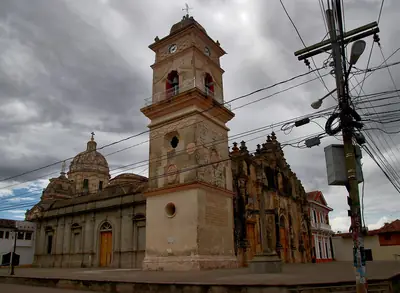
The Iglesia de la Merced, officially Iglesia Nuestra Señora de las Mercedes, is one of Granada’s most iconic churches. Its baroque style reflects the Spanish colonial legacy of the city, while its distinctive façade has become a defining part of Granada’s historic streetscape.
The church dates back to the first half of the sixteenth century. It began as a relatively simple building and changed over time, shaped by the events and rebuilding that formed the city’s architectural heritage.
Convento de San Francisco
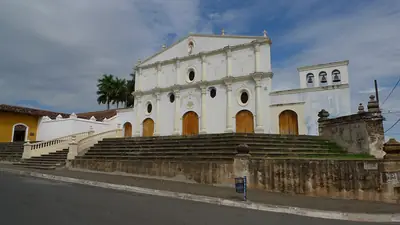
The Convento de San Francisco is a former convent and museum in the center of Granada. Dating from the seventeenth century, it belongs to the Spanish colonial era of the Nicaragua province.
The site has been declared a National Monument of Nicaragua since 2020. It is also known as the Centro Cultural Museos Convento San Francisco, a name that may appear on signs around the building.
Iglesia de Nuestra Señora de Guadalupe
The Iglesia de Nuestra Señora de Guadalupe is a historic place of worship in Granada, in Nicaragua’s Granada Department. Its presence adds another layer to the city’s collection of churches and religious landmarks, making it a worthwhile stop on a walk through Granada’s historic center.
Plaza Xalteva
Plaza Xalteva is a popular gathering place in the heart of Granada. The park offers a chance to slow down, sit for a while, and take in the atmosphere of the historic city.
Capilla María Auxiliadora
The Capilla María Auxiliadora is a small chapel in the municipality of Granada. Compared with the city’s larger churches, it is a quieter place to pause while exploring the area.
Monumento a Rubén Darío
The Monumento a Rubén Darío honors one of Nicaragua’s most celebrated literary figures. Rubén Darío made a lasting contribution to Spanish-language literature, and the monument connects Granada’s streets with the country’s cultural history.
Explore Granada Department and Volcán Mombacho
Granada is the center of the Granada Department, one of Nicaragua’s most historically rich regions. The department also includes towns such as Nandaime, Diriomo, and Diriá, each contributing to the area’s cultural character.
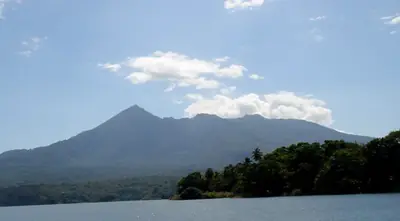
For a natural contrast to the city, Volcán Mombacho rises near Granada and the shores of Lake Nicaragua. The stratovolcano reaches about 1,344 meters and is one of Nicaragua’s protected areas. Its upper slopes are covered by cloud forest and dwarf forest, creating a cool, misty environment distinct from the warm lowlands.
More than 700 plant species have been recorded on Mombacho, including many orchids. The volcano is also notable for its unusual history: its last known eruption took place in 1570, when a crater lagoon broke through the weakened southern wall. Fumaroles still release steam on the slopes and inside the remains of the crater.
Granada’s setting makes it a useful base for discovering more of Nicaragua, from historic cities to volcanic landscapes. Travellers continuing through the country can also compare Granada’s colonial character with León, visit the capital Managua, or head towards the Pacific coast and San Juan del Sur.
Explore Granada with Neywo
Neywo’s free audio guide includes 9 narrated places in Granada, with narration available in 11 languages. The app tells the story of each place as you reach it, at your own pace, with no group and no schedule.
Download Neywo and turn a walk through Granada’s churches, plazas, convents, and monuments into a self-guided experience.
Places with an audio guide in Granada
5 places in Granada with a Neywo audio guide. Each one starts telling its story as you reach it.
Walk Granada with Neywo
Neywo turns Granada into a self-guided audio tour. Stories arrive as you reach the place they belong to, and the route reshapes when you wander off it.

