Visiting León, Nicaragua: Top Sights on Foot
Things to do in León, Nicaragua
The best things to do in León include exploring its grand cathedral, colonial churches, art collections, revolutionary history, and unusual museums. This historic city brings together religious heritage, literature, politics, and the visual character of Nicaragua’s western region. Neywo has a free audio guide for León with 10 narrated places, available in 11 languages.
What to see in León
León’s historic center is well suited to exploring on foot. The city’s most important landmarks reveal different sides of its identity, from colonial architecture to the memory of the Sandinista Revolution.
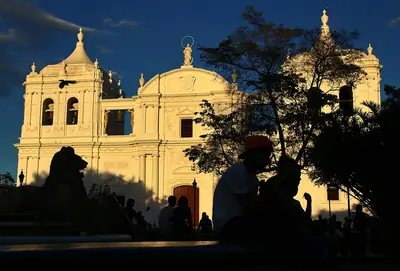
León Cathedral
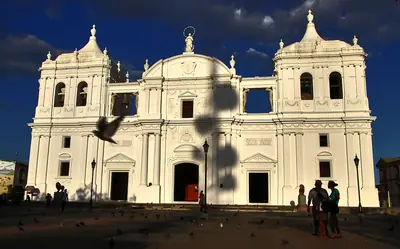
León Cathedral, formally the Cathedral of the Assumption of Mary, is one of Nicaragua’s most important historic landmarks and is regarded as the largest cathedral in Central America. Its construction took place between 1747 and the early nineteenth century, with the full architectural project developed in 1762. The design is attributed to the Guatemalan architect Diego José de Porres Esquivel.
The building combines colonial Baroque and Neoclassical influences, creating an eclectic architectural style. It was consecrated by Pope Pius the Ninth in 1860. Inside are a statue of the Virgin Mary created in the early twentieth century and the burial places of several notable figures from Nicaragua.
Ortiz-Gurdián Foundation Art Center
The Ortiz-Gurdián Foundation Art Center, also known as the Museo de Arte Fundación Ortiz-Gurdián, presents an international collection alongside works by recognized Nicaraguan artists. Founded in 2000, the museum occupies two buildings in central León.
The collection includes works associated with Pablo Picasso, Marc Chagall, and Joan Miró, as well as several well-known Nicaraguan artists. A sculpture garden adds an outdoor element, while contemporary group and solo exhibitions bring changing perspectives to the museum. The León center was the foundation’s original setting before it opened a branch in Managua in 2013.
Museo de la Revolución
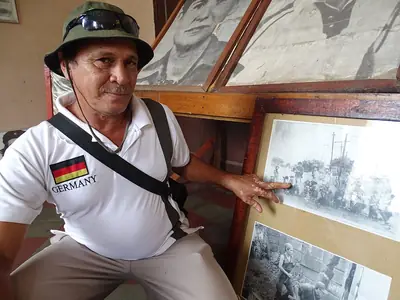
The Museo de la Revolución, also called the Museo Combatientes Históricos de la Revolución Popular Sandinista, preserves the memory of Nicaragua’s Sandinista Popular Revolution. Its exhibitions document the revolution and the events that led to the overthrow of the Somoza dictatorship in 1979.
For León, this is more than a historical collection. The museum forms part of the city’s political memory and helps explain its close association with the Sandinista movement.
Museum of Traditions and Legends
The Museum of Traditions and Legends occupies a former prison known as La 21, or the XXI prison. Between 1921 and 1979, many prisoners were tortured there. The prison’s history ended with the overthrow of Anastasio Somoza Debayle’s dictatorship by Sandinista guerrillas.
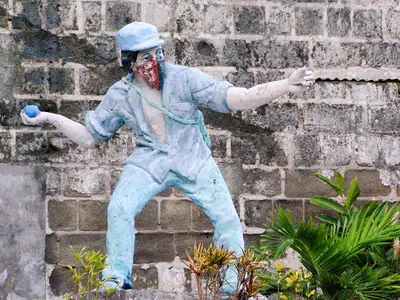
Today, the old cells serve as exhibition rooms for Nicaraguan traditions and legends, represented through puppets. The contrast between the stories of popular tradition and the building’s painful past gives the museum a distinctive atmosphere. A guided visit is available in Spanish, and the museum charges an admission fee.
León and its historic identity
León is formally known as Santiago de los Caballeros de León and is the capital of Nicaragua’s León Department. Founded on June 15, 1524, by Francisco Hernández de Córdoba, it remained Nicaragua’s capital until 1852.
For many years, León rivaled Granada for national influence. The two cities represented competing political traditions before Managua became the country’s capital. León also developed a strong intellectual, agricultural, commercial, and political identity, while the wider department became one of Nicaragua’s most productive areas.
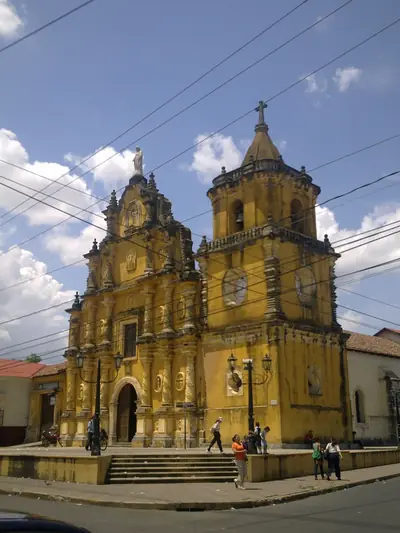
Church of La Recolección
The Church of La Recolección, or Iglesia de La Recolección, stands in León’s historic center. Its warm ochre façade is one of the city’s most recognizable sights and displays the rich decorative language of Mexican Baroque.
Founded as the Oratory of Our Lady of Sorrows by the Recollect fathers of the Oratory of Saint Philip Neri, the church had its first stone laid in 1786 and was consecrated two years later. Spiral columns divide the main façade into five sections and four levels, giving it the appearance of a carved altarpiece. Its reliefs refer to the Eucharist, the Stations of the Cross, the Life-Giving Cross, and the Resurrection.
A low bell tower with a clock stands beside the façade. Inside, the three-nave church contains a richly silvered Baroque main altar dedicated to the Immaculate Conception of the Virgin Mary.
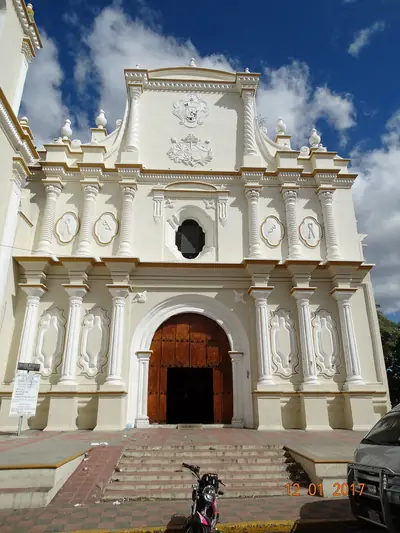
Diocesan Sanctuary of Our Lady of Mercy
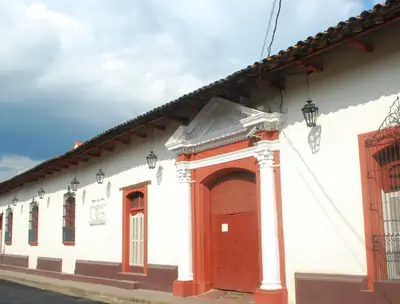
The Diocesan Sanctuary of Our Lady of Mercy, also known as Iglesia de la Merced, is dedicated to the Blessed Virgin Mary under the title of Our Lady of Mercy. Its façade combines late colonial Baroque architecture with Neoclassical elements, giving the sanctuary a distinctive place among León’s historic churches.
Saint John the Baptist of Sutiava Church
Saint John the Baptist of Sutiava Church, or Iglesia de San Juan Bautista de Sutiava, is an eighteenth-century Catholic church in León. It adds another historic religious landmark to the city’s architectural landscape.
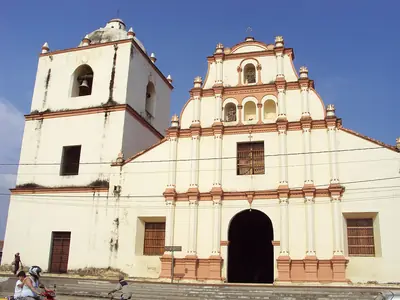
Saint Philip Church
Saint Philip Church, or Iglesia San Felipe, is located in León’s San Felipe neighborhood. Its origins go back to a small chapel created for the community of San Felipe de Austria, a settlement named in honor of the king of the time.
The chapel served people described in the historical account as mulattoes, free Black people, and Indigenous people. In 1872, it became a parish, with the canon Gordiano Carranza as its first parish priest.
José de la Cruz Mena Municipal Theater
The José de la Cruz Mena Municipal Theater, also known as the Teatro Municipal José de la Cruz Mena, is another cultural landmark in León. Its presence reflects the city’s continuing connection with public culture and the arts.
Explore León with a free audio guide
A León self-guided walking tour is a simple way to connect the city’s churches, museums, and historic landmarks. Neywo’s walking tour covers 4.54 km, takes about 113 minutes, and includes 9 narrated stops: Saint Philip Church, Church of La Recolección, León, Nicaragua, León Cathedral, the Diocesan Sanctuary of Our Lady of Mercy, Museo de la Revolución, the Museum of Traditions and Legends, the José de la Cruz Mena Municipal Theater, the Ortiz-Gurdián Foundation Art Center, and Saint John the Baptist of Sutiava Church.
Download Neywo and explore León at your own pace. The app tells the story of each place as you reach it, with no group and no schedule. With one walking tour and 10 narrated places in the city, it turns a free walking tour of León into an independent audio-guided experience. You can also continue planning your trip through Nicaragua, or compare León with Managua and San Juan del Sur.
Places with an audio guide in León
8 places in León with a Neywo audio guide. Each one starts telling its story as you reach it.
Self-guided tours in León
1 tour in León, free in the Neywo app. Each stop tells its story as you reach it.
- Walk
León: Cathedral, Poets and the Prison of Legends
Nicaragua's old capital packs a UNESCO cathedral, ochre Baroque churches, Picasso in a courtyard museum and a former Somoza prison turned puppet theater into a few dusty colonial blocks. Walk from the largest cathedral in Central America to the Sutiava church in the old indigenous quarter, tracing the town where Rubén Darío went to school.
Saint Philip Church · Church of la Recolección, León, Nicaragua · León Cathedral · Diocesan Sanctuary of Our Lady of Mercy · Museo de la Revolución · Museum of Traditions and Legends …
Open this tour: León: Cathedral, Poets and the Prison of Legends
Walk León with Neywo
Neywo turns León into a self-guided audio tour. Stories arrive as you reach the place they belong to, and the route reshapes when you wander off it.

