Visiting Lahore, Pakistan: Top Sights on Foot
Things to Do in Lahore: A Guide to the City’s Historic Landmarks
Looking for things to do in Lahore? Pakistan’s capital of Punjab brings together Mughal monuments, Sikh heritage, historic havelis, museums, gardens, and lively urban culture. The city’s long history is especially visible in the Walled City and in the grand landmarks built during the Mughal period. Neywo has a free audio guide for Lahore with 56 narrated places, available in 11 languages.
Lahore is also an excellent place to explore on foot. From the Lahore Fort and Badshahi Mosque to richly decorated mosques, old family homes, and national monuments, the city reveals a different layer of its history at almost every turn. As the capital and largest city of Punjab, it remains one of Pakistan’s most important cultural, historical, and economic centres.
What to see in Lahore
Lahore Fort and Moti Masjid
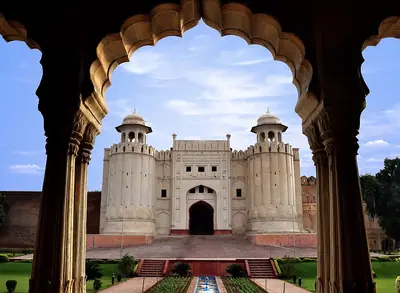
Lahore Fort stands at the northern end of the Walled City and contains 21 notable monuments across more than 20 hectares. Although the site has been inhabited for millennia, the foundations of the modern fort were laid in 1566 during the reign of Emperor Akbar. Its architecture combines Islamic and Hindu motifs, while later Mughal additions include Shah Jahan’s marble decoration with Persian floral inlay and Aurangzeb’s monumental Alamgiri Gate.
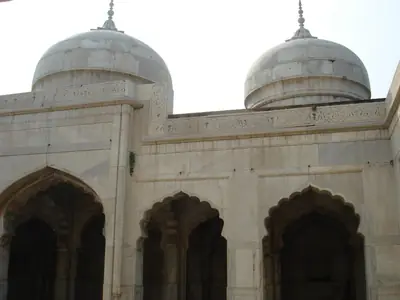
The fort also contains Moti Masjid, or the Pearl Mosque. This small seventeenth-century building is made of white marble and has three domes and five arched openings. During the Sikh period it was converted into a temple and later used to store treasure before being returned to Muslim use during British rule. Its changing history reflects the many eras represented within Lahore Fort.
Badshahi Mosque
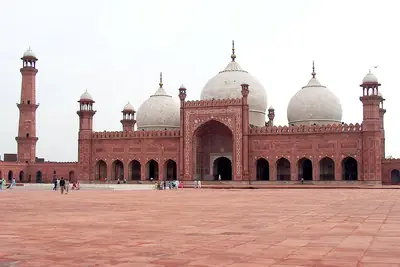
Opposite Lahore Fort, at the northern edge of the historic Walled City, stands Badshahi Mosque. Aurangzeb built the grand Mughal imperial mosque between 1671 and 1673. Its carved red sandstone is enriched with marble inlay, creating the powerful contrast that defines its exterior.
The mosque is closely similar in design to Delhi’s Jama Masjid, commissioned by Aurangzeb’s father, Shah Jahan. Together, Badshahi Mosque and Lahore Fort form one of the city’s most striking historic ensembles.
Gurdwara Dera Sahib
Gurdwara Dera Sahib commemorates the site where the fifth Sikh guru, Guru Arjan Dev, was martyred. Known as Gurdwara Dera Sahib Patshahi Panjvin, it was established in memory of his martyrdom in 1606.
The gurdwara is an important place for Sikh visitors and adds another essential layer to Lahore’s religious and architectural heritage. It is also included in the historic route connecting Minar-e-Pakistan, Lahore Fort, and Badshahi Mosque.
Minar-e-Pakistan and Greater Iqbal Park
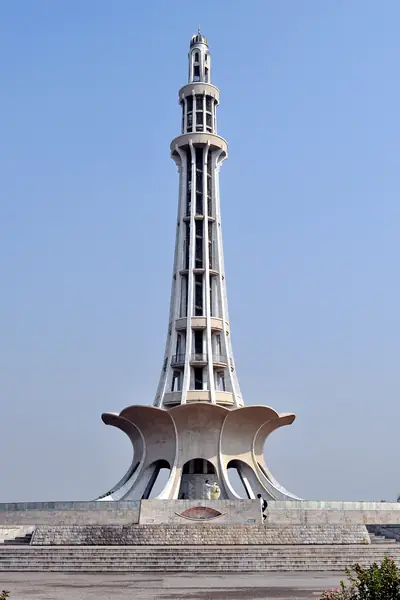
Minar-e-Pakistan, or the Tower of Pakistan, stands in Greater Iqbal Park, formerly known as Minto Park. It marks the exact place where the All-India Muslim League passed the Lahore Resolution on 23 March 1940. Chaired by Quaid-e-Azam Muhammad Ali Jinnah, the resolution was the first official call for a separate and independent homeland for the Muslims of British India.
Built between 1960 and 1968, the tower is also known as the Pakistan Memorial. Its location makes Greater Iqbal Park an important stop for understanding the political history behind the creation of Pakistan in 1947.
Wazir Khan Mosque
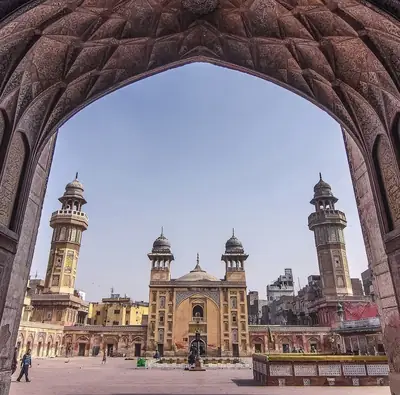
Wazir Khan Mosque is one of the most richly decorated Mughal-era mosques in Lahore. Commissioned by Wazir Khan, the governor of Punjab, during the reign of Shah Jahan, it was built between 1634 and 1641.
The mosque is known for its brilliant kashi-kari, or faience tilework, and for interiors covered almost completely with elaborate frescoes. It stands beside Chowk Wazir Khan, a large serai or courtyard complex with three arched gateways. Nearby, the Shahi Hammam baths formed part of the wider ensemble.
The Walled City and its historic buildings
A walk through Lahore’s Walled City reveals a dense collection of gates, havelis, mosques, bazaars, and religious sites. The area remains closely connected to everyday life, with traditional shops, craft stores, sweet shops, and displays of wedding clothing alongside its historic architecture.
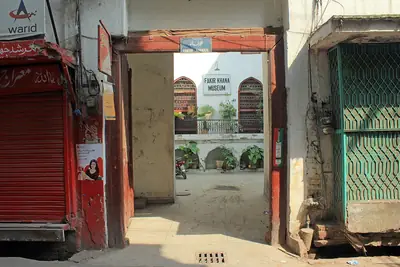
Inside Bhati Gate, Fakir Khana occupies a large haveli and family home. The private museum contains more than 20,000 objects collected and preserved by the Fakir family over six generations. Its antiques and cultural objects provide an extensive view of Punjab’s heritage and history.
The Haveli of Nau Nihal Singh, also called Lal Haveli, is another important building in the old city. Built in the mid-nineteenth century during the Sikh era, it is regarded as one of Lahore’s finest examples of Sikh architecture. It now houses Government Victoria Girls’ High School and is known as the only Sikh-era haveli in the city to preserve its original ornamentation and architecture.
Shalamar Gardens
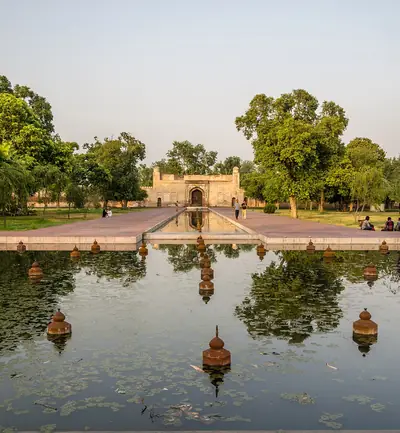
Shalamar Gardens, also known as Shalimar Gardens, were created as a vision of an earthly paradise. Shah Jahan began their construction in 1641 and completed them the following year.
The complex follows the idea of a Persian paradise garden, presenting the landscape as an ideal meeting place between people and nature. Its design reflects the artistic and aesthetic height of the Mughal Empire and offers a different experience from Lahore’s monumental mosques and forts.
Javed Manzil and the Allama Iqbal Museum
Javed Manzil preserves the home where Muhammad Iqbal spent the final three years of his life and died in 1938. He and his family moved there on 20 May 1935, and he named the house after his son, Javed.
The former residence became the Allama Iqbal Museum in 1984. Its nine galleries contain objects used by Iqbal, including his passport, spectacles, rings, clothing, walking sticks, manuscripts, letters, documents, and photographs. The collection also includes his signature seal, visiting-card wallet, bank book, legal coat, Jinnah caps, and correspondence.
Army Museum Lahore
Army Museum Lahore explores Pakistan’s military history from the Mughal Empire of the sixteenth century to modern-day Pakistan. Established in 2017, it stands on Lahore Cantonment land opposite Lahore Airport.
The museum holds the second-largest collection of military objects in Pakistan, making it a significant place to explore the country’s military past.
Grand Jamia Mosque, Lahore
In Bahria Town, the Grand Jamia Mosque is notable for its enormous scale. It can accommodate up to 70,000 worshippers, making it the third-largest mosque in Pakistan and the fourteenth-largest in the world.
Designed by Nayyar Ali Dada and inaugurated on 6 October 2014, the mosque has four 165-foot minarets, a central dome, and 20 smaller domes. More than four million handmade Multani mosaic tiles cover its exterior. Its design draws inspiration from Badshahi Mosque, Wazir Khan Mosque, and Sheikh Zayed Grand Mosque.
Manhala Kos Minar
Near Manhala town in Lahore District, Manhala Kos Minar is a seventeenth-century Mughal milestone connected to the ancient Grand Trunk Road. This route linked Lahore with Delhi and Agra during the Mughal period.
The monument stands in the historic village of Manhala Khan Khana and offers a glimpse of the routes that shaped travel and movement across the region.
Explore Lahore with Neywo
Neywo offers four walking tours in Lahore, with 29 narrated stops in total:
- Mughal Lahore: Fort, Mosque and the Tower of Pakistan — 2.03 km, 71 minutes, 6 stops.
- Inside the Walled City: Havelis, Gates, Tiles and Golden Domes — 4.1 km, 119 minutes, 10 stops.
- Mall Road, the Colonial Quarter and Iqbal’s Lahore — 5.41 km, 117 minutes, 8 stops.
- Mughal Tombs of Begampura and Shalamar Gardens — 4.39 km, 91 minutes, 5 stops.
Download the free Lahore audio guide and explore at your own pace. The app tells the story of each place as you reach it, with no group and no schedule. You can also continue your trip with the audio guides for Karachi or Islamabad.
Places with an audio guide in Lahore
8 places in Lahore with a Neywo audio guide. Each one starts telling its story as you reach it.
Self-guided tours in Lahore
4 tours in Lahore, free in the Neywo app. Each stop tells its story as you reach it.
- Walk
Mughal Lahore: Fort, Mosque and the Tower of Pakistan
Walk through the grand Mughal ensemble at the northern edge of the old city. See the tower that marks the birthplace of Pakistan's independence call in Iqbal Park, the UNESCO-listed Lahore Fort with its Pearl Mosque, the red-sandstone Badshahi Mosque, and the Sikh shrine where Guru Arjan Dev was martyred.
Minar-e-Pakistan · Iqbal Park · Lahore Fort · Moti Masjid · Badshahi Mosque · Gurdwara Dera Sahib
Open this tour: Mughal Lahore: Fort, Mosque and the Tower of Pakistan - Walk
Inside the Walled City: Havelis, Gates, Tiles and Golden Domes
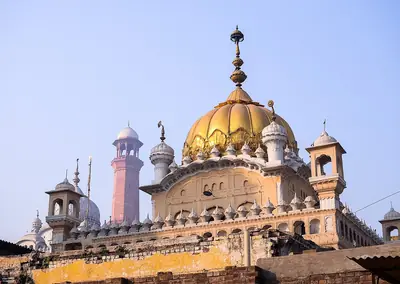
Enter the inner city at Bhati Gate and follow its lanes east: a family museum with over 20,000 objects, a Sikh-era mansion with its original ornament, and a mosque sunk 25 feet below the street. Continue to the faience-covered Wazir Khan Mosque, the golden-domed mosque above Kashmiri Bazaar, two old gates, a Sikh birthplace shrine and the Mughal mosque opposite the fort.
Bhati Gate · Fakir Khana · Haveli of Nau Nihal Singh · Neevin Mosque · Suneri Mosque · Wazir Khan Mosque …
Open this tour: Inside the Walled City: Havelis, Gates, Tiles and Golden Domes - Walk
Mall Road, the Colonial Quarter and Iqbal's Lahore
Leave the old city for Lahore's British-era avenues. Visit the Lahore Museum with its famed Gandhara collection, a Hindu temple in Anarkali, the Neo-Gothic railway church of St Andrew and the Belgian-designed Sacred Heart Cathedral. Continue east past St Anthony's Church to a Shia shrine and the house where the poet Iqbal spent his last years.
Lahore Museum · Valmiki Temple · St. Andrew's Church · Sacred Heart Cathedral · St. Anthony's Church · Convent of Jesus and Mary, Lahore …
Open this tour: Mall Road, the Colonial Quarter and Iqbal's Lahore - Walk
Mughal Tombs of Begampura and Shalamar Gardens
Follow the Grand Trunk Road east of the city to a cluster of Mughal and Sikh-era tombs: Buddhu's Tomb with its three names, the ruined tomb of the governor Ali Mardan Khan, the rose-garden tomb of Shah Jahan's nurse and the Cypress Tomb. End at the UNESCO-listed Shalamar Gardens, a Persian paradise garden laid out in 1641.
Buddhu's Tomb · Tomb of Ali Mardan Khan · Tomb of Dai Anga · Cypress Tomb · Shalamar Gardens
Open this tour: Mughal Tombs of Begampura and Shalamar Gardens
Walk Lahore with Neywo
Neywo turns Lahore into a self-guided audio tour. Stories arrive as you reach the place they belong to, and the route reshapes when you wander off it.

