Visiting Uppsala, Sweden: Top Sights on Foot
Things to Do in Uppsala: A Guide to the City’s Historic Sights
The best things to do in Uppsala include exploring its Gothic cathedral, university museums, royal castle, historic libraries and the archaeological landscapes of Old Uppsala. The city brings together medieval and royal history, scientific discovery, art and Swedish cultural heritage in a compact destination. Neywo’s free audio guide to Uppsala covers 112 narrated places.
What to See in Uppsala
Uppsala Cathedral
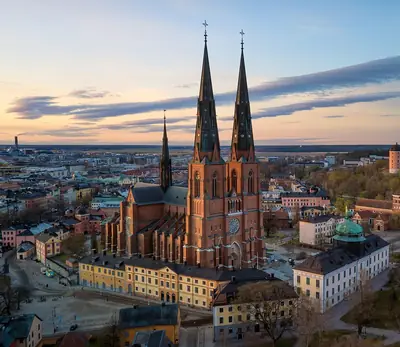
Uppsala Cathedral stands on Domberget, or Cathedral Hill, between Uppsala University and the Fyris River. It is the largest Gothic church building in the Nordic countries, with twin western towers rising to 118.7 metres—the tallest church towers in the Nordic region.
Construction began around 1272 or 1273, after the bishop’s seat was moved to Uppsala in the mid-13th century. French architects, including Étienne de Bonneuil, worked on the French Gothic design. The cathedral was consecrated in 1435, although the western end was completed only in the middle of the 15th century.
The brick building has a cross-shaped plan formed by its nave and transept. It remains the seat of the Archbishop of Uppsala and belongs to the Church of Sweden.
Uppsala Cathedral’s Treasury
The cathedral’s Treasury, or Uppsala domkyrkas skattkammare, occupies the northern tower and is reached by elevator from the information desk near the main entrance. Its collection includes the funeral regalia of King Gustav Vasa and King Johan III, as well as those of their queens.
The museum also contains medieval textiles, including bishops’ chasubles, and the clothes worn by Svante Sture the Younger and his sons Nils and Erik at their execution in 1567. One of its most notable objects is Queen Margaret’s dress, described as the only preserved medieval ceremonial gown in the world.
Gustavianum
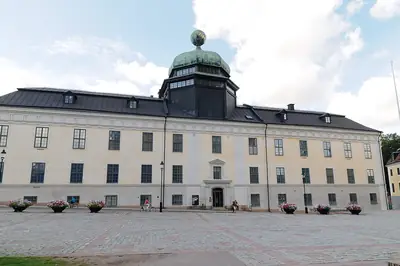
Opposite Uppsala Cathedral, Gustavianum is the oldest surviving building at Uppsala University. It was built between 1622 and 1625 with funding donated by King Gustavus Adolphus, whose name it carries. From 1778 to 1887, it served as the university’s main building.
Today, it houses Uppsala University’s museum. Its collections include Greek, Egyptian and Nordic antiquities, alongside five permanent exhibitions about the history of science and the university. The top floor preserves the Theatrum anatomicum, an anatomical theatre designed by professor Olof Rudbeck for demonstrations of dissections.
Carolina Rediviva
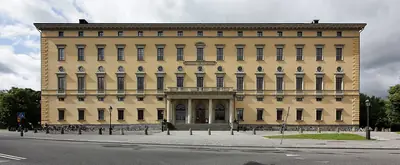
Carolina Rediviva is the main building of Uppsala University Library and the oldest and largest university library building in Sweden. Its Latin name means “Carolina Revived”, referring to the former Academia Carolina building that served as the university library during much of the 18th century.
The foundation stone was laid in 1817, construction began in 1819 and the building opened to the public in 1841. Designed originally by Carl Fredrik Sundvall, it was later extended through work by Axel Johan Anderberg and Peter Celsing.
The library holds the Codex Argenteus and the Cancionero de Upsala, among its important treasures.
Uppsala Castle
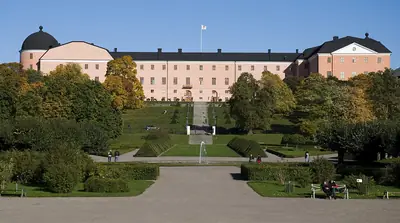
Uppsala Castle rises on Kasåsen and has been part of the city’s skyline since the 16th century. Originally constructed in 1549, it was repeatedly remodelled and expanded and is now a listed building.
The castle is associated with several major episodes in Swedish history. The Sture Murders took place here, and the decision for Sweden to participate in the Thirty Years’ War was made within its walls. In 1654, Queen Christina abdicated at the castle, a decision that shocked Europe. Many of Sweden’s ancient kings and queens lived or were born here.
Today, Uppsala Castle is the official residence of the governor of Uppsala County.
Bror Hjorths Hus
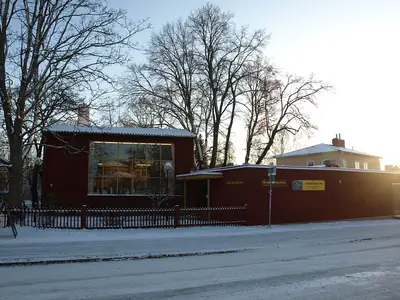
Bror Hjorths Hus occupies the former home and studio of artist Bror Hjorth, where he lived and worked for 25 years. After his death, the building became a museum with the largest and most representative collection of his work.
The collection includes paintings, sculptures, reliefs and drawings, as well as sketches and preparatory works for public commissions. The Falu red wooden villa was designed in 1943 by Sten Hummel-Gumaelius and reflects the traditional building style of Uppland. An exhibition hall was added in the 1990s, and the museum also presents exhibitions by other artists.
The Museum of Evolution
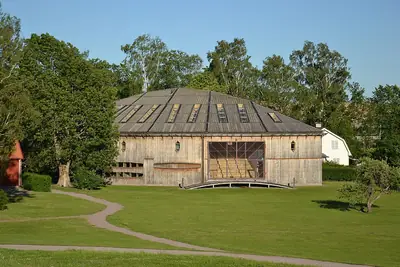
The Museum of Evolution of Uppsala University, or Evolutionsmuseet, is a natural history museum beside the Botanical Garden in the Kåbo district. It holds Scandinavia’s largest collection of dinosaur fossils and more than 5 million zoological, paleontological and mineralogical objects.
The collections began with specimens donated to the university by private collectors in the 1600s. Among the early donors were Queen Lovisa Ulrika, Jonas Alströmer, Carl Linnaeus and Carl Peter Thunberg. The museum took its current form in 1999 and is spread across three buildings.
Biotopia
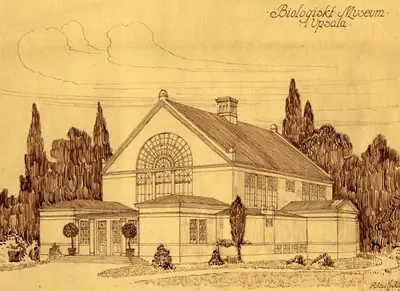
Biotopia is a natural history museum in Vasaparken, next to Vasahuset and Ekonomikum. Formerly known as the Biological Museum, it focuses on Swedish nature and wildlife and offers an introduction to the animals and landscapes of the region.
Its location makes it an easy addition to a walk through Uppsala’s parks and university districts.
The Linnaeus Museum and Linnaeus Hammarby
The Linnaeus Museum in Uppsala is a biographical museum dedicated to Carl von Linné, one of Sweden’s best-known scientists. It focuses on his life and work.
For a broader view of his world, Linnaeus Hammarby lies about 15 kilometres southeast of Uppsala, in Danmarks-Hammarby. The country estate was Carl Linnaeus’s summer home and was built in 1762. The Swedish state purchased and restored it in 1879, and it is now a museum run by Uppsala University together with the Botanical Garden and the Linnaeus Garden.
The site includes exhibitions about Linnaeus’s collections, life and work, along with a botanical garden and park.
Old Uppsala and Gamla Uppsala Museum
Old Uppsala was an important religious and cultural centre from approximately the 5th to the 13th century. The area is associated with the legendary Temple at Uppsala and is marked by several large burial mounds.
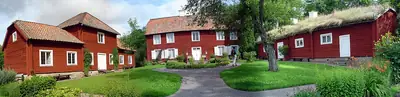
Gamla Uppsala Museum presents the archaeology and history of the site during the Vendel Period and Viking Age. The museum building, designed by Carl Nyrén, opened in 2000. Nearby, Disagården open-air museum brings together historic buildings from the 1500s through the 1800s, relocated from different parts of Uppland to show what a typical regional village might have looked like in the mid-19th century.
Pumphuset
Pumphuset stands beside the Fyris River near the Islandsbron bridge. Built from 1874 by architect Adrian C. Peterson, it served as Uppsala’s waterworks for almost a century.
Following its modernization in 2016 and 2017, the building became an information and meeting place with an interactive exhibition about water, waste and the history of water in Uppsala.
The Museum of Medical History
The Museum of Medical History occupies a former administration and residential building from 1900 in the Ulleråker area. Designed by Axel Kumlien, it was once part of the Ulleråker hospital complex.
Its exhibitions cover Swedish medical history from the 1600s to the modern era, including surgical instruments, medical devices, pharmaceutical history and folk medicine. A section on nursing in Sweden features Emmy Rappe, the country’s first trained nurse, who worked at the Academic Hospital from its opening in 1867.
Explore Uppsala with a Self-Guided Audio Tour
An Uppsala self-guided walking tour is a convenient way to connect the city’s main sights without joining a group. Neywo has three walking tours and one bus route in Uppsala, with narration available in 11 languages:
- Cathedral Hill: Kings, Archbishops and the Oldest University in the North — a 1.29 km walk lasting 89 minutes, with 10 narrated stops.
- Linnaeus, the Fyris River and the Royal Castle — a 2.44 km walk lasting 83 minutes, with 9 narrated stops.
- Gamla Uppsala: Viking Kings, Royal Mounds and a Pagan Temple — a 1.09 km walk lasting 44 minutes, with 5 narrated stops.
- Bus 2: From Bror Hjorth’s House to Gamla Uppsala — a 9.6 km route lasting 41 minutes, with 4 narrated stops.
The app tells the story of each place as you reach it, at your own pace, with no group and no schedule. If you are comparing destinations across the country, you can continue exploring Sweden or discover Stockholm, Gothenburg or Visby.
Download Neywo and Explore Uppsala at Your Own Pace
Download Neywo’s free Uppsala audio guide to explore 112 narrated places through three walks and one bus route. Follow the route that suits you, or move between sights independently: each story starts when you arrive, so you can discover Uppsala without a group, a schedule or a guide to follow.
Places with an audio guide in Uppsala
8 places in Uppsala with a Neywo audio guide. Each one starts telling its story as you reach it.
Self-guided tours in Uppsala
4 tours in Uppsala, free in the Neywo app. Each stop tells its story as you reach it.
- Bus ride
Bus 2: From Bror Hjorth's House to Gamla Uppsala
City bus 2 starts at the sculptor Bror Hjorth's red wooden villa, crosses Stora torget and passes his Näckens polska fountain, then heads north to Gamla Uppsala, the old royal seat. Get off at Österledskyrkan and walk to the Viking mounds.
Bror Hjorths Hus · Stora torget · Näckens polska · Österledskyrkan
Open this tour: Bus 2: From Bror Hjorth's House to Gamla Uppsala - Walk
Cathedral Hill: Kings, Archbishops and the Oldest University in the North
Climb from the great university library to Uppsala Cathedral, where Sweden's kings were crowned and Linnaeus lies buried. Along the way you pass an archbishop's palace, a medieval farm church with a sundial and the oldest standing university building, Gustavianum, with its anatomical theatre.
Carolina Rediviva · Geijersgården · Archbishop's Palace of Uppsala · Holy Trinity Church · Riddartorget · Gustavianum …
Open this tour: Cathedral Hill: Kings, Archbishops and the Oldest University in the North - Walk
Linnaeus, the Fyris River and the Royal Castle
Start in the botanical garden laid out by the father of modern plant naming, then follow the Fyris River across the old squares to the market heart of the city. End at the old waterworks and Uppsala Castle, where Queen Christina gave up her throne.
Linnaean Garden · The Linnaeus Museum · Upplandsmuseet · Fyristorg · Gamla torget · Stora torget …
Open this tour: Linnaeus, the Fyris River and the Royal Castle - Walk
Gamla Uppsala: Viking Kings, Royal Mounds and a Pagan Temple
Five kilometres north of the centre lies the seat of the legendary Swedish kings. Walk between the royal burial mounds, the museum on the Viking Age, the medieval church that may stand on the old temple site and an open-air farm village.
Gamla Uppsala · Old Uppsala archaeological area · Gamla Uppsala museum · Old Uppsala Church · Disagården open air museum
Open this tour: Gamla Uppsala: Viking Kings, Royal Mounds and a Pagan Temple
Walk Uppsala with Neywo
Neywo turns Uppsala into a self-guided audio tour. Stories arrive as you reach the place they belong to, and the route reshapes when you wander off it.

