Visiting Visby, Sweden: Top Sights on Foot
Things to Do in Visby: Medieval Ruins, City Walls and Baltic History
Visby is a medieval town on Sweden’s island of Gotland, known for its remarkably preserved city wall, church ruins and Hanseatic heritage. The compact historic centre is ideal for exploring on foot, with centuries of history unfolding along narrow streets, squares and stone-built landmarks. Neywo’s free Visby audio guide tells the stories of 160 narrated places as you explore.
What to See in Visby
Walk along the City Wall of Visby
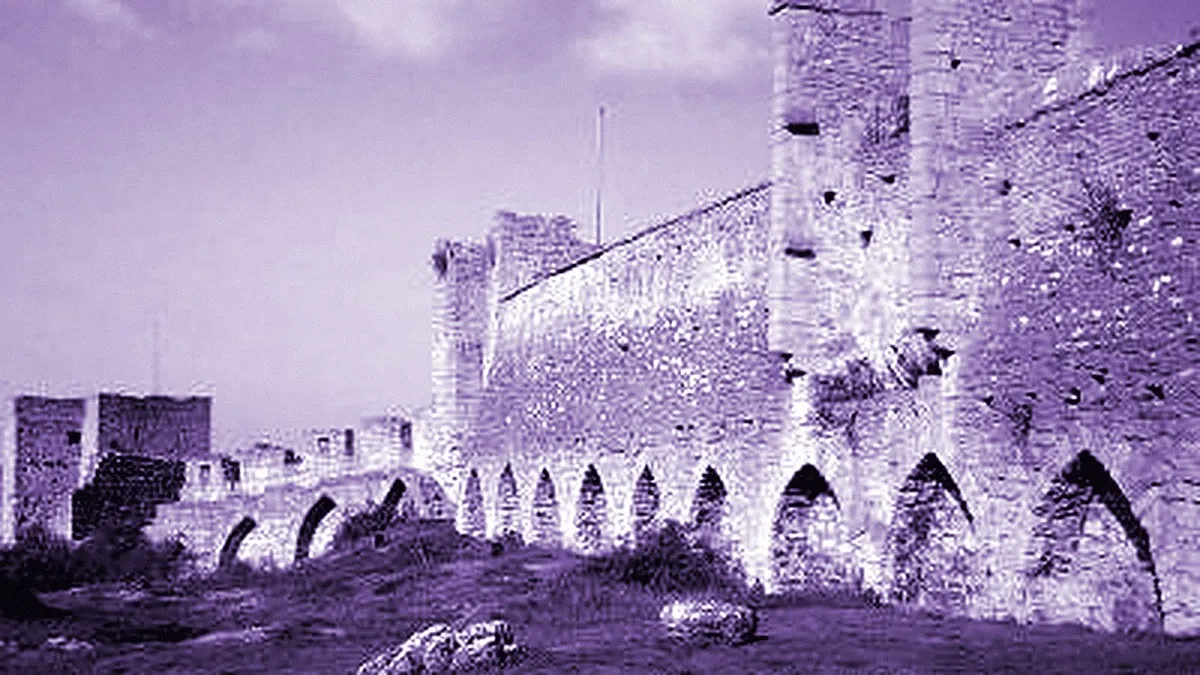
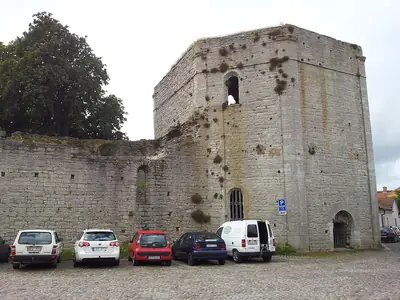
The City Wall of Visby is the town’s defining landmark and one of the strongest and best-preserved medieval walls in Scandinavia. The stone ring stretches for 3.5 kilometres around the medieval heart of the city. In places, the ramparts rise 11 metres, and 27 of the original large towers still stand, along with nine smaller ones.
The wall developed in two main stages during the thirteenth and fourteenth centuries, as Visby grew in wealth and importance. Its defensive system also included gates, ditches and an outer rampart. Söderport, Österport and Norderport were the three principal entrances.
Visit Visby Cathedral
Visby Cathedral, or Sankta Maria, is the only medieval church in the city to have survived intact. It was built for the German merchants who played a major role in Visby’s trade. A wooden chapel was replaced by a stone church, which was consecrated in 1225.
The cathedral began as a Romanesque basilica before being transformed into a hall church. Its architecture reflects German models from Westphalia and the Rhineland, alongside French Gothic details in the pointed arches and window tracery. The building later influenced churches elsewhere on Gotland and cathedrals including those in Linköping and Uppsala.
See the ruins of Saint Catherine
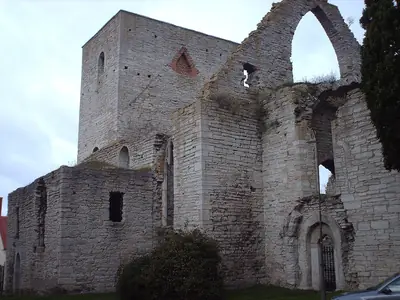
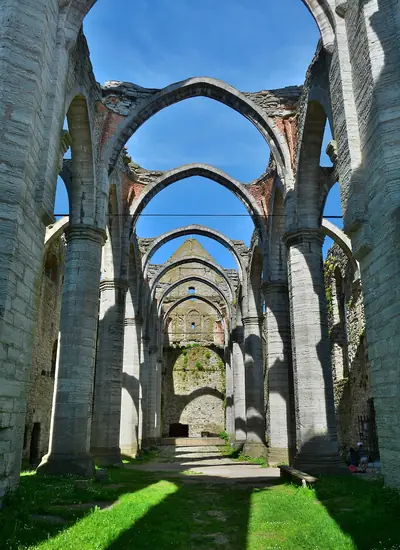
The ruins of Saint Catherine’s Church stand beside Suurtor, the main gate into the medieval town. The Franciscan order founded a convent here in 1233, and the church was built around 1250 as a modest single-nave structure.
During the early fourteenth century, it was expanded into a three-nave hall church. Brick vaults were added around 1400, but they collapsed soon afterwards, leaving the nave unfinished. The ruin remains one of Visby’s most striking medieval sites.
Explore Saint Nicolaus Church Ruin
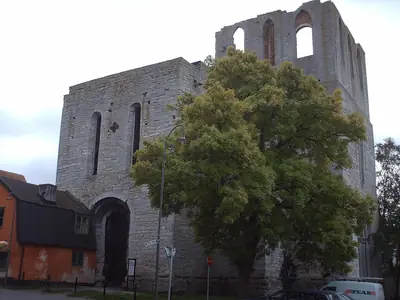
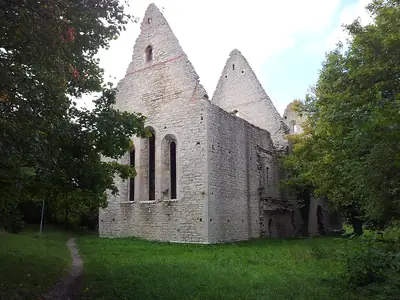
Saint Nicolaus Church was named after the patron saint of sailors, an appropriate dedication for a Hanseatic port. The first church was built between 1215 and 1220 for the German community in northern Visby. After a fire, the German parish moved to the new cathedral around 1240.
Dominican friars later took over the damaged building and began rebuilding it in the mid-thirteenth century. The surviving west gable dates from 1251. The convent and church were eventually destroyed after Lübeckers attacked Visby in 1525.
Discover St. Clement’s Church
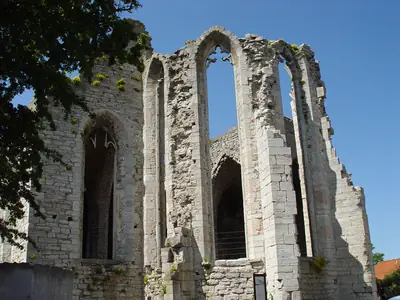
St. Clement’s Church is one of Visby’s oldest stone churches, with walls dating from the mid-eleventh century. Around 1060, Visby was divided into two parishes, and this church served the northern part of the town. Its dedication to St. Clement, the patron saint of seafarers, reflects Gotland’s maritime culture and its connections across the Baltic.
The remaining stonework gives an impression of the church’s original size and importance. Nearby, St. Hans Church served the southern parish.
Visit Sankt Hans and Sankt Per
The ruins of Sankt Hans and Sankt Per belong to two medieval churches that once stood side by side. St. Hans began around 1060 as the first stone church on Gotland, built on an ancient pagan offering place known as a viet. St. Per followed after 1161 on the site of an earlier wooden church called All Saints, serving German merchants in Visby.
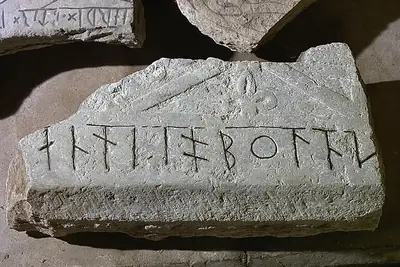
Both churches had fallen into ruin by the seventeenth century. In the nineteenth century, their stones were reused for a nearby house, uncovering hundreds of medieval tombstones beneath the ruins. Among the discoveries was a runic stone dating from around 1070.
Step into Helge And Church Ruin
Helge And Church, also known as the Church of the Holy Spirit, has an unusual octagonal design. Its two-storey nave and projecting choir make it unlike most medieval churches in Visby. The form recalls Charlemagne’s palace chapel in Aachen, as well as other polygonal churches associated with the Crusades.
The church was built in the early thirteenth century, but its original purpose remains uncertain. One theory connects it with Bishop Albert of Riga, while another suggests that it may have been a Danish guild chapel. The first written mention dates from 1226.
See Saint Lars Church Ruin
Saint Lars was built around 1210–1220, when Visby’s growing population required another parish church. Its choir is the oldest surviving part. Unlike many of Visby’s churches, which follow German architectural traditions, Saint Lars shows Byzantine influence in its rounded arches and traces of domed vaulting.
The church is dedicated to Saint Lawrence, one of the seven deacons of ancient Rome. It was also known for a time as Saint Anna’s Church.
Find Drotten Church Ruin
Drotten Church, also called Saint Trinitatis or the Church of the Holy Trinity, was built around 1240 for Visby’s German-speaking community. Its name comes from an old word meaning prince or king. The church was later renovated and expanded, with a rib-vaulted ceiling that influenced the choir vault of Lokrume Church elsewhere on Gotland.
Its decline began in 1528, when townspeople started removing valuable furnishings. The building was subsequently abandoned and became the ruin visible today.
Look beyond the town at Gotland’s ancient monuments
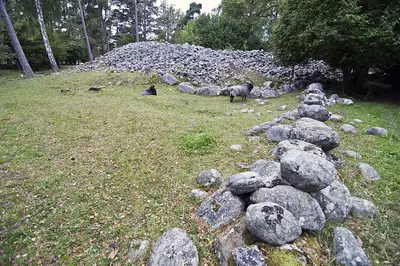
The area around Visby also preserves much older traces of human activity. Lejsturojr is a Bronze Age stone cairn built from grey granite around 1800–1500 BCE. It rises about four metres and measures roughly 40 metres across, with a second, wider cairn nearby. Together, the monuments mark a burial landscape connected to Gotland’s early farming and seafaring communities.
Hagrojr is another ancient stone cairn, while Torsburgens fornborg is an ancient hillfort on Gotland. These sites place Visby’s medieval history within a much longer island story.
Take a trip to Fårö
Fårö lies north of Gotland, separated from the main island by the narrow Fårösund strait. The island has a quiet atmosphere, a mostly flat landscape and a coastline shaped by headlands such as Digerhuvud, Holmudden and Ryssnäs. At Ullahau, shifting sands create a landscape with an almost desert-like character.
Fårö is part of the wider landscape of Sweden, whose largest island is shaped by limestone, coastal cliffs and rauks—distinctive rock formations found along the shore.
Explore Visby with a free audio guide
Neywo offers 3 self-guided walking tours in Visby, with 25 narrated stops in total:
- Stone Skeletons to Gallows Hill: 1.77 km, 82 minutes and 8 stops
- From Old Harbour to Merchant Cathedral: 1.87 km, 79 minutes and 11 stops
- Where Gotland’s Christianity Began: 2.55 km, 68 minutes and 6 stops
The routes cover landmarks including the city wall, medieval church ruins, Visby Cathedral, the Gotland Museum, Stora torget and the Botanical Garden. Each story plays as you reach the place, at your own pace, with no group and no schedule. Narration is available in 11 languages.
Download Neywo and explore Visby as the city’s history appears around you—one ruin, wall and historic square at a time.
Places with an audio guide in Visby
8 places in Visby with a Neywo audio guide. Each one starts telling its story as you reach it.
Self-guided tours in Visby
3 tours in Visby, free in the Neywo app. Each stop tells its story as you reach it.
- Walk
Stone Skeletons to Gallows Hill
Visby grew rich on Baltic trade, and its merchants built a church for every parish, then watched most of them burn or decay. Follow the ruins of Saint Lars, the King's Church, Saint Clement, the octagonal Holy Spirit church and the Dominican convent of Saint Nicolaus, then climb out of town to the windswept hill where Visby once hanged its criminals.
Saint Lars church ruin · Drotten church ruin · St. Clement church ruin · Helge And church ruin · Sankta Gertruds kyrkoruin, Visby · Saint Nicolaus church ruin in Visby …
Open this tour: Stone Skeletons to Gallows Hill - Walk
From Old Harbour to Merchant Cathedral
Start at the library on the edge of the elm park that was once Visby's harbour, then pass a painted 17th-century Lübeck merchant's house, the island museum with its Viking silver and the oldest lived-in apartment building in Sweden. Walk through the old square to Saint Catherine's soaring ruin and the cathedral, and finish in the botanical garden between the medieval town and the sea.
Almedalsbiblioteket · Almedalen · Donners plats · Burmeisterska huset · Gotland Museum · Gotland art museum …
Open this tour: From Old Harbour to Merchant Cathedral - Walk
Where Gotland's Christianity Began
A quieter route through the southern town and just beyond its walls. See the twin ruins where the island's first stone church rose on a pagan offering site, a king's fortress above the harbour and the spot of the only nunnery Gotland ever had.
City wall of Visby · Sankt Hans och Sankt Pers kyrkoruiner · Solberga Abbey · Södertorg · Skeppsbrogränd · Visborg
Open this tour: Where Gotland's Christianity Began
Walk Visby with Neywo
Neywo turns Visby into a self-guided audio tour. Stories arrive as you reach the place they belong to, and the route reshapes when you wander off it.

