Visiting Odesa, Ukraine: Top Sights on Foot
Things to do in Odesa: the landmarks, churches and palaces to see
Odesa is a historic port city on Ukraine’s Black Sea coast, known for its grand architecture, religious heritage and connection with the harbor. The city is worth visiting for its monumental stairway, richly decorated theatre, historic palaces, museums and streets shaped by many different communities. Neywo offers a free audio guide for Odesa with 82 narrated places.
What to see in Odesa
For anyone planning things to do in Odesa, the historic center is the best place to begin. The main sights are close enough to connect in a series of walks, taking you from large civic squares to palaces, churches, museums and the railway station.
Soborna Square and Transfiguration Cathedral
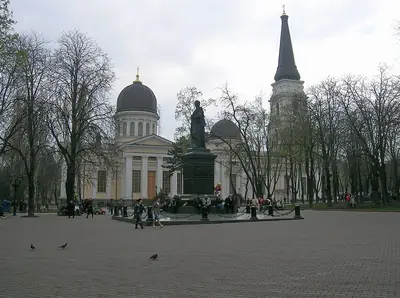
Soborna Square is one of the main squares in Odesa’s historic center. Its unusual shape is an irregular pentagon, formed where several streets meet. Since 2005, it has also hosted an art and craft market selling paintings by Odesa artists and handmade souvenirs.
The square’s central landmark is the Transfiguration Cathedral, an Eastern Orthodox cathedral dedicated to the Transfiguration of Jesus. Founded in the 1790s and consecrated in 1808, it was rebuilt and modernized several times. The present building is a reconstruction: the original cathedral was completely destroyed in 1936, and reconstruction took place from 1999 to 2011. The cathedral suffered severe damage during a missile attack on Odesa on July 23, 2023.
The Statue of Graf Vorontsov
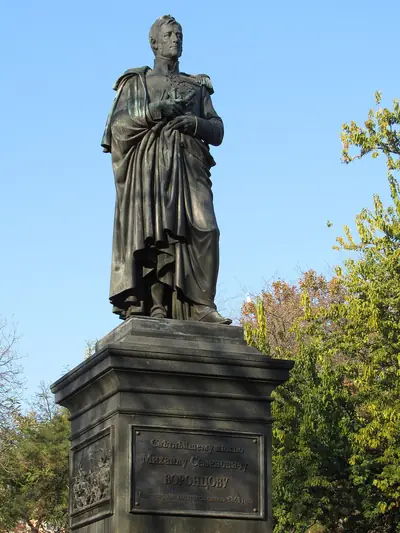
Also on Soborna Square, the Statue of Graf Vorontsov is one of Odesa’s historic monuments. Created in 1863, it honors Mikhail Semyonovich Vorontsov, field marshal and governor of the Novorossiya region and Bessarabia.
The bronze figure stands on a four-sided pedestal made of Crimean diorite. Its inscriptions and reliefs refer to Vorontsov’s military career and his role as governor. The monument was the city’s second, after the Statue of the Duke of Richelieu.
The Potemkin Stairs
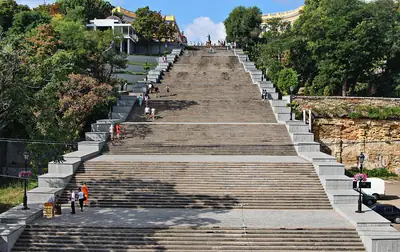
The Potemkin Stairs, officially known as the Prymorski Stairs, form Odesa’s formal entrance from the sea and are widely regarded as the city’s best-known symbol. They connect the city center with the harbor and Maritime Terminal, while the upper steps offer views toward the harbor and Odesa Bay.
The staircase runs for 142 meters in ten flights. Its design creates a famous optical illusion: the lower section is wider than the upper section, measuring about 21.7 meters at the base and 12.5 meters at the top. From above, the parapets appear parallel; from below, the landings seem to disappear into one continuous cascade.
The staircase was designed in 1835 and built between 1837 and 1841. It originally had 200 steps, but eight lower steps were later covered when the port area was expanded, leaving the 192 steps seen today.
Palace of Belina-Brzozowski
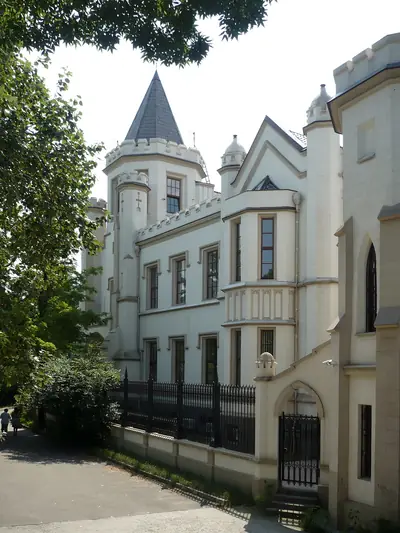
The Palace of Belina-Brzozowski, also called the Shah’s Palace or the Building with Atlantes, is a distinctive Neo-Gothic landmark at 2 Gogol Street. It was built between 1851 and 1852 to a design by the Polish architect Felix Gonsiorowski.
Its nineteenth-century style gives it a striking presence within Odesa’s historic cityscape. The palace is included on the route of Neywo’s walk between the Potemkin Stairs and the Opera.
Vorontsov Palace and its colonnade
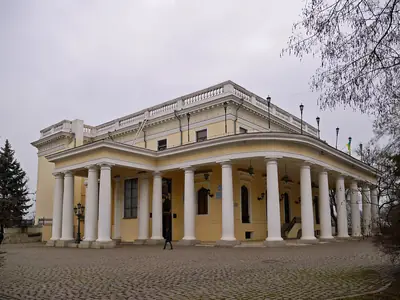
At the end of the pedestrian walkway along Prymorskyi Boulevard stands Vorontsov Palace, an early nineteenth-century architectural landmark. The complex was built between 1826 and 1828 as the residence of Mikhail Vorontsov, governor of the New Russia region, and was designed by the Italian architect Francesco Boffo.
The estate included the main building, a belvedere colonnade, a riding hall, a service wing and the Orlov building. The colonnade remains one of the site’s most recognizable features. The complex later housed a boys’ gymnasium and the Society for the Acclimatization of Animals. Several fires damaged the palace, and the Orlov building was destroyed in 1944. The surviving complex is recognized as an architectural monument of national importance.
Odesa Opera and Ballet Theater
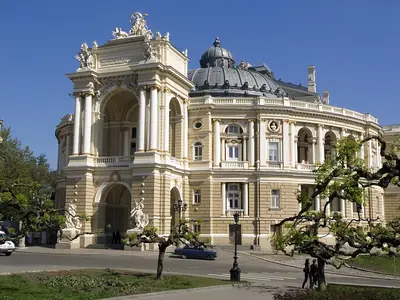
The Odesa National Academic Opera and Ballet Theatre is the oldest theatre in Odesa and one of its best-known landmarks. An earlier opera house opened in 1810, but it was destroyed by fire in 1873. The present theatre opened in 1887.
Designed by Ferdinand Fellner and Hermann Helmer, the exterior follows the Vienna Baroque, or neo-Baroque, style. Inside, the horseshoe-shaped auditorium is decorated in the late French Rococo style. The building’s most recent complete restoration was finished in 2007. Its acoustics are particularly notable: a whisper from the stage is said to carry to every part of the hall.
Odesa Fine Arts Museum
The Odesa Fine Arts Museum occupies the historic Potocki Palace, also known as the Naryshkin Palace. The residence is recognized as a monument of early nineteenth-century architecture, so the building is part of the museum experience.
Founded in 1899, the institution received national status on October 14, 2021, becoming the Odesa National Fine Arts Museum. Its collection includes more than ten thousand works of art, including paintings by well-known Russian and Ukrainian artists from the late nineteenth and early twentieth centuries.
Odesa-Holovna railway station
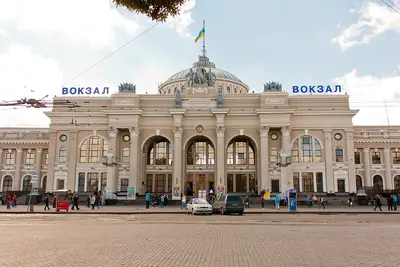
Odesa-Holovna, also known as Odesa Railway Station, is the city’s main railway station and an important point of arrival. The working station building is also recognized as an architectural monument, making it a useful stop for visitors interested in Odesa’s built heritage.
Odesa’s many religious traditions
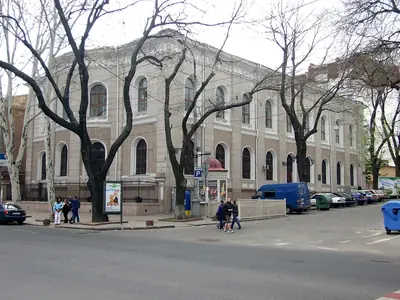
Odesa’s religious landmarks reflect the city’s varied communities and history. The Ohr Somayach Synagogue, at 25 Yevreyska Street, is described as Odesa’s main synagogue and is recognized as a monument of architecture, history and culture.
The Assumption of the Blessed Virgin Mary Cathedral is the principal cathedral of the Odesa and Simferopol Diocese of the Roman Catholic Church. Built between 1844 and 1853 through the efforts of Catholic communities from Poland and Germany, it has a three-aisled basilica plan in the form of a cross, crowned by a dome. Its interior includes white and gray marble, paintings, crystal chandeliers and a marble baptismal font donated by Pope Pius the Ninth in 1852.
Holy Trinity Cathedral is closely connected with Odesa’s Greek community. Its history began in 1795, and a stone church was consecrated in 1808. Two side chapels were added in 1838, creating a cross-shaped Byzantine plan. The church was closed from 1936 to 1941, during which time it lost the upper level of its bell tower and its domes; these were recreated in the 1990s.
Other religious sites covered by Neywo include the Cathedral of St. Andrew, the Cathedral of the Nativity of Jesus Christ, and the Temple of the Life-Giving Spring. The latter is associated with the Dormition Monastery, an Orthodox men’s monastery at the sixteenth station of Velykyi Fontan.
Asvadurov House
At the corner of Italianska and Troitska Streets, Asvadurov House, also known as the Asvadurov Revenue House, is recognized as a local monument of history and architecture. The building suffered extensive damage in a fire on December 4, 2019.
Explore Odesa with a self-guided audio tour
Neywo’s Odesa self-guided walking tours let you explore the city without a group or a fixed schedule. The app tells the story of each place as you reach it, at your own pace, with narration available in 11 languages.
The Odesa routes include:
- Four walking tours:
- Stairs, Palaces and the Opera — 2.42 km, 107 minutes and 12 narrated stops
- Pentagon Square to Greek Quarter: Odesa’s Many Faiths — 3.91 km, 120 minutes and 11 narrated stops
- From the Quarantine Cape to the Railway Station — 4.25 km, 114 minutes and 10 narrated stops
- Palaces, Paintings and the University — 1.93 km, 53 minutes and 5 narrated stops
- One bus route: Marshrutka 242: From Victory Wings to the Greek Quarter — 6.5 km, 28 minutes and 4 narrated stops
- One bike route: Central Odesa on a Cycle Lane — 2.4 km, 12 minutes and 5 narrated stops
Download Neywo to explore Odesa with a free audio guide, and continue discovering Ukraine at your own pace.
Places with an audio guide in Odesa
8 places in Odesa with a Neywo audio guide. Each one starts telling its story as you reach it.
Self-guided tours in Odesa
6 tours in Odesa, free in the Neywo app. Each stop tells its story as you reach it.
- Bike ride
Central Odesa on a Cycle Lane
A short, easy ride along a dedicated cycle lane through the historic centre. Pass St Michael's Monastery, the Chabad synagogue, the Greek Holy Trinity Cathedral and the Dormition Cathedral, and end at the Jewish History Museum.
Saint Michael Monastery in Odesa · Beit Chabad Synagogue · Holy Trinity Cathedral · The Dormition Cathedral · Jewish History Museum
Open this tour: Central Odesa on a Cycle Lane - Bus ride
Marshrutka 242: From Victory Wings to the Greek Quarter
Route 242 is one of Odesa's longest minibus lines, running every few minutes from early morning to 23:00. Ride it from the Victory Wings monument on 10 April Square past the Athos-stone Saint Pantaleon Monastery to the Greek Holy Trinity Cathedral and the old Tyraspolska Square in the historic centre.
10-ho Kvitnia Square · Saint Pantaleon Church and Monastery in Odesa · Holy Trinity Cathedral · Tyraspolska Square
Open this tour: Marshrutka 242: From Victory Wings to the Greek Quarter - Walk
Stairs, Palaces and the Opera
Start among the Neo-Gothic atlantes of the Shah's Palace and stroll Primorsky Boulevard to the Vorontsov colonnade. Drop to the Potemkin Stairs, the optical illusion that became Odesa's emblem, then pass the Vienna-style opera house and Birzhova Square, where the Ottoman fortress of Khadjibey once stood, and finish among the palaces of Langeronivska and Italiiska streets.
Palace of Belina-Brzozowski · Vorontsov Palace · Yevropeiska Square · Potemkin Stairs · Lopukhin Palace · Odesa Opera and Ballet Theater …
Open this tour: Stairs, Palaces and the Opera - Walk
Pentagon Square to Greek Quarter: Odesa's Many Faiths
Follow the story of a city built by many peoples, from the Regional History Museum and the Catholic basilica of St. Peter to Soborna Square and its bronze governor. Odesa's cathedrals, synagogue, Greek church and mosque sit shoulder to shoulder, each telling who arrived, and when. Look for what is missing too: a church the Stalinist terror erased.
Odesa Museum of Regional History · St. Peter church in Odesa · Statue of Graf Vorontsov, Odesa · Transfiguration Cathedral · Jewish History Museum · Intercession church …
Open this tour: Pentagon Square to Greek Quarter: Odesa's Many Faiths - Walk
From the Quarantine Cape to the Railway Station
Begin in Shevchenko Park on the cliff-top above the sea, where the old quarantine, the imperial column and the Green Theater recall Odesa's fortress days. Then walk south past monasteries, contemporary art and the operetta house, across the broad Kulykove Pole to the station.
Odesa Quarantine · Alexander II Column in Odesa · Green Theater · St. Michael Church · Saint Michael Monastery in Odesa · Museum of Odesa Modern Art …
Open this tour: From the Quarantine Cape to the Railway Station - Walk
Palaces, Paintings and the University
A short walk through Odesa's cultured northwest: the Mechnikov University, the Potocki-Naryshkin palace that now holds the Fine Arts Museum, the NT-Art contemporary gallery, the Vasylko theatre and the Nativity Cathedral.
Odesa University · Odesa Fine Arts Museum · Gallery of modern art NT-Art · Ukrainian Musical-Dramatic Theater V. Vasylka · Cathedral of the Nativity of Jesus Christ, Odesa
Open this tour: Palaces, Paintings and the University
Walk Odesa with Neywo
Neywo turns Odesa into a self-guided audio tour. Stories arrive as you reach the place they belong to, and the route reshapes when you wander off it.

