Lviv, Ukraine: Self-Guided Walking Tour
Things to Do in Lviv: What to See in the City
The best things to do in Lviv include exploring its historic churches, aristocratic palaces, memorials, museums, fortifications, and green spaces. The city brings together Ukrainian, Polish, Jewish, Armenian, German, and Austro-Hungarian influences, especially in and around its historic center. Neywo’s free audio guide for Lviv includes 165 narrated places to help you discover the city as you walk.
What to See in Lviv
Latin Cathedral
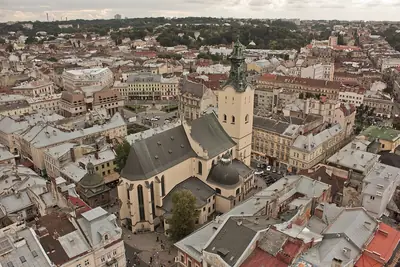
The Latin Cathedral stands at the southwestern corner of the market square, now known as Cathedral Square. Its tower rises 66 meters above the Old Town, making it one of the highest structures in the city center.
Officially the Archcathedral Basilica of the Assumption of the Blessed Virgin Mary, it is the seat of the Latin Archbishop and one of only four churches in Ukraine with the honorary status of a minor basilica. Construction began in the 1360s on the site of an older wooden church, and the original Gothic framework remains visible in the nave. Later chapels added further architectural layers to the building.
The cathedral is also one of the key stops on a Lviv self-guided walking tour.
Saint George’s Cathedral
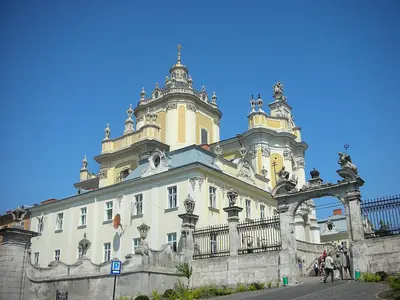
Saint George’s Cathedral occupies a hill overlooking Lviv and serves as the mother church of the Ukrainian Greek Catholic Church. The current building was constructed between 1744 and 1762 with funding from Bishop Athanasius Sheptytsky.
It was the last great Baroque-Rococo cathedral built in this part of Europe. Its plan follows the traditional Eastern three-nave layout, while its decoration combines late Baroque and Rococo elements with Ukrainian national motifs. The cathedral forms part of a larger ensemble that also includes the Metropolitan Palace, completed in 1762, and the chapter houses.
Potocki Palace
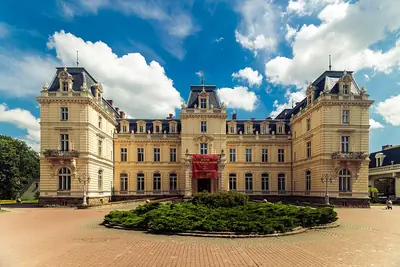
On Copernicus Street, Potocki Palace is one of Lviv’s most distinguished aristocratic residences. Built in the 1880s for Alfred Józef Potocki, it was designed as an opulent urban home and later became a presidential residence and an art venue.
The palace has a French Neo-Renaissance character, with a symmetrical façade, pilasters, cartouches, ornate window frames, and a mansard roof. A ceremonial courtyard leads to the entrance, recalling the building’s original role as a grand private residence. Its historic interiors included salons, ballrooms, reception rooms, gilding, mirrors, oil paintings, carved woodwork, and decorative fireplaces.
Sapieha Palace
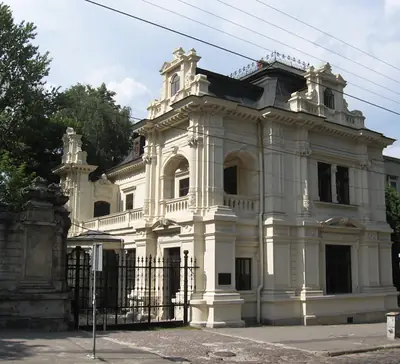
Sapieha Palace is a nineteenth-century mansion set behind an ornate wrought-iron fence. Built in the 1870s for Prince Adam Sapieha, it is associated with the neo-Baroque style and was designed by Adolf Kuhn.
The building’s sculpted façade combines rusticated surfaces, pilasters, projecting cornices, and horizontal bands. After the Soviet takeover in 1939, it became state property and housed School Number Nine. Its eastern wing was destroyed by a bomb during the Second World War, and a new school building was later constructed there. Following restoration in the 1990s, the former palace became the home of Lviv’s regional society for the preservation of historical, cultural, and architectural monuments.
Citadel of Lviv
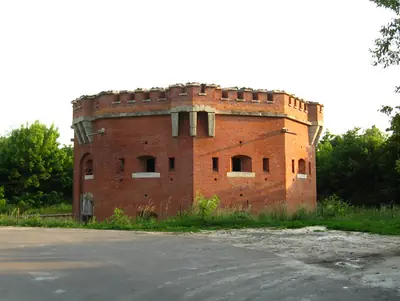
The Citadel is a nineteenth-century fortification complex near the city center. Austrian authorities built it between 1852 and 1854 as the first part of a planned system of fortifications surrounding Lviv.
Designed by K. Ressig and A. Wondraschka, the complex is also valued as a geological monument of nature. Its central building is at 11 Grabovsky Street, and the wider site is enclosed by several streets, including Vitovsky, Kopernika, Stefanyka, Martovycha, Hrushevskoho, and Ivan Franko. The fortifications are recognized as a monument of local architectural significance.
Monument to Ivan Fedorov
Near Podvalna Street, the Monument to Ivan Fedorov stands beside Lviv’s largest second-hand book market. Fedorov was a pioneering printer who settled in Lviv after leaving Moscow.
In 1574, he produced the Apostolos, regarded as one of the earliest dated printed books produced in Ukrainian territory. The 1977 monument shows him holding an open book. Created by Valentyn Borysenko and Valentyn Podolskyi, its modernist style contrasts with the older buildings around it.
Museum of Ancient Monuments of Lviv
The Museum of Ancient Monuments of Lviv explores the city’s princely-era past. It was established in 1993 in the Church of Saint John the Baptist and its courtyard, following archaeological research that identified a Slavic settlement here before the founding of Lviv.
The collections include archaeological discoveries, visual art, church relics, and historical documents. Together, they illuminate the culture, crafts, and everyday life of the communities involved in the city’s early development. The museum’s most valuable exhibit is the Lviv Madonna, a mid-fourteenth-century icon currently kept in storage at the Lviv Art Gallery.
Lvov Ghetto
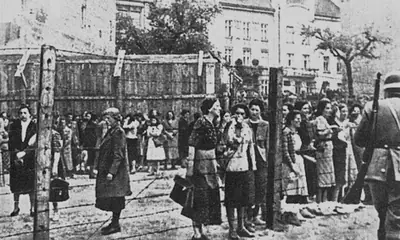
The history of the Lvov Ghetto is an essential and difficult part of understanding Lviv during the Second World War. Nazi authorities ordered the ghetto’s creation on November 8, 1941, and required Jewish residents to move there by December 15.
About 5,000 elderly and sick Jews were killed during this period. By early 1942, more than 100,000 people were inside the ghetto. Deportations began during the winter of 1941 and 1942, including the March 1942 deportation of about 15,000 people to the Bełżec extermination camp. Further deportations followed, with about 7,000 people taken to the Janowska camp in July and more than 50,000 sent to Bełżec in August.
Memorials connected with the ghetto offer a place for remembrance and reflection. The history is also included in Neywo’s Jewish Lviv walk.
Zamarstyniv Forest Park
For a change of setting, Zamarstyniv Forest Park offers a broad green space in Lviv’s Shevchenkivskyi District. Covering 37 hectares, the park was created in the second half of the 1970s on hills regarded as the southeastern edge of the Roztocze region.
It was planned as a recreational area for the growing Zamarstyniv residential district. Paths, benches, gazebos, and playgrounds were added to the landscape.
Arena Lviv
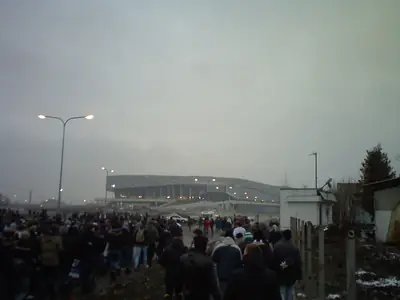
Arena Lviv is a major football stadium in the southern part of the city. Built for the 2012 European Football Championship, it opened on October 29, 2011, and hosted three group-stage matches as one of the eight UEFA Euro 2012 venues.
The stadium seats 34,915 spectators. Its field lighting reaches 2,800 lux, the highest level among stadiums in Ukraine, and its seating capacity ranks fourth in the country.
Other stops in the audio guide include Lviv Hands, the Museum of Science, the State Memorial Museum of Mykhailo Hrushevsky, the Mineralogical Museum named after Yevhen Lazarenko, the monument to Volodymyr Ivasyuk, and Nikorovych Palace.
Explore Lviv with Neywo
Neywo works as a free Lviv audio guide: each story plays as you reach the place, at your own pace, with no group and no schedule. Narration is available in 11 languages.
The Lviv guide includes seven walking tours and one bus route:
- Rynok Square and the Heart of Medieval Lviv — 1.31 km, 80 minutes, 12 narrated stops.
- Baroque Lviv: Bernardines, Carmelites and Franciscans — 2.87 km, 101 minutes, 12 stops.
- Habsburg Lviv: Palaces, Galleries and St George’s Hill — 3.58 km, 108 minutes, 10 stops.
- Lviv’s Northern Quarter: Opera, Cathedrals and Churches — 1.53 km, 74 minutes, 10 stops.
- Jewish Lviv: Synagogues and the Ghetto — 4.57 km, 102 minutes, seven stops.
- Castle Hill, Brewery and Onuphrius Monastery — 2.75 km, 81 minutes, nine stops.
- Lychakiv and Shevchenkivskyi Hai: Cemetery, Churches and an Open-Air Museum — 3.26 km, 74 minutes, six stops.
- Bus 29: From the Railway Station through the Old Town to Lychakiv — 6.2 km, 27 minutes, 11 stops.
Download Neywo and explore Lviv with the city’s stories playing at the places where they happened. You choose the route and the pace, while the app guides you from one narrated stop to the next.
Places with an audio guide in Lviv
8 places in Lviv with a Neywo audio guide. Each one starts telling its story as you reach it.
Self-guided tours in Lviv
8 tours in Lviv, free in the Neywo app. Each stop tells its story as you reach it.
- Bus ride
Bus 29: From the Railway Station through the Old Town to Lychakiv
A local line from Lviv's grand station past Saints Olha and Elizabeth and St Anne, then through the Opera and Dormition Church area to Mytna Square and out along Lychakivska Street to the Taras Shevchenko monument, a good cheap sampler of the centre and the historic eastern suburb.
Lviv railway station · Church of St. Olha and Elizabeth · Church of Saint Anne, Lviv · Lviv Theatre of Opera and Ballet · Church of Our Lady of the Snow, Lviv · Dormition Church …
Open this tour: Bus 29: From the Railway Station through the Old Town to Lychakiv - Walk
Rynok Square and the Heart of Medieval Lviv
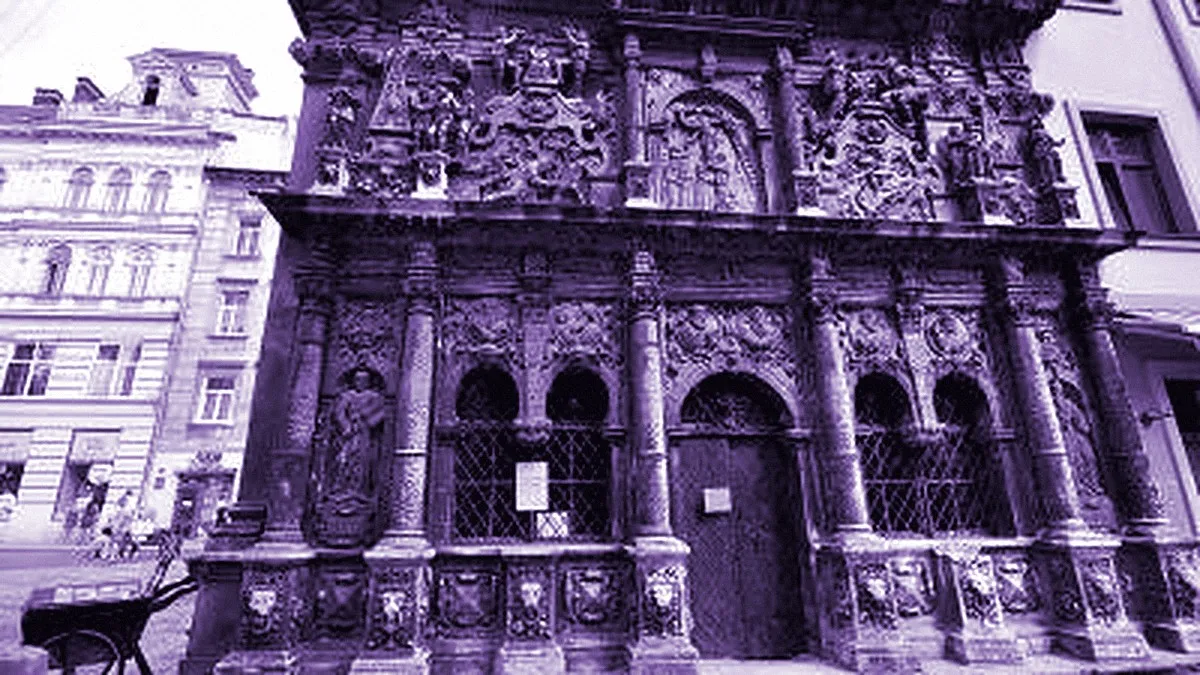
Start with the printer who gave Ukraine its first dated book, then walk through Lviv's Renaissance core: a church with a bell tower that became the city's symbol, the great elliptical dome of the Dominican Church, the Black House, a pharmacy museum, the UNESCO-listed Market Square with its City Hall tower and the carved Boim Chapel beside the Latin Cathedral.
Dormition Church · Dominican Church · Dzyga · Lubomirski Palace · Black House · Pharmacy Museum …
Open this tour: Rynok Square and the Heart of Medieval Lviv - Walk
Baroque Lviv: Bernardines, Carmelites and Franciscans
East of the square, Lviv's monasteries and palaces show the Baroque city: the only surviving 18th-century palace in the centre, a Bernardine monastery, Mytna Square, Carmelite and Franciscan churches and the quiet Greek Catholic parishes of the eastern streets.
Besyadetski Palace, Lviv · Bernardine Church and Monastery · Mytna square · Carmelite Church · Church of the Presentation · Archbishop's Palace, Vynnychenka Street, Lviv …
Open this tour: Baroque Lviv: Bernardines, Carmelites and Franciscans - Walk
Habsburg Lviv: Palaces, Galleries and St George's Hill
Under Austria, Lviv became Lemberg. Walk past aristocratic palaces, Ukraine's largest art gallery, the Palace of Arts, a former Carmelite monastery that is now a library, the oldest university in the country and a theatre, and climb to St George's Cathedral, mother church of Ukrainian Greek Catholics.
Lesia Ukrainka Lviv Academic Dramatic Theatre · Palace of Arts · Potocki Palace · Borys Voznytskyi Lviv National Art Gallery · Catholic church of St. Agnes and the Monastery of the Carmelites in Lviv · Lviv University …
Open this tour: Habsburg Lviv: Palaces, Galleries and St George's Hill - Walk
Lviv's Northern Quarter: Opera, Cathedrals and Churches
From the opera house through the quarter north of Market Square: the Low Castle site, the National Museum, the Armenian Cathedral, the Trinitarian and Benedictine monasteries and the church of John the Baptist.
Franciscan Church of the Holy Cross in Lviv · Lviv Theatre of Opera and Ballet · Ukrainian Dramatic Theatre of Maria Zankovetska · Lviv Low Castle · Lviv National Museum · Trinitarian monastery, Lviv …
Open this tour: Lviv's Northern Quarter: Opera, Cathedrals and Churches - Walk
Jewish Lviv: Synagogues and the Ghetto
Follow the traces of Lviv's Jewish community: surviving synagogues and prayer houses west and north of the old town, and the memorials to the Lviv Ghetto.
Asej Tow Synagogue and Beth-Hamidrash in Lviv · Jakob Glanzer Shul · Old Cemetery synagogue, Lviv · Agudat Shlomo Synagogue in Lviv · Lvov Ghetto · Memorial sign to Lviv ghetto …
Open this tour: Jewish Lviv: Synagogues and the Ghetto - Walk
Castle Hill, Brewery and Onuphrius Monastery
Start at the Beer Brewing Museum on the old brewing street of Klepariv, then climb through the Holy Cross and St Nicholas churches and the monastery of St Onuphrius to Castle Hill. End at the High Castle and its panoramic view over the city.
Beer Brewing Museum · Brovarna Street, Lviv · Holy Cross church, Lviv · St. Onuphrius Monastery · Front stairs in Basilian monastery of Saint Onuphrius · Church of Saint Nicholas, Lviv (Khmelnytskoho Street) …
Open this tour: Castle Hill, Brewery and Onuphrius Monastery - Walk
Lychakiv and Shevchenkivskyi Hai: Cemetery, Churches and an Open-Air Museum
Head east to Lychakiv: a family tomb in the famous cemetery, the church of Saints Peter and Paul, the Taras Shevchenko monument and the Gate of Dawn church, then the open-air museum of Shevchenkivskyi Hai with its wooden houses.
Tomb of Banach and Riedl families at Lychakiv Cemetery · St Peter and Paul church, Lviv · Taras Shevchenko monument · Our Lady of the Gate of Dawn churches in Ukraine · House from Tukholka · Shevchenkivskyi Hai
Open this tour: Lychakiv and Shevchenkivskyi Hai: Cemetery, Churches and an Open-Air Museum
Walk Lviv with Neywo
Neywo turns Lviv into a self-guided audio tour. Stories arrive as you reach the place they belong to, and the route reshapes when you wander off it.

