Visiting Yalta, Ukraine: Top Sights on Foot
15 Things to Do in Yalta: What to See on the Black Sea Coast
Looking for things to do in Yalta? This Crimean coastal city combines historic theatres, writers’ houses, palaces, churches, parks, and views shaped by the Black Sea and surrounding hills. Its landmarks reflect Yalta’s imperial, literary, religious, and Soviet-era history, making it a rewarding destination to explore on foot.
Neywo has a free audio guide for Yalta with 34 narrated places, available in 11 languages.
What to See in Yalta
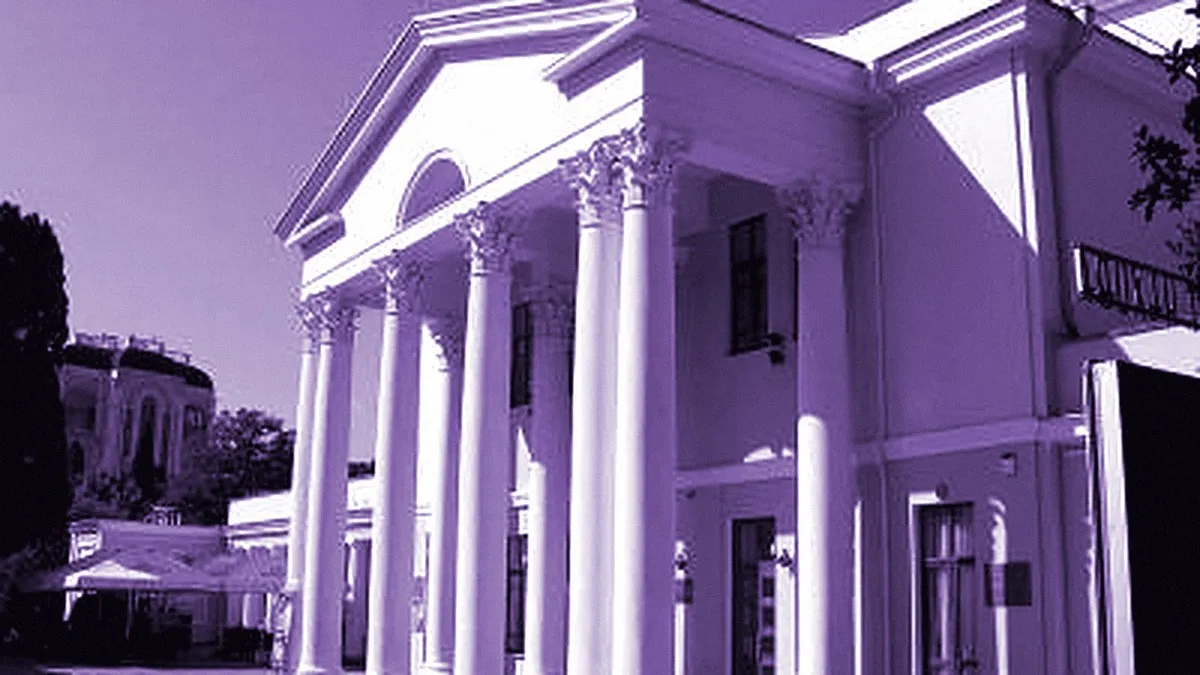
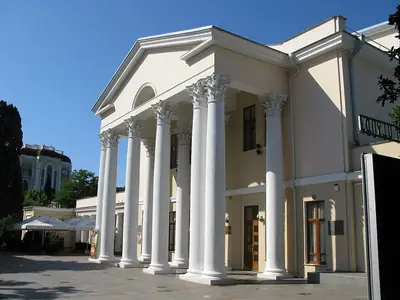
Chekhov Theatre
The Chekhov Theatre stands on Ekaterininskaya Street, a short walk from the embankment. It opened in 1883 as a modest venue and was expanded and reopened in 1890 with Alexander Ostrovsky’s Guilty Without Fault. The theatre later took the name of Anton Chekhov, who lived in Yalta from 1898 to 1904 and met members of the Moscow Art Theatre there.
Its late nineteenth-century classical façade preserves the character of the original building, while a renovation completed in 2008 modernised the interior with updated lighting, sound, and stage technology.
Biryukov House Museum
The house museum of Nikolai Zotovich Biryukov preserves the Yalta home of the Soviet writer, who received the Stalin Prize in 1950 for his novel The Seagull. The museum opened in 1970 and focuses on his personal space and contribution to Soviet literature.
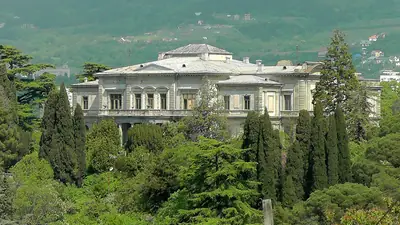
Mordvinov Palace
Mordvinov Palace is a regional architectural monument on Sverdlov Street. Count Alexander Alexandrovich Mordvinov commissioned the building between 1900 and 1903 on a site known as Khoroshaya Pustosh, or “Good Wasteland”.
Architect Fyodor Nagel designed the palace, while Oscar Vegener supervised its construction. During the Soviet period, it was also known as the V. I. Lenin Palace, but its original identity remains connected to the Mordvinov family.
White Dacha
The White Dacha is the house where Anton Chekhov spent his final years and wrote several major works. Chekhov came to Yalta in 1898 in search of a milder climate because of his tuberculosis. He bought the land in late 1898 and moved into the house with his mother and sister Maria on September 9th, 1899.
Built in ten months from Chekhov’s own sketches, the whitewashed house has light-filled rooms, a veranda, and a garden planted with roses and lilacs. Chekhov wrote The Cherry Orchard, Three Sisters, The Lady with the Dog, The Bishop, In the Ravine, On Christmas Eve, and The Bride here. The museum preserves his study, writing desk, letters, medical instruments, walking stick, and family photographs.
Saint Hripsime Church of Yalta
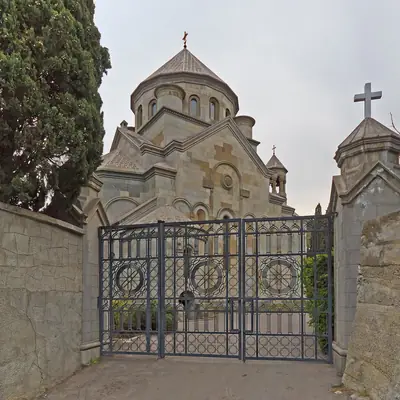
Saint Hripsime Armenian Church rises on the slopes of Darsan Hill. Completed in 1917 after almost a decade of construction, it is an Armenian Apostolic church and a notable example of Armenian ecclesiastical architecture outside Armenia.
The church was funded by oil magnate Poghos Ter-Ghukasyan in memory of his daughter. Gabriel Ter-Melikyan designed it from sketches by the painter Vardges Surenyants, taking inspiration from the seventh-century Saint Hripsime Church in Echmiadzin, Armenia. Local Foros tuff gives the walls their warm, golden colour, while the conical dome completes the building’s distinctive silhouette.
Seaside Park in the name of Y. A. Gagarin
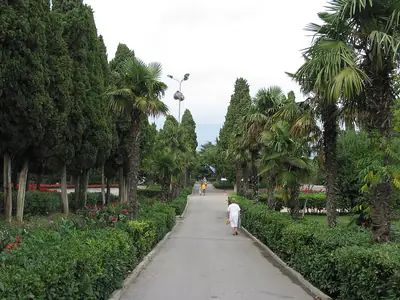
Seaside Park stretches for two kilometres along the Black Sea, continuing Yalta’s embankment with tree-lined paths and coastal views. Created in the early twentieth century as a public promenade, it reflects the city’s development as a fashionable resort of the Russian Empire.
Pines, cypresses, magnolias, and palms create a subtropical atmosphere. Walking alleys lead past sculptures, fountains, and flowerbeds, while the promenade offers a place to look across the sea and experience Yalta’s relaxed coastal character.
Alexander Nevsky Cathedral
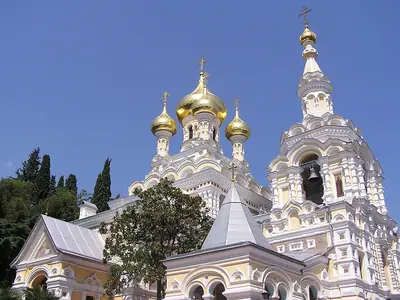
The Alexander Nevsky Cathedral is Yalta’s main Orthodox church and one of its most recognisable landmarks. Its golden domes, white façade, onion-shaped cupolas, and detailed ornamentation combine Byzantine and Russian traditions.
Construction began in 1891 in memory of Emperor Alexander II, who was assassinated in 1881, and was completed in 1902. Architect Nikolai Krasnov, also associated with Livadia Palace, designed the building in the old Moscow style. Inside are frescoes, mosaics, a carved iconostasis, and the central icon of Saint Alexander Nevsky.
Palekur and Polikur Cemetery
Polikurovsky Hill is associated with Palekur, the name given to the ruins of a medieval monastery believed to have existed on the summit between the tenth and thirteenth centuries. The original stones have disappeared, and the hill is now occupied by a modern neighbourhood.
Historical accounts differ over whether the site was an early settlement, a Genoese fortress, or a fortified monastery. The ruins were gradually dismantled, with their stone reused for construction. Nearby, Polikur Memorial Cemetery occupies the site of the former Massandrovskoye cemetery, destroyed during the Nazi occupation. It is the burial place of cultural and scientific figures connected with Yalta.
Palace of the Emir of Bukhara
The Palace of the Emir of Bukhara stands among greenery with white walls and turquoise domes. Emir Sayyid Abd al-Ahad Khan commissioned it between 1907 and 1911 as a seaside retreat during visits to the Russian Empire.
Nikolay Krasnov designed the palace, combining Moorish Revival arches and domes with Art Nouveau details. Stucco decoration, turquoise tiles, and graceful windows give the building a distinctive Central Asian and European character.
Massandrovsky Park
Massandrovsky Park lies in Massandra, just outside Yalta, and is recognised for its garden and landscape design. Its first trees and layout date from the first half of the nineteenth century. Later in that century, the park was redesigned with the formal perspectives and geometry associated with French gardens of the seventeenth century.
Shaded paths, carefully arranged alleys, and views directed towards the palace make the park a place to experience Yalta’s landscape tradition as well as its history.
Ay Vasıl Orta Cami
Ay Vasıl Orta Cami is a mosque in Yalta’s Ay-Vasil district. The area was once the separate village of Vasylivka before becoming part of the city, and the mosque’s name comes from the Crimean Tatar name for the district.
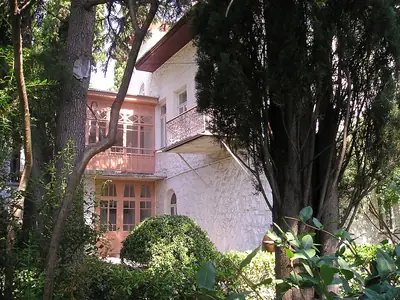
Omur Dacha
The Omur dacha is a two-storey pseudo-Gothic house on Kirov Street, built in 1888. Anton Chekhov lived and worked here from October 1898 to April 1899 while seeking a warmer climate. The house’s pointed windows, decorative trim, and steep roof give it a storybook appearance.
Three rooms on the first floor have housed a museum exhibition since 2006. The exhibition has focused on Chekhov and Crimea since 2014, while the rest of the building remains private residences.
Lenin Square and the Derekoyka River
Lenin Square forms one of Yalta’s central civic spaces. Its fountains, palms, surrounding buildings, and direct connection to the embankment give it an important place in the city’s public life. A bronze statue of Vladimir Lenin, unveiled in 1954, stands at its centre.
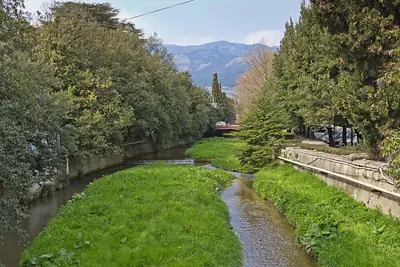
The Derekoyka River, also known locally as Bystraya, flows through Yalta before reaching the Black Sea. Its name comes from the Crimean Tatar Dereköy, meaning “village in a gorge”.
Crimean Humanitarian University
The Crimean Humanitarian University has formed part of Yalta’s academic landscape. Since August 2014, it has operated as part of the Crimean Federal University named after Vernadsky. It has also been known as the Yalta Humanitarian-Pedagogical Academy and the Crimean State Humanitarian University.
Explore Yalta with a Free Audio Guide
Neywo’s Yalta audio guide includes four walking tours and one bus route, covering 34 narrated places in total. The walks range from 1.79 to 2.89 km and from 45 to 93 minutes:
- In Chekhov’s Footsteps: Yalta’s Literary Heart — 2.89 km, 93 minutes, 10 stops
- Golden Domes to Polikurovsky Hill — 2.34 km, 74 minutes, 9 stops
- Armenian Stone, a Count’s Palace and a Mosque — 1.79 km, 45 minutes, 4 stops
- Emir’s Palace to Chekhov’s White Dacha — 2.69 km, 58 minutes, 4 stops
There is also a 4.3 km bus route lasting 18 minutes, with 7 narrated stops, connecting Chekhov’s dacha with the Alexander Nevsky Cathedral and the mosque.
Download Neywo and explore Yalta at your own pace. The app tells the story of each place as you reach it, with no group and no schedule. When planning a wider trip through Ukraine, you can also discover destinations such as Odesa, Lviv, and Kiev.
Places with an audio guide in Yalta
8 places in Yalta with a Neywo audio guide. Each one starts telling its story as you reach it.
Self-guided tours in Yalta
5 tours in Yalta, free in the Neywo app. Each stop tells its story as you reach it.
- Bus ride
Bus 15: Chekhov's Dacha to the Alexander Nevsky Cathedral and the Mosque
A local bus that crosses Yalta from the west, past the Chekhov dacha on Kirov Street and the golden domes of the Alexander Nevsky Cathedral, through the old centre and on up Moskovskaya Street to Dereköy Mosque. Ride it as a cheap way to see the city's heart without climbing the hills.
Country house in Yalta · Alexander Nevsky Cathedral, Yalta · Garden Street · Yalta Municipality · Moskovskaya Street in Yalta · Mosque Derekoy
Open this tour: Bus 15: Chekhov's Dacha to the Alexander Nevsky Cathedral and the Mosque - Walk
In Chekhov's Footsteps: Yalta's Literary Heart
Follow Anton Chekhov and his circle through the streets where he lived, wrote and met his friends. You will pass a pseudo-Gothic dacha, the theatre that took his name, a museum devoted to a Ukrainian poet and a Moorish bathhouse, and finish on the palm-lined embankment and Pushkin's leafy promenade.
Immaculate Conception church in Yalta · Yalta Historical and Literary Museum · Country house in Yalta · Chekhova Street · Museum of Lesya Ukrainka, Yalta · Chekhov Theatre …
Open this tour: In Chekhov's Footsteps: Yalta's Literary Heart - Walk
Golden Domes to Polikurovsky Hill
From the golden-domed Alexander Nevsky Cathedral and the cableway to Darsan Hill, cross the old town centre and climb to Polikurovsky Hill, where a rebuilt cathedral and a medieval mystery overlook the bay. A walk through Yalta's busiest squares, its lively river and the quiet cemetery on the hill.
Alexander Nevsky Cathedral, Yalta · Yalta Cableway · Garden Street · Sovetskaya squares · Derekoyka · Grafskiy Passage (Yalta) …
Open this tour: Golden Domes to Polikurovsky Hill - Walk
Armenian Stone, a Count's Palace and a Mosque
A short uphill walk through the quieter northern streets: an Armenian church of honey-coloured stone built by a grieving father, the palace of Count Mordvinov, the busy Moskovskaya Street with its Soviet circus and the mosque that remembers a vanished village.
Saint Hripsime Church of Yalta · Mordvinov Palace · Moskovskaya Street in Yalta · Mosque Derekoy
Open this tour: Armenian Stone, a Count's Palace and a Mosque - Walk
Emir's Palace to Chekhov's White Dacha
Walk west along the coast from the shaded seaside park to the turquoise domes of the Emir of Bukhara's palace, then on to the Baryatinsky princes' summer estate and the White Dacha, the whitewashed house where Chekhov wrote The Cherry Orchard.
Seaside Park in the name of Y. A. Gagarin · Palace of the Emir of Bukhara, Yalta · Museum of the Estate of Princess Nadezhda Alexandrovna Baryatinsky · White Dacha
Open this tour: Emir's Palace to Chekhov's White Dacha
Walk Yalta with Neywo
Neywo turns Yalta into a self-guided audio tour. Stories arrive as you reach the place they belong to, and the route reshapes when you wander off it.

