Things to Do in Rhyolite, United States: Walking Guide
Things to do in Rhyolite, Nevada
Rhyolite is a historic ghost town in Nevada’s Bullfrog Hills, near Death Valley. Its abandoned buildings tell the story of a gold-boom settlement that grew rapidly after a valuable ore discovery in 1904, then declined when nearby mining production fell. The nearby Goldwell Open Air Museum adds an unexpected layer of contemporary art to the desert landscape.
Neywo offers a free audio guide for Rhyolite with 13 narrated places, available in 11 languages.
What to see in Rhyolite and the surrounding area
Rhyolite’s ghost-town ruins
Rhyolite is the central attraction: a former mining community that developed far beyond the scale of a temporary frontier camp. Prospectors, merchants, investors and railroad builders arrived after the discovery in Boundary Canyon, and the settlement quickly gained a reputation as a prosperous modern town.
Its surviving structures include the remains of substantial commercial buildings, a railway station, and a bank that was decorated with marble and bronze. Their scale reflects the confidence surrounding the gold boom—and makes the town’s later disappearance especially striking.
When mining production declined, businesses closed and residents moved away. Today, the weathered ruins stand in an open volcanic landscape, offering a vivid picture of the speed with which a mining town could rise and vanish.
Goldwell Open Air Museum
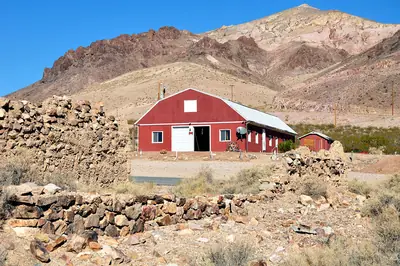
Just outside Rhyolite, the Goldwell Open Air Museum brings sculpture into the middle of the desert. The outdoor museum covers 7.8 acres and includes the Red Barn Art Center, a studio and exhibition space used by artists in residence and others.
The project began in 1984, when Belgian artist Albert Szukalski created the first sculptures near Rhyolite’s abandoned railway station. After his death, a nonprofit museum was organized in 2000, and artists continued expanding the site through 2007.
The most recognizable work is Szukalski’s The Last Supper. Ghostly, life-sized forms reproduce the composition of Leonardo da Vinci’s painting. Szukalski created the figures by draping plaster-soaked burlap over live models and allowing it to dry until the shapes could stand independently. The same technique appears in Ghost Rider, which depicts a figure preparing to mount a bicycle.
The museum also stands among traces of earlier mining communities. Near the Red Barn Art Center are ruins of a jail and other buildings from the historic mining town of Bullfrog, linking the artwork directly to the area’s mining past.
Beatty Museum
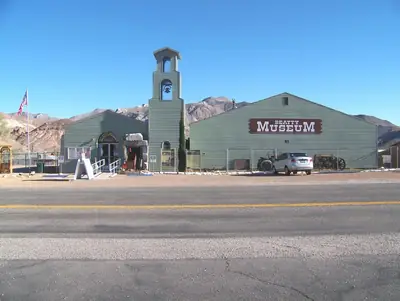
For more context on the Bullfrog mining district, the Beatty Museum and Historical Society presents the history of the communities that grew around it. The volunteer-run museum covers Beatty as well as Rhyolite, Bullfrog, Gold Center, Transvaal and Springdale.
Its displays focus not only on mining, but also on the people who lived in these towns and their everyday lives. Beatty itself was established in 1905 after the Las Vegas and Tonopah Railroad arrived, becoming a railway center for the Bullfrog Mining District and linking the area with mining communities such as Rhyolite.
Beatty
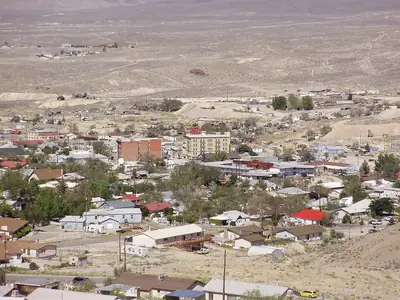
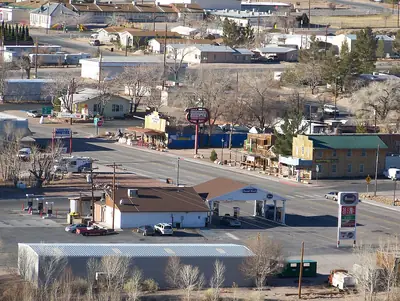
Beatty is a small desert community shaped by railroads, mining and travel. It was once known as the “Chicago of the West” and became the center of the gold railroads. The town lies along the Amargosa River in Nye County and remains closely connected to the surrounding historic sites.
Its name comes from Montillus, or Montillion, Murray “Old Man” Beatty, who settled on a ranch in Oasis Valley in 1896 and became the community’s first postmaster. Before non-Indigenous settlers arrived in the nineteenth century, the region was home to groups of Western Shoshone.
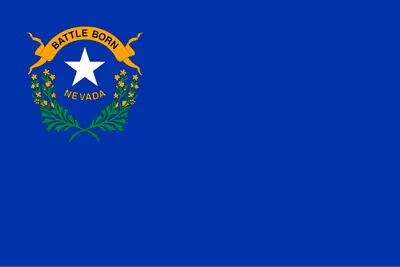
The town also provides a broader introduction to the area’s mining history through the Beatty Museum. It is one of several places to visit in Nevada, a state where desert and semi-arid landscapes meet mountain ranges that can be capped with snow in winter.
Exploring Nevada beyond Rhyolite
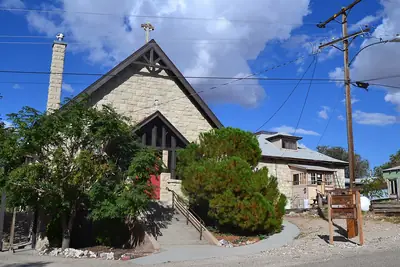
Rhyolite’s story belongs to a wider Nevada landscape shaped by mining, travel and changing industries. Tonopah, known as the Queen of the Silver Camps, preserves another chapter of the state’s mining history. Its attractions include the Mizpah Hotel, the Clown Motel, St. Mark’s Episcopal Church and the First Tonopah Cemetery.
Elsewhere in Nye County, Devils Hole protects the only naturally occurring population of the endangered Devils Hole pupfish. The site is a geothermal aquifer, with water at about 33 degrees Celsius, fed by a pool inside a limestone cave in the Amargosa Desert. It is surrounded by Ash Meadows National Wildlife Refuge and managed as part of Death Valley National Park.
The region also contains the Nevada National Security Site, the former Nevada Test Site. Established in December 1950 for nuclear weapons testing, it became the location of the first atmospheric test on January 27, 1951. By 1992, about 928 nuclear tests had been conducted there. The reservation covers about 1,350 square miles, or 3,500 square kilometers, across desert and mountainous terrain.
For travellers planning a wider trip through the state, Las Vegas, Boulder City and Reno are other Nevada destinations to explore.
Explore Rhyolite with Neywo
Neywo’s free Rhyolite audio guide includes 13 narrated places. The app tells the story of each place as you reach it, at your own pace, with no group and no schedule. Narration is available in 11 languages, making it an easy way to explore the ghost town, Goldwell Open Air Museum and the surrounding sites while keeping your attention on the desert landscape.
Places with an audio guide in Rhyolite
8 places in Rhyolite with a Neywo audio guide. Each one starts telling its story as you reach it.
Walk Rhyolite with Neywo
Neywo turns Rhyolite into a self-guided audio tour. Stories arrive as you reach the place they belong to, and the route reshapes when you wander off it.

