Things to Do in Albany, United States: Walking Guide
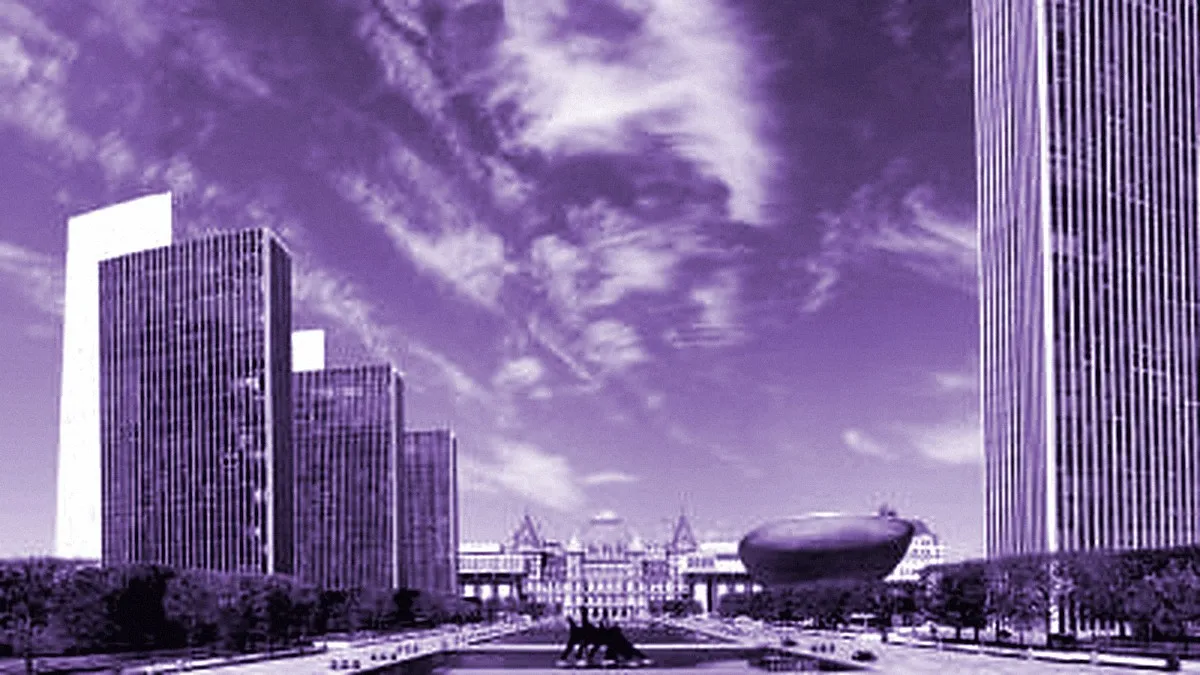
Things to Do in Albany, New York
Looking for things to do in Albany? New York’s capital combines historic houses, monumental government architecture, museums, churches, theatres, and a preserved World War II warship. Albany’s story stretches from the colonial era through the state’s political and cultural development, making it a rewarding city to explore on foot. Neywo’s free audio guide for Albany includes 59 narrated places.
What to See in Albany
Cherry Hill
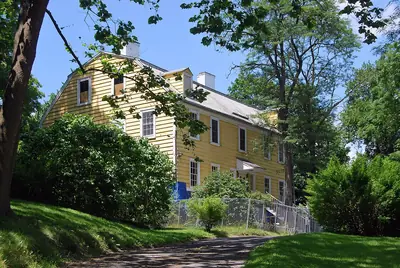
Cherry Hill is an 18th-century historic house on South Pearl Street. Built in 1787 by Colonel Philip Kiliaen van Rensselaer for his bride, Maria Sanders, the timber-frame house preserves details including a full-width wooden porch, six-over-six sash windows, and a projecting section on its north side.
The estate later became the manor house of a large farm. Its history also includes a connection with the Marquis de Lafayette, who lived there for several years during his return visit to the United States in the 1820s. A murder and controversial trial that led to Albany’s last public hanging added another dramatic chapter to the house’s story.
Schuyler Mansion
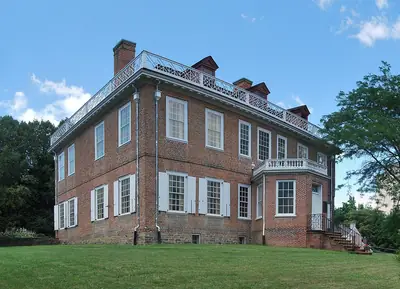
Schuyler Mansion is a National Historic Landmark and one of New York State’s important historic houses. Philip Schuyler had the Georgian brick mansion built between 1761 and 1765, and he lived there from 1763 until his death in 1804.
The house stood at the center of an 80-acre estate with an orchard, formal gardens, and a working farm. It was also a place for military planning, political discussions, and social gatherings. Today, the mansion is a museum and historic site, with guided tours from mid-May through October.
Cathedral of the Immaculate Conception
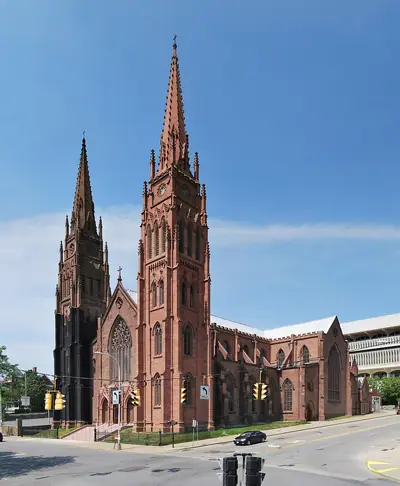
Near the Mansion District, the Cathedral of the Immaculate Conception is the mother church of the Diocese of Albany. Designed by Irish American architect Patrick Keely, it was built between 1848 and 1852 for Albany’s growing Catholic immigrant population.
The cathedral was the first American Catholic cathedral built in the Neo-Gothic style. Its twin spires were completed at different times: the north tower in 1862 and the south tower in 1888. Inside are original stained-glass windows imported from England and Stations of the Cross statuary.
USS Slater
Docked on the Hudson River, USS Slater is a Cannon-class destroyer escort launched in 1944. It is the only surviving destroyer escort in the United States preserved in its original wartime configuration.
During World War II, the ship served in both the Atlantic and Pacific theatres. It protected Atlantic convoys from German U-boats and defended Pacific task forces from Japanese submarines and kamikaze attacks. After the war, it served in the Greek Navy under the name Aetos until 1991. The ship was later returned to the United States and designated a National Historic Landmark in 2012.
Empire State Plaza
The Governor Nelson A. Rockefeller Empire State Plaza is a large complex of New York State government buildings in downtown Albany. Built between 1965 and 1976, it was designed by architect Wallace Harrison from an idea developed by Governor Nelson Rockefeller.
Its architecture is distinctly brutalist, with bold geometric forms and extensive use of raw concrete. The plaza is also home to the Empire State Art Collection, a permanent display of monumental abstract works from the 1960s and 1970s.
The Egg
The Egg is one of Albany’s most recognisable buildings. Designed by Harrison & Abramovitz as part of the Empire State Plaza, the performing arts venue was built between 1966 and 1978.
Its unusual form appears to rest on a tilted pedestal, but the structure is supported by a central stem extending six storeys into the plaza. A concrete girdle helps hold the building in shape. Inside are two amphitheatres: the 450-seat Lewis A. Swyer Theatre and the 982-seat Kitty Carlisle Hart Theatre.
New York State Museum
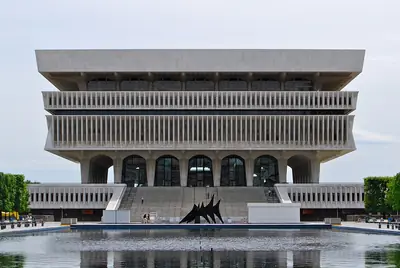
Attached to the south side of the Empire State Plaza, the New York State Museum explores New York’s cultural, natural, and geological heritage. Founded in 1836, it is described as the oldest state museum in the United States.
The museum occupies the first four floors of the Cultural Education Center, a ten-storey building that also houses the New York State Archives and New York State Library. Its displays include art, historical and prehistoric artefacts, and natural material. “Birds of New York” and “Ancient Life of New York” are among the exhibitions presented there.
Albany Institute of History & Art
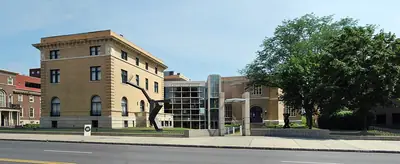
Founded in 1791, the Albany Institute of History & Art is dedicated to the history, art, and culture of Albany and the Upper Hudson Valley. Its campus consists of three buildings, including the Rice Building, a late-19th-century Beaux-Arts mansion designed by Richard Morris Hunt.
The museum’s collection contains more than 20,000 objects, covering subjects such as architecture, fashion, photography, and historical artefacts. Its library holds around 140,000 printed volumes and 85,000 photographs. Permanent displays include Nineteenth Century American Sculpture and Ancient Egypt.
Albany Center Gallery
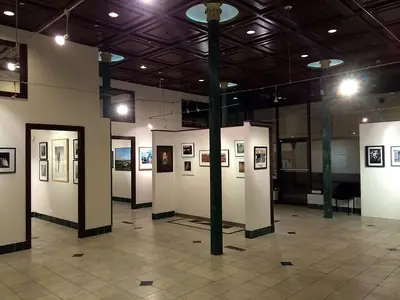
Albany Center Gallery is a nonprofit downtown art space focused on regional artists. Exhibitions, receptions, and artist interviews are free and open to the public. The gallery presents at least seven major exhibitions each year, including the Mohawk Hudson Regional Invitational.
Ten Broeck Mansion
Ten Broeck Mansion began as a Federal-style house built in 1797 and later acquired its present mixture of styles. Renovations and additions introduced Greek Revival, Italianate, Second Empire, and Victorian elements.
The Olcott family lived in the mansion from 1848 to 1948. It later passed to the Albany County Historical Association with its original furnishings, memorabilia, and decorations, and now operates as a living museum.
St. Peter’s Episcopal Church
St. Peter’s Episcopal Church was established in 1715 at the request of Queen Anne. It became the first Anglican congregation north of New York City and west of the Hudson River, and still possesses a silver communion service given by the queen.
The present church was designed by Richard Upjohn and Richard M. Upjohn in the French Gothic Revival style. Built with Schenectady bluestone and New Jersey sandstone trim, it is distinguished by a tower with a narrow 180-foot octagonal section and a spiral staircase.
Palace Theatre
The Palace Theatre opened in October 1931 and was then the third-largest movie theatre in the world. Designed by John Eberson for the Radio Keith Orpheum company, it features an Austrian Baroque interior.
The foyer includes red marble staircases, decorative scrollwork, cartouches, garlands, and a brass chandelier. Original murals by Hungarian artists Andrew Karoly and Louis Szanto remain in the forelobby.
Albany Pump Station
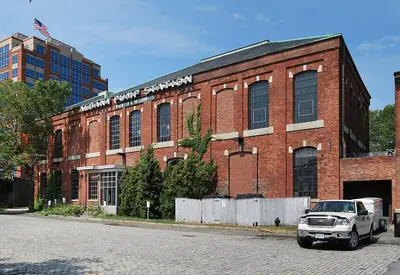
The Albany Pump Station in Quackenbush Square began as the Quackenbush Pumping Station of the Albany Water Works. Built in the 1870s and expanded later in the century, it pumped municipal water from the Hudson River for 60 years.
The brick complex has large elliptically arched windows, broad pilasters, and a slate-shingled hipped roof. Its former pumping station has been partly converted into a restaurant and brewpub, giving the historic building a new use.
Nut Grove
Nut Grove, also known as the William Walsh House, is a Greek Revival residence designed by Alexander Jackson Davis in the mid-19th century. It is Davis’s only house in this style in the Hudson Valley and one of the few examples of the “Grecian country house” variant.
The house was added to the National Register of Historic Places in 1974. It was later modified for use as a hospital, but its original form and some interior decoration remain.
SUNY
The State University of New York, or SUNY, is a public university system established in 1948 by Governor Thomas E. Dewey. It includes 64 campuses across New York State and has a major presence in Albany through the University at Albany.
The system expanded significantly under Governor Nelson A. Rockefeller, who took a personal interest in developing new facilities across the state. Its flagship universities include Stony Brook University and the University at Buffalo.
Explore Albany with a Self-Guided Walking Tour
Neywo’s Albany audio guide offers four walking tours, with 34 stops across the routes:
- Capitol Hill: Marble, Concrete and a Giant Egg — 2.19 km, 82 minutes, 11 stops.
- Dutch Beverwyck to Gilded Age: The Old Heart of Albany — 1.8 km, 70 minutes, 10 stops.
- North Pearl Street: Dutch Pulpits, Palaces and Mansions — 1.91 km, 66 minutes, 8 stops.
- Mansion District: Schuylers, Cherry Hill and a Warship — 3.78 km, 95 minutes, 5 stops.
The routes cover major landmarks such as the Albany Institute of History & Art, St. Peter’s Episcopal Church, Palace Theatre, Ten Broeck Mansion, Empire State Plaza, The Egg, Schuyler Mansion, Cherry Hill, and USS Slater. Each story plays as you reach the place, at your own pace, with no group and no schedule. Narration is available in 11 languages.
Download Neywo and explore Albany independently with a free audio guide that brings the city’s history and architecture to life as you walk. For more destinations in the region, see New York, or continue exploring nearby cities such as Buffalo, New York and Saratoga Springs.
Places with an audio guide in Albany
8 places in Albany with a Neywo audio guide. Each one starts telling its story as you reach it.

Self-guided tours in Albany
4 tours in Albany, free in the Neywo app. Each stop tells its story as you reach it.
- Walk
Capitol Hill: Marble, Concrete and a Giant Egg
Albany's government quarter packs two centuries of ambition into a few blocks. Walk from a Beaux-Arts museum to the Education Building's 36-column colonnade, past an unfinished Gothic cathedral, then through the brutalist Empire State Plaza, with its Egg-shaped theatre and the tallest skyscraper in New York outside the city.
Washington Avenue Armory · Walter Merchant House · Albany Institute of History & Art · Alfred E. Smith Building · New York State Education Building · Cathedral of All Saints …
Open this tour: Capitol Hill: Marble, Concrete and a Giant Egg - Walk
Dutch Beverwyck to Gilded Age: The Old Heart of Albany
Albany is one of the oldest European settlements in the original thirteen colonies, and its downtown still shows it. Visit Richardson's Romanesque City Hall and its carillon, the 1815 Albany Academy where Joseph Henry worked on electromagnetism, Queen Anne's church, and the round-cornered banks of State Street.
Old Albany Academy Building · New York Court of Appeals Building · Albany City Hall · St. Peter's Episcopal Church · St. Mary's Church · Young Men's Christian Association Building …
Open this tour: Dutch Beverwyck to Gilded Age: The Old Heart of Albany - Walk
North Pearl Street: Dutch Pulpits, Palaces and Mansions
Follow North Pearl Street out of downtown to Albany's oldest church building, with a pulpit carved in the Netherlands in 1656. The route continues past the lavish Palace Theatre, an old pumping station turned Irish museum, and Ten Broeck's Federal mansion on the hill.
Albany Center Gallery · Palace Theatre · First Church in Albany · Irish American Heritage Museum · Quackenbush House · Saint Joseph's Church …
Open this tour: North Pearl Street: Dutch Pulpits, Palaces and Mansions - Walk
Mansion District: Schuylers, Cherry Hill and a Warship
South of downtown, Albany keeps its colonial families' houses. Visit Cherry Hill, the 1787 van Rensselaer house where Lafayette once stayed, then the Schuyler Mansion, where Alexander Hamilton married into a great Albany family, and the Immaculate Conception cathedral. Finish at the Hudson, where the destroyer escort USS Slater is moored.
Cherry Hill · Schuyler Mansion · Cathedral of the Immaculate Conception · SUNY Plaza · USS Slater
Open this tour: Mansion District: Schuylers, Cherry Hill and a Warship
Walk Albany with Neywo
Neywo turns Albany into a self-guided audio tour. Stories arrive as you reach the place they belong to, and the route reshapes when you wander off it.

