Bulawayo, Zimbabwe: Self-Guided Walking Tour
Things to Do in Bulawayo: Museums, Heritage and Historic Landmarks
The best things to do in Bulawayo include exploring its railway heritage, discovering Zimbabwean history and wildlife at its museums, and visiting distinctive landmarks such as Nesbitt Castle and the Cathedral Basilica of the Immaculate Conception. The city also provides a base for seeing Khami, the remains of a royal city and a UNESCO World Heritage Site west of Bulawayo. Neywo has a free audio guide for Bulawayo with five narrated places, available in 11 languages.
What to See in Bulawayo
Bulawayo Railway Museum
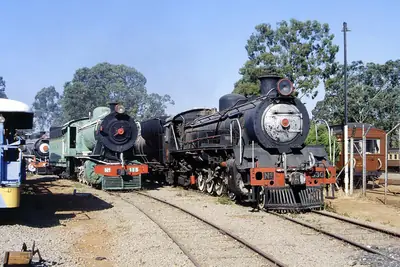
Located at Bulawayo railway station, the Bulawayo Railway Museum traces the history of Zimbabwe’s railway system, formerly known as Rhodesia. The museum opened in 1972, exactly 75 years after the first train arrived in Bulawayo.
Its collection includes railway objects dating from 1897, along with historic locomotives and carriages. One of the most notable exhibits is the personal railway coach of Cecil Rhodes. For anyone interested in engineering, transport or the development of the city, the museum offers a direct connection to Bulawayo’s role as a railway centre.
Natural History Museum of Zimbabwe
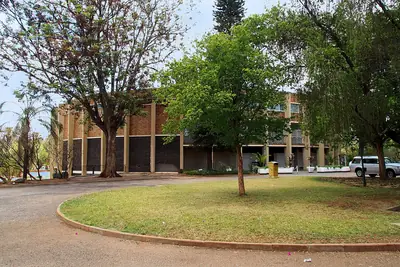
The Natural History Museum of Zimbabwe stands on Leopold Takawira Avenue and is the only natural history museum in Zimbabwe. It is also one of the country’s five national museums.
The museum officially opened in 1964 in a purpose-built building designed by architect James Whalley. Nine public galleries cover Zimbabwe’s natural and human history, including its wildlife and mineral wealth. One of the most striking exhibits is a mounted elephant described as the second largest in the world.
Nesbitt Castle
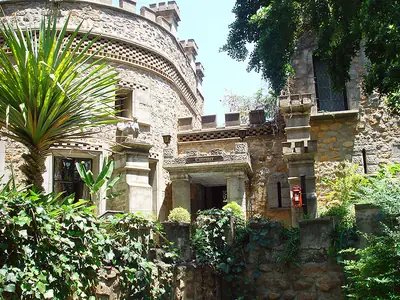
Nesbitt Castle is an unusual landmark near Bulawayo, with a neo-Gothic design that gives it the appearance of a castle. Businessman Theodore Holdengarde created the building in the 1920s, when it was known as Holdengarde Castle.
The building’s castle-like form is its defining feature. Its neo-Gothic style makes it stand out from the surrounding twentieth-century setting and gives Bulawayo a distinctive architectural curiosity to seek out.
Cathedral Basilica of the Immaculate Conception
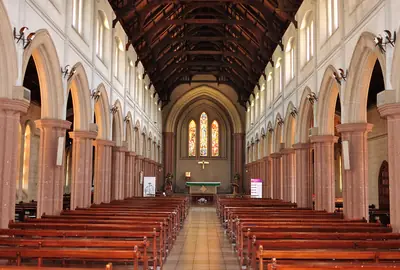
Also known as Saint Mary’s Cathedral Basilica, the Cathedral Basilica of the Immaculate Conception is the seat of the Metropolitan Archbishop of Bulawayo. The Catholic church has held the title of Minor Basilica since 2013.
Its history began with a small Jesuit chapel established in Bulawayo in the mid-1890s. The present church opened on April 3, 1904, after its first stone was placed in 1903. The stone was imported from Croatia.
The church served as a pro-cathedral from 1920 to 1955. It became the cathedral associated with the Archdiocese of Bulawayo in 1955, and Pope John Paul II visited it in September 1988. On June 21, 2013, Pope Francis elevated it to the status of Minor Basilica by decree.
Khami
West of Bulawayo, Khami preserves the remains of a royal city and the former capital of the Kingdom of Butua. The ruins are both a national monument and a UNESCO World Heritage Site.
Khami developed after Great Zimbabwe and became the capital of the Torwa dynasty. It was abandoned in the middle of the sixteenth century, but objects discovered at the site from Europe and China show that it was an important trading centre over a long period.
The site covers about 108 hectares and extends for roughly two kilometres, from Passage Ruin to North Ruin. Its most impressive features are the stone platforms and walls. Wealthy homes were built on massive stone foundations filled with earth, with some decorated in hematite and graphite. At the highest point, the ruler occupied a protected citadel surrounded by the residences of aristocrats, while working communities lived outside the walled area.
In the northern part of Khami, the royal citadel stands on a hill. The stonework and the arrangement of the ruins reveal how the city was organized, from the ruler’s protected position to the homes and communities beyond the walls.
Explore Bulawayo with Neywo
There are no group departures or fixed schedules with Neywo. Its free Bulawayo audio guide includes five narrated places, and each story plays as you reach the place, at your own pace. Narration is available in 11 languages, making it a simple way to explore Bulawayo independently while learning about its railway history, museums, architecture and heritage.
Download Neywo and discover Bulawayo with the app as your guide. You can also continue exploring Zimbabwe or visit Harare.
Places with an audio guide in Bulawayo
4 places in Bulawayo with a Neywo audio guide. Each one starts telling its story as you reach it.
Walk Bulawayo with Neywo
Neywo turns Bulawayo into a self-guided audio tour. Stories arrive as you reach the place they belong to, and the route reshapes when you wander off it.

