Visiting Siem Reap, Cambodia: Top Sights on Foot
Things to do in Siem Reap: Temples and Heritage of Angkor
Siem Reap is much more than a convenient base for visiting Angkor Wat. Located in northwestern Cambodia, this lively yet approachable city combines Khmer history, Buddhist spirituality, traditional crafts, bustling markets, and a relaxed riverside atmosphere. For travelers searching for things to do in Siem Reap or wondering what to see in Siem Reap, the city offers an extraordinary ancient world surrounded by a welcoming and creative destination. Neywo provides a free audio guide for Siem Reap with 53 narrated places to help you explore.
What to See in Siem Reap: The Angkor Archaeological Park and Beyond
Siem Reap’s global reputation comes from the Angkor Archaeological Park, a vast landscape that preserves the former heart of the Khmer Empire. Between the ninth and fifteenth centuries, Angkor developed into one of Southeast Asia’s greatest urban centers. The region features numerous monumental ruins that reveal the ambition, artistry, and religious beliefs of the Khmer civilization.
Angkor Wat
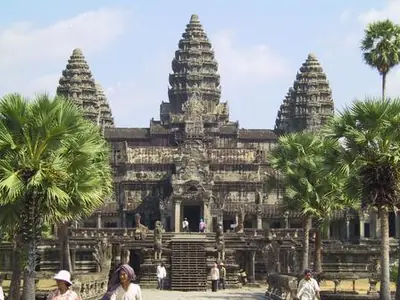
As you come to Angkor Wat, the first thing that strikes you is its scale. This vast temple complex is Cambodia’s largest Hindu temple and the largest religious complex in the world, built between 1113 and 1150 CE during the reign of King Suryavarman II. Dedicated to Vishnu, it features three progressively elevated rectangular galleries and five lotus-shaped towers rising around a central tower that reaches 65 metres above the ground.
Angkor Thom and the Bayon
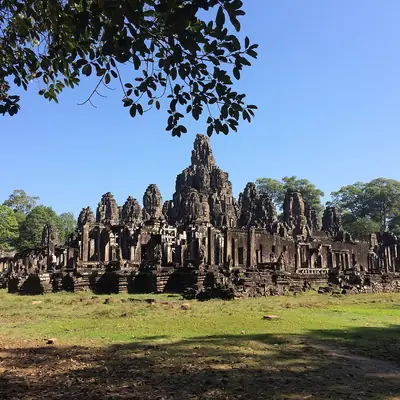
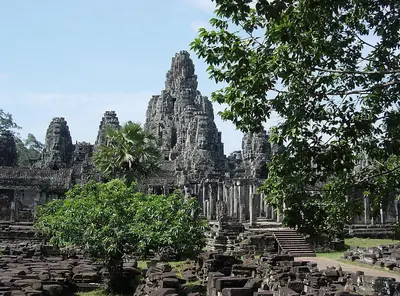
Angkor Thom is a great fortified city that served as the last capital of the Khmer Empire, built in the late twelfth century by King Jayavarman VII. Spreading over about nine square kilometres, it is surrounded by a moat and an eight-metre-high wall. At its heart stands the Bayon, King Jayavarman VII’s state temple, famous for its stone towers bearing serene, smiling faces looking out in the cardinal directions.
Ta Prohm
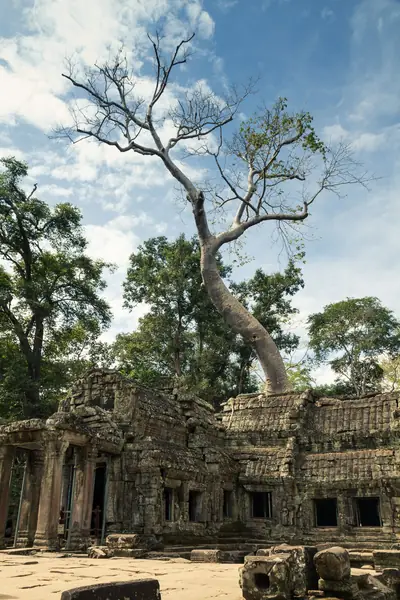
Ta Prohm is one of Angkor’s most distinctive temples, located about a kilometre east of Angkor Thom. Often called the ‘Temple in the Trees’, it was founded by King Jayavarman VII as a Mahayana Buddhist monastery and center of learning dedicated to his mother. The jungle has grown through its unmortared ruins, where massive silk-cotton trees and strangler figs embrace the stone.
Preah Khan
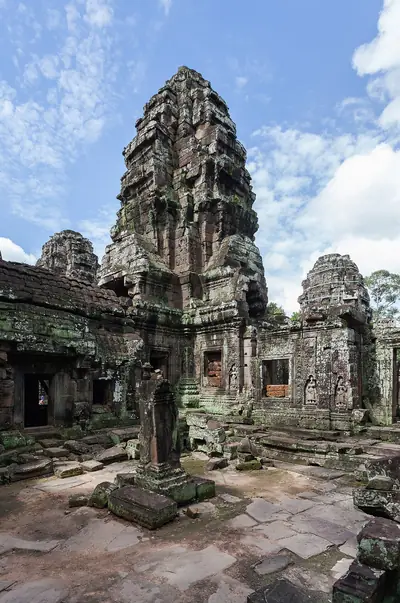
Preah Khan, meaning the ‘Royal Sword’, was built by King Jayavarman VII in 1191 to honor his father. In its heyday, it served simultaneously as a Buddhist monastery, a university, and a royal administrative center, featuring a flat, sprawling layout with massive silk-cotton trees and strangler figs weaving through doorways.
Banteay Srei
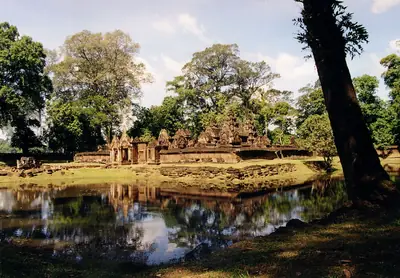
About twenty-five kilometers northeast of the main Angkor complex, Banteay Srei is known as the Citadel of Women. Consecrated in 967 CE during the reign of Jayavarman V, every surface of its fine-grained pink sandstone is carved with miniature scenes from the Ramayana and the Mahabharata.
Ta Keo
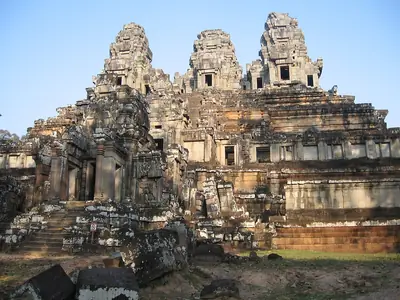
Ta Keo is a towering temple-mountain built as a steep pyramid of massive sandstone blocks. Construction began in the late tenth century under King Jayavarman V and continued under Suryavarman I, but work stopped when Jayavarman V died, leaving it as a structural skeleton without its intended intricate carvings.
Baphuon
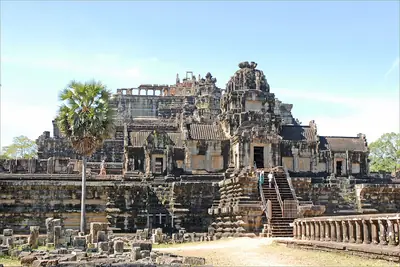
Rising from the forest floor like a great stepped pyramid, Baphuon is a mountain temple dedicated as a three-dimensional model of Mount Meru. Carbon-dating of iron crampons inside its stonework links its construction to the reign of King Suryavarman I.
Banteay Kdei
Banteay Kdei is a Buddhist temple built between the mid-12th and early 13th centuries during the reign of Jayavarman VII. Known as the Citadel of Monks’ Cells, its plan is similar to Ta Prohm and Preah Khan, featuring successive enclosure walls and concentric galleries.
Banteay Samré
Banteay Samré is a Hindu temple built in the early 12th century during the reigns of Suryavarman II and Yasovarman II. Compact and elegant in the Angkor Wat architectural style, it features deep, dense carvings depicting stories from the Ramayana.
Bakong
Bakong is the very first sandstone temple mountain ever built by the Khmer Empire, commissioned by King Indravarman I in the late ninth century as his official state temple at Hariharalaya. Its five-tiered pyramid represents Mount Meru, combining laterite and sandstone.
Spean Thma
Spean Thma is an ancient stone bridge spanning the former course of the Siem Reap River between Angkor Thom and the Eastern Baray. It features fourteen narrow corbelled arches built or rebuilt using reused sandstone blocks from older monuments.
Phnom Bakheng
Phnom Bakheng crowns a 67-metre hill with a temple shaped like a sacred mountain. Built toward the end of the ninth century during the reign of King Yasovarman I, its pyramidal form symbolizes Mount Meru, and its summit provides panoramic sunset views.
Thommanon
Thommanon is an elegant small temple standing east of the Victory Gate, built in the early 12th century during the reign of King Suryavarman II. Dedicated to Shiva and Vishnu, its carvings also weave in Buddhist imagery.
Explore Siem Reap with Neywo
To experience the city and its ancient ruins at your own pace, a Siem Reap self-guided walking tour or bike ride offers complete flexibility. Download Neywo to explore with a free walking tour Siem Reap visitors can use without any group or schedule.
The app includes 5 walking tour(s) and 1 bike route(s):
- Angkor Thom: The Royal Square and the Faces of the Bayon: A 4.8 km walk taking 115 min across 8 stops.
- Victory Gate to Ta Prohm: Small Temples and a Stone Bridge: A 5.38 km walk taking 120 min across 6 stops.
- Angkor Wat to Phnom Bakheng: temple, hill and the first mountain: A 3.25 km walk taking 69 min across 4 stops.
- East of Angkor: the Royal Bath, Pre Rup and the island temple: A 4.86 km walk taking 89 min across 4 stops.
- Siem Reap town: the museum, the royal villa and a teaching monastery: A 2.3 km walk taking 53 min across 4 stops.
- Angkor Cycle Circuit: Angkor Wat to Prasat Kravan: An 11.2 km bike route taking 56 min across 10 stops.
Each story plays automatically as you reach the place in 11 available languages. Beyond Siem Reap, you can also plan your travels across Cambodia, including nearby cities such as Phnom Penh, Battambang, Kampong Cham, Kep, and Bokor.
Places with an audio guide in Siem Reap
8 places in Siem Reap with a Neywo audio guide. Each one starts telling its story as you reach it.
Self-guided tours in Siem Reap
5 tours in Siem Reap, free in the Neywo app. Each stop tells its story as you reach it.
- Bike ride
Angkor Cycle Circuit: Angkor Wat to Prasat Kravan
A flat ride on the park roads of Angkor Archaeological Park, where cycling is welcome. Start at Angkor Wat, pass the small temple of Baksei Chamkrong, the Bayon and the Terrace of the Elephants in Angkor Thom, leave by the Victory Gate for Thommanon and Ta Keo, then ride on to Ta Prohm, Banteay Kdei, the Royal Bath of Srah Srang and the brick towers of Prasat Kravan.
Angkor Wat · Baksei Chamkrong · Bayon · Terrace of the Elephants · Thommanon · Ta Keo …
Open this tour: Angkor Cycle Circuit: Angkor Wat to Prasat Kravan - Walk
Angkor Thom: The Royal Square and the Faces of the Bayon
Walk the heart of the last great Khmer capital. Enter through the South Gate past the little temple of Baksei Chamkrong, stand under the smiling towers of the Bayon, follow the processional way along the Terrace of the Elephants and the Terrace of the Leper King, then wander through the forest to the stone footprint of the Royal Palace and climb to the Baphuon, the golden mountain.
Baksei Chamkrong · Angkor Thom · Bayon · Terrace of the Elephants · Terrace of the Leper King · Preah Palilay …
Open this tour: Angkor Thom: The Royal Square and the Faces of the Bayon - Walk
Victory Gate to Ta Prohm: Small Temples and a Stone Bridge
Leave Angkor Thom by the Victory Gate for a quieter side of Angkor: the elegant little temple of Thommanon, the old stone bridge of Spean Thma, the unfinished mountain of Ta Keo, the jungle-wrapped ruins of Ta Prohm and the Citadel of Monks' Cells at Banteay Kdei, ending at the small brick temple of Prasat Kravan.
Thommanon · Spean Thma · Ta Keo · Ta Prohm · Banteay Kdei · Prasat Kravan
Open this tour: Victory Gate to Ta Prohm: Small Temples and a Stone Bridge - Walk
Angkor Wat to Phnom Bakheng: temple, hill and the first mountain
Start at Angkor Wat, the largest religious monument in the world, then walk to the small hospital chapel of Ta Prohm Kel and the hill of Phnom Bakheng, the first temple built at Angkor, and finish at the tiny three-tiered temple of Baksei Chamkrong by the South Gate of Angkor Thom.
Angkor Wat · Ta Prohm Kel · Phnom Bakheng · Baksei Chamkrong
Open this tour: Angkor Wat to Phnom Bakheng: temple, hill and the first mountain - Walk
Siem Reap town: the museum, the royal villa and a teaching monastery
A short walk in Siem Reap itself. Start at the Angkor National Museum, where the finds of the temples are displayed in eight galleries, pass the King's villa in town and the French quarter and Old Market, and finish at Wat Damnak, a teaching monastery where novices in saffron robes study.
Angkor National Museum · Royal Residence in Cambodia · Siem Reap · Wat Damnak
Open this tour: Siem Reap town: the museum, the royal villa and a teaching monastery
Walk Siem Reap with Neywo
Neywo turns Siem Reap into a self-guided audio tour. Stories arrive as you reach the place they belong to, and the route reshapes when you wander off it.

