Things to Do in San Pedro de Atacama, Chile: Walking Guide
Things to Do in San Pedro de Atacama
San Pedro de Atacama is a high‑altitude adobe village set in the extreme landscapes of Chile’s Atacama Desert, offering access to salt flats, volcanoes, geysers, lagoons and some of the clearest night skies on Earth. Neywo provides a free audio guide for San Pedro de Atacama with 15 narrated places, letting you explore the desert at your own pace.
Explore the Highlights
Atacama Large Millimeter Array
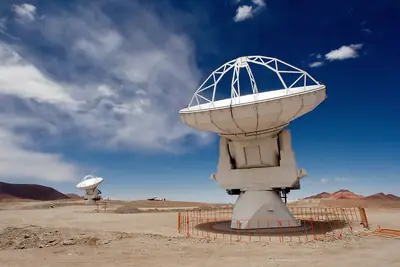
As you arrive at the ALMA observatory you see 66 radio telescopes, each seven or twelve metres across, working together as an interferometer to study the universe in millimetre and submillimetre wavelengths. The array began scientific observations in the second half of 2011, released its first images on 3 October 2011 and was inaugurated in March 2013 as a partnership between Europe, North America, East Asia and Chile.
Pukará de Quitor
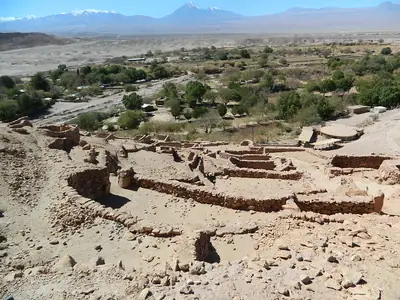
Approaching the stone fortress you notice it climbing a steep hillside above the San Pedro River valley. Built by the Atacameño (Lickan Antai) people before the Inca era, it dates from the twelfth century and served mainly as a defensive stronghold against neighbours such as the Aymara, while also protecting trade routes. The site follows the natural terraces of the hill, with a winding wall as the first barrier and structures made from unshaped liparite stone. From the upper terrace, about eighty metres above the base, defenders could watch for approaching enemies; inside were homes, silos, grain stores, defensive enclosures and lookout points.
Valle de la Luna
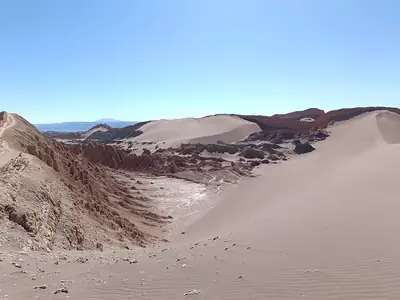
Just west of the village the landscape opens into the Valley of the Moon, where wind and water have sculpted stone, sand and salt into a colourful, otherworldly scene. You can walk among dry lakes coated in white salt, saline outcrops that resemble sculptures, and a variety of caves. The depression is surrounded by ridges that rise roughly five hundred metres and is linked to the nearby Valle de la Muerte. As the sun sets the light shifts from pink to purple to black, highlighting the forms while the wind among the rocks adds to the sense of isolation.
Museo Arqueológico Gustavo Le Paige
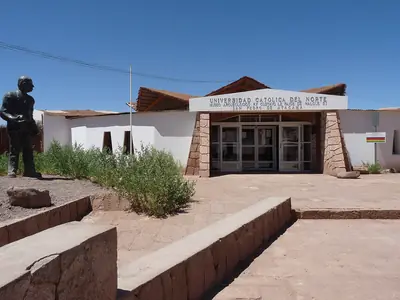
In the centre of town you encounter the former archaeological museum founded by Father Gustavo Le Paige, who arrived in 1955 and gathered nearly 380 000 pre‑Columbian objects from the Atacameño culture. The museum opened in the parish house in 1957, expanded with a new section in 1963 supported by the Catholic University of the North, and added a Treasury Room in 1991 with backing from Minera Escondida. At the request of the Lickanantai people, the mummies were moved from display to a conservation area in 2007.
Museo del Meteorito
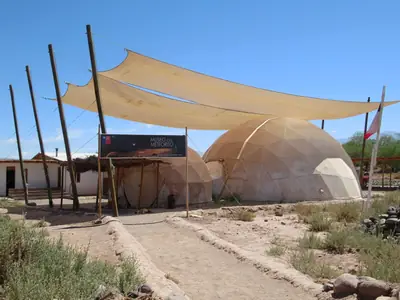
A few steps ahead lies the Meteorite Museum, which presents a close look at meteorites recovered from the Atacama Desert in northern Chile, offering insight into the extraterrestrial material that has fallen onto this dry region.
Iglesia de San Pedro
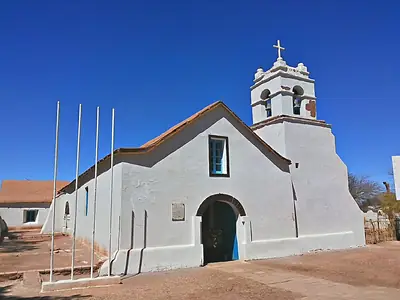
Facing the plaza, the simple yet elegant Iglesia de San Pedro stands as a defining landmark of the village. Built during the Spanish colonial period in the seventeenth century, it is reportedly the second oldest church in Chile and was later modified in the eighteenth and nineteenth centuries. Its adobe construction gives it a modest appearance rooted in local tradition, and it was declared a historical monument in 1951.
Tulor
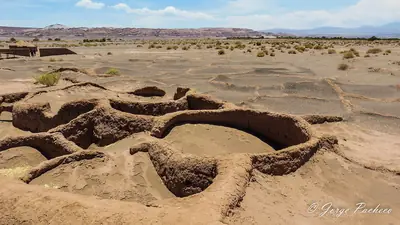
A little southwest of San Pedro, between the Cordillera de la Sal and advancing dunes, you find the archaeological site of Tulor (also Aldea de Tulor). This settlement preserves the remains of one of the oldest sedentary villages in northern Chile, covering about 5 200 square metres with traces extending roughly two kilometres east‑west. Its architecture features circular mud walls linked together, some with vaulted forms, and spaces that served different daily functions. Occupation spans from around 380 BCE to 200 CE, with most structures dating from 800 to 1200 CE. The first remains were uncovered in 1956 by Gustavo Le Paige, and further excavations took place in 1980 under archaeologist Ana María Barón, revealing ceramics, stone tools, and human and animal bones.
Licancabur
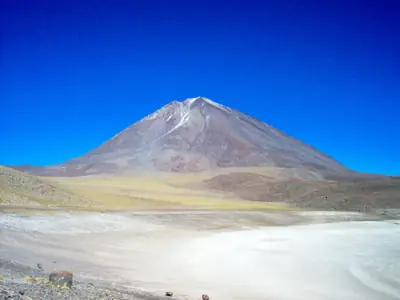
Looking toward the horizon you see Licancabur, a striking stratovolcano that rises on the Chile‑Bolivia border to nearly six thousand metres above sea level. Its summit crater, 400‑500 metres wide, holds Licancabur Lake, one of the highest crater lakes in the world. Despite its height the surrounding aridity prevents glacier formation. The volcano belongs to the Central Volcanic Zone of the Andes, its lava flows appear young, and no historical eruptions are recorded, although lava reaching Laguna Verde has been dated to about 13 240 years ago. Archaeological sites at the summit and the northeastern flank suggest Inca or Atacama ceremonial use, and local myths describe the mountain as the husband of another peak, an Inca hiding place, or a burial site for an Inca king.
El Loa Province
While exploring San Pedro you are within El Loa Province, a vast area of the Antofagasta region characterised by desert landscapes and mountain‑filled terrain. The province is divided into three communes: Calama, Ollagüe and San Pedro de Atacama, together forming a region known for its striking desert scenery and highland vistas.
Acamarachi (Pili)
A little southeast of town rises Acamarachi, also known as Pili, reaching 6 046 metres and marking the highest point and volcano in this part of northern Chile. Its cone‑shaped form features steep upper slopes and a lava dome on the northern flank, composed of andesitic and dacitic rock. The exceptionally dry climate has helped preserve older volcanic features; while some flank lava flows are ancient, others around the summit crater and a lava coulee toward the Colachi volcano may date from after the last glacial period. Near the summit an Inca mountain sanctuary was discovered, accompanied by figurines—a silver female figure and a male figure made from thorny oyster—both found with miniature clothing.
Atacama Pathfinder Experiment (APEX)
A short distance from San Pedro, high on the Llano de Chajnantor, stands the APEX radio telescope at 5 104 metres above sea level. Its twelve‑metre dish, built from 264 aluminium panels, observes submillimetre wavelengths to study cold dusty material between stars, star‑formation processes and early‑universe galaxies. The surface maintains an average accuracy of seventeen micrometres. APEX was inaugurated on 25 September 2005, developed as a prototype for ALMA and operated today by the European Southern Observatory on behalf of the Max Planck Institute for Radio Astronomy.
Puritama Hot Springs
A little beyond the village you reach Puritama Hot Springs (Termas de Puritama), where geothermal water gathers in a series of large pools at the base of a canyon carved by the Puritama River. In total there are eight pools to explore, extending roughly one kilometre along the river’s course.
Llano de Chajnantor Observatory
A little east of San Pedro lies the Llano de Chajnantor Observatory, also called the Atacama Astronomical Park. Situated within the Puricó volcanic complex, this remote site hosts the ALMA array and is recognised as one of the world’s premier locations for astronomical observation thanks to its extreme dryness and high elevation.
Iglesia de San Lucas, Toconao
In the locality of Toconao you will find the Iglesia de San Lucas, a Catholic church whose detached bell tower together with the nave were declared a Chilean National Monument on 6 July 1951 by Supreme Decree 5058. The simple stone structure reflects the region’s colonial‑era architecture while standing apart from its tower.
Salar de Atacama
A short drive south brings you to the Salar de Atacama, Chile’s largest salt flat covering about three thousand square kilometres. Framed by the Andes to the east and the Cordillera Domeyko to the west, the basin is dotted with volcanoes including Licancabur, Acamarachi, Aguas Calientes and the highly active Láscar. Beneath the salt lies the Indigenous Likan Antay people; scientific surveys in the twentieth century identified lithium in the brines in 1962, and since the 2000s the salar has become a major centre for lithium extraction. From San Pedro de Atacama the salar lies roughly fifty‑five kilometres to the south.
Explore San Pedro de Atacama with Neywo
Neywo’s free audio guide turns your walk into a self‑guided discovery of the desert. The app offers one walking tour—“Adobe, Meteorites and a Fortress in the Desert”—that is 4.71 kilometres long, takes about 90 minutes and includes four narrated stops: Iglesia de San Pedro, Museo Arqueológico Gustavo Le Paige, Museo del Meteorito and Pukará de Quitor. As you reach each point, the app tells the story of that place, allowing you to move at your own pace with no group and no schedule. Narration is available in eleven languages, and the guide covers fifteen locations in total across San Pedro de Atacama.
Download Neywo, plug in your headphones, and let the desert reveal its secrets step by step.
Chile – country page
Santiago – nearby city
Valparaíso – city in Chile
Places with an audio guide in San Pedro de Atacama
8 places in San Pedro de Atacama with a Neywo audio guide. Each one starts telling its story as you reach it.
Walk San Pedro de Atacama with Neywo
Neywo turns San Pedro de Atacama into a self-guided audio tour. Stories arrive as you reach the place they belong to, and the route reshapes when you wander off it.

