Visiting Tampere, Finland: Top Sights on Foot
Things to Do in Tampere: What to See in Finland’s Industrial City
Tampere is a Finnish city built around water, industry and culture, between Lake Näsijärvi and Lake Pyhäjärvi and divided by the Tammerkoski rapids. Its former factories, distinctive red-brick architecture, museums and lakeside districts make it one of the most rewarding places to explore in Finland. Neywo’s free audio guide for Tampere covers 71 narrated places, so you can discover the city while walking, cycling or travelling by bus.
What to See in Tampere
Tampere Cathedral
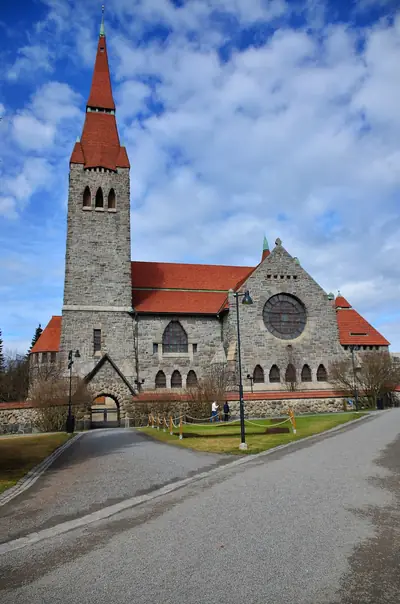
Tampere Cathedral stands in the Jussinkylä district and is the seat of the Diocese of Tampere. Designed by Lars Sonck in the National Romantic style, it was built between 1902 and 1907 from grey granite quarried in Uusikaupunki.
The cathedral is especially known for its striking frescoes by the symbolist artist Hugo Simberg, painted between 1905 and 1906. They include versions of The Wounded Angel and The Garden of Death. The ceiling fresco of a winged serpent on a red background caused controversy when it was first revealed. The altar piece, by Magnus Enckell, depicts the future resurrection of people of all races.
Finlayson and Tampere’s industrial heritage
The Finlayson district is the clearest expression of Tampere’s industrial past. The former factory area preserves the red-brick buildings and working history that earned the city the nickname “Manchester of Finland”, or “Manse”.
The complex once supported cotton, paper, machinery, clothing and shoe production. Today, its buildings contain museums, restaurants, cafés, galleries, performance spaces and event venues. The Finnish Labour Museum Werstas is one of the district’s main attractions. It is Finland’s largest free-admission museum destination and a national responsibility museum focused on social history, work and the Finnish working class.
The district is also home to the Museum of the Deaf, whose collections include objects, photographs, documents, books and works of art connected with deaf education, sign language, community life and the struggle for equality.
Finlayson Palace
Finlayson Palace is one of the most distinctive buildings in the former factory area. Completed in 1899 in the Neo-Renaissance style, it was designed by city architect Lambert Pettersson for Alexander von Nottbeck, head of the Finlayson factory.
The building occupies the site of an old state distillery that had once been the home of James Finlayson, the factory’s earlier owner. From the 1910s until the late 1970s, the palace served as the residence of Finlayson’s managing director. It is now a restaurant and event venue.
Vapriikki Museum Centre and the Finnish Ice Hockey Museum
Vapriikki Museum Centre occupies the old Tampella factory premises beside the Tammerkoski rapids. Its oldest sections date from the 1880s, and the complex forms part of the nationally significant Tammerkoski industrial landscape.
Vapriikki brings together museums covering natural history, archaeology, art, industry and technology. The centre also houses the Finnish Ice Hockey Museum, an important stop in a city with a strong hockey tradition.
Nootti
Nootti, the Museum of Finnish-Russian Relations, opened in February 2025 in Tampere’s Workers’ House. Its exhibitions trace Finland’s relations with the Soviet Union and later Russia, from Finnish independence to the country’s NATO membership.
The building has an important political history of its own. Vladimir Lenin and Joseph Stalin met there face to face in 1905 during a secret Bolshevik party conference. The same rooms later housed the Lenin Museum, which opened in 1946 and closed in November 2024 after almost eighty years.
Museum Milavida
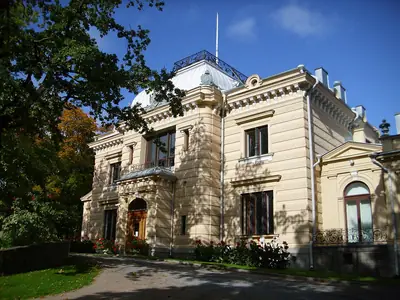
Museum Milavida is located inside Näsilinna Palace on Näsikallio. Its main exhibition tells the story of the von Nottbeck family, owners of the Finlayson cotton factory, and their influence on Tampere’s industrial history.
The museum also hosts changing exhibitions focused particularly on fashion and design. Past displays have included Salvatore Ferragamo shoes, Valentino evening gowns, fabrics by Finnish designer Timo Sarpaneva and a crown designed for the King of Finland.
The Steamboat Kuru memorial
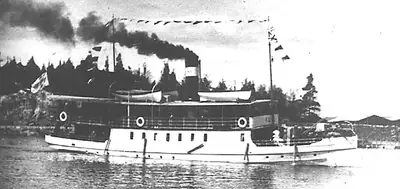
The Steamboat Kuru memorial stands by Lake Näsijärvi and commemorates the sinking of the steamship Kuru on September 7, 1929. The disaster remains the worst maritime accident on a Finnish lake or river.
There were 150 passengers and 12 crew members on board. Passenger counts and officers’ accounts recorded 136 deaths, although other sources give a figure of 138. The ship became unstable in heavy weather after a third deck had been added in 1927 without expert help or a proper inspection of its balance. The wreck was raised later that year and repaired.
Sara Hildén Art Museum
The Sara Hildén Art Museum is in the Särkänniemi district. Its collection began with the private art collection donated by Sara Hildén’s foundation in 1962. It now includes around 4,500 works, approximately 4,000 of them by Finnish artists.
The collection is particularly strong in art from the 1960s and 1970s. The museum building, designed by Pekka Ilveskoski, opened in 1979. Its courtyard also contains a sculpture park, and the museum is fully accessible to visitors with mobility impairments.
Emil Aaltonen Museum
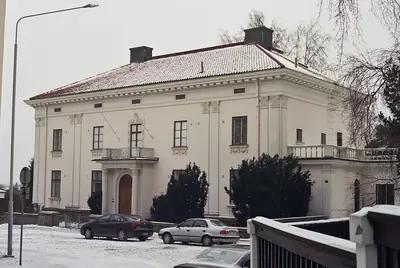
The Emil Aaltonen Museum combines Finnish industrial history with art. It is housed in Pyynikinlinna, Emil Aaltonen’s former home on the Pyynikinrinne ridge. The building was designed by Jarl Eklund and completed in 1924; it was renovated as exhibition space in 1984.
The museum opened in 2004 and presents the development of industrialization in Finland alongside Aaltonen’s life and art collection. He began collecting art in the 1920s and displayed works in the offices of his factories. The collection is dominated by older Finnish art.
Hiekka Art Museum
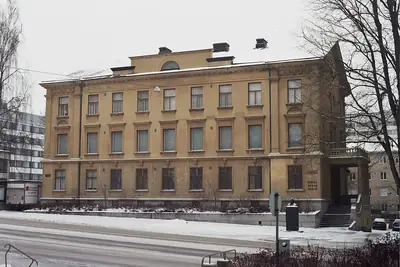
Hiekka Art Museum, or Hiekan taidemuseo, is in the Amuri district. Founded in 1931 by industrial counsellor and goldsmith Kustaa Hiekka, it is Finland’s oldest private art museum.
Galleria Rajatila
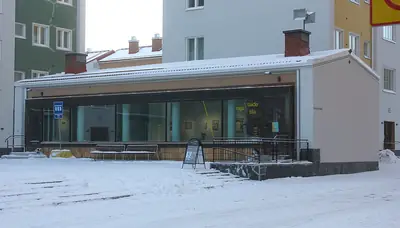
Galleria Rajatila, on Hämeenpuisto, offers an introduction to Finland’s contemporary art scene. Founded in 1997, it gives emerging artists a platform alongside contemporary work.
Its exhibitions change roughly every three weeks. In addition to the street-level gallery, the space includes a small windowless room downstairs painted entirely black, creating a contrasting setting for the works displayed there.
Police Museum and Spy Museum
The Police Museum in Hervanta is Finland’s national museum of policing. Its permanent exhibition follows the history of the Finnish police from the medieval period to the present, using objects, photographs and films. The children’s police station, Pokela, lets younger visitors sit in a police car, try on a small police uniform and experiment with police tasks.
In central Tampere, the Spy Museum explores international espionage. Founded by Teppo Turja, it opened in 1998 and presents the world of spies and secret operations to the public.
Tampere Ice Stadium
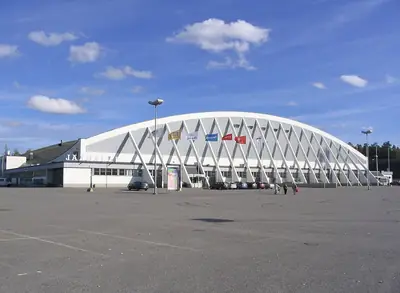
Tampere Ice Stadium, locally known as Hakametsä, is Finland’s oldest ice hockey arena. Designed by Jaakko Tähti for the 1965 Ice Hockey World Championships, it hosted its first game on January 29, 1965.
For many years, it was the home arena of Ilves and Tappara. Both teams played their final games there in November 2021 before moving to Nokia Arena. The stadium continues to host ice hockey matches and other events.
Aunessilta
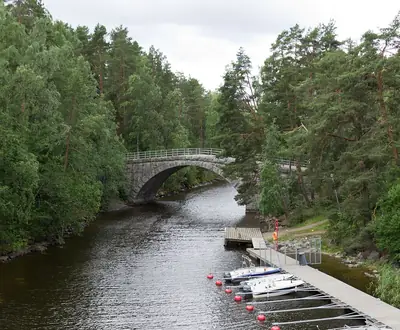
Aunessilta is a granite arch bridge in Kämmenniemi, now reserved for walkers and cyclists. Built between 1898 and 1899, it is 46.7 metres long and has a free span of 19 metres. Architect Georg Schreck designed the single-arch bridge, which rests directly on solid rock.
It once carried the main road between Tampere and Ruovesi and remained in regular use until 1983. After the nearby Kaitaveden silta took over road traffic, Aunessilta was restored as a museum bridge. Its stone vault is the largest in Finland and is considered significant by Nordic standards.
Explore Tampere with a self-guided audio tour
Neywo offers four walking tours in Tampere, one bus route and one bike route:
- Finlayson: The Cotton Mill That Built Tampere — 1.11 km, 66 minutes and 10 narrated stops.
- Näsinkallio Ridge to Särkänniemi Shore — 1.05 km, 43 minutes and 5 narrated stops.
- Pyynikki and Amuri: Workers’ Homes and Art Hill — 2.43 km, 88 minutes and 10 narrated stops.
- Central Square to the Cathedral and the Moomins — 3.34 km, 106 minutes and 11 narrated stops.
- Bus 8A: Pispala, Pyynikintori and Central Square to Messukylä — 9.5 km, 41 minutes and 8 narrated stops.
- Tampere Ride: Stadium, Workers’ Hall and Pispala — 4.6 km, 23 minutes and 7 narrated stops.
The app tells the story of each place as you reach it, at your own pace, with no group and no schedule. The narration is available in 11 languages. Download Neywo and explore Tampere independently, from its industrial centre and museums to its churches, bridges and lakeside districts.
Places with an audio guide in Tampere
8 places in Tampere with a Neywo audio guide. Each one starts telling its story as you reach it.
Self-guided tours in Tampere
6 tours in Tampere, free in the Neywo app. Each stop tells its story as you reach it.
- Bike ride
Tampere Ride: Stadium, Workers' Hall and Pispala
Ride the cycle lanes from Tampere Stadium through the Workers' Hall district and Amuri to the Pispala ridge. You pass the Nootti museum, the churches of Aleksanteri and the Holy Cross, Pyynikintori and the two Pispala churches.
Tampere Stadium · Nootti · Aleksanteri Church · Holy Cross Church, Tampere · Pyynikintori · Pispala Church …
Open this tour: Tampere Ride: Stadium, Workers' Hall and Pispala - Bus ride
Bus 8A: Pispala, Pyynikintori and Central Square to Messukylä
A regular city line from Pispala's hillside churches along the Pyynikki ridge and over the Tammerkoski rapids to Central Square, the theatre, the Orthodox church and out to Messukylä. Ride it for two wooden Pispala churches, Pyynikintori, the Hiekka Art Museum and the rapids themselves.
Pispala Old Church · Pispala Church · Pyynikintori · Hiekka Art Museum · Tammerkoski · Tampere Theatre …
Open this tour: Bus 8A: Pispala, Pyynikintori and Central Square to Messukylä - Walk
Finlayson: The Cotton Mill That Built Tampere
Walk through the red-brick factory town that made Tampere the Manchester of Finland. Pass the factory gate, Väinö Linna Square with Finland's first modern factory, the Neo-Gothic head office, the director's Neo-Renaissance palace and a workers' church, and visit the labour, spy and Vapriikki museums along the Tammerkoski rapids.
Rupriikki Media Museum · Taidehalli TR1 · Väinö Linna square · Spy Museum · Finlayson gate · The Finnish Labour Museum Werstas …
Open this tour: Finlayson: The Cotton Mill That Built Tampere - Walk
Näsinkallio Ridge to Särkänniemi Shore
Climb the ridge above Lake Näsijärvi to the Neo-Baroque Näsilinna palace and the Art Nouveau cliff fountain, remember the worst lake disaster in Finland, then walk down to the Särkänniemi shore and the Sara Hildén Art Museum.
Näsikallion suihkukaivo · Museum Milavida · Höyrylaiva Kurun haaksirikon muistomerkki · Särkänniemi · Sara Hildén Art Museum
Open this tour: Näsinkallio Ridge to Särkänniemi Shore - Walk
Pyynikki and Amuri: Workers' Homes and Art Hill
A loop through west-central Tampere. Start at the Emil Aaltonen Museum on the Pyynikki ridge, then visit the Workers' Theatre and the Nootti museum in the Workers' Hall, step inside the preserved homes of Amuri's working families, and pass art museums, a neo-Gothic brick church and Pyynikintori, the square locals call Plassi, to the contemporary art of Galleria Rajatila.
Emil Aaltonen Museum · Tampere Workers' Theatre · Nootti · Aleksanteri Church · Hiekka Art Museum · Pyynikintori …
Open this tour: Pyynikki and Amuri: Workers' Homes and Art Hill - Walk
Central Square to the Cathedral and the Moomins
From the Tammela market square and the Civil Guard museum to Lars Sonck's granite cathedral with Hugo Simberg's famous frescoes, then Keskustori with its fountain and wooden Old Church, the oldest building in the city centre, past the boxing museum and the onion-domed Orthodox church to the only Moomin museum in the world.
Tammelantori · Tampere Civil Guard and Lotta Svärd Museum · Tampere Cathedral · Tampere Old Church · Keskustorin suihkukaivo · Tampere Central Square …
Open this tour: Central Square to the Cathedral and the Moomins
Walk Tampere with Neywo
Neywo turns Tampere into a self-guided audio tour. Stories arrive as you reach the place they belong to, and the route reshapes when you wander off it.

