Visiting Porvoo, Finland: Top Sights on Foot
Things to Do in Porvoo: Historic Churches, Museums and Riverside Heritage
The best things to do in Porvoo are concentrated around its historic streets, churches, museums and river landscape. This Finnish town offers a rich look at local history, from its medieval cathedral and castle hill to traditional crafts, artists’ studios and distinctive religious communities. Neywo has a free audio guide for Porvoo with 17 narrated places, available in 11 languages.
What to See in Porvoo
Porvoo Cathedral
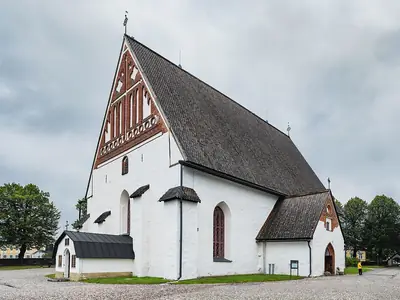
Porvoo Cathedral, known in Finnish as Porvoon tuomiokirkko and in Swedish as Borgå domkyrka, is one of the city’s most important landmarks. The grey-stone church stands in the centre of Porvoo and represents late Gothic architecture.
The cathedral took its present form around 1480, while its oldest parts date from the thirteenth century. Its design includes features associated with Baltic and northern German brick Gothic, although the building itself is made of grey stone. It became a cathedral in 1723 when the Diocese of Viipuri was transferred to Porvoo.
The church also played an important role in the Finnish Diet of 1809. Today, it remains the seat of the Swedish-speaking Diocese of Porvoo and is used by Porvoo’s Finnish-speaking parish.
Porvoo Finnish Church
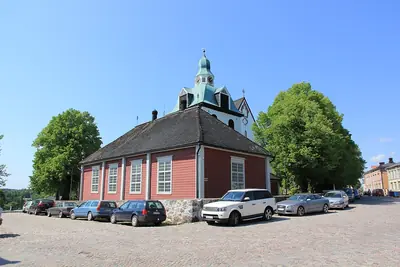
Only a short distance from the cathedral, the Porvoo Finnish Church is a red-painted wooden building also known as the Little Church. It was inaugurated in 1740 so Finnish- and Swedish-language services could take place in Porvoo at the same time.
The church was once at risk of demolition. Although the church council approved that decision in 1964, it later chose renovation instead. Restoration took place between 1973 and 1974, and the building reopened on March 10, 1974.
Porvoo Old Town Hall and Porvoo Museum
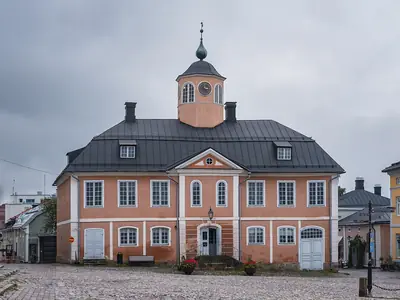
Beside the market square in Old Porvoo, the former Town Hall now forms one of the main locations of Porvoo Museum. Known as Porvoon raatihuone in Finnish and Borgå rådhus in Swedish, it is regarded as Finland’s oldest town hall building.
The present building was constructed mainly between 1763 and 1764, with its wooden tower completed in 1771. Designed by master builder Gotthard Flensborg, it represents Hårlemanian Baroque classicism, with brick walls, two storeys and a mansard roof.
The building’s unusual slope is part of its story. Its foundations could not fully support the weight of its thick structures, so the Town Hall settled at an angle. The floors were adapted to the slope, and the building was left in that condition once the settling stopped. Inside, the museum’s permanent exhibitions explore the history of Eastern Uusimaa from the Ice Age to the eighteenth century, along with the history of the Town Hall and later local life.
Iso Linnamäki, or Porvoo Castle Hill
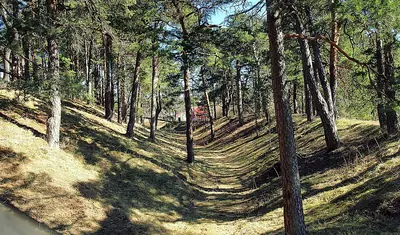
At the edge of Old Porvoo beside the Porvoo River, Iso Linnamäki—also called Isolinnamäki or Porvoo Castle Hill—offers a glimpse into the town’s medieval past. The site is a historic hill fort rather than simply a natural rise in the landscape.
The fort is thought to date from the Middle Ages, although traces of earlier use have also been found. It stood close to the river and was surrounded by moats. The fort was altered several times after its original construction, adding to the layers of history associated with the hill.
Porvoo Doll and Toy Museum
The Porvoo Doll and Toy Museum is a private museum in a nineteenth-century building on Jokikatu in Old Porvoo. Its collection covers dolls and toys from the early nineteenth century through the 2000s, showing how children’s play changed across generations.
Evi and Jorma Söderlund founded the museum in 1974 after beginning their collection in the 1960s. It contains about one thousand dolls and many other toys, all of which were once played with. The museum is open to visitors during the summer months.
Postimäki Open-Air Museum
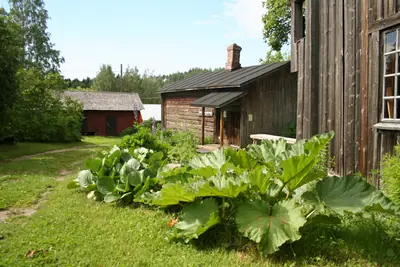
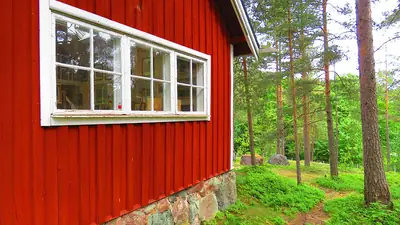
Beyond Porvoo, in the village of Illby, Postimäki preserves one of Finland’s best-preserved genuine crofter settlements. The site is built around a hill with traditional cottages, some of whose oldest surviving buildings date from the eighteenth century.
During the nineteenth century, Postimäki was home to crofters who often supported themselves through handicrafts. Tailors, a blacksmith and a shoemaker worked there, while straw braiding became the settlement’s best-known craft and continued until the middle of the twentieth century.
Several cottages have period-style interiors. Among the buildings are a straw museum, a shoemaker’s workshop and a blacksmith’s forge. Postimäki stands beside the old King’s Road, linking its traditional crafts with an older route through the area.
Albert Edelfelt Ateljè Museum
In Haikko, within the Porvoo archipelago, the Albert Edelfelt Ateljè Museum occupies the studio where Finnish artist Albert Edelfelt spent many summers working. His mother, Alexandra, rented a summer villa at Haikko Manor in 1879, and Albert had a studio built on the property in 1883. Its skylight helped create better conditions for painting.
Edelfelt kept the studio until his death. He spent twenty-six summers at Haikko and painted more than two hundred and twenty works there. He died at the estate in August 1905. Since 1951, the studio has been a museum displaying drawings, lithographs and photographs connected with his life and work.
Haikko Manor
Haikko Manor lies outside central Porvoo and is now a hotel and spa with a main building, spa hotel, conference centre, restaurant and fourteen-hectare seaside park. Its history reaches back to 1362, when the estate was first mentioned in written records.
The manor belonged to several notable figures over the centuries and entered a new era in 1876, when General Sebastian von Etter bought it. His descendants owned Haikko until the 1960s. The estate was known for its social life, and European royalty visited it.
The earlier main manor house was destroyed by fire in 1911. The present building was designed by Armas Lindgren and erected in 1913 for Emelie von Etter, the widow of General von Etter.
J. L. Runeberg’s Grave
J. L. Runeberg’s grave is a memorial site dedicated to the person it commemorates. It is one of the stops included in a compact walking route through Porvoo’s historic landmarks.
Porvoo’s churches and congregations
Porvoo’s religious heritage extends beyond the cathedral and Little Church. In the city centre, Borgå Metodistförsamling has been part of local life since 1906. The church is on Kaivokatu, and Sunday services remain an important part of the congregation’s weekly life.
Borgå Filadelfiaförsamling, also known as Filadelfia Borgå, traces its local Pentecostal history to 1912, when Thomas Ball Barratt visited Porvoo and conducted baptisms in Haikko. After several changes of name and periods of relocation, the congregation inaugurated its own Filadelfia Church in 1955.
Porvoon helluntaiseurakunta on Adlercreutzinkatu is another Pentecostal congregation in central Porvoo. Founded in 1949, it is involved in worship, prayer, children’s and youth activities, and mission work.
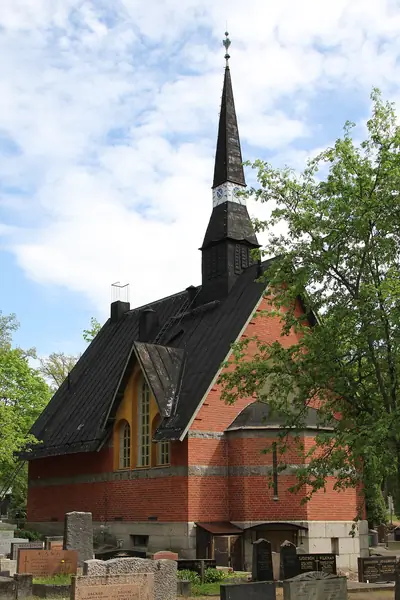
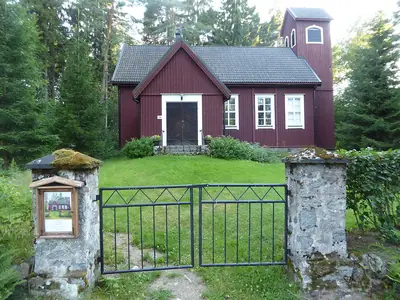
Outside the centre, Vålax Pingstförsamling was founded in 1932 after a local religious revival. The Svartbäck-Spjutsund Archipelago Church, known in Finnish as Svartbäck-Spjutsundin saaristolaiskirkko, is another church in the Porvoo area. Näsinmäki Chapel serves as a cemetery chapel.
Explore Porvoo with a Self-Guided Walking Tour
A Porvoo self-guided walking tour is a practical way to connect several of the city’s central landmarks. Neywo’s walking route, “Borgå by the River: Finland’s Oldest Town Hall and a Wooden Little Church,” covers 1.65 km in 52 minutes and includes five narrated stops:
- Porvoon museo
- Porvoo Cathedral
- Porvoo Finnish Church
- Iso Linnamäki
- J. L. Runebergin hauta
It is a focused introduction to Porvoo’s historic core, combining civic history, religious architecture, the castle hill and a memorial site.
Porvoo also makes a useful stop when exploring Finland. For a wider itinerary, you can compare it with Helsinki, Tampere, Turku or Rovaniemi.
Download Neywo for Porvoo
Neywo offers one walking tour in Porvoo: a 1.65 km route lasting 52 minutes, with five narrated stops. The free Porvoo audio guide includes 17 narrated places in total, and narration is available in 11 languages.
The app tells the story of each place as you reach it, at your own pace, with no group and no schedule. Download Neywo and explore Porvoo’s cathedral, museums, churches and historic hills while the stories play at the places where they happened.
Places with an audio guide in Porvoo
8 places in Porvoo with a Neywo audio guide. Each one starts telling its story as you reach it.
Self-guided tours in Porvoo
1 tour in Porvoo, free in the Neywo app. Each stop tells its story as you reach it.
- Walk
Borgå by the River: Finland's Oldest Town Hall and a Wooden Little Church
Porvoo's Old Town is a few lanes of red storehouses, but its story is older than Finland as a nation. Visit the leaning Town Hall where Christmas Peace is proclaimed, the stone cathedral where Alexander I received an oath in 1809, the Little Church beside it, the medieval hill fort that gave the town its name and the grave of the national poet.
Porvoon museo · Porvoo Cathedral · Porvoo Finnish Church · Iso Linnamäki · J. L. Runebergin hauta
Open this tour: Borgå by the River: Finland's Oldest Town Hall and a Wooden Little Church
Walk Porvoo with Neywo
Neywo turns Porvoo into a self-guided audio tour. Stories arrive as you reach the place they belong to, and the route reshapes when you wander off it.

