Things to Do in Antigua Guatemala, Guatemala: Walking Guide
Things to Do in Antigua Guatemala: A Self-Guided Walk Through Its Colonial Heritage
Antigua Guatemala is a historic city in Guatemala’s central highlands, known for colonial churches, convent ruins, stone arcades, and streets shaped by centuries of earthquakes. The city’s compact historic center makes it especially rewarding to explore on foot, with major landmarks gathered around Central Square and quieter ruins extending into the surrounding neighborhoods. Neywo offers a free audio guide for Antigua Guatemala with 15 narrated places.
Antigua is part of Guatemala, a country whose highland cities and communities offer very different perspectives on history and culture. If you are planning a wider trip, you could also compare it with Guatemala City, Quetzaltenango, or Chichicastenango.
What to see in Antigua Guatemala
The best way to understand Antigua is to move between its churches, civic buildings, museums, and earthquake-damaged religious complexes. Each stop adds another detail to the story of the former colonial capital.
Central Square, the Palace of the Captain Generals, and MUNAG
The Palace of the Captain Generals dominates Antigua Guatemala’s Central Square. It was originally built as the residence and office of the captain generals and remains an important civic building, housing government offices as well as the National Museum of Guatemalan Art, known as MUNAG.
The palace’s colonial architecture reflects the craftsmanship of the Spanish era. Inside, MUNAG presents works from Guatemala’s different historical periods, using modern technology and audiovisual resources to explore the country’s artistic heritage.
Ayuntamiento of Antigua Guatemala
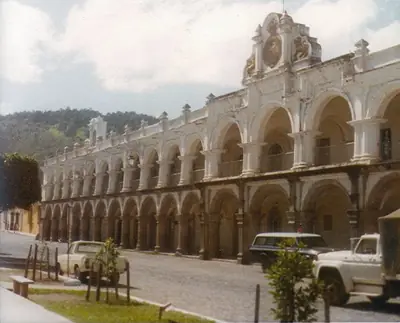
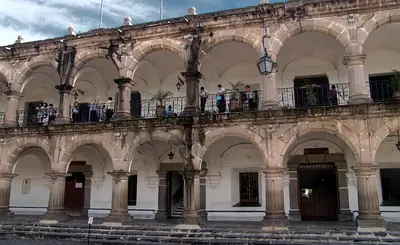
Facing Central Park beside the cathedral, the Ayuntamiento is Antigua’s historic town hall and remains a center of municipal life. Its façade is distinguished by a double arcade of solid Tuscan stone columns, while the eastern wall features finely carved stonework.
The design is attributed to Luis Diez de Navarro and Juan de Dios Aristondo, with Diego de Porres also associated with the building as the city’s chief architect.
Antigua Guatemala Cathedral
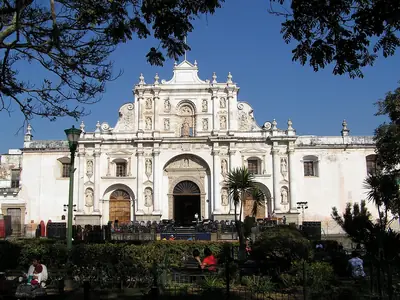
Also known as the Catedral de San José, Antigua Guatemala Cathedral stands beside the city’s central civic buildings. Construction began in 1545, using rubble from the destroyed settlement of Almolonga.
Earthquakes repeatedly affected the cathedral. The first temple was demolished on April 7, 1669, and a second sanctuary was inaugurated in 1680 under the direction of Juan Pascual and José de Porres. Today, the remaining walls of the original cathedral form one of Antigua’s most evocative historic scenes.
Museum of the Ancient Book
The Museum of the Ancient Book, or Museo del Libro Antiguo, focuses on the development of printing in Guatemala. Its exhibitions present the printing techniques used in the country, offering a more intimate perspective on the history of knowledge and written culture in colonial Antigua.
Church of Saint Peter the Apostle
The Church of Saint Peter the Apostle is a baroque building whose construction began in 1654. It served as Antigua Guatemala’s provisional cathedral until 1680, when that title passed to the San José parish.
Its architecture makes it a useful stop for anyone interested in the city’s religious heritage and the baroque style that appears throughout Antigua.
San Francisco Church
San Francisco Church has been a spiritual center of Antigua for centuries and remains one of the city’s most frequented sanctuaries. Its first sanctuary was built in the mid-1500s and was damaged by an earthquake in 1565.
The present building dates from 1702 and was raised under the direction of Diego de Porres. It suffered further damage in the earthquakes of 1717, 1751, and 1773, as well as later tremors in 1874 and 1917. After a long period of abandonment, the church was rebuilt in the second half of the twentieth century. The Franciscans regained the complex in 1967.
Escuela de Cristo
The Escuela de Cristo stands out for its plain stone Renaissance façade. While many of Antigua’s churches are richly ornamented, this building has a simple, symmetrical appearance, with only its bell towers painted white.
The congregation traces its origins to 1664, and the church was rebuilt by 1730 under Diego de Porres after damage from the 1717 San Miguel earthquake. Following the 1773 earthquake, it moved to the premises of the Nuestra Señora de los Remedios parish. Today, it remains in good condition and welcomes visitors.
Ermita de Santa Isabel de Hungría
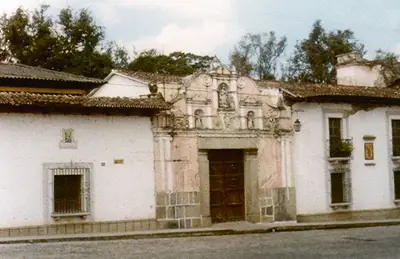
In the historic Santa Isabel neighborhood, the Ermita de Santa Isabel de Hungría survives as a quiet baroque ruin. The hermitage once served as a place of worship dedicated to Saint Isabel of Hungary.
The surrounding district was once known for its soap-making workshops and was called Barrio de los jaboneros. Although the exact construction date is unknown, art historians suggest that the hermitage was built around the second quarter of the eighteenth century.
La Merced Church
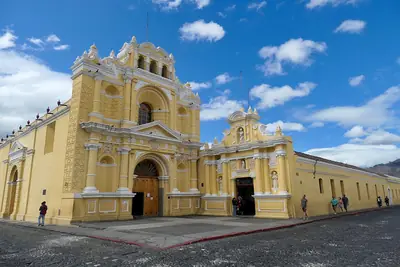
La Merced Church is considered the best-preserved Baroque building in Antigua Guatemala. Construction began in 1749 under architect Juan de Dios Estrada, and the church was dedicated in 1767.
It served as the principal church of the Mercedarian order, a religious community founded in 1218 by Petrus Nolascus in the Kingdom of Aragon. Its preserved architecture offers a strong contrast with the city’s earthquake-damaged ruins.
Church and Convent of Capuchins
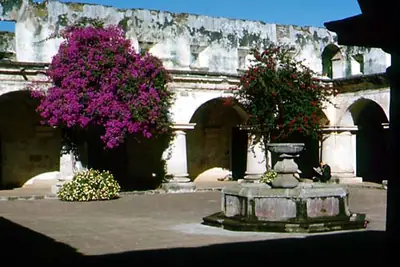
The Church and Convent of Capuchins is an eighteenth-century complex and one of Antigua Guatemala’s most visited sites. It was consecrated in 1736 and later damaged by the earthquakes of 1751 and 1773.
After the 1773 earthquake, the Captain General ordered the convent abandoned and the nuns departed. The surviving walls and arches still reveal the arrangement of the convent and suggest the quiet religious life that once took place there.
Convento de la Concepción
The ruins of the Convento de la Concepción stand along the banks of the Pensativo River. Dating from the colonial era, the convent is particularly associated with Sor Juana de Maldonado, a poet and urbanist who lived there during the first half of the seventeenth century.
Her presence gives the ruins an additional human dimension. Beyond the stone walls, the site recalls the life of a woman whose reputation made her one of the most discussed figures of Santiago de los Caballeros.
Santo Domingo Monastery
Santo Domingo was once a large Dominican monastery and an important center of worship and learning. The Dominican order arrived in Guatemala in 1538, and the monastery grew into a major religious complex before the Santa Marta earthquake of 1773 reduced it to ruins.
Before the earthquake, its two towers held five bells each. The remains now evoke both the scale of the former monastery and the destruction that transformed Antigua’s urban landscape.
Candelaria Parish
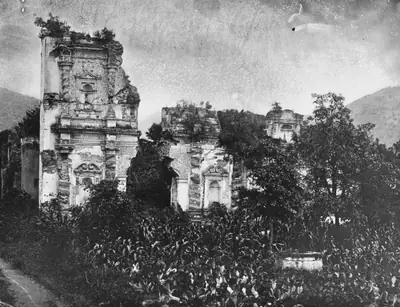
The ruins of Candelaria Parish preserve the memory of a church founded in 1548 as a hermitage serving the Indigenous community northeast of Santiago de los Caballeros. It later became Antigua’s fourth parish and served the community for more than two centuries.
The Santa Marta earthquakes of 1773 reduced the church to ruins. Religious images and paintings that survived were transferred to the new Candelaria Parish in present-day Guatemala City. The remaining walls and foundations offer a glimpse of the temple’s former role as a spiritual center.
Sacatepéquez Department
Antigua Guatemala is located in Sacatepéquez Department, one of the twenty-two departments of the Republic of Guatemala. The department occupies part of the country’s central region and takes its name from the historic city of Sacatepéquez, which existed from November 21, 1542, until it was destroyed by the Guatemala earthquake of July 29, 1773.
The name Sacatepéquez comes from a Pipil Maya word meaning “grassy mountain.” San Lucas Sacatepéquez is known for its marketplace and culinary attractions.
Explore Antigua Guatemala with Neywo
An Antigua Guatemala audio guide lets you explore the city independently while keeping its history connected to the places around you. Neywo has two self-guided walking tours:
- Earthquakes and Saints: Antigua’s Colonial Core — 2.54 km, 84 minutes, and 9 narrated stops.
- Ruined Convents of Santiago de los Caballeros — 2.63 km, 63 minutes, and 5 narrated stops.
The app tells the story of each place as you reach it, at your own pace, with no group and no schedule. Download Neywo and walk through Antigua Guatemala’s churches, civic buildings, museums, and convent ruins while the city’s history unfolds around you.
Places with an audio guide in Antigua Guatemala
8 places in Antigua Guatemala with a Neywo audio guide. Each one starts telling its story as you reach it.
Self-guided tours in Antigua Guatemala
2 tours in Antigua Guatemala, free in the Neywo app. Each stop tells its story as you reach it.
- Walk
Earthquakes and Saints: Antigua's Colonial Core
Antigua was the capital of Spanish Central America until the earthquakes of 1773 ruined it. Start on the Central Park between the old town hall, the cathedral and the Palace of the Captain Generals, then follow the baroque churches south to the tomb of Santo Hermano Pedro and a quiet soap makers' barrio.
Ayuntamiento of Antigua Guatemala · Museum of the Ancient Book · Palace of the Captain Generals · National Museum of Guatemalan Art · Antigua Guatemala Cathedral · Church of Saint Peter the Apostle …
Open this tour: Earthquakes and Saints: Antigua's Colonial Core - Walk
Ruined Convents of Santiago de los Caballeros
Antigua's northern streets hold the grandest ruins of the colonial capital. Walk from the riverside convent of La Concepción, where the poet Sor Juana de Maldonado took her vows, past baroque La Merced and the Capuchin convent to the Santo Domingo ruins and the remains of Candelaria.
Convento de la Concepción · La Merced Church · Church and Convent of Capuchins · Santo Domingo Monastery · Candelaria Parrish
Open this tour: Ruined Convents of Santiago de los Caballeros
Walk Antigua Guatemala with Neywo
Neywo turns Antigua Guatemala into a self-guided audio tour. Stories arrive as you reach the place they belong to, and the route reshapes when you wander off it.

